MY FAVOURITE AEROPLANE IN 200 WORDS #10 de Havilland Vampire by Luke Holt


Image
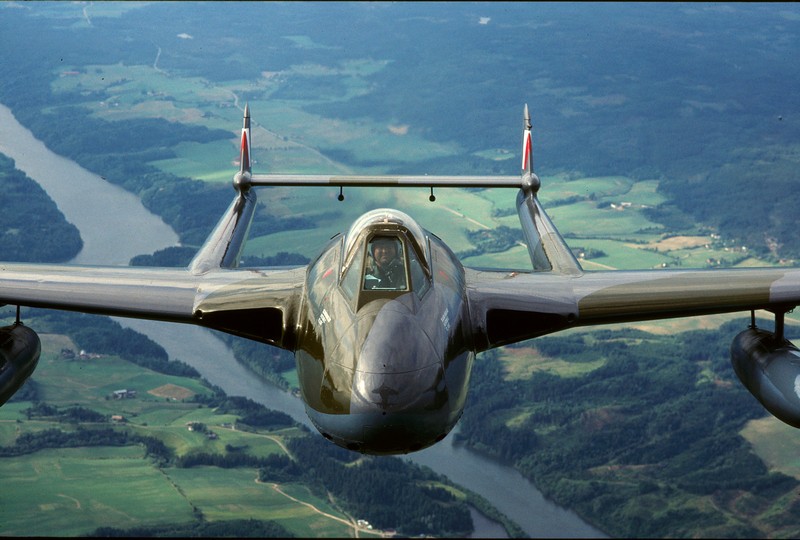
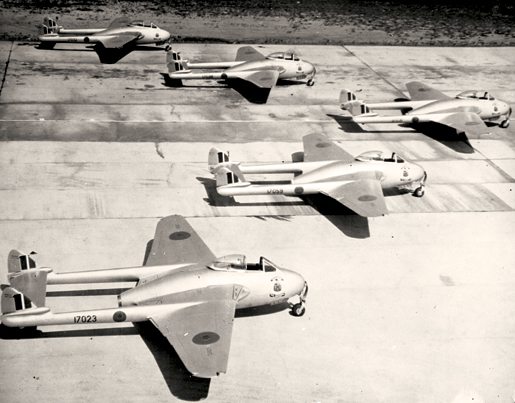
Fighter jets should inspire fear; their vicious appearance should carry some of the beastliness of their task. The Messerschmitt Me 262- a shallow-water killer, looked every inch the flying shark. The F-4 Phantom II was a flying ironclad, billowing satanic black smoke behind it. The de Havilland Vampire..well, it was cute. It didn’t look like it was going to kill anything, if anything it looked like it needed looking after.
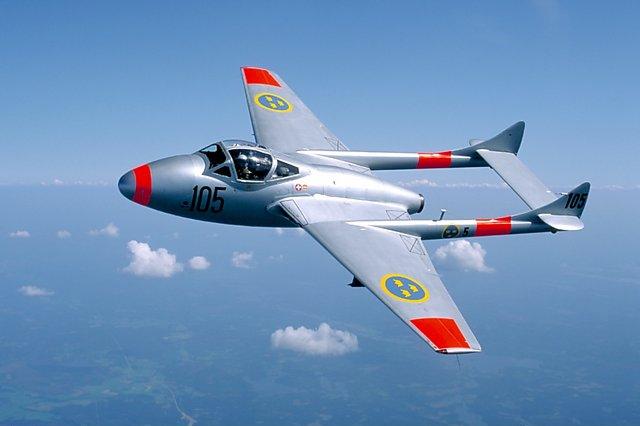
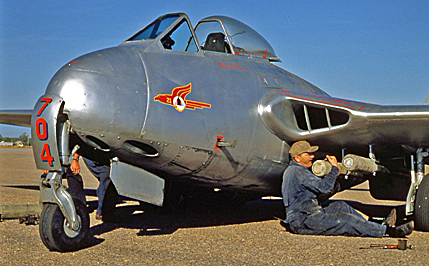
Stand next to one and it will cower in your shadow: it is tiny. The happy dog-like nose, jelly bean of a fuselage and fragile twin-boom, give it a very friendly appearance. Over 3,000 were built and today over 20 remain displayed in public places. The eccentric little Vampire seems to enjoy these retirement shows, and even in these conditions it retains its perkiness. Some aircraft become sad lonely hulks when consigned to a life on a display pole, but the plucky Vampire has enough personality to remain positively zingy. I was delighted to stumble upon one in a small park in Switzerland in 1988.
Image

The Vampire was more agile, cheaper and longer-ranged than the Meteor. More importantly, the Vampire was the cheekiest little jet fighter ever made.
MY FAVOURITE AEROPLANE IN 200 WORDS #9 Lockheed SR-71 Blackbird by Tim Robinson

Image

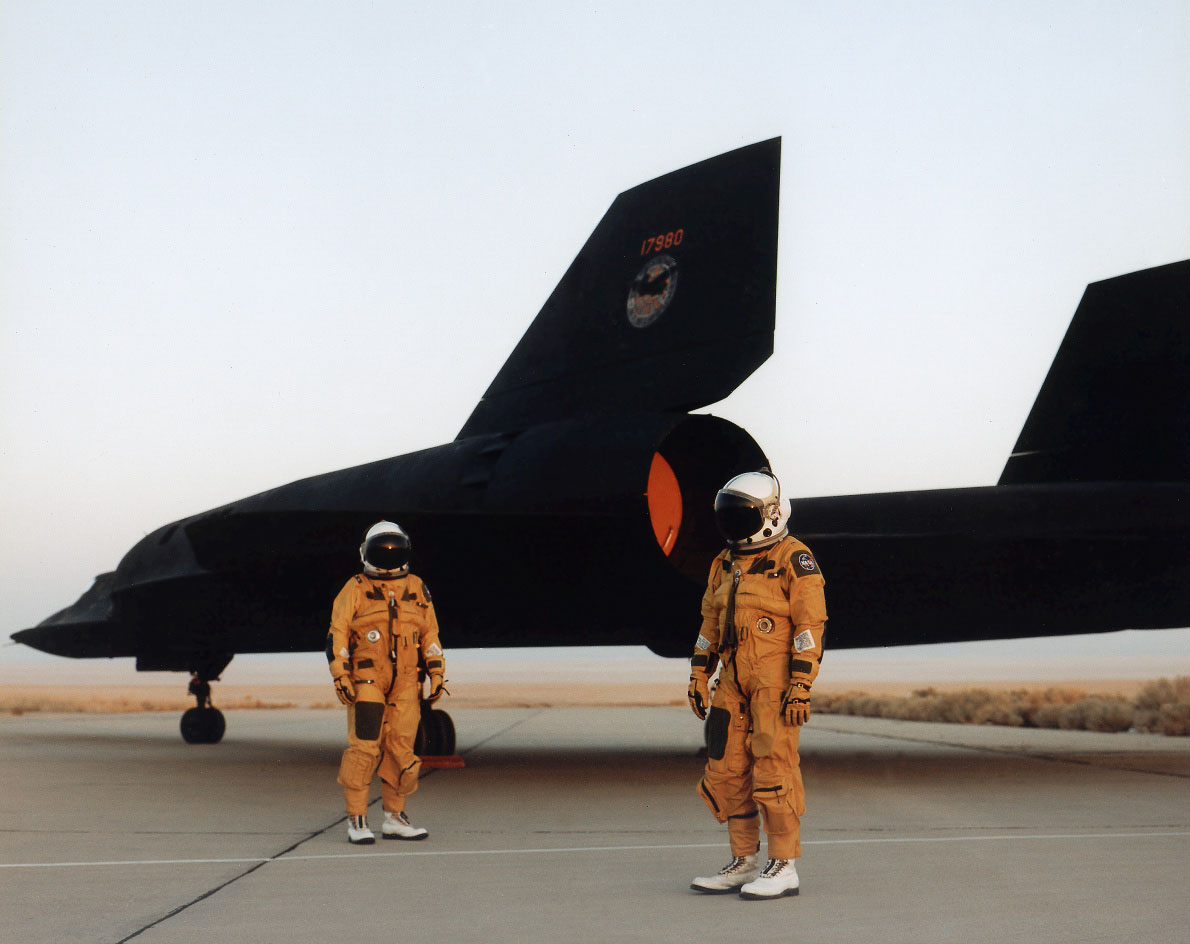
Sleek, supersonic and superbly sinister the Lockheed  SR-71 reconnaissance aircraft is in a class of its own in aviation terms.

Incredibly, its Mach 3+ performance at the edge of space (85,000ft) came nearly 20 years after 400mph propeller fighters were state-of-the-art in WW2 (its predecessor, the even faster A-12 , first flew in 1962). No wonder people thought we’d be living on Mars by 1980.

Even more astoundingly, this record-beating aircraft was designed using slide-rules, pencils and notepads. CFD computer analysis was unknown and that goes for all the aerodynamics, thermodynamics and one-off systems that the Blackbird incorporated. Pure engineering genius.

Today the US struggles to get a hypersonic scramjet to ignite and run for more than a few seconds at a time. But in the 1970s – Mach 3+ flight was routine for the Blackbird’s highflying spy missions, taunting Cold War enemies with its swiftness. Plus, just LOOK at it – from all angles it looks like an alien spaceship, not of this planet.

Other aircraft may be national icons, or perhaps have greater historical significance, but the SR-71 still looks like it belongs in the future. One day we’ll catch up with it.

By Tim Robinson, Aviation Journalist

 http://media.aerosociety.com/aerospace-insight/

Image

MY FAVOURITE AEROPLANE IN 200 WORDS #8 Westland Wyvern by Ed Ward

ImageLike all the most interesting aircraft, the Wyvern was slightly obscure, not particularly successful, and quite dangerous. Weighing 650 pounds shy of a loaded Dakota it was nonetheless expected to operate off dinky 1950s RN carriers. Tellingly, its main claim to aviation immortality derives not from any superlative quality of the aeroplane itself but a desperate desire to escape it: the world’s first underwater ejection was from a Wyvern. Suffering from the standard post-war British aircraft ailments of lengthy development and unrealised potential but unlike such ‘world-beaters’ as the perennially overrated TSR.2, it did make it into service. Wyverns even flew strike missions over Suez.
But this is by the by, for the Wyvern remains the most fantastic looking airscrew driven aircraft ever to fly, a nose that goes on forever surmounted by contra-props, an elliptical Spitfire-esque wing, slightly cranked a la Corsair, a massive, elegantly curved fin and rudder that is impossible to draw properly (try it) combined with pretty elliptical tailplanes topped off with finlets. (Finlets!) Also it is a post-war FAA aircraft and therefore blessed with the most attractive camouflage scheme ever to grace a military aircraft.
Like its namesake, the Wyvern is unlikely, brutish and wonderful.
Ed Ward is an illustrator, writer, historian and regular Hush-Kit contributor (like the Wyvern, he is unlikely, brutish and wonderful)
See his fantastic artwork 
Donating to Hush-Kit will help us.The button is above and below. Thank you.
Image

MY FAVOURITE AEROPLANE IN 200 WORDS #7 Lockheed Martin F-35 Lightning II by Jack Luttrell

Image

The Producers tells the story of a theatrical producer and an accountant who want to produce a Broadway flop. They borrow outrageous amounts from investors, knowing that nobody ‘follows the money’ after a failure. Following this, they planned to abscond to Brazil as millionaires.

The plan went badly wrong when the show turned out to be a surprise hit. Despite a pro-nazi theme and a terrible cast, it succeeded. How did they get wrong so wrong? Lockheed Martin and the Pentagon would take no such risks …

It must be made to fail, mustn’t it? Here are the golden rules of making a fighter, they have been proven repeatedly over the last 90 years (with few exceptions):

  1. Fighters must be fast and agile
  2. Never plan any aircraft as ‘multi-role’
  3. You can’t make a fighter out of a bomber
  4. Never rely on one unproven technology as a lynchpin

Space limits me from listing the others…the F-35 has broken ALL of them.

Has the F-35 been schemed by a joker seeking to high-light the insanity of military procurement? Or maybe somewhere there are two men in Hawaiian shirts packing suitcases? Either way the F-35 is my favourite comedy.

Hush-kit is reminding the world of the beauty of flight.

follow my vapour trail on Twitter: @Hush_kit

Do you have an idea for a Hush-Kit article you would like to write? Contact: hushkiteditorial@gmail.com

Image

Jack Luttrell is a US defence analyst, he used to work for a major defence contractor

MY FAVOURITE AEROPLANE IN 200 WORDS #6 de Havilland DH.89 Dragon Rapide by David Piper

Image

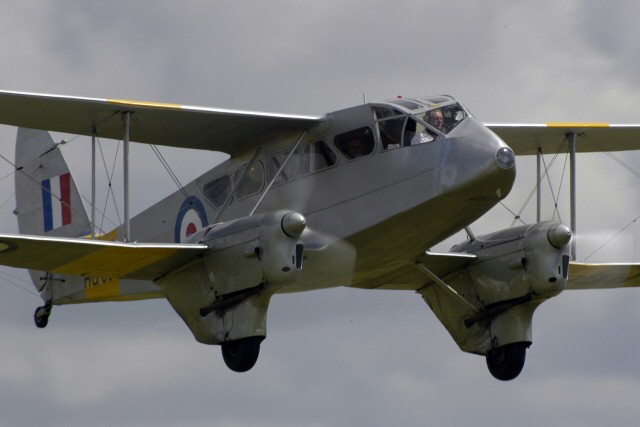
Peter Pendragon and Louise Laleham, the heroes of Aleister Crowley’s searing novel Diary of a Drug Fiend, hurtle headlong into the pitchblack night and intense love, in the freezing cockpit of Peter’s plane, fantastically high on beautifully pure cocaine. They first met a few hours ago, and neither of them have ever taken drugs before.

Jack Parsons was a very handsome man; a wayward father of modern rocketry, explosives expert, explosion addict, practising sex magician, OTO lodge leader, and mentor to L. Ron Hubbard. A week after he performed the Babalon Working ritual in the Mojave desert (against Crowley’s wishes), the remarkable Marjorie Cameron, a flame-haired visionary artist exactly matching the depiction of the goddess he’d invoked, knocked on his door and became his lover.

In my head there is a brilliant Hollywood biopic of Parsons. One sequence, amidst all the flame and fire and red desert smoke, shows Jack and Marjorie becoming Peter and Louise, flying through the night, lit by pale cold terrifying brilliance, howling wind, and mad passion, from the California desert to Thelema, Crowley’s judgement, and rebirth. The only aeroplane beautiful enough to carry them is the de Havilland Dragon Rapide.

David Piper is Commander of Special Operations for Hendrick’s Gin

Image

My favourite plane in 200 words #5: BAe 146 by Caroline Kiernan

Image

Keep your modern fighter planes, they’re just a noisy way to burn money. All they do nowadays is bomb – where’s the romance in that?

If I loved pewter and ale (and dressing up in my grandmother’s clothes) I might love old warbirds, but I don’t and I don’t.

Big airliners? You might as well be on a ferry. If I wanted to watch Jennifer Aniston movies while developing deep-vein thrombosis, I would have stayed in Eastbourne.

The ‘whisper-jet’ slips quietly from chic-city to city. A petite, elegant jet for those who know that understated is the only cool worth having.

She first flew the day that the Convention on the Elimination of Discrimination Against Women came into effect. In the same month the sensuous TGV train service began in France. She was born of a month of intelligence and quiet speed.

She colonised the skies above Dalston long before the shouting jumble-sale of fashionistas had set (ridiculous and self-aware) foot down below. She remains the aviation world’s quietly spoken traveller, not boasting of her hour in Geneva or evening in Berlin. And I love her (even if she took her first flight on the day Fearne Cotton was born).

Caroline Kiernan is a Casting Director and stunt-kite flyer

Follow my vapour trail on Twitter: @Hush_kit
This blog can only carry on with donations, please hit the donation button and share what you can. Every donation helps us- thank you. Donations buttons can be spotted by the eagle-eyed on this page.

You may also enjoy Ten incredible cancelled Soviet fighter aircraft, Ten worst Soviet aircraft, Ten incredible cancelled military aircraft, Fighter aircraft news round-up,  11 Cancelled French aircraft or the 10 worst British military aircraft, Su-35 versusTyphoon, 10 Best fighters of World War II , Su-35 versus Typhoon, top WVR and BVR fighters of today, an interview with a Super Hornet pilot and a Pacifist’s Guide to Warplanes. Flying and fighting in the Tornado. Was the Spitfire overrated? Want something more bizarre? Try Sigmund Freud’s Guide to Spyplanes. The Top Ten fictional aircraft is a fascinating read, as is The Strange Story and The Planet Satellite. The Fashion Versus Aircraft Camo is also a real cracker. Those interested in the Cold Way should read A pilot’s guide to flying and fighting in the Lightning. Those feeling less belligerent may enjoy A pilot’s farewell to the Airbus A340. Looking for something more humorous? Have a look at this F-35 satire and ‘Werner Herzog’s Guide to pusher bi-planes or the Ten most boring aircraft. In the mood for something more offensive? Try the NSFW 10 best looking American airplanes, or the same but for Canadians. 10 great aircraft stymied by the US. 

Image

MY FAVOURITE AEROPLANE IN 200 WORDS #4: Supermarine S6 by Stephen Mosley

Image

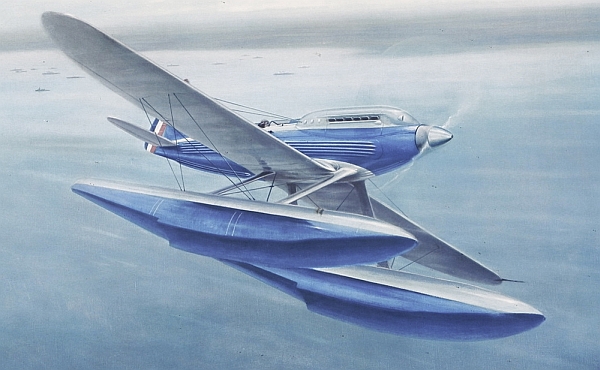
The Supermarine S6 earned itself the position of the ultimate racer built for the Schneider Trophy by securing the 2nd and 3rd consecutive wins for Great Britain. Every inch the thoroughbred, she boasted a Rolls Royce R Type engine so closely cowled that the cam covers were a part of the streamlined outer surfaces. No ounce of excess weight was allowed, nor any square inch of unnecessary cross sectional area. I used to think that, as the fastest machine of her day, she was hugely sophisticated but having seen one stripped down at Southampton I realised the opposite is true – and that she is the better expression of the ultimate for it. There is no crudity to the design but rather a simplicity that speaks of clarity of purpose. High speed aerodynamics, minimal packaging and maximum cooling are the only considerations. All this and achingly beautiful too.

Her legacy is also impeccable, though with no direct lineage lessons learned here greatly influenced the Merlin and Spitfire.   So – successful, pivotal and displaying the pure aesthetics born from the focused pursuit of speed. By default a shining example of the Bauhaus ideals of Walter Gropius.

There can be no finer aircraft.

Stephen Mosley is an artist and aeronautical engineer


MY FAVOURITE AEROPLANE IN 200 WORDS #3 English Electric Lightning by Consolata García Ramírez

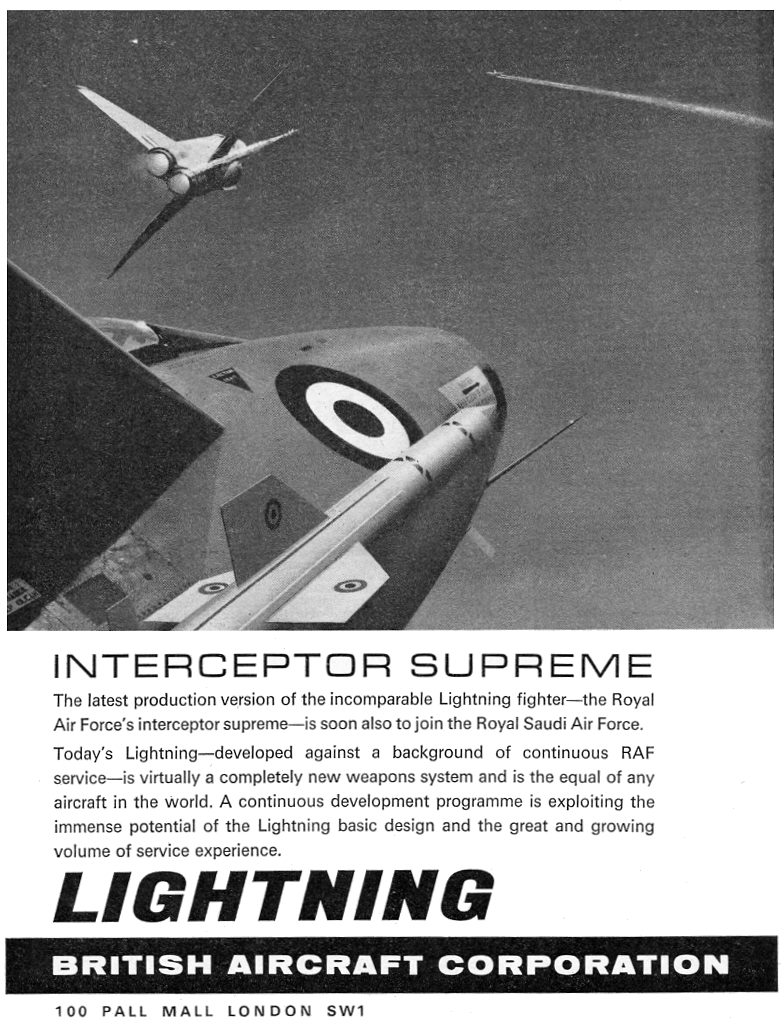
English Electric Lightning. Three words which sit so beautifully together (ignoring the tautology of ‘electric’ lightning). The charged air of English skies ripped apart by riveted lunacy.

The Lightning was quite mad- a greedy machine set on eating fuel and turning it into speed. It was so greedy its great gaping mouth was half-full, trying to eats its own nose. Its hunger saw it eating up sky to reach altitudes where few could reach it. Unlike anything else, its engines were stacked one on top of each other, making it stand monstrously tall on the ground.

The Lightning would scorn today’s tedious drones controlled by gamers in porta-cabins. The Lightning was the anti-thesis of the UAV- it was a manned missile, tricksy and twitchy – and it killed more of its own pilots than it did enemies.

It could outfly and outfight any of its peers, but like an English genius, they neglected it and tried to kill it. The English Electric P.1A flew two months after Alan Turing died, another English product killed by a nation that loves to punish its greatest children.

Follow my vapour trail on Twitter: @Hush_kit

Do you have an idea for a Hush-Kit article you would like to write?  Are you an editor with pages to fill? Contact: hushkiteditorial@gmail.com

My favourite aeroplane in 200 words #2: Blackburn Buccaneer by Dr. Raymond N. Wolejko, MD

Image

Blackburn Aircraft Limited produced some of the worst aeroplanes ever made. From the TB of 1915 (an engine start set the float on fire), the Sidecar of 1919 (sold at Harrods, but couldn’t fly), the Roc (a fighter of 1938, that was slower than any bomber), and the pathetic Botha (underpowered, impossible to see out of in rain), through to the shameful Firebrand (late, extremely dangerous to pilots- but scandalously pushed into service with a hush-up that resulted in many deaths)- their track record was pretty appalling, so it is all the more impressive that they went on to make the wonderful ‘Bucc’, a masterpiece from 1958.

The Buccaneer was designed to counter the threat of Sverdlov-class cruisers. It was prepared in great secrecy, as a fast, low-level maritime attack aircraft capable of using nuclear weapons. The S. Mk.1 was underpowered, as test pilot Dave Eagles quipped in his recent Hush-Kit interview it “relied on the curvature of the earth to get airborne ”. This was solved when the S.Mk 2 was introduced in 1962, powered by the Spey. The result was a superb low-level aircraft with a long-range (longer even than the Tornado), a virtually indestructible construction and a rock-steady low-level ride. The type proved its worth in Desert Storm, and remained to the end of its life a potent weapon.


Image

You may also enjoy Ten incredible cancelled Soviet fighter aircraft, Ten worst Soviet aircraft, Ten incredible cancelled military aircraft, Fighter aircraft news round-up,  11 Cancelled French aircraft or the 10 worst British military aircraft, Su-35 versusTyphoon, 10 Best fighters of World War II , Su-35 versus Typhoon, top WVR and BVR fighters of today, an interview with a Super Hornet pilot and a Pacifist’s Guide to Warplanes. Flying and fighting in the Tornado. Was the Spitfire overrated? Want something more bizarre? Try Sigmund Freud’s Guide to Spyplanes. The Top Ten fictional aircraft is a fascinating read, as is The Strange Story and The Planet Satellite. The Fashion Versus Aircraft Camo is also a real cracker. Those interested in the Cold Way should read A pilot’s guide to flying and fighting in the Lightning. Those feeling less belligerent may enjoy A pilot’s farewell to the Airbus A340. Looking for something more humorous? Have a look at this F-35 satire and ‘Werner Herzog’s Guide to pusher bi-planes or the Ten most boring aircraft. In the mood for something more offensive? Try the NSFW 10 best looking American airplanes, or the same but for Canadians. 10 great aircraft stymied by the US. 

Follow my vapour trail on Twitter: @Hush_kit
This blog can only carry on with donations, please hit the donation button and share what you can. Every donation helps us- thank you. Donations buttons can be spotted by the eagle-eyed on this page.

MY FAVOURITE AEROPLANE IN 200 WORDS #1: THE A-26 (B-26) INVADER BY BRUNO BAYLEY

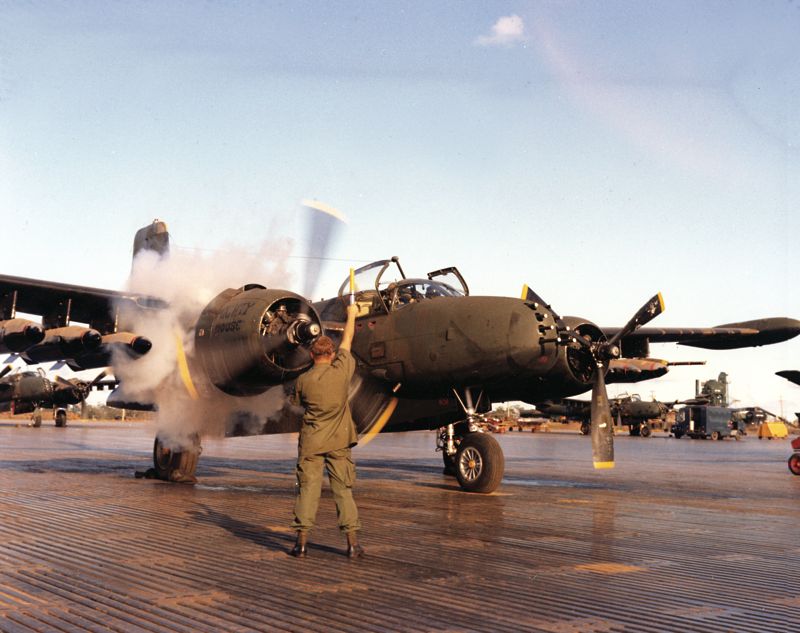
“The Vietnam War; perhaps summed up most commonly by exciting new aircraft like Phantoms, Skyhawks, Super Sabres, or the terrifying giant B-52, was also the last outing for a slew of World War II-era designs that suddenly found themselves thrown back into the rainy, humid, mud-spattered fray. Models like the A-1 Skyraider, a late war design  intended to be both a dive-bomber and strike aircraft was a perfect fit for the ‘Sandy’ (SAR) missions, that became a harrowing and regular part of the Vietnam air war. But the best example of this however, was the re-duxing of the A-26 (which some call a B-26 due to utterly confusing US Military penickityness). A late World War II light-bomber, the A/B-26 was initially stripped of its gun turrets and pressed into attack roles in the murky early 60s era of  ‘not quite admitting we are fighting in Vietnam’, having already flown in Korea. In time the chunky, but somehow rather graceful, machine was upgraded to specialise in attacking the Ho Chi Minh trail. Wing tip tanks upped loiter time, eight 50.cal guns clustered in the nose, and the ability to carry large amounts of external arms ranging from napalm, to rockets, to conventional and cluster bombs, made the Invader to top scoring traffic destroyer in Vietnam. Sometimes it’s good to be slow and old.”

By Bruno Bayley, Managing editor of Vice Magazine