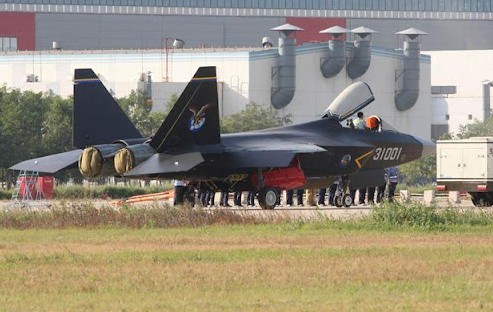
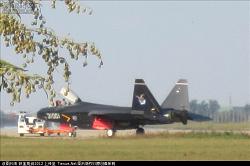
Yesterday photos appeared on several Chinese websites show Chinese latest fighter, the Shenyang J-31 ‘Falcon’ in flight. The pictures reveal many details about the aircraft that were unclear in the first released images. Find out the latest aviation news on Twitter @hush_kit
I followed the competition to provide India’s air force with a new fighter aircraft like a soap opera. I loved it. Six fighters competed for a multi-billion dollar deal. The capabilities of the six entrants had been discussed for years, but the debates were little more than innuendo, sales-spin and national pride. Six of the world’s best fighters were evaluated in detail to determine which would become India’s MMRCA (Medium Multi-Role Combat Aircraft). Never before had the types been examined against each other with such scrutiny, the results would be very revealing.
The USA offered two types: the Boeing F/A-18 Super Hornet, pride of the US Navy, and the largest and heaviest of the contenders. The other type the US offered was the Lockheed Martin F-16. The F-16 had already been sold to Pakistan, the traditional enemy of India, which led many to belief it was a lame duck from the get-go.
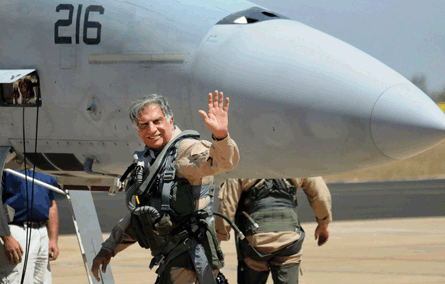
Ratan Tata takes a flight in a Super Hornet
The Russians offered the MiG-35, a souped-up variant of their MiG-29 (a type losing favour around the world). The MiG-29 was already in service with the Indian air force, a foot-in-the-door which gave the Russians hope.
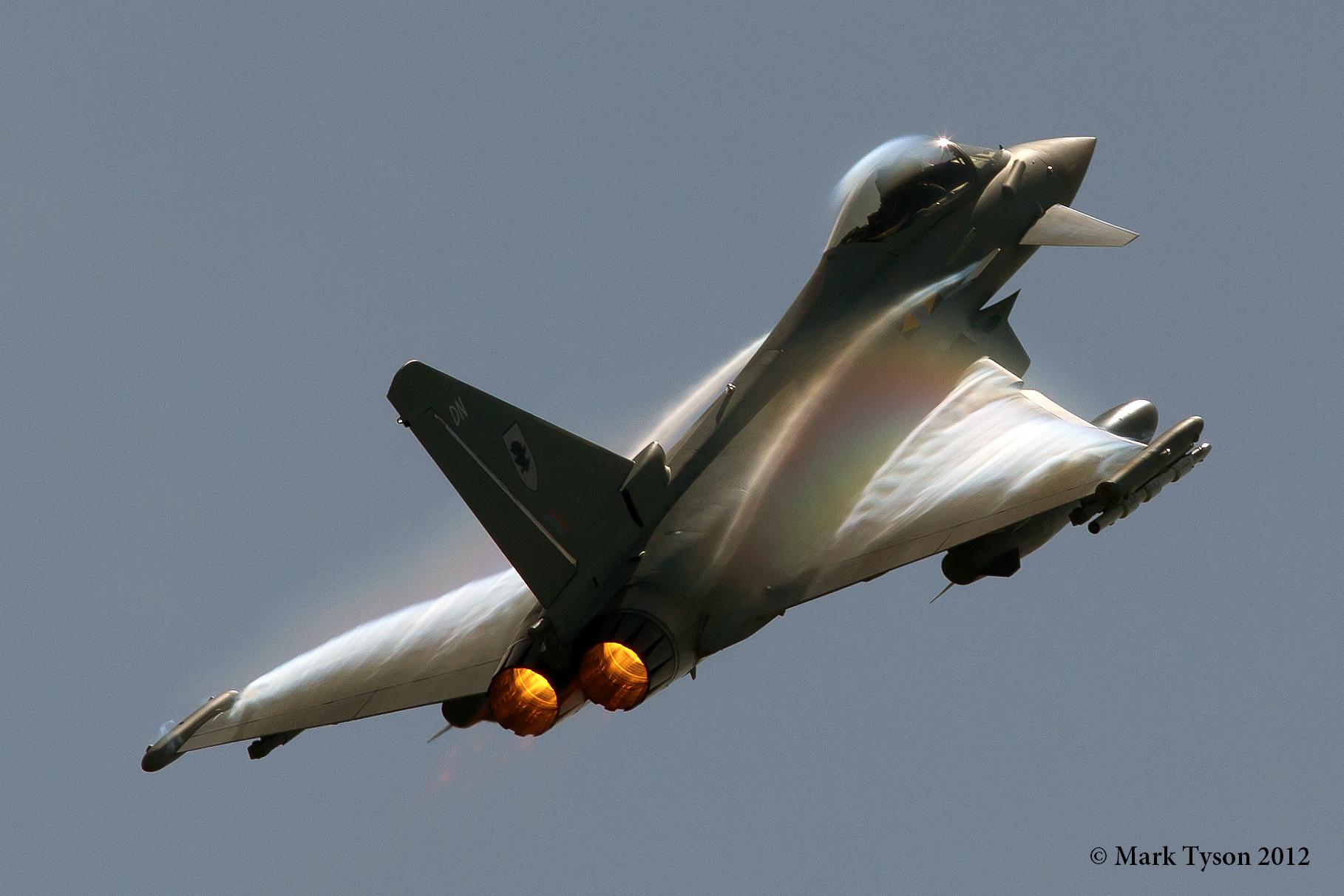
A European consortium of the UK, Germany, Italy and Spain offered the spectacularly expensive Typhoon. Their drive to sell Typhoon in India was led by Germany.
France offered the Rafale, long the fighter world’s underdog, having failed to achieve a single export sale.
Even idiosyncratic Sweden joined in, offering its petite Saab Gripen.
This contest was big. India wanted at least 126 fighters, with more orders likely. The fighters will stay in service for at least forty years, needing support and spares. Success in India was the golden ticket for the fighter ‘houses’, making other sales around the world almost inevitable.
For some companies, failure in India would mean the end of their fighter lines. The MiG series had started in 1940 in Stalin’s USSR and fought in virtually every air war up to the present day, most notably Korea and Vietnam. The other big Russian fighter house, Sukhoi, is poised to decimate RSK MiG, and has support from the highest levels. According to a startling statement from the labour union that represents MiG’s workers:
“In the past five years, six general directors have been replaced, they all come from the Sukhoi company.. they are strangling us, they want to close our companyâ€
India could mean life or death to MiG, but the Russian company was confident that over 40 years of selling aircraft to the IAF would put it in a strong position.
Another company that needed India was Dassault. The French company had it origins in a pre-war company set up my Marcel Bloch. The war brought misery to Marcel. Being of Jewish descent and refusing to collaborate with the German aviation industry, he was sent to the hell of Buchenwald. Meanwhile his brother fought in the French resistance under the nome de guerre Darius Dassault. The surname derived from char d’assaut (the French word for battle tank); d’assaut means ‘for assault’. Marcel also took the surname. Following the war, he took back control of his old aircraft company and it was renamed Dassault. The company went onto to develop the Mirage series of fighters, among the most beautiful and capable jet fighters in history. The Mirage family is inextricably linked to the story of Israel. In 1967, a French embargo on military exports to the Jewish state led to a bizarre and very exciting Mossad mission to steal the plans for the French jet (which succeeded).
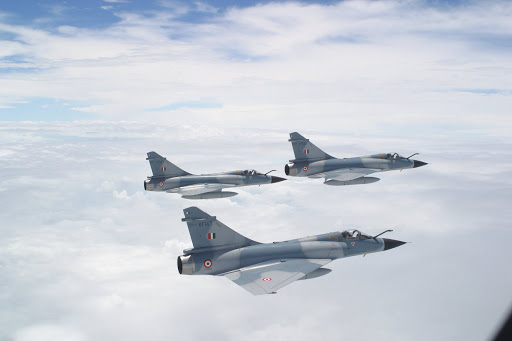
The Mirage 2000 was the final fighter to carry the famous name, and was bought by India. The type has proved popular with the IAF (what type hasn’t?) and was deemed highly effective in the 1999 Kargil War with Pakistan.
The Mirage series sold well around the world, but Dassault made two decisions that risked ending its fighter line.
Risky move number 1!
In the early 1980s it grouped together with other European nations to develop a new advanced tactical fighter. The advantages of collaboration where obvious: it would ensure a large production run, the development costs would be shared and when one government wobbled on the project, another would badger them to persist with it. However, Dassault-Breguet (as it was then known) could not resolve key differences with the other nations and went its on way in 1985. France went off to develop what was later named Rafale (‘sea squall’). The Mirage name, which had been applied to several generations of very different aircraft was dropped.
Britain, Italy and West Germany went off to develop what would become the Eurofighter Typhoon. Spain couldn’t quite make its mind up, and flirted with France, before returning to the bigger party.
France had pitted itself against its neighbours. France would have to pay for Rafale by itself, spending billions of Francs and Euros on developing a fighter which was in many, many ways similar to Typhoon.
Like all the best things, the Mirage 2000 was born in 1978. It was beautiful; a dynamic triangle that looked it had escaped from a 1950s corporate logo. It is the shape of speed and harmony. The dynamism of 50’s futurism was combined with the miracles of the electronic age. It could even fly very slow with its nose raised high, something delta (tri-angular) winged aircraft shouldn’t be able to do.
“ The Mirage 2000 is the perfect aeroplane.†was a surprising quote I got from a Rafale test pilot I spoke to in 2005. He said Rafale was great, very capable, but the older Mirage 2000 was perfect. The type is known by some in French air force as the Electric Cake Slice.
The 2000 was an export hit. India, the UAE, Peru, Greece, Taiwan, Egypt and Brazil all bought it. Pilots loved it. The Mirage 2000 could face up to the US F-16, the most popular modern fighter. The F-16 is slightly older than the 2000, but in 2012 remains in production. In 2007 Dassault ceased 2000 production to concentrate on the Rafale. This was a risky move indeed. The Mirage 2000 was still highly capable.
Recession scorched nations bent over backwards to chase the rupee. Indian filmstars were given fighter flights, heads of state flew out to India, Cameron from the UK, Sakozy from France, Obama from the US… promises of industrial collaborations , commercial offsets and ‘strategic partnerships’.. all heads were turned to see what India would do..
Internet forums exploded with patriotic fervour and Top Trumps speculation. Which fighter was most agile, had the greatest instantaneous turn-rate, longest radar range…would India’s traditional use of French and Russian-supplied kit continue?
Rumours and counter-rumours flowed daily, and it was a nail-biting drama, with unexpected twists and turns and press statements along the way.
Strangely all of the aircraft types (barring the MiG-35) competing for the contract took part in the 2010 air campaign against Libya. Even neutral Sweden sent Gripens to Libya. This led some cynical observers to wonder whether the ‘noble defence’ of the Libyan people may have had a commercial angle.
Hush-kit is reminding the world of the beauty of flight.
Like the X-factor it was eventually whittled down to the two finalists: The Eurofighter Typhoon and Dassault Rafale. The United States had lost, days later the US ambassador for India announced his retirement. Russia and Sweden were out too.
Typhoon versus Rafale was the most dramatic final possible. The fighter business held its breath as the painfully slow Indian procurement process weighed the arch-rivals. Both had passed the gruelling assessments, now which ever could come up with a lower bid had the deal.
On 31 January 2012 it was announced that France had won. Within minutes of the announcement the Eurofighter website, which had been plastered with adverts for Typhoon in India, switched to a bland India-less image.
The British government threw a hissy-fit and France celebrated.
The millions spent on marketing the losing aircraft were lost.
Now the reason I recount this is to go back to the idea of double-think and the enjoyment of military aircraft. I enjoyed the MMRCA contest as a fiction, as sport.
How the healthy this is, I can’t say. I was biased, I wanted Typhoon to win.
But, a couple of months ago I was reading the child mortality figures for India in The Times and did wonder how much India really needs a vast force of cutting edge fighter planes? I wondered how I could hold two Indias so separately in my mind.
Update: the MMRCA was eventually cancelled, following the failure of the Indian MoD and Dassault to agree on the terms and costs of the deal. Â Eventually 36 Rafales were ordered.
If this interests you, support Hush-Kit.net with a donation (buttons above and below). If this goes well we’ll be able to give you much more! Recommended donation £15. Many thanks for helping to keep us impartial and independent.
Images have emerged of a Chinese aircraft closely resembling the F-22 Raptor. Some sources have referred to it as the Shenyang J-31 as the serial number begins ’31’. The relationship between these photos and the mystery aircraft seen on a truck in June (see Hush-Kit archives, June) is unclear, though some have dismissed the link say the two shapes are too different to be related.
The aircraft appears to be smaller than the F-22, though similar in general appearance, strongly suggesting a similar role- a stealthy air dominance fighter (the designation J-21 was previously associated with an aircraft more in the F-35 class). As long time stealth-guru Bill Sweetman noted, the J-31 is appears to freed from the STOVL demands for a single engine that lead to the F-35’s configuration. This could mean a less draggy fuselage and a larger weapons bay. It is possible that whereas the F-35 is attack-optimised, the J-31 puts more emphasis on the fighter role.
A noticeable difference is that the aircraft appears to have 3D vectoring nozzles, as opposed to the Raptor’s flat 2D exhausts. The smaller size may also suggest that the J-31 is the ‘lo’ to the J-20’s ‘hi’. Today the ‘Flanker’ series represent China’s high-level fighter and the J-10, their low, F-16 equivalent, fighter.
Another notable feature is the twin nosewheels, possibly suggesting a carrier role for the fighter (though some land-based Chinese fighters have twin nosewheels). It is possible that China has followed the US in producing a ‘joint’ multi-service aircraft and this variant is equivalent to the F-35 ‘C’ variant.
The front aspect reveals several similarities with the F-35, and is it possible that the intakes feature a divertless ‘bump’, something China has experience of from both the JF-17 and J-10B. Several reports have discussed alleged Chinese hacking of the F-35 programme, whether this relates to the J-31 is unknown. It is questionable if China has the know-how to develop the avionics which are key to both the F-35’s potential capabilities, though one wry observer noted ‘..It is also questionable as to the extent that the US can produce the F-35 systems..’.
The type appears to be stealthier than J-20, and the surface finish more representative of a production stealth fighter. The type is gaudily decorated with a bird of prey design on the tail and is numbered ‘31001’. The tail design features the Chinese symbols for ‘Falcon’. A similar motif was seen on a scale model of the same basic configuration, revealed on the internet in 2011, described as the F-60 (Chinese fighters for export are prefixed with an ‘F’ designation).
Whereas both the J-20 debut pictures and ‘J-21/31 truck’ pictures were initially greeted with scepticism, analysts are generally impressed by these most recent pictures, demonstrating a shift in general mood towards Chinese internet leaks. Could this be a fake?
With the J-15, ‘J-20’ and ‘J-31’ in development, China has more nascent fighter projects than any other nation, and has eclipsed Russia as the ‘call and response’ counter to US projects. The ‘stealth club’ currently has one member,the US, but it is clear that China and Russia are likely to join at some point in the future. If the aircraft sighted is a prototype, then it would be reasonable to expect frontline aircraft by 2022. The lag between initial flying prototype and squadron aircraft in the West is generally no less than 9 years. Though we do not know if the sighted aircraft is more akin to the YF-22 or the first F-22. The first flew in YF-22 form 1990, Â followed by the first F-22 1997, and squadron service in 2005. It is even possible, but unlikely, that this is close to production standard. China tends to move faster than the West, with the J-10 taking around 7 years from likely first flight (1998) to service entry (2005).
Clearly the ‘J-31’ is far more ambitious than the J-10 (or J-10B) and the timescale is likely to be longer. The political motives for the very public transportation of a fighter shape on a truck in June and the recent images is unknown, but on the anniversary of the invasion of the disputed Diaoyu islands, Japan is on the mind of many in Chinese government, and anti-Japanese sentiments are increasingly vocal. Could this publicity be a response to Japan’s selection of the F-35? Even more likely, considering the time this project was originated, is the possibility that this is a response to Japan’s earlier intentions to acquire the F-22 Raptor, an effort quashed by US export regulations. Another factor in the timing of the unveiling must be the forthcoming visit by US  Defense Secretary Panetta, some observers noting the similar debuting of the J-20 when Robert Gates visited China in 2011.
Hush-kit is reminding the world of the beauty of flight.
Twitter: @Hush_kit
Do you have an idea for a Hush-Kit article you would like to write? Contact: hushkiteditorial@gmail.com
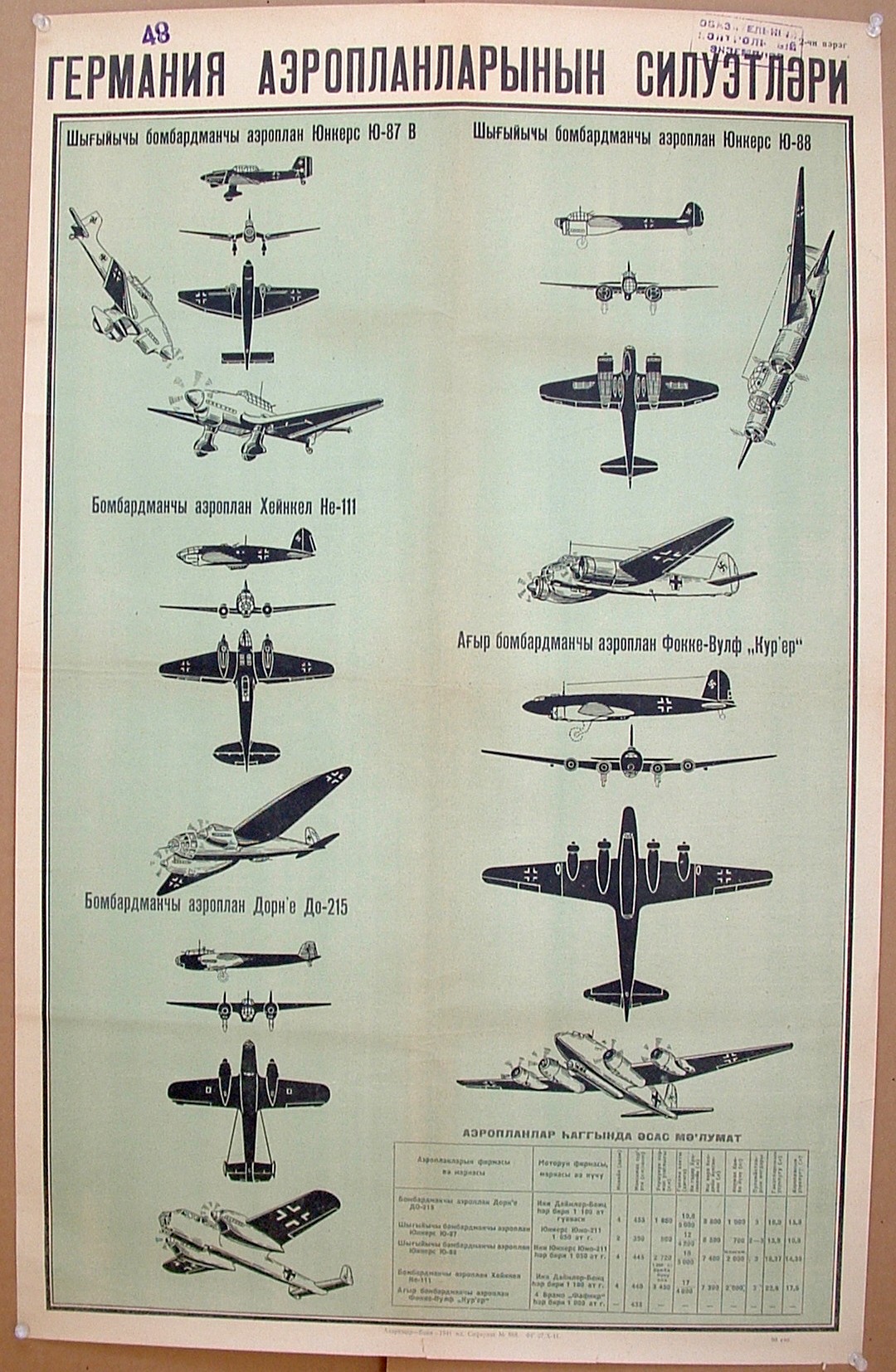
This propaganda poster features British and Soviet aircraft shooting down a Luftwaffe Ju 87, with a caption in Persian for distribution to Iran.
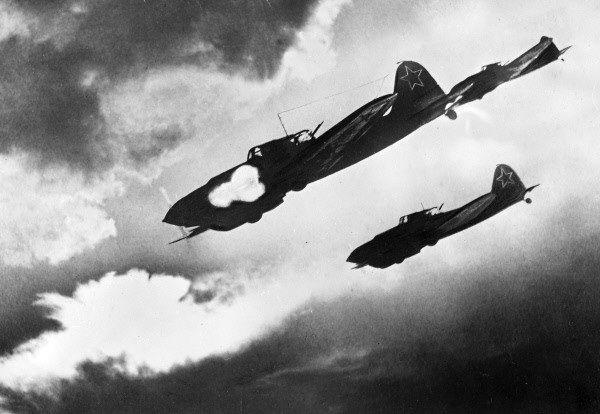
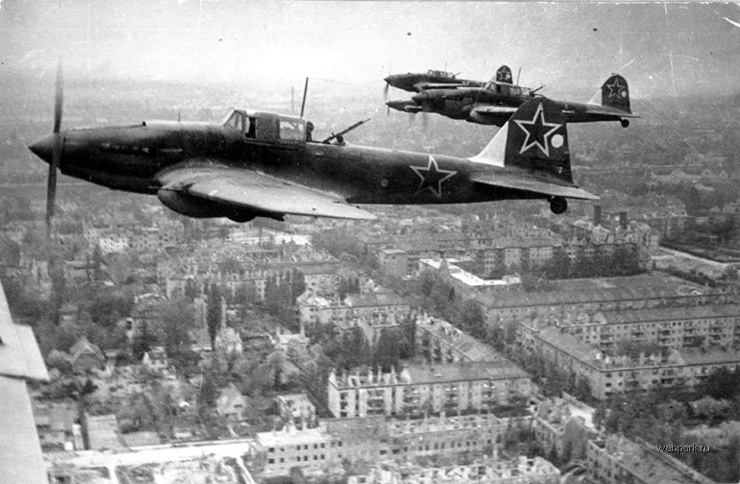
USSR –Â Ilyushin Il-2
There is a well-worn, and possibly false, anecdote about the Soviet nail factory that met its quotas by producing a two-ton nail. Or maybe that was just a lie my history teacher told me. Either way, it sort of sums up the target obsessed insanity of Stalin’s Russia. The Il-2, possibly more perfectly than any other aircraft in this run down, sums up the mentality of the regime that created it.
Produced more numerously than any other aircraft in the war, the Il-2 was the primary Soviet ground attack weapon. Ugly, heavy, crude, and easily mass-produced it suited the appalling conditions of the Eastern Front as well as the staggering requirements of a nation already reeling from the initial success of Hitler’s Operation Barbarossa.
In a slightly callous fashion, that many associate with the wider Stalinist mentality (not without just cause) the pilot was ensconced in thick armour plating, as was the engine, while the rear gunner was left fairly exposed, often equipped only with a standard issue machine gun on a rope bungee. It should be noted however, that the Il-2 was designed as a single seat aircraft and the rear gunner position was added to try and stop crippling losses.
Though loses were heavy with Il-2 units, quite possibly a result of the Soviet policy of not returning to base with unspent ammunition, their impact on the Eastern front has long been attested to. Not least at the typically grim Battle of Kursk where they claimed a great many German tank kills.
If any aircraft sums up the mass-production obsessed, brutal, and grimly effective nature of Stalin’s Russia it is the ‘hunchback’.
BRITAIN – HawkerHurricane
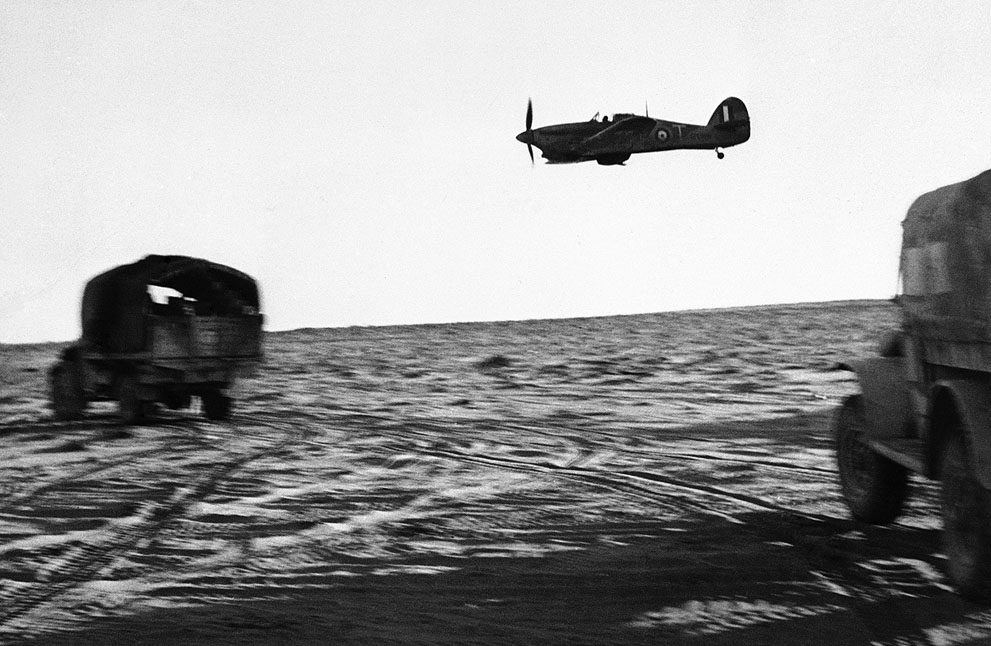
Sydney Camm’s greatest work – the Hurricane – was an evolution of interwar aircraft like the Hawker Fury and Hart. The Hurricane was essentially a monoplane version of the Fury and was explicitly referred to as the ‘Monoplane Fury’ in Air Ministry and Hawker correspondence. It was known as the ‘Interceptor Monoplane’ from 1934 and the Hurricane name was formally adopted in 1936. The Hurricane was an evolution of the interwar Fury fighter .
Built expressly to use the Merlin engine that would also equip greats of the war like the Supermarine Spitfire, P-51 Mustang, Avro Lancaster, and the de Havilland Mosquito among others, the Hurricane cruelly lived in the shadow of the sexy Spit. However, in spite of being more portly and far less lauded, the Hurricane racked up over 60% of the RAF kills during the Battle of Britain, went on to be a prestigious tank-buster in North Africa, night-fighter, and carrier and catapult launched naval fighter – known as Sea Hurricanes and Hurricats and respectively.
The Hurricane embodied the ballsy pugnacity of war-time Britain, frankly outdated as a design by the start of the war, its blending of inter-war and modern construction techniques made it easier, cheaper, and faster to build (and repair) than all metal craft like the Spitfire (and made it more battle-resistant). Its rear fuselage draped with doped fabric (as were the wings on some versions) it didn’t eat into the Nation’s meager supply of desperately rationed metals. If any craft summed up the stiff upper lip, ingenuity under pressure, and slightly stuffy geography teacher air people associate with 1940s Britain, this was it.
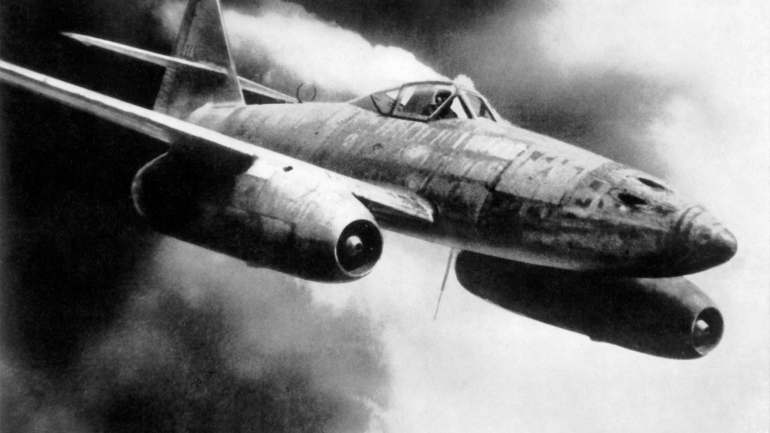
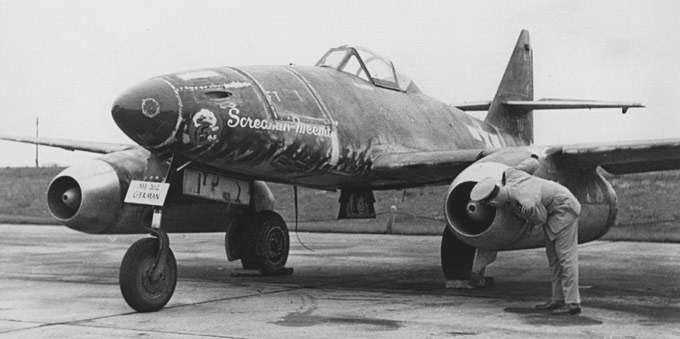
GERMANY –Messerschmitt Me 262
Perhaps the most staggering thing about the Luftwaffe in the war, was the volume of wasted potential – in both leaders, pilots, and most crucially, machines. The Me 262, the first jet fighter to enter widespread service (the very first had been the He 280), typified both the exceptional potential of Germany’s scientists and designers as well as the insane impact of political meddling in Hitler’s Reich.
First conceived in 1938, and prototyped in 1941, it was only in the later months of 1944 that Hitler showed enough faith in the 262 to push it into full-blown production. He, and under him Goering, had spent the previous years insisting on the mass production of tried and tested models like the 109, 190, Ju 88 – all of which were retro-fitted endlessly to fulfill any task – ultimately to the detriment of the original aircraft. As well as that, an obsession with producing troublesome new ‘defensive’ bombers, like the Do 217 hampered jet fighter production.
Had the 262’s almost miraculous potential to repel the round-the-clock bombing offensives of the USAAF and the RAF been recognized earlier, things may well have been different. Even once operational, many of these excellent fighters were modified to carry almost ineffective bomb loads, or to house heavy cannon for ground attack roles. In the last days of the war, the few operational Me 262s formed one of the most elite air units of the war -Â Jagdgeschwader 44, headed by the pre-eminent ace Adolf Galland and made up of numerous top aces of the Luftwaffe. By the end of the war, only around 100 of the 1,433 Me 262s built had seen combat. The Me 262 was a testament to a system plagued by meddling and misguided policies spurred on by blind optimism and a refusal to face facts.
Many Me 262s were produced by Slave labour. It is rumoured that some Me 262 workers sabotaged the engine components by urinating on them.
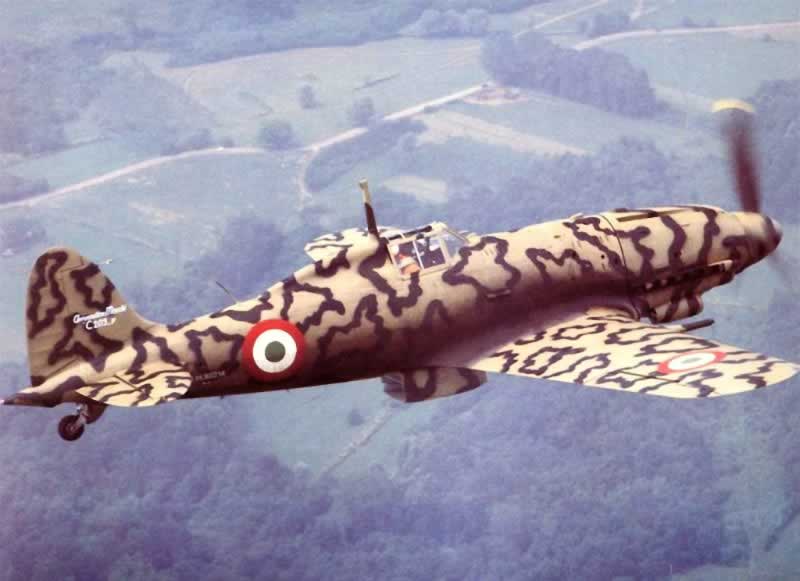
The MC.202: “an irrelevant ghost at the air war ball”
As my grandfather used to say – what’s the difference between toast and Italians? The answer being that you can make soldiers out of toast. And the chortle goes around. True enough, the Italians had a rough time of it in the war, but their Macchi C.202, or Folgore (‘lightning‘) was about the only plane that could line up with the Spitfire in the ‘Miss Pretty Aeroplane of the War’ pageant. Superbly good-looking, with the cockpit sat far back on the fuselage. Possibly the most stunning feature of the Folgore was its wings. Not in that they were especially pretty in most aspects, but in that one was a whole eight inches shorter than the other, a design quirk that offset the propeller torque – a trick that Reggiane did it as well with the Re 2005.
But true to those stereotypes, the beautiful fighter was under-armed, and though a stunning piece of kit, never had the impact it could have on a fashion runway. In the Mediterranean theatre it outclassed the underwhelming P-40 Kittyhawk and out-flew the Hurricane, but was somewhat late to the party in North Africa, where it could have provided solid fighter cover for the embattled Italian troops.
The blame for the Folgore’s lack of impact could arguably be placed at the feet of the Italian air industry overlords who ignored the evidence (Italy having won the world speed record in 1934 with its in-line-engine-powered Macchi C.72) and focused on heavy duty radial engined fighters, rather than embracing the often speedier, in-line, options. The Folgore was destined to be a beautiful, iconic, and essentially irrelevant ghost at the air war ball.
“Late to the party? I am the party!”The C.205 was a development of the earlier C.202 Folgore.
USA – Republic P-47 Thunderbolt
The most iconic American fighter of the war, the P-51 Mustang, was also rather exceptional by American design standards. It was originally built for the RAF, and at first a rather disappointing product until the introduction of the Rolls-Royce Merlin engine. It was a sleek, almost pretty, aircraft (far prettier after its upgrading to a bubble cockpit) with an in-line engine. Aside from the Airacobra / Warhawk families and so on – all generally below par as purebred fighters – the typical American approach to fighter aircraft was based around heavy, powerful, radial engines. The planes themselves also tended to be heavy and tough.
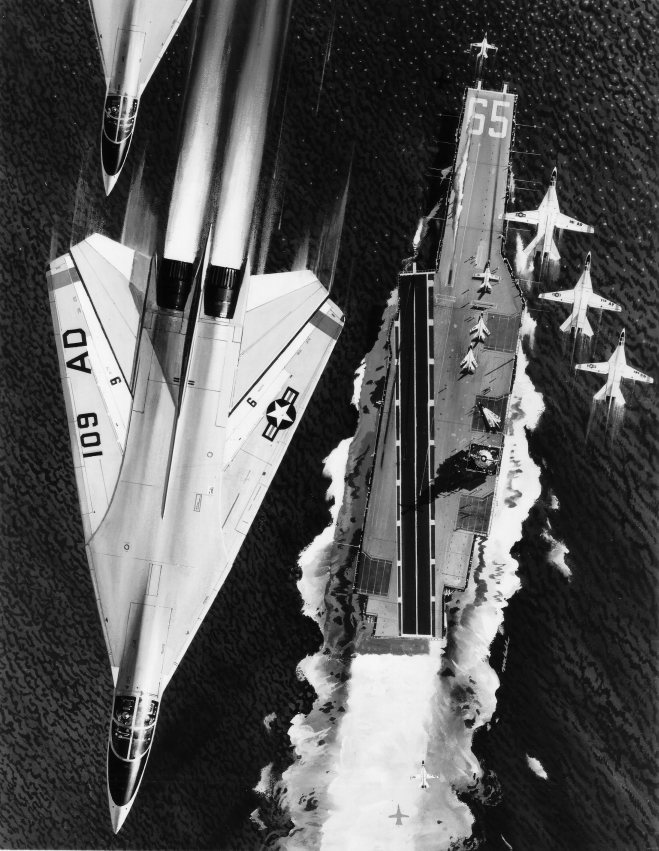
A tough, powerful naval fighter…and a Super Hornet
Machines like the Corsair and the Hellcat (and Wild/Bearcats) conformed to this type well. The P-47 thunderbolt however was the epitome of that attitude and reflected America’s wealth in both financial and material terms.
“Tubby and verging on ugly, it developed a reputation for taking punishment”
It was the heaviest and most expensive single (piston) engined fighter of World War II. Few ‘single piston’ aircraft ever surpassed the ‘Jug’ regarding weight, with the exception of the experimental Boeing XF8B-1 and the post-war Eagle-powered Wyvern and Douglas A-1 Skyraider. Tubby and verging on ugly, it developed a reputation for taking punishment, and the nickname the ‘Jug’. Though surpassed by the Mustang as a bomber escort, the Thunderbolt’s armor plating, ruggedness, and ability as a weapons platform made it an exceptional ground attack aircraft. There is a tale of a National Guard P-47 over-shooting a runway in 1946, going through a wall, and the pilot then climbing out and trotting off. Pretty sturdy.
Bruno Bayley is the Managing Editor of Vice Magazine. From an original idea by Juanita Franzi. Juanita’s excellent aviation illustrations can be seen at:http://aeroillustrations.com/
The dream of a supersonic STOVL (Short Take-Off and Vertical Landing) fighter has been striven toward for over half of the history of heavier-than-air flight. When the F-35B reaches real operational readiness with the USMC, it will be a very significant event. Lockheed Martin will have succeeded where dozens of the world’s greatest aircraft design houses have failed. The tortuous road which led, via the Harrier, to the F-35B started with NATO requirement NBMR-3 of 1961. This almost led to a British superfighter, the Hawker P.1154.
Help Hush-Kit to remain independent by donating here. Donations enable us to carry on creating unusual and engaging articles. Thank you.Â
The author of Catch-22, Joseph Heller, fought with the 340th Bomb Group in Italy as a bombardier on B-25s. His commander was one Colonel Willis Chapman. Following the war Chapman set up USAF’s first jet bomber force. In 1956, Chapman was sent to Paris as part of the Pentagon’s Mutual Weapons Development Plan (MWDP) field office. His mission was to source and help develop new military technologies from European sources and strengthen Europe’s contribution to NATO.
Chapman was commander of the ‘Catch-22’ bomber group. Chapman’s daughter’s excellent book revealed that the characters in the book were barely different to those in reality.
Chapman was soon approached by Michel Wibault, a visionary French aircraft designer (he had been an early exponent of the use of metal in aircraft exhibiting a very advanced metal wing years earlier, at the 1921 Paris air show).
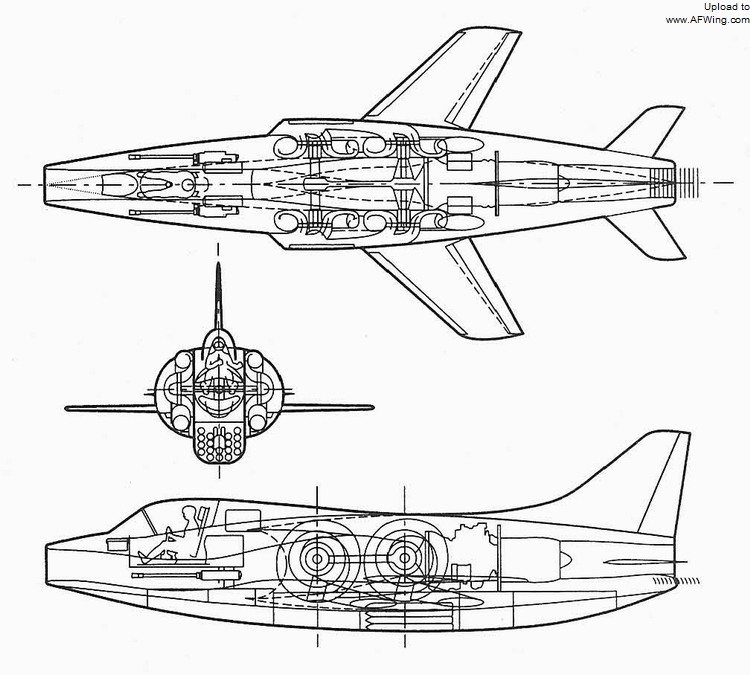
The basic principle of Wibault’s concept was that the thrust of an engine could be directed through four swiveling nozzles. The thrust could then be directed downwards to allow an aircraft to take-off vertically or swiveled back to facilitate forward flight. Wibault had designed a Vertical Take-Off and Landing (VTOL) fighter incorporating this principle.
Wibault’s concept.
Doomsday fighters
Why VTOL? By the mid-1950s it was obvious to many western military planners that, in the event of war, Warsaw Pact forces would quickly obliterate NATO airbases. For NATO aircraft to mount counter- attacks (some with tactical nuclear weapons), they would need to be able to operate from rough unprepared airstrips. These capability could turn air arms into survivable, ‘guerrilla’ forces able to fight on after the apocalypse. VTOL was also tempting to many navies; it could eliminate the traditional hazards of carrier landing. If an aircraft could ‘stop’ before it landed, the task of landing on a tiny, pitching deck would be far easier. Likewise, it could liberate ships from the need to carry enormously heavy catapult launch systems; it could even allow small ships to carry their own, high performance, escort aircraft.
Thank you for reading Hush-Kit. Our site is absolutely free and we have no advertisements. If you’ve enjoyed an article you can donate here– it doesn’t have to be a large amount, every pound is gratefully received. If you can’t afford to donate anything then don’t worry.
At the moment our contributors do not receive any payment but we’re hoping to reward them for their fascinating stories in the future.
Hooker’s expertise
Chapman was very impressed and brought the idea to the attention of Dr. Stanley Hooker, director of the British Bristol Aero Engine Company. At this time Bristol was at the forefront of jet technology.
Hooker was also impressed. The VTOL research aircraft then flying used a series of batty principles which either involved rotating the whole fuselage (the tail-sitters), the engine of the aircraft (sometimes with the whole wing) or carried a battery of auxiliary lift-jets which once in flight were dead weight. All were complex and involved very large design compromises. Contrary to this, Wibault’s principle was simplicity itself; it involved a single fixed-engine, and would allow for the precise control of the vectored thrust.
How the P.1154 would have looked in RAF service. This aircraft is seen in the colours of No.29 Squadron.
Hooker led a team to develop the BE.53, a vectored thrust engine based on the first two- stages of the Olympus engine. Hooker teamed up with the designer of the Hawker Hurricane, Sydney Camm, to develop a light fighter concept powered by the BE.53.
At the 1957 Farnborough air show Hooker and Camm met Chapman. They showed him the design for P.1127. By early 1958 the MWDP were funding the BE.53 engine. The P.1127 fighter was struggling to get funding, as Britain’s Ministry of Defence believed that there would be no future manned bombers or fighters. This belief was expressed in the 1957 White Paper on Defence (Cmnd. 124) by Duncan Sandys- the most hated document in British aviation history.
Sandys- inventor of a helmet. Hated by many.
Duncan Sandys had been Chairman of a War Cabinet Committee for defence against German flying bombs and rockets during World War II, and during this tenure, he had accidentally revealed information about where the V1s and V2s were landing. This was a shocking error, allowing the Germans to accurately calibrate their weapons trajectories and endangering British lives. It also threatened to uncover Agent Zig-Zag, the famed double-agent, who at the time was feeding German intelligence false reports of bomb damage in London. His wartime experiences may have informed his belief in the late 1950s that missiles could take over from manned aircraft.
Help Hush-Kit to remain independent by donating here. Donations enable us to carry on creating unusual and engaging articles. Thank you.Â
Success
His 1957 report was also ill-judged, as 55 years later the UK is about to receive a new manned fighter (the F-35B) that is expected to remain in service for the next forty years.
As there was little official support in the UK, Hawker decided to fund building two prototypes itself, with some research support from NASA (who noted that, unlike rival VTOL aircraft, the P.1127 would not need a complex auto-stabilisation system). By the time Hawker had started building the prototypes, the MoD was interested and funded the building of four more. The P.1127 first flew on 19 November 1960 and proved very successful. It could take off and land vertically with ease, something dozens of research aircraft around the world had failed to do. But, it shared a deficiency with its rivals; an aircraft with a high enough thrust-to-weight ratio to lift vertically could carry little in the way of fuel or payload. This is where the P.1127 really came into its own. It was discovered that by putting the exhaust nozzle into an interim position (45 degrees) the aircraft could take off in very short distances at very low speeds (60 knots, around half the taking-off or ‘rotation’ speed of a Hawker Hunter). At this point, VTOL gave way to V/STOL (Vertical/Short Take-Off and Landing).
Designs for the Spey-engined P.1179, a development of the P.1154 concept.
The MoD was now warming to the idea of a P.1127-based type and the RAF prepared a draft requirement (OR345) for a new V/STOL fighter of modest capabilities.
In 1961 NATO Basic Military Requirement 3 (NBMR-3) was issued. This followed on from the 1953 NBMR-1 (for a lightweight tactical strike fighter, which was won by the Fiat G.91 and the Breguet Taon – though the Taon never entered service). The NBMR-2 was for a maritime patrol aircraft, and was won by the Breguet Br.1150 Atlantic.
NBMR-3 specification called for a single-seat tactical close-support and reconnaissance V/STOL fighter. The requirement demanded a combat radius of 250 nautical miles at a minimum sea level speed of Mach 0.92, and 500 ft altitude, while carrying a 2,000 lb store. This was a doomsday fighter-bomber, able to launch a retaliatory tactical nuclear strike from whatever improvised airstrips were available – even including selected motorway sections, heavily cratered main runways or worse.
Hush-kit is reminding the world of the beauty of flight.
Help Hush-Kit to remain independent by donating here. Donations enable us to carry on creating unusual and engaging articles. Thank you.Â
A P.1154 as it would have appeared in Royal Navy service.
The prospect of providing NATO with a common fighter soon attracted most major Western aircraft companies. NBMR-3 became the biggest international design competition ever held. Two months later NBMR-3 was split into two; AC 169a would cover a F-104G replacement, and kept the original demands: AC 169b was to be a Fiat G.91 replacement. AC 169b differed to AC 169a in calling for a lower payload-range requirement of 180 nautical mile range with 1,000 lb store.
Enter P.1154
At this point OR345 was dropped in favour of NBMR-3. Hawker Siddeley’s bid was the monstrous P.1154 powered by the insanely powerful Bristol Siddeley BS.100 engine.
The BS.100 was designed to produce a mighty 33,000 lb of thrust in reheat, around twice the power of the most powerful fighter engine then in service. The only engine with more power at the time was the Pratt & Whitney J58, which had yet to fly. The J58 was being developed for the top-secret Lockheed A-12 spy plane, which evolved into the SR-71 Blackbird. However, unlike the BS.100, at the speeds the J58 produced its maximum thrust, it was effectively a ramjet. As another example of how powerful the BS.100 was, the first fighter engine with greater power did not enter service until 2005 (44 years later). The engine was the Pratt & Whitney F119 and the aircraft was the Lockheed Martin F-22 Raptor. The potent BS.100 would have given the P.1154 a Mach 1.7 top speed, an unprecedented thrust-to-weight ratio and a scorching rate-of-climb. The aircraft was to be far more than just a brutish hot-rod, it was to be equipped with some very advanced avionics. Ferranti would provide the P.1154 with a radar which was at least a generation ahead of any other. The radar would feature both air-to-air and terrain-following modes. This was a true multi-mode radar, planned at a time when the world’s best fighters were carrying crude air interception radars with tiny ranges. The P.1154 would have one of the world’s first Head-Up Displays (HUD). The HUD is a piece of glass in front of the pilot with vital flight information projected onto it, which allows the pilot to keep his eyes up and looking ‘out’ and not to be distracted by looking down at instruments in the cockpit. The aircraft would also be fitted with another piece of innovative equipment, Inertial Navigation System (INS), a technology first seen in the V2 rockets that Sandys’ had accidentally aided!
But Hawker Siddeley was not the only company to be lured in by the big bucks promised by NBMR-3. Italy had been fucked over by NBMR-1. The contest had declared Fiat’s G.91 the winner, but nationalism got in the way. National governments which had been more than happy to support their own bids to the contest, grew shy when Italy won the contest, and the G.91 did not receive orders on the scale that could have been expected.
A notional RAF No.111 Squadron P.1154. The Paveway IVs are not a representative weapon-load, as the type would have probably been retired prior to this weapon’s service entry.
Victory and conflicting demands
Hawker and Bristol’s P.1154 was declared the winner, but history repeated itself. Though nobody was tied to buying the winners of NBMR contests, it still seems unfair that no country outside of Britain was forthcoming in wanting to invest in P.1154. Hawker had been stitched-up far worse than Fiat had been. Still, at least Hawker still had a generous MoD budget to work with, and the type was elected to replace RAF Hunters and RN Sea Vixens- what else could go wrong? Two things. The first was the differing needs of the Royal Navy and the RAF. The RAF wanted a single-engined, single seater. The Navy wanted a two-seat, twin-engined aircraft. To some degree both the Navy’s wants may have been driven by safety regulations regarding nuclear-armed aircraft (though the single-seat Scimitar carried the Red Beard tactical nuclear bomb). The Royal Navy was also impressed by the McDonnell (later MD) F-4 Phantom II, and there were some within the Admiralty which considering this a safer option. Giving the P.1154 twin engines would involve a complex modification of the design. The BS.100 was too big, so Rolls-Royce Speys were selected. To stop a twin-engined P.1154 flipping over in the event of a single engine failure, a complicated twin-ducting concept was added (comparable to the V-22 Osprey’s transmission system). The Royal Navy also wanted a larger radar.
On top of this, P.1154 threatened the existence of the Navy’s big carriers, if these new machines could take-off in next to no distance, why did the navy need massive expensive carriers? It should be noted that the Navy intended to catapult-launch their P.1154s, using an US style of operation. The Navy’s self-preservation instinct was kicking in. While the RAF P.1154s could have been made to work (with limitations), many, even at Hawker, doubted the viability of the naval variant.
Technical problems
If the first major problem facing the P.1154 was inter-service differences, the second set were technical. The P.1154 would be firing hot, after-burning exhaust from its front nozzles down onto runways or carrier decks. The temperature was great enough to melt asphalt or distort steel- this was a big problem (the Yak-141 would later encounter similar problems). It would also churn up a potentially dangerous cloud of any present dirt.
Added to this was hot gas re-ingestion (HGR). The aircraft would be ‘breathing in’ its own hot exhausts on landing. This re-circulating hot air would raise the temperature in the engine to more than it liked, a very serious problem.
A possible export operator?
On 2 February 1965, the incoming Labour government, led by Harold Wilson, cancelled the P.1154 on cost grounds. Was this to be the end of V/STOL fighters? Well, fortunately not. While the P.1154 was being designed, Hawker had been busy developing the P.1127 into the Kestrel, with the help of funds from Britain, West Germany and the USA (initially from the US Army). This of course led to the Harrier, the famous jump-jet which today remains in service with the United States, Spain, Italy and India.
Hush-Kit would like to thank: Chris Sandham-Bailey from inkworm.com for his wonderful profiles, and Nick Stroud for providing access to his photographic archive.
Save the Hush-Kit blog. This site is in peril, we are far behind our funding targets. If you enjoy our articles and want to see more please do help. You can donate using the buttons on the top and bottom this screen. Recommended donation £10. Many thanks for your help, it’s people like you that keep us going.
Want to see more stories like this:Â Follow my vapour trail on Twitter:Â @Hush_kit
Thank you for reading Hush-Kit. Our site is absolutely free and we have no advertisements. If you’ve enjoyed an article you can donate here.Â
The later P.1179G was schemed around two Turbo-Union RB199s.
“If you have any interest in aviation, you’ll be surprised, entertained and fascinated by Hush-Kit – the world’s best aviation blogâ€. Rowland White, author of the best-selling ‘Vulcan 607’
I’ve selected the richest juiciest cuts of Hush-Kit, added a huge slab of new unpublished material, and with Unbound, I want to create a beautiful coffee-table book. Pre-order your copy now righthere Â
TO AVOID DISAPPOINTMENT PRE-ORDER YOUR COPY NOW
From the cocaine, blood and flying scarves of World War One dogfighting to the dark arts of modern air combat, here is an enthralling ode to these brutally exciting killing machines.
The Hush-Kit Book of Warplanes is a beautifully designed, highly visual, collection of the best articles from the fascinating world of military aviation –hand-picked from the highly acclaimed Hush-kit online magazine (and mixed with a heavy punch of new exclusive material). It is packed with a feast of material, ranging from interviews with fighter pilots (including the English Electric Lightning, stealthy F-35B and Mach 3 MiG-25 ‘Foxbat’), to wicked satire, expert historical analysis, top 10s and all manner of things aeronautical, from the site described as:
“the thinking-man’s Top Gear… but for planes”.
The solid well-researched information about aeroplanes is brilliantly combined with an irreverent attitude and real insight into the dangerous romantic world of combat aircraft.
FEATURING
Interviews with pilots of the F-14 Tomcat, Mirage, Typhoon, MiG-25, MiG-27, English Electric Lighting, Harrier, F-15, B-52 and many more.
Engaging Top (and bottom) 10s including: Greatest fighter aircraft of World War II, Worst British aircraft, Worst Soviet aircraft and many more insanely specific ones.
Expert analysis of weapons, tactics and technology.
A look into art and culture’s love affair with the aeroplane.
Bizarre moments in aviation history.
Fascinating insights into exceptionally obscure warplanes.
The book will be a stunning object: an essential addition to the library of anyone with even a passing interest in the high-flying world of warplanes, and featuring first-rate photography and a wealth of new world-class illustrations.
Rewards levels include these packs of specially produced trump cards.
Hush-Kit grilled Hornet fighter pilot Dave Buonerba to find out what was the hottest fighter in the US Navy. Buonerba has a wealth of experience flying the old F/A-18C (‘Charlie’) Hornet. Two years ago, he began flying the Super Hornet, making him the ideal man to give us the low-down on Charlie’s big sister and how she compares with the legacy ‘Bug’. If you enjoy this article, check out the F-35 review.
To keep this blog going – we need donations. We’re trying to do something different with Hush-Kit: give aviation fans something that is both entertaining, surprising and well-informed. Please do help us and click on the donate button above – you can really make a difference (suggested donation £12). You will keep us impartial and without advertisers – and allow us to carry on being naughty. The donate buttons are on this page. Many thanks.Â
“On the one hand it’s very similar; you could almost, as a Charlie pilot, jump in and figure it out. There are some differences, it’s got a lot more capability. The APG-79 AESA radar is much more capable, it’s got all the bells and whistles. We’ve been slowly upgrading the legacy Hornet Charlies, giving them the helmet-mounted sight, Link 16, the AIM-9X, I mean those are the big upgrades now, they all carry ATFLIR now. But the Super Hornets come with all that stuff. The digital displays are that little bit nicer, they’re all colour. Whereas on some, especially the older F/A-18 Charlies, it’s just a green display. The WSO (the backseater) of the Foxtrot, he’s got a really nice, huge display in the back. It’s totally missionised in the back. Most of the mission we can do single-seat, but there’s some, like Forward Air Control where the back-seater earns his keep.”
“Most of the other fourth gen’ fighters have all been touted as multi or swing role. Which is true, and its pretty much a push-button to switch between air-to-air and air-to-ground. But this is the first one that can do both at the same time. I can be in the front painting the air picture as pilot and my WSO can be doing the air-to-ground picture back, painting a SAR image of our target area, getting some coordinates. Meanwhile I can be watching the air picture, whether its enemy, or frankly sometimes friendly, you gotta watch out for other traffic. It’s a nice airplane.”
In terms of handling how does it compare with the C model?
“The engineers will tell you, that the flight control software in the two airplanes they tried to make as similar as possible. But you can feel some differences. As the pilot, it feels just a little heavier. I think that’s to be expected. It’s bigger, its got a bigger wingspan, much bigger leading extension extension on the wings. It’s heavier. Everything is just a little thicker. The legacy Hornet, to me, feels just a little more nimble, just a little sportier.”
“Landing on the ship, this one is definitely easier. They’ve made the approach speed slower, and it’s just a little bit more forgiving if you deviate from glide slope. You can recover a little more gracefully in a Super Hornet than you can in a Hornet. The Hornet is a lot less forgiving coming aboard the ship, it’s totally do-able, but if you get yourself low or underpowered you can get yourself in trouble pretty quick. Whereas the Super Hornet is about a 10 knot slower approach speed, to begin with, and it’s just a little more responsive and to me it’s an easier plane to fly.”
There’s a very cool die-cast model you can get of the Super Hornet here
How does the E compare to the C in terms of acceleration?
“I think down on the deck it’s better, and then up at altitude, the higher you get, then it’s maybe a little less responsive.”
“The legacy Hornet, to me, feels just a little more nimble, just a little sportier.”
Have you flown against dissimilar types?
“Since flying in the Super Hornet, I’ve only flown against other Hornets, Super Hornets and F-5s. When you get slow, the handling characteristics are a bit better than the Hornet. You’ve got pretty good nose authority, it is really good at high Alphas. It’s damn near impossible to depart the thing from controlled flight- the computers help me out there. But, it’s a solid, solid airplane.”
In terms of threat platforms, which would you rate as the most capable? The Su-30 for example?
“I’ve not flown against those, we tried to arrange some training with the Malaysians when we were passing through there with the carrier last year. But unfortunately they just sent out F/A-18Ds at us. Something we’re quite used to, still it was good to turn with those guys. The Chinese are investing a lot in that Sukhoi airframe, and from what I understand it’s pretty darn capable.”
Which aircraft would most like to fly against in a training exercise?
“Any of the Sukhoi products (‘Flanker’ series), it would be pretty fun to turn with those guys and see what they can do. We’re definitely not going to keep up with those guys in drag race, but it would be nice to mix it up in the BFM environment.”
“The biggest advantage the Super Hornet would have against the ‘Flanker’ would be the pilot-machine interface. I mean that was great on the Hornet, but even better on the new aircraft. It fuses your radar information, your link information, all the different sources are brought together for the pilot. This is combined with the HOTAS capability, allowing you to do anything pretty much. There isn’t voice control though and I don’t know if there are any plans to integrate that. But I’m pretty happy with the way the interface is now.”
Thank you for reading Hush-Kit. Our site is absolutely free and we have no advertisements. If you’ve enjoyed an article you can donate here– it doesn’t have to be a large amount, every pound is gratefully received. If you can’t afford to donate anything then don’t worry.
At the moment our contributors do not receive any payment but we’re hoping to reward them for their fascinating stories in the future.
“The HOTAS for the most part is pretty good. On a lot of the things, you can either use HOTAS or push button functionality on a menu. In some cases it’s pilot preference, there’s somethings I like to do HOTAS and there’s somethings I like to do just hitting a manual button. We’re going more to touch screen now, as opposed to the original Hornet. Most of the displays on this jet, you got the display with roughly twenty buttons going around. Today data entry is done via touchscreen and this took me a little time to get used to, as it’s different when you’re used to feeling a button. On the original Hornet I could do a lot of data entry without even looking at the keypad, just resting my hand there and I could feel what I’m doing.”
“And with this one, I’ve got to look at and touch it, to make sure I’m hitting the right button and occasionally I get into fights with it..I’m doing loops and it will error out..because I’m going too fast and it can’t keep up or whatever. It’s just like trying to teach an old dog new tricks.”
Thank you for reading Hush-Kit. Our site is absolutely free and we have no advertisements. If you’ve enjoyed an article you can donate here. At the moment our contributors do not receive any payment but we’re hoping to reward them for their fascinating stories in the future.
Are there particular upgrades you’d  like to see?
“In this day and age, it’s mostly software upgrades. Getting all the capabilities out of the radar, installing new systems. You can always work on improving the radar and the FLIR, I mean that technology is always moving. Though we haven’t currently got a dedicated IRST, you can use the ATFLIR to cue what you’ve got on the radar.”
How frequently do you take the Super Hornet to its maximum stated speed?
“You’ll do it on functional check flights; so, acceptance flights or after maintainance, especially on the engines. You’ll do Mach runs, and there’s different systems to check. In training, a lot of times you’re limited on your airspace. Even in the US, there’s very few places where we can go supersonic. There is particular ranges and what-not. There’s more freedom when you’re operating off the ship, over the water, when you’re outside, roughly, 30 miles of the coast. Then you really don’t have those restrictions. So if you have the airspace, you’ve then got to have the luxury of the gas to do it and sometimes you do and sometimes you don’t.”
Is the aircraft comfortable at Mach 1.8, or is that an absolute maximum that is achieved for very brief durations?
“That is the top end speed.”
I’ve also seen the figure of Mach 1.6 listed as its top speed, is that a speed the aircraft is more comfortable in attaining?
“If you’ve got enough fuel! I mean at that speed its burning a lot of fuel. obviously it depends on its configuration, what you got hangin’ on the airplane. This aircraft right here could get there (Dave points to the aircraft behind him, which is fitted with two AMRAAMs, one on each wing, and one AIM-9X on each wingtip). You start sticking drop tanks on, or a lot of laser-guided bombs and stuff like that hangin’ off, you’re going to be hard-pressed to get up to those top speeds. It’s easy to go supersonic at forty five thousand feet. In a light configuration, it’s supersonic at sea level. In Hawaii we did a demo for friends and families and did a supersonic fly-by at 300 feet with both Super and regular Hornets.”
“But let’s face it, in any fighters, 95% of your time in the tactical regime will be spent at 400-500 knots and you can manage that without any issues, with a large air-to-ground load-out. The only time you’re really going to go supersonic is if you’re going to try get up there and intercept somebody or if you’re trying to get away from somebody.”
Dave Buonerba is the Operations Officer of the Strike Fighter Wing Pacific Fleet. He was previously Operations Officer at Carrier Air Wing 14
Hush-kit is reminding the world of the beauty of flight.
To keep this blog going – we need donations. We’re trying to do something different with Hush-Kit: give aviation fans something that is both entertaining, surprising and well-informed. Please do help us and click on the donate button above – you can really make a difference (suggested donation £12). You will keep us impartial and without advertisers – and allow us to carry on being naughty. The donate buttons are on this page. Many thanks.Â
“If you have any interest in aviation, you’ll be surprised, entertained and fascinated by Hush-Kit – the world’s best aviation blogâ€. Rowland White, author of the best-selling ‘Vulcan 607’
I’ve selected the richest juiciest cuts of Hush-Kit, added a huge slab of new unpublished material, and with Unbound, I want to create a beautiful coffee-table book. Pre-order your copy now righthere Â
TO AVOID DISAPPOINTMENT PRE-ORDER YOUR COPY NOW
From the cocaine, blood and flying scarves of World War One dogfighting to the dark arts of modern air combat, here is an enthralling ode to these brutally exciting killing machines.
The Hush-Kit Book of Warplanes is a beautifully designed, highly visual, collection of the best articles from the fascinating world of military aviation –hand-picked from the highly acclaimed Hush-kit online magazine (and mixed with a heavy punch of new exclusive material). It is packed with a feast of material, ranging from interviews with fighter pilots (including the English Electric Lightning, stealthy F-35B and Mach 3 MiG-25 ‘Foxbat’), to wicked satire, expert historical analysis, top 10s and all manner of things aeronautical, from the site described as:
“the thinking-man’s Top Gear… but for planes”.
The solid well-researched information about aeroplanes is brilliantly combined with an irreverent attitude and real insight into the dangerous romantic world of combat aircraft.
FEATURING
Interviews with pilots of the F-14 Tomcat, Mirage, Typhoon, MiG-25, MiG-27, English Electric Lighting, Harrier, F-15, B-52 and many more.
Engaging Top (and bottom) 10s including: Greatest fighter aircraft of World War II, Worst British aircraft, Worst Soviet aircraft and many more insanely specific ones.
Expert analysis of weapons, tactics and technology.
A look into art and culture’s love affair with the aeroplane.
Bizarre moments in aviation history.
Fascinating insights into exceptionally obscure warplanes.
The book will be a stunning object: an essential addition to the library of anyone with even a passing interest in the high-flying world of warplanes, and featuring first-rate photography and a wealth of new world-class illustrations.
Rewards levels include these packs of specially produced trump cards.
Eurofighter GmbH, producer of the Typhoon fighter, is beginning to emerge from a period of serious self-reflection. Recent sales campaigns have ended in bitter defeat. Eurofighter has watched big prized contracts being dished out to all of it rivals. It lost in Switzerland to the Swedes, in Japan to the United States and in India to the French. Rafale, Typhoon’s closest rival, had emerged victorious in India, the biggest fighter contest in the world. Future enhancements to Rafale are almost certain to be bank-rolled by India, as well as making sales to additional customer more likely for the French fighter. This was disastrous news as the Rafale is very similar in capability to the Typhoon. Could the shrinking fighter market support two such near rivals?
Added to this gloom was the F-35’s seeming invincibility to cancellation. The F-35 is set to become the first massed-produced stealth fighter, available to all (well, almost all). Many air forces have been envious of the US’ stealth technology since the F-117’s star-turn in the 1991 war with Iraq. As well as the promise of stealth, the F-35 has enormous political backing and Lockheed Martin’s incredible mastery of the black arts of military hardware promotion. Despite the F-35’s dire development problems, customers are still clinging to the notion that the F-35 will be the Model-T of stealth and will make ‘aluminum’ aeroplanes obsolete overnight. However, the F-35’s problems have given Eurofighter an extended time window in which large sales have been possible, but these opportunities have been repeatedly squandered. To many observers it was looking like Typhoon was a dead duck, that would fail to achieve any more significant export sales.
 Typhoon boon?
After several years of misery for Eurofighter, the last week has brought a little bit of sunshine. The most conspicuous piece of good news was from the Luftwaffe regarding Typhoon’s performance over in Alaska. A detachment of 8 German Typhoons from JG74 were deployed to Red Flag 2012 in Eielson AFB in June. During the exercise they took part in basic fighter manoeuvres (BFM) against the F-22. Now before I go any further, we all know the usual disclaimer: without details, and in particular without rules of engagement specifics, not much can be inferred from BFM anecdotes. But…the following exciting titbits did emerge-
According to the Col. Andreas Pfeiffer, commander of JG74 “Typhoon is a superior dogfighter†to the F-22 in within visual range combat.
Typhoon can out-climb the F-22
Typhoon can out-accelerate the F-22
These are all very interesting claims. The latter point reminds me of a conversation I had with a Eurofighter representative a few years ago. I asked him if Typhoon could out-climb the F-22. He replied it could. Two days later he withdrew this comment.
The confident statements by Pfieffer are significant for two reasons:
The F-22 is the aircraft to beat
Of course the Raptor decimated the Typhoons at Beyond Visual Range, a domain where the F-22 is still peerless. But, the Raptor is also one of the very best close-in dogfighters, thanks partly to thrust vector control (TVC). Performing well against the F-22, even if just in the Within Visual Range domain is still a notable achievement. On the subject of TVC, Luftwaffe pilots noted the F-22’s tendency to sink when employing thrust-vectoring. This echoes the experience of the F-15C pilots who flew against India Su-30s in training exercises. The USAF Eagle pilots were quick to identify counter-tactics to the energy depleting TVC moves employed by IAF ‘Flanker’s, though admittedly the F-22 is probably far better at recovering energy than the Su-30.
2. Â These were German Typhoons
Luftwaffe Typhoons (for the sake of clarity I will not refer to them as ‘Eurofighters’ as the Luftwaffe generally does) are the worst equipped of the partner nations (the RAF aircraft are the best). To put it simply, if the worst Typhoons can put up a decent fight against the F-22, what could the best Typhoons do?
The defensive systems are not to the same spec as the RAF, lacking several components and featuring a smaller amount of data about potential threats. They do not have an infra-red search and track device, possibly the best way to track a low Radar Cross Section (RCS) target like the F-22.
Importantly they didn’t have the Typhoon’s advanced helmet system. The helmet displays vital information to the pilot and allows weapons to be slewed onto targets very quickly indeed and at extreme angles.
RAF Typhoons took the helmet system to a multi-national exercise in Malaysia last year. The system was deemed to be a strong contributor to the Typhoon’s domination of air combat exercises against F/A-18s, F-16s, MiG-29s and advanced F-15 variants during this training event.
The JG74 aircraft sent to the US were upgraded examples. Changes included an upgrade to the aircraft’s radar software and new radio, mission data and countermeasures software system. Other modifications were classified.
Luftwaffe Typhoons are considered behind the curve in terms of tactics and equipment, especially when compared with RAF aircraft. This success in Red Flag is thus particularly good news. Especially as Germany is keen to offload as many of its older Typhoons to export nations as possible, offering these low-mileage, early Tranche aircraft at competitive rates.
The next piece of good news, is that Eurofighter is waking up to the basics of sales. Shockingly, it emerged that the company put little or no effort into reducing unit costs to potential buyers, instead relying on the weight of high-level governmental support. The obvious example must be India, where the Typhoon bid was supported by extravagant promises and visible efforts by heads of state, but ultimately lost on cost grounds.
Guiseppe Orsi, chairman and chief executive of Finmeccanica (one of Eurofighter’s main partners), acknowledged the lessons learnt in an interview with the Financial Times. He stated:
“We will all be around the table and start from what is the competitive price to win a competition, as we do in the commercial field, then we go back and see what each company has to do in order to get that competitive price.â€
The partner companies must work together to achieve this for the greater good of Typhoon sales. Clearly the united ‘front’ of Eurofighter is a smokescreen for large defence contractors viewing their partners as rivals and being unwilling to share sensitive information on costs and margins. Sadly it seems Eurofighter represents a microcosm of the EU itself, its problems analogous to a failing Europe.
However, awareness and public admission of this is a sign that this culture may change.
The aircraft itself is by all accounts excellent, the missing piece to the puzzle of its failure to achieve greater export success may have been found.
If this interests you, support Hush-Kit.net with a donation (buttons above and below). If this goes well we’ll be able to give you much more! Recommended donation £10. Many thanks for helping to keep us impartial and independent.
This week a photograph emerged of what appears to be a new Chinese fighter. The mysterious aircraft wrapped in a camouflage tarpaulin was delivered from Shenyang by flat-bed lorry to a testing location. The shape (it is possible that it is a mock-up) appears to have no tail surfaces or canopy fitted. It is likely that this is the new Shenyang Aircraft Corporation J-21 (the designation J-60 has been used by some in connection with this aircraft), the Chinese equivalent to the US Lockheed Martin F-35 Lightning II. The shape is apparently similar to that of the F-35, with faceted low-RCS shaping and a conventional wing and tail. The aircraft seems to be somewhat smaller than the F-35 (which is 15.67 m long), with an estimated length of 14-15 m, though size estimates are notoriously difficult  to get right. A good example of this is the J-20; early guesstimates put the aircraft as long as 22 metres, whereas today many analysts believe it is not much bigger than than the 18.90 m long F-22 Raptor . There is some confusion about how many engines the new aircraft will have, but this shape appears to be twin-engined, unlike the single-engined F-35. It seems likely that the aircraft will be twin-tailed, with outward canted vertical fins.
That it was transported by road and allowed to be photographed suggests a staged leak.
Alternatively, the aircraft could be the rejected XXJ contender that lost out to the J-20, this aircraft may carry the designation J-19. But, this seems unlikely as the airframe appears to small for this fighter class. It seems that Lockheed Martin have set a template for what a modern low-RCS fighter looks like, and the F-35 and F-22 are likely to influence most fighters now in development (though the Russian Sukhoi T-50 PAK FA with its wide-body shares something of the YF-23, and the J-20 is an altogether different concept). Several models and artist’s impressions (above and below) have been realised purporting to show the configuration of China’s next fighter.
If the new fighter has not yet been test flown it is unlikely to enter service before 2025.
New US Fighters
Meanwhile the USAF has announced a thirty year plan, which includes a 6th generation fighter to replace the F-22. Though many see China’s fighter developments as a threat to the US’ technological lead, it is still clearly around 20 years behind the US in this field. China does not appear close to having a 5th generation aircraft in service and both the USAF and USN have begun studies into their 6th generation.
It should be noted that many do not agree with the use of the popular Lockheed Martin-defined ‘5th Generation‘ term. Eurofighter have pointed out that Lockheed Martin have manipulated the term to fit their marketing needs. If used as originally defined by Lockheed Martin- as a supercruise capable, super-manouevrable, steathly fighter with sensor fusion- the F-22 is the only 5th Generation aircraft. The F-35, which lacks the first two capabilities, is not.
With Russia dedicating its future efforts to heavy fighters, (the PAK FA and Indo-Russia Sukhoi/HAL FGFA) there will be a strong market gap for a lighter stealth fighter for nations wishing to avoid the US sphere of influence. Perhaps the J-21 could prove an export success and end up as the MiG-21 of the future?
The sighting of the J-31 in September 2012 led many to believe that the aircraft on the truck was not fact the ‘J-21′ but the J’-31′.
Once upon a time a new fighter was planned. It would be a great fighter. It would push the boundaries of technology and it would be all things to all air forces – and navies.
The military knew that it had to ask for every piece of technology and every capability it could think of. It knew this because a responsible government keeps a check on defence procurement, making sure that the military doesn’t spend all the treasure. So the military asked for all the toys it could ever want, expecting that it’d actually get only the toys it needed. That was usually the way of things. It also decided that it’d be really smart to ask for just one type of fighter, but have it built in really different versions.
So the military sat down and made a list of all the magic it wanted in its new fighter. The list said: stealth; a new radar and sensor suite; a helmet-mounted sight that did away with the traditional HUD; a single, widescreen cockpit display; advanced sensor and data fusion; a new propulsion system; the ability to operate from land bases without compromise; the ability to operate from aircraft carriers without compromise; the ability to operate from smaller ships without compromise; weapon bays; supersonic performance; a brand new logistics and maintenance system; world-beating air-to-ground capability; and world-beating air-to-air capability.
It also made a list of all the aeroplanes it wanted to replace. On the list it wrote F-16, F/A-18, A-10, Harrier, Tornado, F-4 and EA-6B, a long list of very different aeroplanes with diverse capabilities. Could the new fighter really take-off like a Harrier, kill tanks like an A-10 and jam mobile phone signals before they could trigger an IED?
Airframe Wizards
Now the aircraft and engine manufacturers, high-tech wizards with great magic in their wands, looked at what the military was asking for and saw treasure. They saw the chance to develop technology beyond their wildest dreams and, if everything went well, to make billions of money from all the fighter jets they would sell to air forces and navies of the world.
It all seemed so possible and soon they were busily at work, crafting and concocting. Each piece of technology was possible, given enough time and resource, but no one stopped to ask if all the technology was possible at the same time and for the same machine. No one stopped to ask if so much technology could be adapted to fit the requirements of the very different versions of that machine. And no one stopped and said to the government, or the military, ‘Yes, we can do all these things, but probably, if we’re entirely honest, not in a useful timescale, certainly not on budget, and maybe not all for just one airframe design.’ Worse still, everybody became so engrossed in trying to make it all work, that nobody thought to ask if they really should be trying to make it all work.
Problems, problems
Many years passed. A great deal of treasure was made and a huge amount lost. Wizards came and went. Dates and deadlines came and went. Some aeroplanes were built while the wizards were still working their magic and although these aeroplanes were upgraded, they were never as good as the aeroplanes that were made years later, when all the magic was finally working.
The problem was that none of the wizards ever lay down his wand and said: ‘What are we doing? This is all going horribly wrong and we should admit that we’re all wrong and fix it.’
The problem was also that the military saw all its wildest dreams coming true and didn’t want to admit that it had set off the wizards on a quest that would stretch their magic so far that it’d keep breaking. It had been allowed almost all of the toys that it had wished for, even though, in the real world, most of those toys were pure luxury most of the time.
The government simply didn’t understand and it didn’t think to ask anybody who did. It started out with a big chest of treasure and although it added a little bit of extra gold, it still wasn’t enough to pay for the fighter programme as it struggled along. So it decided to buy fewer aeroplanes, but it was the development costs using all the treasure up, not the production, so the government actually paid for fewer, much, much, much, much more expensive aeroplanes.
Happily Ever Afters
There were several possible endings to the Fighter Fairy Tail. In one, the whole programme was stopped and the wizards put all their magic and their clever spells into the aeroplanes that the new fighter was supposed to replace, and into much more modern aeroplanes that were already in production, but still evolving. Legend has it that this had been done once before, long, long ago, when a very clever helicopter gave away all its magic. It worked out quite well.
In another ending, the programme was cancelled and the military made do with the fighters it already had in production. This seemed like a very silly ending, because it wasted so much magic and most of the very, very clever wizards disappeared.
Ending number three saw some of the magic requirements relaxed. This meant that the remaining magic could be made to work much better, much more quickly. One of the fighter variants was abandoned, which allowed the others to be much less compromised. The wizards managed to get really, really good aeroplanes to the military without too much more delay. By the time the military got its hands on the jets it had forgotten about all the problems and the aeroplanes worked so well that everyone, even the government, was delighted.
In the final ending, the wizards carried on as they were. The military wriggled and jiggled and although some changes were made, it pretty much got what it wanted. At first the government made the military order far fewer jets, but the aeroplane remained in production for 30 years and because orders kept being added, in the end the military got all its aeroplanes and the wizards made lots and lots of treasure.
The problem was that the first aeroplanes were delivered when their magic was immature. They all needed new spells and some of them had lots of their magic missing for many years. By the time it was ready, they were worn out.
But finally, the military got all the variants of the new fighter into service. Eventually they all worked. All the magic did what it was supposed to do and because the magic was clever, the wizards could keep writing new spells that kept the aeroplanes on top of the world.
But there was a snag. The ending was not entirely happy, although it did take forever after. Almost two decades passed from the time when the wizards delivered the first aeroplanes until all the variants were in service and doing all the things that the wizards had promised and that the military wanted. This was always going to be the ending. The aeroplane was superb. Its technology was superb. Its powerplant was superb. But in combination, they were just too much for the wizards to make quickly and at the same time. For a truly happy ending, somebody should have realised that.
This is a work of fiction. Any similarity to militaries, governments, wizards or fighters, living or dead, is purely coincidental.
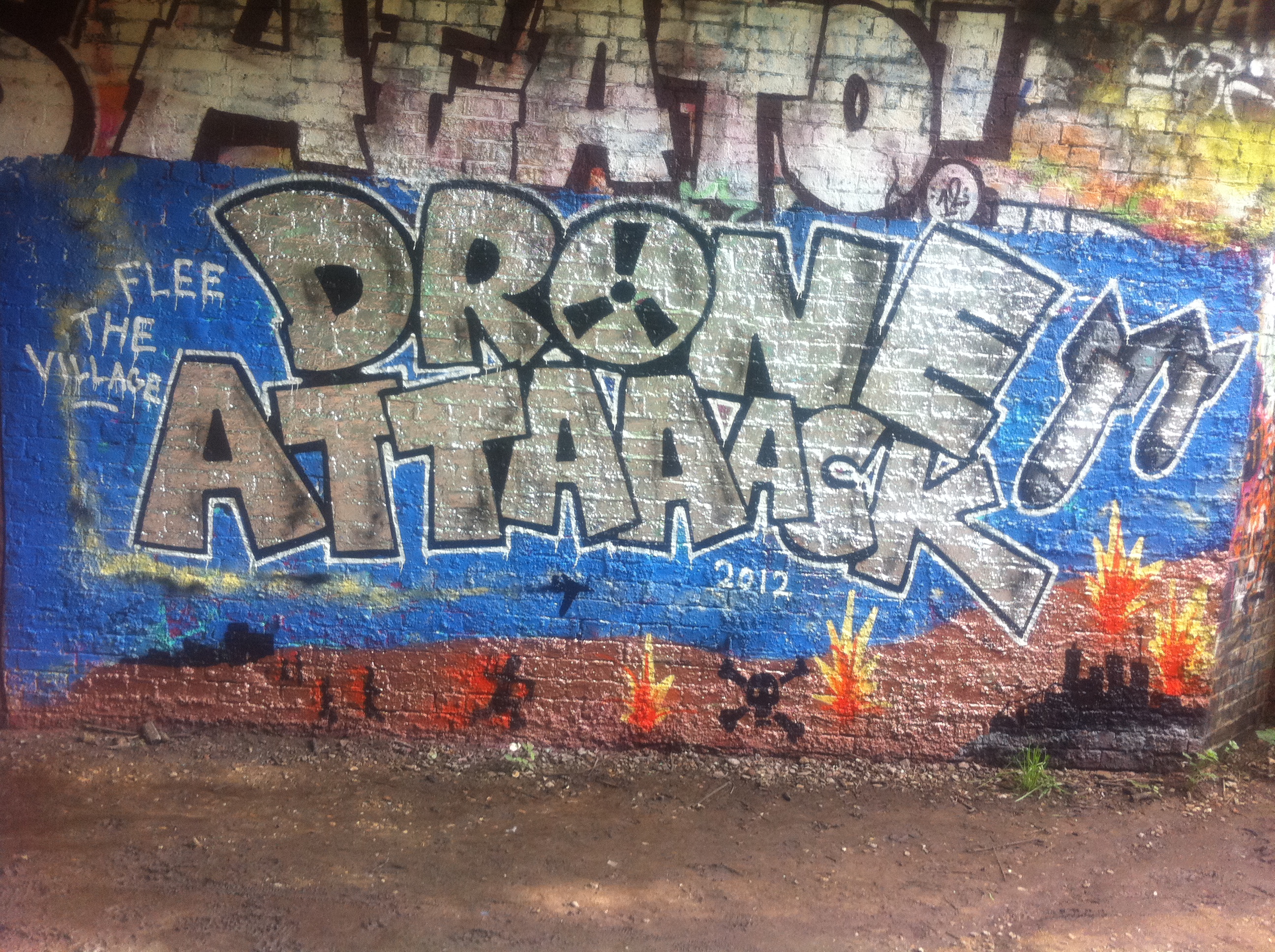
About half an hour ago I spotted this painted on a bridge on the abandoned railway line that runs from Finsbury Park to Highgate. I find it interesting how remotely piloted aircraft (‘drones’) are perceived.
In the last 12 years, the concept of drones has become a household idea that everyone is familiar with. To many, they symbolise war without responsibility, and it is certainly true that they have been used in deniable actions in Pakistan and Somalia (among many other places). In a more abstract way, they bring to mind the intruding, data-hoarding big governments that many fear. The fear and distrust of them is part Luddite and part well founded.
A secret US spy drone, a Lockheed Martin RQ-170 Sentinel, went down in Iran 2011. One response to this event, by an Iranian government-sanctioned satirist, was to send a pink toy version of the aircraft to President Obama. “He said he wanted it back and we will send him one,” Reza Kioumarsi, the head of cultural production at the Ayeh Art group said on Iranian state radio.
The 1:80 scale toy versions, available in several colours, have proved popular in Iran and are sold on a stand eblazoned with the rather charming Ayatollah Khomeini quote:  ‘We will trample America’.