Thanks to Thomas Newdick
Find out about the latest Hush-Kit articles on Twitter:Â @Hush_kit
Who was Sweden’s flying farm girl?
The alternative aviation magazine
Thanks to Thomas Newdick
Find out about the latest Hush-Kit articles on Twitter:Â @Hush_kit
Who was Sweden’s flying farm girl?


Find out about the latest Hush-Kit articles on Twitter:Â @Hush_kit
Who was Sweden’s flying farm girl?


You may also enjoy B-52 pilot chooses Top 10 Cold War bombers, Flying & Fighting in the Mirage 2000: a pilot interview, The World’s Worst Air Force, 10 most formidable dogfight missiles, The ten coolest cancelled airliners, Ten incredible cancelled Soviet fighter aircraft, Ten worst Soviet aircraft, Ten incredible cancelled military aircraft, Fighter aircraft news round-up,  11 Cancelled French aircraft or the 10 worst British military aircraft, Su-35 versusTyphoon, 10 Best fighters of World War II , Su-35 versus Typhoon, top WVR and BVR fighters of today, an interview with a Super Hornet pilot and a Pacifist’s Guide to Warplanes. Flying and fighting in the Tornado. Was the Spitfire overrated? Want something more bizarre? Try Sigmund Freud’s Guide to Spyplanes. The Top Ten fictional aircraft is a fascinating read, as is The Strange Story and The Planet Satellite. The Fashion Versus Aircraft Camo is also a real cracker. Those interested in the Cold Way should read A pilot’s guide to flying and fighting in the Lightning. Those feeling less belligerent may enjoy A pilot’s farewell to the Airbus A340. Looking for something more humorous? Have a look at this F-35 satire and ‘Werner Herzog’s Guide to pusher bi-planes or the Ten most boring aircraft. In the mood for something more offensive? Try the NSFW 10 best looking American airplanes, or the same but for Canadians. 10 great aircraft stymied by the US.Â
Â
An Air France Boeing 707-328 and popstar Dion Di Mucci in 1962. The song is a cover of Jerry Leiber and Mike Stoller’s ‘Ruby Baby’ originally recorded by The Drifters. As an aside, Â there’s an amazingly fierce cover of this song by Cody Brennan featuring some great guitar playing by the young Roy Buchanan (the intro of which was re-used by The Cramps for ‘Alligator Stomp’.

When Gary Powers’ U-2 was shot down in 1960, it was clear that flying high offered Britain’s V-bombers no protection. Instead the RAF began training to go in under the radar.  The strain of flying in thick low-level air soon caused fatigue cracks that saw the immediate retirement of the RAF’s Vickers Valiant B1.
‘And paint the fucker black …’
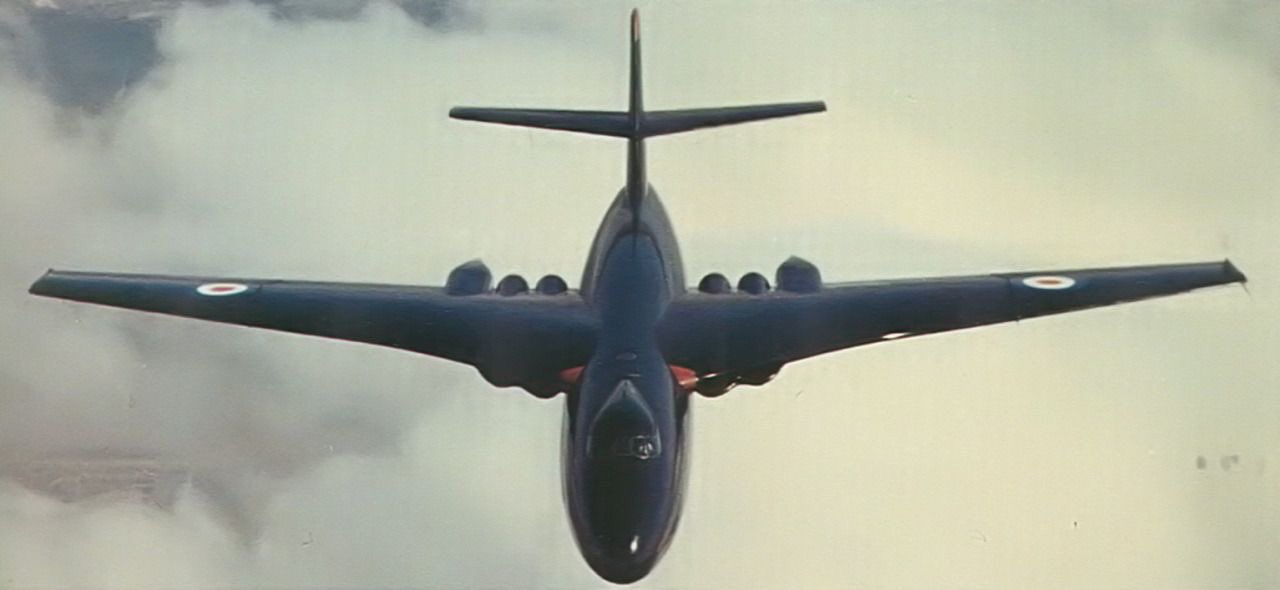
The irony is that Vickers had actually built an aircraft that was perfectly suited to the new tactics.  Alongside the standard Valiant, a one-off variation on a theme had been ordered.  Based on experience from WWII, the Air Staff wanted a machine that could fly ahead of the main bomber force to accurately mark targets.  The result was the Valiant B.2. Beefed up to fly fast and low, the ‘Pathfinder’ was tested at speeds of up to 640mph.  That’s comparable to the low level performance of the USAF’s swing wing B-1B Lancer, a machine that first flew nearly thirty years later and remains in service today.
Â

Lowdown at 600mph, condensation wrapped the bomber in its own flaring cloud.  It only added menace to an imposing presence that test pilot Brian Trubshaw had been instrumental in creating.  When he saw the bomber’s muscular shape in the Vickers design office, he signalled his approval, then added ‘And paint the fucker black …’
Rowland White’s new book, The Big Book of Flight, is published by Bantam Books on May 23rd, 2013.  The Valiant B2 – and other cancelled aircraft projects – are all featured in the book.  Alongside much more besides, from airline food to drones, by way of cluster ballooning, WWII, aerial firefighting and tortoises in deep space. To keep well-informed of the latest aviation stories follow @hush_kit on twitter or on Facebook.


Piston-engined fighters ruled the roost for thirty years. A brutal survival of the fittest ensured a rapid evolution of these characterful machines; the final fighters were over six times faster and around ten times heavier than the first generation. Whereas the first fighters had only a single rifle-calibre weapon, the Tigercat of 1943 had an awe-inspiring arsenal of four ‘.50 Cals’ and four 20-mm cannon. The Tigercat also had forty times more horsepower than a World War I fighter. The era of classic fighter planes ended on a high-point with huge, powerful masterpieces. We look at the zenith of ‘prop’ fighter design and choose the ten most formidable machines. To keep this blog going- allowing us to create new articles- we need donations. We’re trying to do something different with Hush-Kit: give aviation fans something that is both entertaining, surprising and well-informed. Please do help us and click on the donate button above – you can really make a difference (suggested donation £10). You will keep us impartial and without advertisers – and allow us to carry on being naughty.  A big thank you to all of our readers.
Â
10. Focke-Wulf Ta 152H

Faster and possessed of greater range than the Spitfire XIX, the Ta 152H was possibly the finest piston-engined fighter in the world at high altitude. Had the war lasted and the high-flying B-29 been committed to Europe then this aircraft would have been its nemesis.
9. Lavochkin La-11

The ultimate Soviet piston-engined fighter and the go-to aircraft for low and medium altitude operations, the La-11 represented the zenith of the superlative Lavochkin series of combat aircraft and is one of the few aircraft on this list to have seen a serious amount of use on operations. Combat Aircraft’s Thomas Newdick noted that it was “Last of an illustrious line, and scored a hat-full of Cold War air-to-air kills (well, a lot more than the Sea Fury, anyway)… the La-9 was a better flier, but the La-11 marked the apogee of the Soviet piston-engined fighter. It also showed that you could still eke performance out of the rugged basic design (which went back to 1940), while the agile Yak series of fighters came to an end with the wartime Yak-3 (after which its wing was put to use for early jet fighters).”
8. Dornier Do 335

The Do 335 was very unorthodox. It featured two tandem engines in the fuselage and a unique ‘push-me/pull-you’ propeller arrangement. With the power of a two-engined aircraft and the frontal cross-section of a single: the result was a remarkable top speed of 474 mph. Pierre Clostermann was one of the first allied pilots to encounter the aircraft, however even in the extremely fast Tempest, the flight he was leading was unable to catch the ‘Pfeil’. Fortunately we will never know what this amazing machine was truly capable of. The performance of the pre-production aircraft was spectacular. A handful served on operations but little is known of what they achieved. Had the jet engine not burst onto the scene, it is likely that a spate of designs would have aped its revolutionary layout.
Was the Spitfire overrated? Full story here. A Lightning pilot’s guide to flying and fighting here. Find out the most effective modern fighter aircraft in within-visual and beyond-visual range combat. The greatest fictional aircraft here. An interview with stealth guru Bill Sweetman here. The fashion of aircraft camo here. Interview with a Super Hornet pilot here. Most importantly, a pacifist’s guide to warplanes here. F-35 expose here.Â
Thank you for reading Hush-Kit. Our site is absolutely free and we have no advertisements. If you’ve enjoyed an article you can donate here– it doesn’t have to be a large amount, every pound is gratefully received. If you can’t afford to donate anything then don’t worry.
At the moment our contributors do not receive any payment but we’re hoping to reward them for their fascinating stories in the future.
7. Spitfire Mk 24
The last model of Spitfire designed for land operations by the RAF was a potent combat aircraft, and easily one of the world’s finest at the end of the 1940s. This serves to underline the remarkable unbroken development of a basic design that first flew in 1936, the Mk 24Â was twice as heavy, more than twice as powerful and showed an increase in climb rate of 80% over that of the prototype Spitfire.
Â
6. Grumman F7F Tigercat

Over 4000 horsepower. a Great range, a superb climb and tremendous speed of 460mph. For a twin-engined aircraft it was also highly manoeuvrable. It is therefore surprising to learn that it scored only two kills (and they were slow vulnerable biplanes). However it could be argued that it has done more good than any other aircraft on this list as Tigercats operated for many years as fire-fighting tanker aircraft in California. Interestingly the F7F was intended to be named ‘Tomcat’ but this was deemed to be too sexually suggestive – a serious problem for an aircraft designed to kill people.
5. Martin-Baker M.B.5
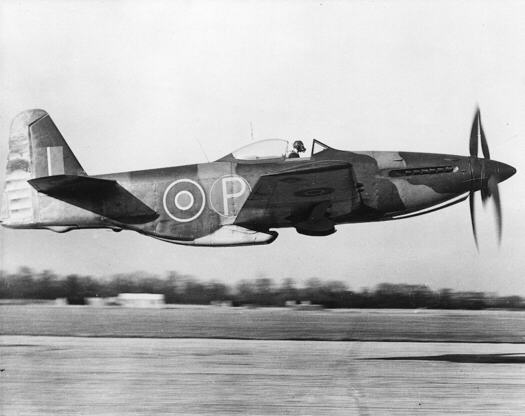
The greatest Allied might-have-been of the war? The M.B.5 drew unanimous praise from those who flew it, for its speed, range and climb-rate were outstanding, and it got more out of the Rolls-Royce Griffon than any other aircraft. Whether it would have lived up to its obvious potential will remain unknown, having the misfortune to emerge into a world teeming with inferior but numerous Spitfires and Tempests. Click here for the ten greatest cancelled fighters.
4. North American P-82 (later F-82) Twin-Mustang

A bizarre machine consisting (more or less) of two lengthened P-51H fuselages joined with a new centre section, the P-82B holds the record for the longest un-refuelled non-stop flight by a propeller-driven fighter (8129 km). It was also exceptionally fast. Sadly for the USAF later models of the Twin-Mustang were powered by Allison engines rather than the superlative Merlin fitted to earlier examples (due to increased royalties demanded by Rolls-Royce) and performance was reduced as a result.
Click here for the Twin-Spitfire
3. de Havilland Hornet

Faster and far longer ranged than the first-generation jets, the Hornet also happens to be achingly beautiful. Eric Brown, the world’s most experienced test pilot, maintained it was his favourite piston-engined aircraft, as he put it “My favourite piston engine (aircraft) is the de Havilland Hornet. For the simple reason it was over-powered. This is an unusual feature in an aircraft, you could do anything on one engine, almost, that you could do on two. It was a ‘hot rod Mosquito’ really, I always described it as like flying a Ferrari in the sky.” (Sea Hornet illustrated).
Equal 1st: Hawker Sea Fury and Grumman F8F Bearcat:
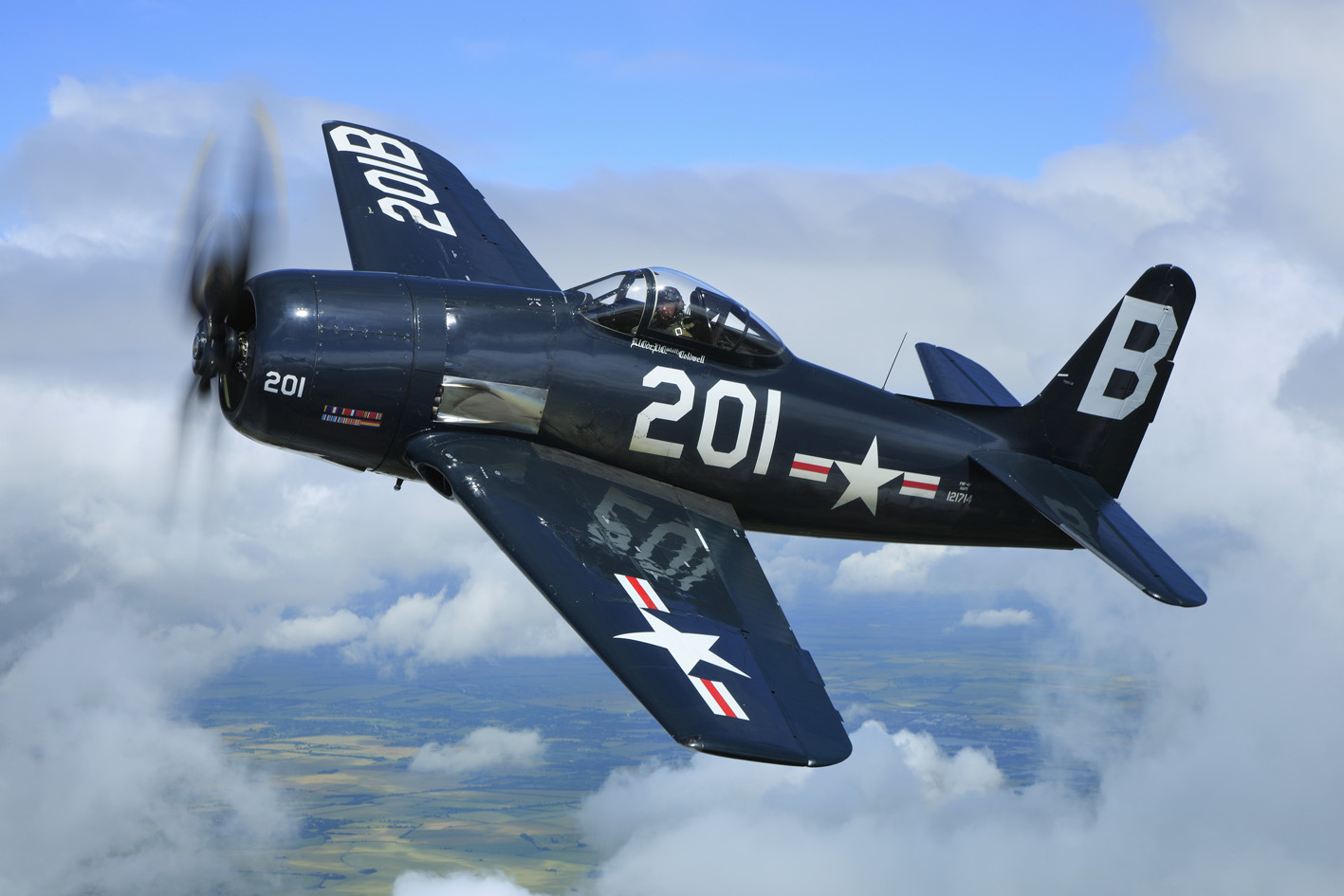
One holds the absolute climb rate record for piston-engined aircraft, the other the maximum speed record. Both appeared as a result of the same problem – it was too difficult to operate a jet fighter from a carrier and thus piston-engined fighter development was allowed to develop to its apogee. They are so closely matched that it is impossible to choose between them. Captain Eric Brown, who flew both, sums it up rather neatly:
“In the case of the Bearcat I found myself inevitably comparing it with the Hawker Sea Fury, and there really was very little to choose between the two. The Bearcat probably had the edge on climb and manoeuvrability, but was not such a good weapons platform nor as good in instrument-flight conditions as the Sea Fury. It was rather like the Fw 190 versus Spitfire IX situation – they were so evenly matched that if they met in combat the skill of the pilot alone would have been the deciding factor. Both were certainly great aircraft.”
The Sea Fury was the pinnacle of Hawker’s illustrious prop fighter line. The Sea Fury had everything a great fighter needs: it was tough, well-armed, fast and agile . Despite its enormous size and power (2,480 HP) Â it had delightful handling qualities; pilots were impressed with how spin-resistant it was, and Sea Fury pilot Dave Eagles gave it it ‘top marks for agility’. The Sea Fury was sent to war in Korea, where it proved itself an excellent warplane, notably downing a MiG-15 jet fighter in 1952.
Find out what it’s like flying the Sea Fury here.
Â
Thank you for reading Hush-Kit. Our site is absolutely free and we have no advertisements. If you’ve enjoyed an article you can donate here. At the moment our contributors do not receive any payment but we’re hoping to reward them for their fascinating stories in the future.
Have a look at 10 worst British military aircraft, Su-35 versus Typhoon, 10 Best fighters of World War II , top WVR and BVR fighters of today, an interview with a Super Hornet pilot and a Pacifist’s Guide to Warplanes. Was the Spitfire overrated? Want something more bizarre? The Top Ten fictional aircraft is a fascinating read, as is The Strange Story and The Planet Satellite. The Fashion Versus Aircraft Camo is also a real cracker. Those interested in the Cold Way should read A pilot’s guide to flying and fighting in the Lightning. Those feeling less belligerent may enjoy A pilot’s farewell to the Airbus A340. Looking for something more humorous? Have a look at this F-35 satire and ‘Werner Herzog’s Guide to pusher bi-planes or the Ten most boring aircraft. In the mood for something more offensive? Try the NSFW 10 best looking American airplanes, or the same but for Canadians.Â
Check out the Top ten fighters of World War II here
Â
“If you have any interest in aviation, you’ll be surprised, entertained and fascinated by Hush-Kit – the world’s best aviation blogâ€. Rowland White, author of the best-selling ‘Vulcan 607’
I’ve selected the richest juiciest cuts of Hush-Kit, added a huge slab of new unpublished material, the beautiful coffee-table book is available now from Amazon here
From the cocaine, blood and flying scarves of World War One dogfighting to the dark arts of modern air combat, here is an enthralling ode to these brutally exciting killing machines.
The Hush-Kit Book of Warplanes is a beautifully designed, highly visual, collection of the best articles from the fascinating world of military aviation –hand-picked from the highly acclaimed Hush-kit online magazine (and mixed with a heavy punch of new exclusive material). It is packed with a feast of material, ranging from interviews with fighter pilots (including the English Electric Lightning and Mach 3 MiG-25 ‘Foxbat’), to wicked satire, expert historical analysis, top 10s and all manner of things aeronautical, from the site described as
“the thinking-man’s Top Gear… but for planes”.
The solid well-researched information about aeroplanes is brilliantly combined with an irreverent attitude and real insight into the dangerous romantic world of combat aircraft. The book is a stunning object: an essential addition to the library of anyone with even a passing interest in the high-flying world of warplanes, and features first-rate photography and a wealth of new world-class illustrations.I’ve selected the richest juiciest cuts of Hush-Kit, added a huge slab of new unpublished material, and with Unbound, I want to create a beautiful coffee-table book. Here’s the book link . Â
Â
I can do it with your help.


Eamon Hamilton is the author of the Rubber-Band Powered Blog
Want to see more stories like this:Â Follow my vapour trail on Twitter:Â @Hush_kit
Thank you for reading Hush-Kit. Our site is absolutely free and we have no advertisements. If you’ve enjoyed an article you can donate here. At the moment our contributors do not receive any payment but we’re hoping to reward them for their fascinating stories in the future.
Have a look at 10 worst British military aircraft, Su-35 versus Typhoon, 10 Best fighters of World War II , top WVR and BVR fighters of today, an interview with a Super Hornet pilot and a Pacifist’s Guide to Warplanes. Was the Spitfire overrated? Want something more bizarre? The Top Ten fictional aircraft is a fascinating read, as is The Strange Story and The Planet Satellite. The Fashion Versus Aircraft Camo is also a real cracker. Those interested in the Cold Way should read A pilot’s guide to flying and fighting in the Lightning. Those feeling less belligerent may enjoy A pilot’s farewell to the Airbus A340. Looking for something more humorous? Have a look at this F-35 satire and ‘Werner Herzog’s Guide to pusher bi-planes or the Ten most boring aircraft. In the mood for something more offensive? Try the NSFW 10 best looking American airplanes, or the same but for Canadians.Â
Thirty years after retirement, the once mighty Vulcan returns to duty for a dangerous new mission. The prehistoric Vulcan is to fight a long range campaign alongside the world’s worst most advanced bomber, the sinister B-2. But would the famous British bomber survive ‘Operation Somnium’?
Its KC-135 fleet depleted by chronic serviceability issues and ongoing software integration problems delaying the KC-46, the USAF’s tanker fleet was overstretched supporting deployed forces fighting a coalition war in Southwest Asia and a recent intervention to put down terrorist factions threatening a Pacific state. A Middle Eastern earthquake had then eaten into the KC-135 and KC-10 tanker reserves, when humanitarian supplies and rescue equipment were rushed to the area from the US.
Similarly engaged in the coalition effort, the UK had Voyager tanker/transports deployed to support its Combat Air assets. The Voyagers were also flying the constant air bridge into and out of theatre, via Middle East bases. A considerable percentage of Voyager capacity was then diverted to humanitarian support in the earthquake zone.
-Donating to the Hush-Kit blog will not cause any of the following: dizziness, nausea or narcolepsy. The donation buttons can be found by the eagle-eyed on this page. Thank you.
Indian Ocean Coup
The Indian Ocean coup attempt had been unexpected, arising through the rapid movement of terrorist-sponsored rogue military commanders against their previously stable government. The island was considered of strategic importance to the US and UK.
Rich in natural resources, the island state had traditionally maintained an effective air defence system, relying primarily on early warning radar and an integrated surface-to-air missile (SAM) chain. Defensive air power was minimal, based on rotating deployments of US and UK fighters, the coup coming during a gap in coverage when tanker support was temporarily unavailable to complete the incoming movement of USAF F-22 Raptors.
With the joint US/UK base under siege, rapid action was required to destroy rebel forces threatening the facility, neutralise the SAM chain and deny access to the government’s military vehicle, fuel and ammunition depots, as rebel leaders marched on the capital. With naval forces five days to a week distant, immediate intervention by air was the only option for the combined forces.
Bomber Necessity
Overflight and basing rights were denied by those nations in nearest proximity to the island, obliging the joint strike force to operate from an austere forward-operating base some 2,500 miles away. A paucity of parking spots restricted aircraft numbers and even if a full tanker fleet had been available, there was space for just nine aircraft.
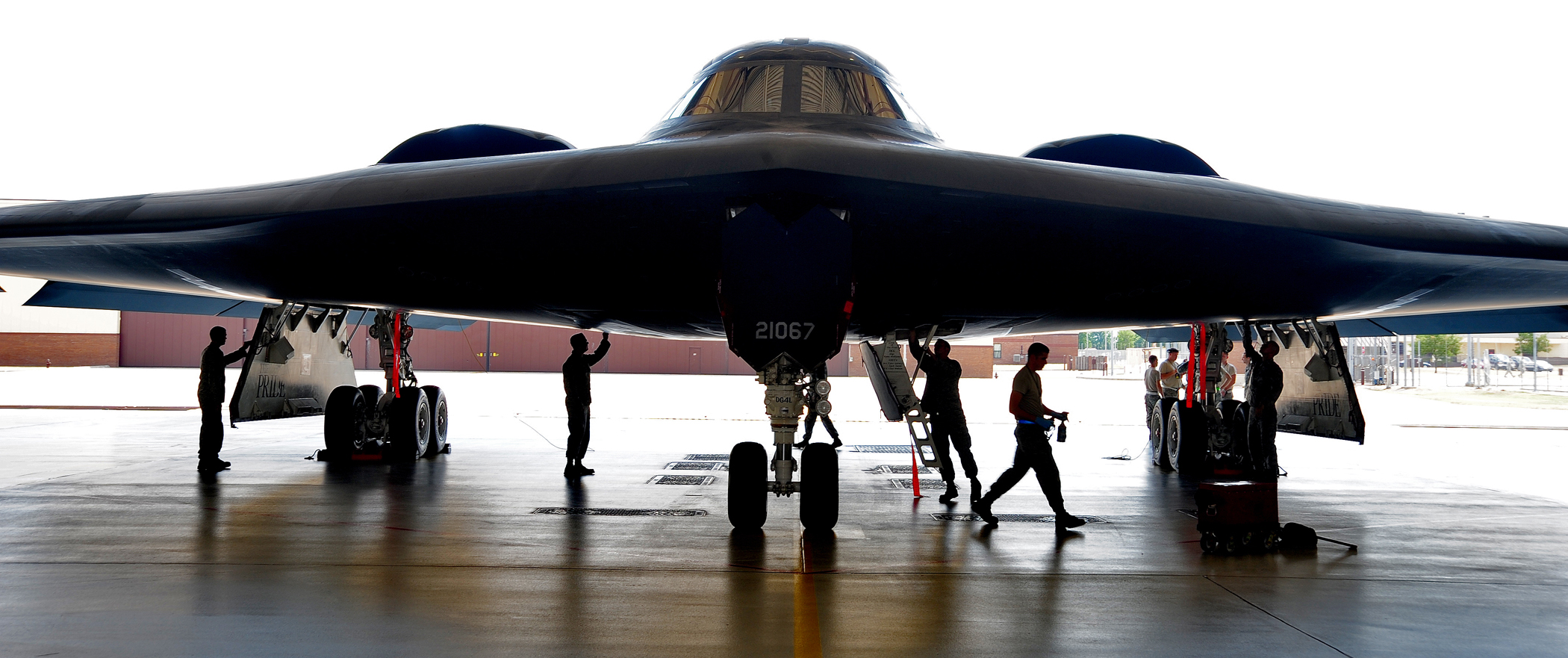
A force of five bombers was considered necessary to accomplish the required tasks in the five days before naval units arrived in-theatre. Ensuring that national interests were fairly met, the USAF deployed three B-2 Spirit aircraft. The RAF, relying on its Storm Shadow-equipped Tornado and Typhoon for strategic might, but with insufficient tankers available to support these essentially tactical warplanes, was forced to look for a longer-ranged alternative. The search quickly fell upon the final serviceable pair of Vulcans, latterly taken off heritage duties to plug part of the gaping whole left in the UK’s maritime patrol capabilities when Nimrod MRA4 was scrapped.

Both aircraft were deployed, along with a pair of Voyager tankers, while the USAF included three KC-135s to support its B-2 package. A combined force of ten aircraft was despatched on the basis that at least one would be airborne for the duration of the operation, but rendered reinforcement impossible.
The B-2 sortie rate was envisaged as three times that of the Vulcan, with the American jet’s range and the USAF’s more numerous tankers allowing two B-2s to be airborne simultaneously, while both Voyagers would be needed to support a single Vulcan mission. There could be no sharing of tankers – the KC-135’s underwing hose pods were unsuitable for the Vulcan, while the Voyager was not equipped with the flying boom required to refuel the B-2.
Operations Begin
Shortly before midnight on the eve of the campaign’s first day, a B-2 launched with a load of GPS-guided JDAMs. Using coordinates provided by overhead systems and confirmed by its onboard targeting system, the aircraft successfully prosecuted air defence targets in a swathe from the coast, inland towards the combined base.

Meanwhile, a Vulcan was airborne and running in at low level. The old machine’s inadequate ECM system was no match for a modern air defence network, but a high-speed, low-level approach was seen as an entirely valid tactic against the integrated air defence system. As the Vulcan’s crew neared the coast, they executed a pop-up to 500ft, but remained undetected, thanks to clever tactics based on the supposed success of the B-2’s earlier strike.
Aligning their ingress route for an attack on rebel forces at the base perimeter, they flew through the ‘safe’ corridor created by the Spirit. At the same time, they carefully adjusted the Vulcan’s track; its engine compressor faces and radar antenna were never allowed to come close to being perpendicular to any radar source and the aircraft remained undetected until it released its weapons. Twenty-one unguided, retarded bombs fell in a line across the rebel formation, two damaging the objective, three falling on the base and the remainder exploding in open ground at the base perimeter.
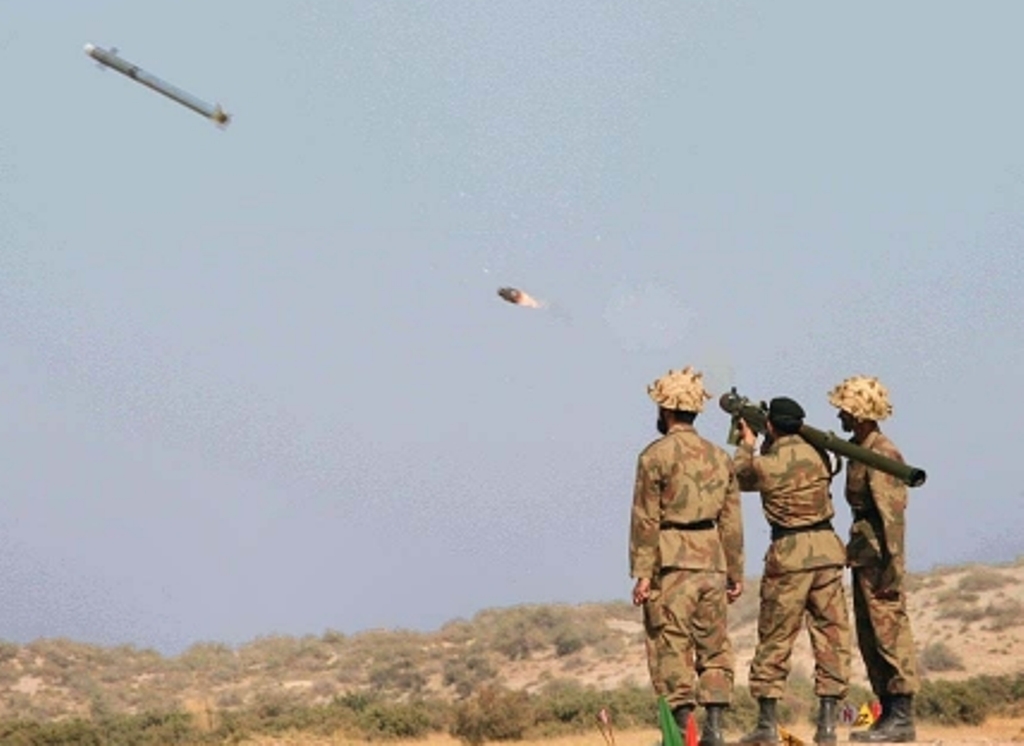
its low-level egress, the Vulcan attracted the attention of a shoulder-launched SAM. Unprotected against an IR threat, the aircraft was struck in its starboard outer engine, but through its shear bulk, survived to return on three engines. With considerable damage to its wing structure and defensive systems, the venerable bomber was out of the campaign.
Towards a Conclusion
As the damaged Vulcan returned to base, the second B-2 was airborne, striking further air defence targets and communications nodes. A third B-2 mission was deemed necessary before a second Vulcan raid was committed. This time the aircraft successfully scored three hits out of 21 bombs dropped on a rebel convoy moving towards the capital, halting its advance, before turning for home.
A severe hailstorm was clearing the area as the Vulcan approached to land. The B-2 crew ahead of it had been less fortunate. Forced to fly through the heart of the storm, they had badly compromised the stealthy finish of their bomber, even as similar, though less extensive havoc was wrought on the two bombers sitting on the ground. Without their dedicated support facilities, the B-2s were now committed to relying on their defensive aids suite for protection, since low-level operations were not within their remit.

Already compromised, the island’s defences were unable to counter the subsequent B-2 and Vulcan attacks. By now the force was down to a single B-2 and the remaining Vulcan, one B-2 airframe being too badly damaged to fly after recovering through the hailstorm and another entangled with a maintenance truck that skidded on the wet apron, wrapping itself around the aircraft’s port main undercarriage unit.
As the combined naval task force moved into position to retake the island by amphibious landing, a final combined strike by B-2 and Vulcan was launched to soften up defences around the landing sites. All five tankers launched in support, one KC-135 and a Voyager recovering as the bombers attacked. Egressing successfully, they searched for their remaining tankers, both taking fuel as they flew for home.

Soon after, however, the B-2 began experiencing power surges. Rapid analysis by the bomber and KC-135 crew determined that locally sourced fuel might have been contaminated with water. Fearing the worst, all three airborne tankers made immediately for base.
Flying as economically as possible, the bombers followed, their crews relieved to hear the tankers returning safely one by one. When the final tanker, a 65-year old KC-135, suffered a nose gear collapse on the single runway, the stakes were immediately raised.
There was no prospect of jacking the aircraft, extending the failed leg and towing it off the runway. Immediate action was required to recover the bombers. Base construction vehicles – an ancient bulldozer and a semi-serviceable tractor – were put to work, pushing and dragging the tanker clear, but as both circling bombers called fuel emergencies, rapid decisions had to be made.
Ditching both aircraft offshore was a possibility, except for concerns that the Vulcan’s three-person rear crew might have difficulty escaping the floating aircraft and would have little or no chance if it sank or broke up. None of them were sitting on ejection seats. Priority was given to the Vulcan. Its crew had to land and clear the runway immediately, making way for the B-2 to land in their wake.
With a final mighty effort, the bulldozer and KC-135 wreak cleared the runway. Seconds later, the Vulcan’s mainwheels hit the concrete. The old bomber rolled to a stop and shut down, too low on fuel to taxi. The combined groundcrew scrambled to tow the British jet clear, but a small boat was already on its way out to retrieve the B-2 pilots. They had successfully tested their ejection seats, abandoning the aircraft two miles offshore.
By Paul E Eden
Paul E. Eden has been editing and writing for aerospace publications since 1996. He writes for Aircraft Cabin Management; Airliner World; Aerospace, the journal of the Royal Aeronautical Society; Aerospace Testing International; andBusiness Jet Interiors International. He also edits for Aviation News and several book publishers. Paul is contributing editor of the acclaimed Royal Air Force Official Annual Review and Royal Air Force Salute.
You may also enjoy A B-52 pilot’s guide to modern fighters, Flying and fighting in the Lightning: a pilot’s guide,Interview with a Super Hornet pilot, Trump’s Air Force Plan, 11 Worst Soviet Aircraft, 10 worst US aircraft,and10 worst British aircraft
You may also enjoy Ten incredible cancelled Soviet fighter aircraft, Ten worst Soviet aircraft, Ten incredible cancelled military aircraft, Fighter aircraft news round-up,  11 Cancelled French aircraft or the 10 worst British military aircraft, Su-35 versusTyphoon, 10 Best fighters of World War II , Su-35 versus Typhoon, top WVR and BVR fighters of today, an interview with a Super Hornet pilot and a Pacifist’s Guide to Warplanes. Flying and fighting in the Tornado. Was the Spitfire overrated? Want something more bizarre? Try Sigmund Freud’s Guide to Spyplanes. The Top Ten fictional aircraft is a fascinating read, as is The Strange Story and The Planet Satellite. The Fashion Versus Aircraft Camo is also a real cracker. Those interested in the Cold Way should read A pilot’s guide to flying and fighting in the Lightning. Those feeling less belligerent may enjoy A pilot’s farewell to the Airbus A340. Looking for something more humorous? Have a look at this F-35 satire and ‘Werner Herzog’s Guide to pusher bi-planes or the Ten most boring aircraft. In the mood for something more offensive? Try the NSFW 10 best looking American airplanes, or the same but for Canadians. 10 great aircraft stymied by the US.Â

I transitioned to the Hun right out of UPT after flying the T-38. The T-38 was small, sleek, white and sexy. The Hun was, by comparison, huge, camouflaged, grimy and a workhorse. Best of all -it only had one engine and one seat. It was the most beautiful thing I had ever seen!
2. When did you fly it? With which units?
I flew the Hun (C/D/F) from 1973 to 1979 for about 1500 hours, mostly with the 178 TFG (Ohio) and 131 TFW (Missouri) Air Guard units.
3. What was the best thing about it?
It was an “honest†airplane with excellent control harmony and good visibility. It was simple and reliable.
4. What was the worst thing about flying it?
Pilots like to say the Hun invented adverse yaw, and one did have to be careful with lateral stick input at high AOA. Final approach speeds were relatively high (166 KIAS + fuel in the D; higher in the C). It was underpowered – like a lot of the early Century-Series airplanes – and we had two power settings: “not enough†(military power); and “just okay†(afterburner). It was hard to fly really well.
5. Was it an effective weapon system?
I never flew the Hun in combat, so I’m not the best one to ask. I have several friends who flew as “Misty FACs†(Forward Air Controller, a very dangerous mission) in South East Asia; I never heard them say a bad thing about the plane. In training missions, it was a stable bomb and gun platform.

6. Did you ever fly mock dogfights against any other types, what was this like and which types were the most challenging?
We were commonly called-upon to do duty as MiG-15/17/19 simulators and as training partners in DACT with more advanced fighters such as the F-4, F-14 and F-15. We often flew “canned†scenarios or profiles specific to another unit’s training requirements.
Occasionally, we’d get an opportunity to do anything we wanted. A “clean†Hun – even the heavier D model – could climb to above 45,000 and get up to Mach 1.3 in a shallow dive. No one looked for us up that high, and we could usually engage from above unseen – the first time. We could generally win a 1-vs-1 guns-only or rear-aspect missile fight against a hard-winged F-4 and break even against a slatted E, unless the Phantom pilot was very good (Ron Keys comes to mind) and didn’t fight our fight. Same with the F-14. Best tactic was to go single-circle, co-plane. We’d give up knots for angles and out-rate the other guy, who would honor your nose position and become defensive immediately. (I have 2000 hours in F-4C/D/E and know those airplanes pretty well.)
The F-15 was a superior airplane in every respect and it was rare you got the advantage on one unless the pilot was a doofus (and there were a few).

7. What three words best describe the F-100?
Honest, reliable, predictable.
8. What was your most memorable flight in a F-100?
14 hours in the cockpit / 12 hours flight time during a winter-time redeployment from Ramstein AB Germany to Richards-Gebaur AFB, Missouri. We strapped in and started-up, then shut-down and waited in the cockpit while our tankers at RAF Mildenhall fixed a problem. After we got airborne and mid-way across the Atlantic both tankers lost their drogues (equipment, not pilot error). We found another tanker – this one scrambled out of Canada – using UHF-ADF and Air-to-Air TACAN while IMC in 1 NM visibility conditions. When we finally joined with two more tankers we flew…and flew…and continued flying westward because the weather at every AFB east of the Mississippi was below landing minimums. (The F-100D didn’t have ILS at the time.)
I don’t think we ever saw groundspeeds in excess of 360 knots the entire route. Only if you have worn the old-style poopy suit* can you appreciate how enjoyable the last four hours of that flight was like.
Scotty Wilson built a flyable Bugatti 100P. Tragically he died flying it in 2016.
Thank you for reading Hush-Kit. Our site is absolutely free and we have no advertisements. If you’ve enjoyed an article you can donate here. At the moment our contributors do not receive any payment but we’re hoping to reward them for their fascinating stories in the future.
Have a look at 10 worst British military aircraft, Su-35 versus Typhoon, 10 Best fighters of World War II , top WVR and BVR fighters of today, an interview with a Super Hornet pilot and a Pacifist’s Guide to Warplanes. Was the Spitfire overrated? Want something more bizarre? The Top Ten fictional aircraft is a fascinating read, as is The Strange Story and The Planet Satellite. The Fashion Versus Aircraft Camo is also a real cracker. Those interested in the Cold Way should read A pilot’s guide to flying and fighting in the Lightning. Those feeling less belligerent may enjoy A pilot’s farewell to the Airbus A340. Looking for something more humorous? Have a look at this F-35 satire and ‘Werner Herzog’s Guide to pusher bi-planes or the Ten most boring aircraft. In the mood for something more offensive? Try the NSFW 10 best looking American airplanes, or the same but for Canadians.Â
First there was cinema, then 3D cinema..now at long last jet-a-sound!
I’ve matched aeroplanes to appropriate songs. The aircraft have been matched to songs which sum them up. The connection may be been an obvious one or maybe something more subtle.
Please add your suggestions to comments and I’ll include them to make the ultimate aircraft mix tape! BOOM!
It’s a simple game:
1. Turn down the volume on the plane clip
2. Turn up the volume on the song clip and start playing it.
3. Watch the plane clip.
Convair B-58 Hustler
Hustler song clip
Hustler plane clip
Messerschmitt Me 163Â Komet
Me 163 plane clip
Me 163 song clipÂ
Lockheed ConstellationÂ
Constellation plane clip
Constellation song clip
Blohm & Voss BV 141
BV 141 Plane clip
BV 141 song clip
de Havilland CometÂ
Comet plane clip
Comet song clip
Sukhoi ‘Flanker’
‘Flanker’ plane clip:
song clip
Lockheed Martin F-22 RaptorÂ
Plane clip:
song clip
Gloster Javelin
Plane clip
Song clip