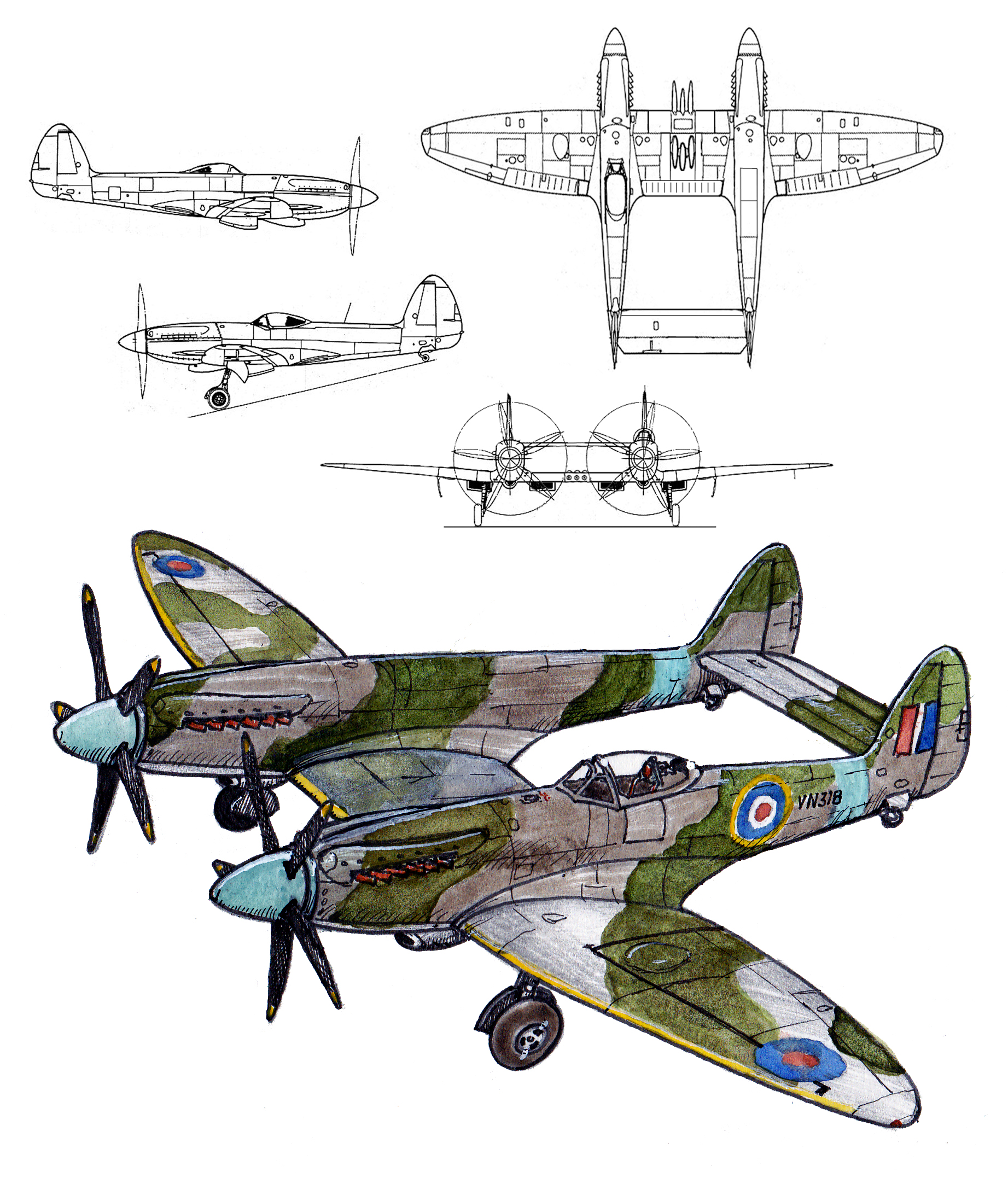
The Twin Spitfire

Image

Save the Hush-Kit blog. This site is in peril, we are far behind our funding targets. If you enjoy our articles and want to see more please do help. You can donate using the buttons on the top and bottom this screen. Recommended donation £10. Many thanks for your help, it’s people like you that keep us going.

Want to see more stories like this: Follow my vapour trail on Twitter: @Hush_kit

Thank you for reading Hush-Kit. Our site is absolutely free and we have no advertisements. If you’ve enjoyed an article you can donate here. 

Initially intended as a very long-range escort fighter, the Twin Spitfire was designed to escort ‘Tiger Force’ Avro Lincoln bombers to Japan, missions beyond the range of any conventional RAF fighter. It was also seen as an alternative to the de Havilland Hornet should that aircraft prove unsatisfactory for its intended role in an ‘island-hopping’ campaign in the Pacific theatre.

Supermarine’s design team under Joe Smith developed a remarkably simple conversion consisting of two standard late production Spitfire Mk 22 fuselages and wings joined by a constant chord centre section and tailplane and with the cockpit removed from the right hand fuselage. Unlike its American counterpart, the P-82 Twin Mustang, the Twin Spitfire was a single seat aircraft, reflecting a peculiar British meanness with personnel and maximisation of offensive potential. The absence of the second cockpit and associated equipment made for a very great increase in fuel capacity and the range capability of the new aircraft was unprecedented. When external fuel tanks were added (the wings were equipped for drop tanks) the aircraft’s endurance effectively exceeded that of the average pilot.

Performance

With double the available power of a standard late-model Spitfire but less drag and lighter weight the performance of the new aircraft was outstanding. Maximum speed was 495 mph at 21,000 feet and the rate of climb and acceleration were similarly impressive. Although agility was not in the same league as the standard Spitfire, the aircraft was considered nimble for its size. A less desirable quality was the amount of torque generated by the two Griffons. With less wing area per engine relative to a standard Spitfire; the Twin Spitfire was infamous for swing on take off. Both the F-82 and the Hornet were equipped with ‘handed’ engines to negate torque effects but the Twin Spitfire was never so-equipped and pilots were required to apply full opposite rudder (even with the larger vertical surfaces developed for the Spiteful) and refrain from using full throttle until the aircraft was safely in the air.

Armament

Armament was, surprisingly, reduced in comparison to the Mk 22 Spitfire. Three 20mm cannon were mounted in the centre section of the wing, it being considered that the concentration of these weapons on the centre line of the aircraft increased the effectiveness over the standard four cannon dispersed outboard in the wings. This also allowed for a useful increase in ammunition capacity for each weapon. Later marks were developed to carry underwing ordnance for the strike role.

Operational History

The atomic bombing of Nagasaki and Hiroshima occurred as the first two Twin Spitfire squadrons were working up. Tiger Force was never deployed and the aircraft did not see operational service during World War Two. Orders for the type were slashed, though its relative ease of production due to the large levels of commonality with the Spitfire combined with the obvious merits of its performance (the aircraft was superior in speed, range and disposable load to the Gloster Meteor) meant that production did go ahead though in relatively modest numbers. The first Twin Spitfire F.Mk 1 squadron, was declared operational on the 1st of December 1945 and was deployed to Germany as part of the occupation forces in the spring of 1946, two more squadrons working up on the type throughout that year. Notwithstanding its handling quirks, the aircraft was generally popular with pilots as its blistering performance made it more or less the most potent aircraft in service in the immediate post war era. It is said that ex-Beaufighter pilots were particularly fond of it as the handling problems of both aircraft were similar but the Twin Spitfire’s levels of performance and agility were markedly superior.

Later marks adapted for the night fighter, ground attack and reconnaissance roles were speedily developed and produced.

An early problem with regard to the operational employment of the aircraft was identified almost as soon as it entered service. The pilot, sat in the left hand fuselage, had a largely unobstructed view to the left but his view to the right was severely compromised by the second fuselage and broad chord centre section of the aircraft. A few individual aircraft were modified at unit level to swap the fuselages and produce a ‘right hand drive’ version, which would invariably be detailed to fly on the right flank of any formation. Eventually right handed Twin Spitfires entered series production alongside their left handed brethren, though they were always something of a rarity. Similarly aircraft with a cockpit in both fuselages were produced, allowing for a radar operator to be carried in the Night Fighter version, a student in the training variant, and a winch operator for the target tug.

 Korea

Seeking a presence for itself over Korea during the escalating conflict, the RAF deployed a squadron of Twin Spitfire FB Mk 2s to Kimpo airfield (shared with RAAF Meteors) in 1951. The spectacular range and loitering capability of the aircraft was intensely attractive for close air support purposes and though no longer competitive in pure speed terms when compared to the latest jet fighters, the Twin Spitfire could still compare fairly favourably with the F-80 Shooting Star and was expected to be able to outmaneouvre any North Korean fighters that might be encountered. As it turned out this was to be the Twin Spitfire’s moment of glory. On the 4th of August 1952, Twin Spitfires dove on two Mig-15s and destroyed them both. A fortnight later they repeated the feat and the Twin Spitfire became one of the very few piston engined types to destroy a jet fighter in air to air combat.

Later Service 

For most of its operational life the Twin Spitfire was regarded as a tactical aircraft for strike and ground attack tasks. It operated in concert with Hornets over Malaya and appeared briefly over Suez in a single photographic sortie from a base on Cyprus. Long after this the aircraft served as a target tug, the drogue and winch being carried in a large fairing under the centre section. A few drone controller aircraft were in use until 1962.

Hush-Kit is reminding the world of the beauty of flight.

follow my vapour trail on Twitter@Hush_kit.  If you enjoyed this, you may also enjoy ‘A pacifist’s guide to military aircraft

Do you have an idea for a Hush-Kit article you would like to write? Contact: hushkiteditorial@gmail.com

Variants

Supermarine Type 493:   Prototype, 2 constructed.

Twin Spitfire F Mk 1:  Initial production version, long range escort fighter, 134 built.

Twin Spitfire F Mk 1(r):  As above but produced with cockpit in right hand fuselage, 32 built.

Twin Spitfire FB Mk 2:  Equipped for underwing ordnance and epitomised for the ground attack role, 203 built.

Twin Spitfire PR 3:

Reconnaissance version, 8 built, 15 converted from F Mk 1.

Twin Spitfire NF 4:  Night fighter, 58 built.

Twin Spitfire TF Mk 5:

Trainer variant, 35 built, 30 conversions from FB Mk 2.

Twin Spitfire TT Mk 6:

Target tug, 90 produced – all conversions from FB Mk 2.

Save the Hush-Kit blog. This site is in peril, we are far behind our funding targets. If you enjoy our articles and want to see more please do help. You can donate using the buttons on the top and bottom this screen. Recommended donation £10. Many thanks for your help, it’s people like you that keep us going.

Want to see more stories like this: Follow my vapour trail on Twitter: @Hush_kit

Thank you for reading Hush-Kit. Our site is absolutely free and we have no advertisements. If you’ve enjoyed an article you can donate here. 

Have a look at How to kill a RaptorAn Idiot’s Guide to Chinese Flankers, the 10 worst British military aircraftThe 10 worst French aircraft,  Su-35 versus Typhoon10 Best fighters of World War II top WVR and BVR fighters of today, an interview with a Super Hornet pilot and a Pacifist’s Guide to Warplanes. Was the Spitfire overrated? Want something more bizarre? The Top Ten fictional aircraft is a fascinating read, as is The Strange Story and The Planet Satellite. The Fashion Versus Aircraft Camo is also a real cracker. Those interested in the Cold Way should read A pilot’s guide to flying and fighting in the Lightning. Those feeling less belligerent may enjoy A pilot’s farewell to the Airbus A340. Looking for something more humorous? Have a look at this F-35 satire and â€˜Werner Herzog’s Guide to pusher bi-planes or the Ten most boring aircraft. In the mood for something more offensive? Try the NSFW 10 best looking American airplanes, or the same but for Canadians. 

THE ULTIMATE WHAT-IF: The cancelled SUPERMARINE SPITFIRE progenitor

Image

 Just as the Messerschmitt Bf 109 was derived from the civil Bf 108 Taifun so the Spitfire was derived from the four seat cabin monoplane Supermarine Typhoon. First flown in 1935 the Gypsy Major powered Typhoon achieved a remarkable performance due to its fine aerodynamics. The sole example was written off barely two months after the first flight when chief test pilot ‘Mutt’ Summers forgot to lower the undercarriage on landing. The projected high price and complicated construction coupled with Supermarine’s increasing preoccupation with Spitfire development doomed the project and the attractive Typhoon was destined to remain an intriguing example of what might have been had war clouds not threatened.

If you enjoyed this, you may also enjoy: http://hushkit.net/2012/06/27/the-ultimate-what-if-the-supermarine-jetfire/

What-if: The Griffon-engined Hawker Hurricane Mk XIV

Following Vickers decision to rationalise its aviation interests and close the Supermarine design office in 1936, the RAF’s high performance fighter needs were served purely by the Hawker Hurricane. The Mk XIV was developed as a matter of urgency following the cancellation of the Typhoon programme in 1942 due to insuperable aerodynamic problems and the simultaneous failure of the Napier Sabre to mature into a viable powerplant.

Hawker had no choice but to look to the proven Hurricane airframe and the Rolls-Royce Griffon. The Centaurus was considered but marriage of the radial engine to the slender Hurricane fuselage was rejected as too complicated. Along with the engine change, aerodynamic and practical improvements were made to the airframe. Cutting down the rear fuselage proved relatively simple due to its steel tube and fabric construction, stability was retained by use of a large fin fillet. The tailwheel was arranged to retract into the ventral fin and the large radio mast was replaced with a simple whip aerial, further reducing drag.

Armament was unchanged from the Merlin Hurricane though the new aircraft benefited from a cleaner gun barrel fairing for its four 20 mm Hispanos.

If you enjoyed this check out the Super Lightning

Hush-kit is reminding the world of the beauty of flight.

follow my vapour trail on Twitter: @Hush_kit 

Thank you for reading Hush-Kit. Our site is absolutely free and we have no advertisements. If you’ve enjoyed an article you can donate here. At the moment our contributors do not receive any payment but we’re hoping to reward them for their fascinating stories in the future.

The BAC TSR.2: Bombing the myth

ImageGive a British aviation enthusiast more than two pints and he will invariably tell you the story of TSR.2. This tale of an axed nuclear bomber will be told to you in a far more tender tone than he used to talk about his family. This bar room lecture will climax in an angry rant at the crass, penny-pinching government that killed Britain’s flying dreams. 

The story goes: Britain produces a world-beating aircraft, technologically superior to anything else- a fast, long ranged, survivable strike aircraft. A foolishly short-sighted Labour government cancel it. The British aircraft industry was already in terminal decline from Duncan Sandys’ mad announcement of the end of manned aircraft in 1957. The killing of TSR.2 was the final act of vandalism, leaving the industry that had given the world the Spitfire, the Hurricane and Hunter to wither and die.

This idea was fed to me from the rather good Take-Off magazines I read as a child. The story is a compelling one, it reaches into the recesses of the British psyche. It plays to the heart of a faded colonial superpower and affectionately pats the chip that sits on many British (particularly English) men’s shoulder.

‘You could have been the best, if only…’ is a powerful sentiment, and always reassuring, as it can’t be disproved. The only problem with the TSR.2 story is the foundations it rests upon are very shaky. Let’s imagine a world where TSR.2 was not cancelled in 1965….

 A World where TSR-2 was not cancelled

Several events conspired to save the TSR.2 from cancellation. The replacement of the MoD chief scientific advisor Solly Zuckerman (inventor of both the helmet and ‘folly’ of the same name’) certainly helped. Zuckerman, a fierce opponent of TSR.2, quit in 1964 amid allegations that his personal beliefs regarding nuclear weapons were affecting his professional decisions. With the appointment of a new, pro-TSR.2 advisor, things were looking brighter for the ‘white bomber’, which took to the air on 27 September 1964 confounding the critics with its superb performance.

Meanwhile, backroom dealings between the Royal Navy and the RAF were taking place. This unusually cordial discourse took place amid fears that inter-service squabbling could see the end of funding to both air carriers and manned land-based bombers. Though by this time RAF fears that the subsonic Buccaneer would be forced on them in place of TSR.2 were dispelled, it was clear to both services that the effectiveness of future nuclear-armed submarines threatened traditional ideas of how big air forces and navies needed to be.

Click here for the story of the Hawker P.1154, Britain’s cancelled superfighter

The Ferranti company was found to be grossly overcharging for  Bloodhound missiles (surface-to-air missiles designed to defend V-bomber and Thor missile bases) and this scandal led to big questions being asked about the survivability of V-bombers in a full-scale war and lead to further support of the TSR.2. Meanwhile Prime Minister Wilson’s commitment to ‘ the White Heat’ of technology, saw R&D investment increase (though initially only for civil aircraft projects). As money poured into Concorde, the coffers were also opened for TSR.2.

However, the development of TSR.2 was proving to be a nightmare.  The highly advanced avionics system caused huge delays and saw the price of the project sky-rocket. To survive against the world’s biggest integrated air defence network, the bomber would use a combination of speed, electronic counter-measures and flight profiles below enemy radar. To safely fly at speeds approaching Mach 1 at 200 ft,  in the murk of Northern European weather or at night would require a new technology.

UK electronics giant Ferranti was charged with developing the world’s first terrain following radar (TFR) for TSR.2, which it had been working on since 1958. It initially made excellent progress, flying successful trials in its test Dakota and Canberra (WT327). The radar was first fitted to a TSR.2 in late 1965. Initial tests concentrated on testing the radar at low level (200 ft) at speeds approaching the speed of sound, it been flown this low before, but not at these speeds.

The severe vibration proved too much for the pioneering radar and Ferranti went to back the lab to start a virtual redesign. This meant that TSR.2 entered service without its most vital sensor- the radar. After soaking up millions of pounds in, the Ferranti TFR was eventually cancelled, and the UK turned to the US company Texas Instruments to provide the TFR.

It wasn’t just the avionics that were causing problems, BAC itself had issues. The British Aircraft Corporation, formed in 1960, was a forced merger of English Electric Aviation Ltd., Vickers-Armstrongs (Aircraft), the Bristol Aeroplane Company and Hunting Aircraft. Though the company had one name, BAC was still a patchwork quilt of different, often incompatible cultures. The pressure of TSR.2 development made the already fragmented world of BAC even worse, with arguments over factory work-share and work practice leading to drawn-out industrial debates, and in early 1968, the infamous strike.

The USA strikes back

The RAF had ordered 300 TSR-2s, and the type entered service in 1969. Confident in the aircraft’s abilities, Britain was actively marketing the aircraft to several nations including Australia and Iran. This alarmed the US aerospace industry, fearful of a new contender in the fiercely competitive export market. The closest US aircraft was the F-111, which was not receiving much export interest, being seen as too expensive and complex (many air arms were also put off by its initially poor performance over Vietnam), others saw it as inflexible, as it could not perform the fighter mission. Due to its advanced nature, export limitations where also in place. McDonnell Douglas responded with a ground attack optimised F-4 Phantom II in the early 1970s. Primarily aimed at the European market, this impressive aircraft was fitted with TFR, FLIR and a laser target designator. A fuselage ‘plug’ and uprated engines gave the new Phantom impressive range/payload performance. The aircraft was dubbed ‘Strike Phantom’. The US mounted a covert anti-TSR.2 campaign, sowing doubt on the type’s maturity and highlighting the growing cost. Strike Phantom were sold to Italy, West Germany and Iran (which used them to great effect in the Iran-Iraq War). Meanwhile the TSR.2 was struggling to achieve its first export sale. Compared to the Strike Phantom, TSR.2 was big, very expensive, hard to maintain and lacking a laser-guided bombing capability.

The big tree that took all the sunlight

With TSR.2 going ahead the Anglo-French AFVG (Anglo-French Variable Geometry) aircraft, a swing-wing carrier compatible fighter (for interceptor, tactical strike and reconnaissance roles), was discontinued. In turn the UKVG was also not proposed and so did not lead to MRCA, which would have grown into Tornado. With the future of  the ground attack mission safely in TSR.2’s hands, the Anglo-French Jaguar went back towards its Taon roots, becoming a small (marginally supersonic) trainer with next to no offensive capability. The Jaguar’s success as a trainer meant the Hawk was never built. Without the collaborative base of Panavia, attempts by various European companies to start work on a new fighter in the 1980s failed to gain momentum, and the Typhoon never was.

Though in many ways a capable aircraft, TSR.2 was ultimately the aircraft that killed both Britain and Europe’s warplane industry and left it dependent on the United States.


TSR.2 Timeline

First flight 27th September 1964.

In 1968 TSR.2 was named ‘Tornado’

The TSR.2 entered service on April 1st 1969 in interim TSR.Mk 1 standard.

Upgraded to definitive Tornado TSR.Mk 2 standard with fully functioning Texas Instruments TFR in 1978.

Two TSR.2s crashed on the infamous failed ‘White Buck’ mission against Argentina in 1982.

TSR.2s were suggested for US attacks on Libya 1986, but declined for political reasons. Upgraded in 1986 to Tornado TSR.Mk.3, TSR.Mk.3A (recce) and TSR Mk.3B (anti-shipping with Sea Eagles) standard. UK buys 165 F-15F Eagle (enhanced two-seat F-15C fitted with Sky Flash and radar upgrade) in 1986 to replace Lightning and complement F-4 fleet.

During Desert Storm the large low-flying TSR.2 (with its significant IR signature) proved vulnerable to SAMs, 8 lost (of 30 sent) to enemy, 4 lost in accidents.

Fatigue problems and increased attrition rate causes a search for a replacement.The US offered F-15E and second-hand F-111s, France offered Mirage 2000D/N derivative with UK systems, Sweden offered upgraded AJ 37 Viggens. After prolonged procurement assessment the F-15G was chosen in 1994 (124 ordered). The F-15G features UK ECM equipment, weapons and Martin-Baker ejection seats.  The F-15G entered service in 1998, Tornado TSR.2 was withdrawn from attack role in 2000 (after Balkans deployment). 12 recce versions upgraded to TSR.2.Mk 4As standard and remained in service until 2004, used in Afghanistan.

2012 RAF fast jet fleet: 110 F-15Fs, 100 F-15G(UK).

If you enjoyed this, check out our exclusive article on Britain’s P.1154 STOVL fighter: http://hushkit.net/2012/07/20/the-hawker-p-1154-britains-supersonic-jumpjet/ and remember to donate if you’d like to.


safe_image.jpg

“If you have any interest in aviation, you’ll be surprised, entertained and fascinated by Hush-Kit – the world’s best aviation blog”. Rowland White, author of the best-selling ‘Vulcan 607’

I’ve selected the richest juiciest cuts of Hush-Kit, added a huge slab of new unpublished material, and with Unbound, I want to create a beautiful coffee-table book. Pre-order your copy now right here  


TO AVOID DISAPPOINTMENT PRE-ORDER YOUR COPY NOW

From the cocaine, blood and flying scarves of World War One dogfighting to the dark arts of modern air combat, here is an enthralling ode to these brutally exciting killing machines.

The Hush-Kit Book of Warplanes is a beautifully designed, highly visual, collection of the best articles from the fascinating world of military aviation –hand-picked from the highly acclaimed Hush-kit online magazine (and mixed with a heavy punch of new exclusive material). It is packed with a feast of material, ranging from interviews with fighter pilots (including the English Electric Lightning, stealthy F-35B and Mach 3 MiG-25 ‘Foxbat’), to wicked satire, expert historical analysis, top 10s and all manner of things aeronautical, from the site described as:

“the thinking-man’s Top Gear… but for planes”.

The solid well-researched information about aeroplanes is brilliantly combined with an irreverent attitude and real insight into the dangerous romantic world of combat aircraft.

FEATURING

        • Interviews with pilots of the F-14 Tomcat, Mirage, Typhoon, MiG-25, MiG-27, English Electric Lighting, Harrier, F-15, B-52 and many more.
        • Engaging Top (and bottom) 10s including: Greatest fighter aircraft of World War II, Worst British aircraft, Worst Soviet aircraft and many more insanely specific ones.
        • Expert analysis of weapons, tactics and technology.
        • A look into art and culture’s love affair with the aeroplane.
        • Bizarre moments in aviation history.
        • Fascinating insights into exceptionally obscure warplanes.

The book will be a stunning object: an essential addition to the library of anyone with even a passing interest in the high-flying world of warplanes, and featuring first-rate photography and a wealth of new world-class illustrations.

Rewards levels include these packs of specially produced trump cards.

Pre-order your copy now right here  


I can only do it with your support.