Ten Reasons I loved Flying The Sea Harrier FA2

“Have a look at number two’s flaps. They are UP not at MID like the rest of ours. Silly boy. I was number 3.”

Paul Tremelling flew the ultimate Sea Harrier, the formidable FA2, with Britain’s Royal Navy. This Cold War naval fighter was equipped with some of the most capable weapons and sensors in the world, and proved a dangerous opponent to those who underestimated the tenacious little jump-jet. As Paul explains, the Sea Harrier could also bite pilots who didn’t handle it with due care. Deadly, unique and characterful, those who flew the Sea Harrier inevitably fell in love with it. Here Paul shares ten fascinating reasons why he loved flying what was affectionately known as the ‘SHAR’.

“…if you flew a Sea Harrier in the speed band of 30-120 knots, with sideslip  – the jet had a little treat for you. It flipped over and you died.”

10. The boat

I know, it’s a ship. I said it just to annoy the people who get annoyed by that sort of thing. Going to the ship is special. It’s a heart-warming experience finding a slate grey bit of the UK bobbing around on the sea. Especially when your fuel plan allows you for not much more that ‘find ship and land’ at the end of a tactical rough and tumble. The only issue with a ship being our base was that absolutely everything became harder. It moved, in the sense of not being where it was supposed to be 100% of the time. It moved, in the sense of it would actually be pitching, heaving and rolling (and yawing) when you were trying to land on it. But it was home and it made us (almost) unique. It’s probably impossible to be almost unique. Being in the ship made things harder. It was harder to move between briefing rooms, it was harder to make phone calls to coordinate with other assets. It was harder to find your immersion suit. But it was also the most exciting form of ‘fast jet’ aviation available to a British pilot and it made you good at what you did. It put you in a variety of corners and offered you a simple choice – cope or be gone. There were plenty of differences to operating ashore that seem obvious but you did need to learn them. Things like having your ejection seat live whenever you were in the aeroplane. This wasn’t a thing at an airfield because the chances of you falling off an airfield and into the sea whilst strapped to a jet are minimal or nil. If you pitch up at an airfield either before or after your allotted landing time it is doubtful that you’ll have messed up the entire day for everyone who works there – that’s possible on a ship! There is also the much misunderstood notion of being amongst a platform’s primary outputs. This should not result in arrogance. This should result in humility and a desire to get things right. If a whole ship’s company is there to put you into the battlespace (repeat – amongst other key tasks) you had better not screw it up!

9. The AIM-120 Advanced Medium-Range Air-to-Air Missile

The Advanced Medium-Range Air-to-Air Missile was, and remains, your best bet for coming home alive if you happen to get into an air-to-air engagement with someone else. It is on the one hand the weapon that sets the standard for all others and, because anyone who was sensible bought them, it is also the currency medium-range weapon of the free world. The Sea Harrier got it a little before everyone else and it was perfectly integrated into the machine. It seemed to have a holy marriage with the Blue Vixen and could be used to bring pain to the enemy in any weather by day or night. It is the AIM-120 and Blue Vixen combination that took the Falkland era FRS Mk 1 which was a simple jet with moveable nozzles – to the FA2 standard which was a decent air defender. The real joy of the Sea Harrier setup was that most aircraft at the time were used to enormous amounts of energy being needed to guide weapons onto them. This allowed them to use their warning receivers to detect weapons being launched at them. Not the Blue Vixen and AMRAAM combo. Sadly [or happily] never used in combat by the UK.

Pre-order The Hush-Kit Book of Warplanes here

8. The corners

There would be no real point in mastering a jet which didn’t need to be mastered in the first place. Part of being the pilot of a British machine was to acknowledge and overcome its shortcomings (one day we’ll invent something foible-free) or to avoid them altogether. The Sea Harrier had a couple of corners one had to avoid. It might sound a little far-fetched – but if you flew a Sea Harrier in the speed band of 30-120 knots, with sideslip, i.e. not going straight forward and with a raised angle of attack – the jet had a little treat for you. It flipped over and you died. Full stop; unless you were very quick at getting rid of one of those three conditions. You could fly around all day with two out of the three and be safe as houses – but all three brought doom, and quickly. Similarly, if you wanted a relaxing day at the office you knew how much fuel and water could be on board for the jet to hover and you never attempted to see what happened above those weights. Simple answer – a crash. The jet was actually quite good at telling you whether or not you could hover as the power the engine was developing as you passed 100 knots decelerating could give you an accurate estimation of that needed to hover. The last thing to be avoided at all cost was to go anywhere near the ramp without first having done the calculations to determine minimum and maximum deck run. If you tried to go from less than the minimum then you crashed. If you went from beyond the maximum it caused the nose wheel to collapse and, well, you crashed. Knowing and avoiding these corners was, in many ways, what being a Sea Harrier pilot was all about – bending this fabulous machine to your will!

7. The ramp

Let’s be honest, few people understand VSTOL, fewer people understand VIFF, fewer still understand the ramp. Think of it as a ballistic throw that allows you to accelerate on a runway that isn’t there. There were a couple of things to get right going off the ramp. As we mentioned above there was a maximum and minimum deck run that needed to be calculated on every launch. This would depend on aircraft weight, air temperature/pressure and individual engine performance. It would result in the two distances – and the nozzle setting to be used, snatched in by the left hand at ramp exit and also the tailplane setting. If you had a very short run the ramp looked like a wall in front of you. The minimum deck run was 200 feet. Any shorter and the engine would not spool up in time as you launched.

Early ramp test with Sea Harrier FRS.1 carried out on land.

On the boat, the technique was relatively simple and once all other procedures had been followed and the launch was ordered by the ship and one had been shown a green flag – it really was just a case of waiting. Waiting for the ramp to be going down through the far horizon before a smart slam to full power. By holding the brakes it was possible to momentarily delay travel to check that the engine appeared to be fine, before the aircraft skidded and it was time to release the brakes and go! The pilot pointed at the centre of the ramp, which by this time would be going back up and snatched in nozzle as jet parted company with ship. At night this took you from dim light to abyss in a heartbeat. A pretty cool way of defeating gravity. Whilst we’re on the subject – night approaches to the ship in a VSTOL fighter, without any night vision aid – is about as high end as it gets.

This site is facing a funding shortage and may pause or shut down in June, please consider donating. Our site is absolutely free and we want to keep it that way. If you’ve enjoyed an article you can donate here. Your donations keep this going.

This wasn’t just any old club. This was a club that was forged in a pretty gnarly furnace called combat. It was a club whose everyday business was single-seat flying from aircraft carriers. It had a heritage that harked back to one of the modern world’s most decisive air power results – the besting of everything that Argentina could throw at the Task Force. Sure, there are modern and accurate examinations of the war that throw new light on the efficacy of the Argentine attack – and yes the main attribute of the Sea Harrier itself was that it was there. But the Royal Navy and RAF aircrew who fought in the Falklands conflict and the maintenance personnel who gave them jet after serviceable jet – set a tone and an expectation that the community carried forward for its whole service life. This did lend itself to some of the training becoming a little bit of a rite of passage – but who would want to join a club that didn’t have some form of barrier to entry? Who would let sub-standard applicants into a club they cherished? Perhaps club is the wrong term, perhaps ‘community’ is a better one. Whatever we decide it doesn’t really matter – what mattered was that one way or another you were thought of as being connected to some amazing aviators, maintainers and other squadron personnel – who gave a land-based air force and its maritime sister service a kicking the world will never forget. 5000 miles away from home, operating from two smallish aircraft carriers. Every day as a Sea Harrier pilot is your job was to be a worthy successor to them.

Listen to The Hush-Kit podcast (episode features Al Murray discussing the Westland Whirlwind) here

6. Vectoring in Forward Flight (VIFFing)

 If V/STOL (see below) was about using the nozzles to take off and land efficiently, Vectoring In Forward Flight was the science/ art of using them to increase the combat effectiveness of the aircraft. Combat effectiveness is really only made up of two things. Lethality and survivability. In air-to-air combat it’s all about getting a weapon off at your adversary, from a position that it will actually work – whilst denying him/ her the chance to do the same. VIFF is, on the face of it, quite simple and is about moving the nozzles, whilst in flight, to point the thrust somewhere other than straight back. The nozzles could be used to bring the nose to bear when aerodynamic forces had already given their all. They could also be used to tighten turns towards an enemy and deny them a shot opportunity by giving them a massive closure problem to deal with. One could slow down rapidly with one big movement of the nozzles or use them in small ‘bites’ to gain a little advantage at a time. Again the nozzles were controlled using the simple lever on the left-hand side of the cockpit. If jet combat is quite a trial on the body, eyesight, inner ear and various other human bits and pieces – the injection of vectored thrust adds a further degree of brutality. What usually happened with nozzles was that people used them in a cycle. An application of nozzle would give you an advantage in a fight, for example using them fully forward to kill your speed and getting an adversary to overtake – straight into your missile envelope. This momentary success would result in a couple of months of nozzle-use in every fight. Some of these would give the user no advantage whatsoever as they bled energy off the jet, so had to be used judiciously. At some point the evil forces of over-use and complacency would coalesce and – in exactly the same situation as they proved so useful before – the nozzles would bite you, and hard. Nozzles had to be used sensibly and had a couple of handling instructions such as ‘Ease off the back stick before applying’. If this advice wasn’t heeded the jet would flick and start tumbling through the air. This was termed a departure from controlled flight. A good departure was a little eye-watering and would put you off nozzle use for a little bit. But then a day would come when a little VIFF was required – it would go well and the cycle could start again.  

5. Vertical/ Short Take-Off Landing

V/STOL. It has to be acknowledged that V/STOL never killed any bad guys – and was at least partially responsible for a few accidents along the way. The trick with Vertical/ Short Take Off and Landing was to maintain a healthy balance between familiarity and skill fade. To never allow fear or complacency to creep in. Thus the Sea harrier driver could take off vertical, almost vertically, using a short take-off technique – all of which used the nozzles; or indeed just do without them and take off like a normal aeroplane using aft stick at the correct speed. The number of different take-off techniques was matched by a similarly broad means of landing. All the way from the heart-pounding Conventional Landing which tended to be very fast – to the vertical landing we always used at the boat. A good example of which had a firm, but not teeth-chattering arrival at the far end. All these techniques relied upon the elegantly simple nozzle lever which deflected the nozzles from straight back, to 19 degrees forward. Somewhere at the heart of these was the ability to hover. To sit on a stack of air and, whilst monitoring thrust and precious little fuel, delight in having bucked a major law of physics using the amazing Pegasus engine. Like the Blue Vixen another masterpiece of engineering. At home in the hover, comfortable at 500 knots, able to cope with savage accelerations and decelerations if the Blue Vixen was the brains of the show – the Pegasus was a Harrier’s beating heart.

4. The Blue Vixen radar

British engineering has had a patchy history. One of the undoubted highlights, if not the zenith of our achievements is the Blue Vixen as fielded by the Sea Harrier FA2. It is quite hard to summarise briefly so I will use one word: Superb. The radar was easy to use, the switches were intuitive and the display simple. We used to compare it to US systems which I have since used – and I learned that it was streets ahead of them. It had a high enough power output to form tracks on adversaries at decent ranges – but was sufficiently subtle to go unnoticed too. As one of the first radars that didn’t need to illuminate a target to guide a missile onto its prey – this caught out quite a few exercise foes. The radar had an extraordinary capacity for showing multiple tracks at once and really only needed a single mode for an entire intercept which made it simple but effective. In slightly geeky radar speak it used the correct emissions to get the best results depending on whether it was looking up or down. It could be used in the visual arena to cue a Sidewinder onto a target when ‘in close and personal’; it could be used for a ‘self-talk down’ to the boat; it could be used to tighten up the bombing solution or to upgrade the gunsight. Fabulous system.

via @rowlandwhite/Twitter

3. Multirole

Everything in aviation is a compromise. Even the machines that don’t look like compromises are at some level – maybe in capability, possibly in the development budget. The Sea Harrier could make a fist of most roles including attack, reconnaissance and air defence. The nomenclature has changed over time but the essence of the missions hasn’t. The motto of the Sea Harrier headquarters Squadron, 899 Naval Air Squadron was Strike and Defend for good reason. For a significant part of its history, the Sea Harrier possessed the UK’s most potent air-to-air weapon in AMRAAM and its most potent anti-shipping weapon in Sea Eagle. It could also drop dumb bombs, with a weapon aiming system which was actually pretty accurate and the jet could be armed with cannon. It couldn’t do many of these roles at once – but few platforms throughout history have been able to. Almost forgot – it did have a decent, if basic reconnaissance camera – used in the Falklands, the Balkans and in Sierra Leone. The multi-role nature of the jet was reflected in the training, meaning that you had to stay up to speed on numerous roles and weapons. In peacetime there are few sorties as rewarding as fighting through an air threat, to deliver air-to-surface stores before doing the same again to get back to the boat.

2. Single-Seat Cockpit

Flying a single-seat fast jet is hard work – but also one of unbounded joy. There are a couple of ways of complicating already complex tasks. One of the best is to subdivide them further and assign them to different people whilst accepting that the two lists are interwoven and that any breakdown is sub-optimal. The obvious antidote to this poisoned line of reasoning is to equip a suitably able and trained person with all the tools they need to do the role on their own. In the aviation world, this results in the single-seat cockpit. The Sea Harrier had a superb integrated weapon system and all the information that the driver needed was readily available. It allowed one person of the requisite ability to fight the aircraft across its entire flight envelope and range of roles. What could possibly be better than being in complete charge of one’s own destiny when blasting off the front of the carrier (or getting back to it)? Yes, teamwork between jets was critical but teamwork between the self-sufficient was incredibly rewarding.

  1. The club

This wasn’t just any old club. This was a club that was forged in a pretty gnarly furnace called combat. It was a club whose everyday business was single-seat flying from aircraft carriers. It had a heritage that harked back to one of the modern world’s most decisive airpower results – the besting of everything that Argentina could throw at the Task Force. Sure, there are modern and accurate examinations of the war that throw new light on the efficacy of the Argentine attack – and yes the main attribute of the Sea Harrier itself was that it was there. But the Royal Navy and RAF aircrew who fought in the Falklands conflict and the maintenance personnel who gave them jet after serviceable jet – set a tone and an expectation that the community carried forward for its whole service life. This did lend itself to some of the training becoming a little bit of a rite of passage – but who would want to join a club that didn’t have some form of barrier to entry? Who would let sub-standard applicants into a club they cherished? Perhaps ‘club’ is the wrong term, perhaps ‘community’ is a better one. Whatever we decide it doesn’t really matter – what mattered was that one way or another you were thought of as being connected to some amazing aviators, maintainers and other squadron personnel – who gave a land-based air force and its maritime sister service a kicking the world will never forget. 5000 miles away from home, operating from two smallish aircraft carriers. Every day as a Sea Harrier pilot it was your job to be a worthy successor to them.

This site is facing a funding shortage and may pause or shut down in June, please consider donating. Our site is absolutely free and we want to keep it that way. If you’ve enjoyed an article you can donate here. Your donations keep this going.

Buy Paul’s book here

Spitfire plane takes to the sky made of Winston Churchill’s upcycled tophats and cigar-butts

Patriotic British amateur aircraft maker Keith Pluck has built and flown a replica of the famous World War II fighter aircraft, made from upcycled material from top hats worn by wartime leader Winston Churchill. The aircraft took its first flight today from Margate Airport.

The Spitfire first flew in 1936 and went on to defend Britain from Nazi invasion and win the War.

In celebration of this aircraft, Margate-based aero engineer Keith Pluck has created an exact replica – but one with a difference: most of its structure is made of a composite created from top hats, cigar butts and other miscellaneous items sourced from the Winston Churchill Collection. According to Pluck, “It is an absolute honour to fly the Tophat Spitfire, you can literally smell Churchill’s ghost in the cockpit.”

Pluck’s intends the aircraft to raise awareness of the part hatmakers had in the making of Britain.

Tophat Spitfire facts

The Spitfire’s composite laminate structure contains materials that include:

5 of Churchill’s trademark top hats

Winston’s Zumba leotard

498 cigar butts

3 pairs of Churchill’s ‘long johns’

Churchill’s first Tamagotchi 

The former Prime Minister’s Pieminister loyalty card

Notes from a ‘Felon’ (apologies to Dostoevsky)

The Existential Worries of a Developing Air Superiority Fighter in a Undeveloping Nation

I AM a sick plane. . . . I am a spiteful plane. An attractive plane. I think that my port inlet hurts. But actually, I don’t know a damn thing about my developmental ills. I am not even sure what it is that hurts, my nozzle petals feel more unstealthy by the day. I am not in radar-absorbent treatment and never have been, although I respect both aerodynamicists and propulsion experts. Besides, I am supercruising in the extreme; well, at least to the extent of respecting overland noise limitations. (I am sufficiently educated not to supercruise, but I do) No, sir, I refuse to see an engineer simply out of spite. Now, that is something that you probably will fail to understand. Well, I understand it…

…I have been living like this for a long time-about twenty years since the Defence Ministry selected Sukhoi over Mikoyan as the winner of the PAK FA competition and the lead design bureau of the new aircraft. Now I am twenty-two…

When defence journalists came to my desk at MAKS seeking information, I gnashed my leading-edge vortex controllers  at them, and gloated insatiably whenever I succeeded in distressing them. I almost always succeeded. Most of them were timid folk: naturally freeloaders in search of funky lanyards and some sandwiches. But there were also some sharper fellows, and among these I particularly detested a certain critic in the pay of MiG RAC. He absolutely refused to submit to accepting that I was actually low observable and clattered revoltingly about my endless engine failures. I battled him over that contract for a year and a half. And finally, I got the best of him. He stopped clattering. This, however, happened long ago, when I was still a swept forward wing testbed with nothing to lose but that empire that may me…

…You might be imagining, gentlemen, that I am trying to amuse you, to make you laugh? Wrong again. I am not at all the jolly aerobatic airshow aircraft you think I am, or may perhaps think I am. But then, if, irritated by all this prattle & Whitney (and I feel it already, I feel you are irritated), you’ll take it into your heads to ask me what I am, I’ll answer you: I am a certain collegiate aggressor.

I am told that the Moscow climate is becoming bad for me, that my endless woes means it’s too expensive to produce me in numbers. I know all that, I know it better than all those wise, experienced defence analysts and head-shakers. But I stay on in Moscow, I shall not leave Moscow! I shall not leave because. . . . Ah, but what difference does it make whether I leave or don’t leave.

Analysis of Russian airpower deployment in Ukraine by Guy Plopsky

Credit: mil.in.ua

Russia’s savage aggression against Ukraine has revealed much about the state of Russia’s combat air capabilities. We asked Guy Plopsky to take a deeper look.

Which Russian Aerospace Forces combat aircraft have been used in this campaign, which have been most active, and what have they been doing?

There may be a lot we don’t know simply because it doesn’t get reported and/or captured on film, but available information suggests that the Russian Aerospace Forces’ (VKS) army aviation has been quite active. Attack helicopters being employed include Mi-35Ms, Mi-28Ns, Ka-52s, and one or more variants of the older Mi-24. The Ka-52 in particular seems to be among the most active Russian combat aircraft types in this war so far. Ka-52s appear to be flying close air support (CAS), air interdiction, armed reconnaissance, and armed escort sorties. They appear to typically operate in flights of 2-4 aircraft.

Credit: mil.in.ua

As for VKS operational-tactical aviation, Su-25s (including Su-25SM and Su-25SM3 versions) in particular seem to be among the most active. They appear to typically operate in flights of two, flying CAS, air interdiction and likely also armed reconnaissance sorties. Some of the other aircraft types known to be taking part in the campaign include the Su-35S and Su-34. Su-35Ss are being employed for suppression of enemy air defense (SEAD) missions. They are likely flying other counterair missions too (for example, fighter sweeps), and possibly also air interdiction and/or other missions. Missions performed by the Su-34 during the war likely include air interdiction and possibly also offensive counterair (SEAD/attack of counter-air targets on the ground) and/or other missions (for example, attack of critical infrastructure assets). Tragically, hospitals and other healthcare facilities have been included in this ‘critical infrastructure’ targeting. The Russians are also known to target other civilian targets. It is not clear which specific VKS assets were used to target various civilian targets.

As for VKS long-range aviation, to the best of my knowledge, there are no videos documenting the use of bombers in the campaign; however, Tu-95MS and/or Tu-160 bombers have no doubt been employed to launch cruise missiles, likely against both military targets (for example, counterair targets on the ground) and critical infrastructure assets.

The VKS is also employing Inokhodets medium-altitude long-endurance (MALE) and Forpost-R tactical armed unmanned aerial systems (UASs). These systems, too, seem to be more active than they were earlier in the war. They appear to be used for air interdiction and armed reconnaissance.      

Does Russia use smart munitions to the same extent as the US/NATO?

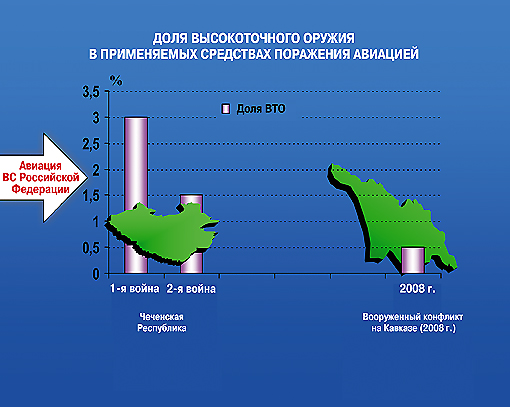
In short, no. Not even close. According to figures published in the Vozdushno-Kosmicehskaya Oborona (Aerospace Defense) journal, only 3% of the total munitions employed by Russian aircraft during the First Chechen War were guided. The figures for the Second Chechen War and the August 2008 Russo-Georgian War are even lower – a meager 1.5% and 0.5%, respectively. For comparison, nearly 70% of the total weapons employed by NATO/Coalition air and naval platforms during Operation Deliberate Force (1995)/Operation Iraqi Freedom (2003) were guided, and, in 2011, NATO struck targets in Libya exclusively with precision-guided weapons. The figure for Russian operations in Syria is not known; however, when air strikes commenced in late September 2015, the vast majority of munitions employed were unguided. To this day, guided weapons continue to account for a tiny portion of the total munitions employed by the VKS and the Russian Navy in Syria since September 2015. This may explain the Russian Defense Ministry’s continued reluctance to publish an official figure. No such official figure is available for Russian operations against Ukraine either. The total number of missiles launched by the VKS, Russian Navy and Ground Forces against Ukraine surpasses that of other Russian military operations; however, VKS operational-tactical and army aviation appear to be employing predominantly unguided munitions.

Generally speaking, how do the Russian aerospace forces’ precision-strike capabilities compare to those of the US/NATO?

On the whole, despite extensive modernization efforts, the gap in precision-strike capabilities between the VKS and leading Western air forces remains very large. In particular, the VKS’ ability to prosecute fixed hard and buried targets, mobile targets and moving targets is far more limited, especially in a contested environment and/or during night and adverse weather conditions. There are numerous interrelated factors as to why there remains a very large gap in precision-strike capabilities. They include, inter alia:

Inferior target acquisition, targeting and information exchange capabilities of Russian combat aircraft:

The VKS still operates a large number of Soviet-era platforms, many of which received various upgrades (including installation of more modern navigation, targeting and other equipment, and, in most cases, integration of additional precision-guided weapons); however, the large majority of these upgraded platforms still lack modern data link and sensor systems, and can only employ a limited variety of guided weapons (some can only use older types of guided weapons). Both non-upgraded and some of the upgraded platforms also lack glass cockpits. Put together, these and other factors translate into markedly inferior situational awareness, high aircrew workload and limited/very limited precision targeting capabilities. Apart from these platforms, the VKS also operates some more extensively modernized older platforms and a large number of newer platforms equipped with more modern avionics and mission systems; however, their precision-strike capabilities, too, are more limited than those of modern US/NATO fixed and rotary-wing combat aircraft. Notably, their built-in sensor systems are less capable than many advanced Western built-in systems and targeting pods, and they lack the sensor fusion capabilities of modern Western platforms.

Very few stealth platforms:

The VKS has thus far taken delivery of a very small number of production version Su-57 fighters and has yet to equip a single operational squadron with the type. As for the PAK DA bomber programme, Russia has yet to roll out a prototype and it remains to be seen whether the VKS will even begin to take delivery of production version aircraft by the end of the decade. The VKS’ stealth aircraft fleet will remain both quantitatively and, in many respects, qualitatively markedly inferior to that of the US/NATO in the foreseeable decades.

Absence of certain types of precision-guided weapons:

There are several types of precision-guided weapons that are neither in service with the VKS nor known to be in development for it. These include precision-guided missiles and bombs that are “network-enabled” and/or equipped with tri-mode seekers for enhanced tactical flexibility. Another example are heavy penetrator bombs for defeating hard and buried targets (the heaviest precision-guided “bunker buster” bombs available to the VKS are 1,500 kg-class weapons).

Very few modern combat support platforms:

At present, the VKS operates a relatively small fleet of manned combat support platforms such as airborne early warning and control (AEW&C), electronic warfare (EW) and intelligence, surveillance and reconnaissance (ISR) aircraft for supporting precision-strike and other missions. This fleet comprises both older platforms, some of which have undergone modernization (for example, A-50 AEW&C aircraft that were upgraded to the A-50U standard), and newer platforms. The latter in particular are available in very limited numbers; for example, the VKS’ fleet of Il-22PP EW aircraft and Tu-214R ISR aircraft is tiny. Furthermore, the VKS has no high-altitude ISR platform.

Very few unmanned combat aerial vehicles (UCAVs):

There are two types of UCAVs currently available to the VKS. Both are relatively basic designs (part of the Inokhodets and Forpost-R armed UASs), and both are available in small numbers. Heavier/more advanced UCAVs are still not ready. Notably, prototypes of the S-70 stealth UCAV are currently undergoing testing and it remains to be seen whether the VKS will begin taking delivery of production version aircraft before the late 2020s.

The above list of factors is by no means exhaustive.

It must be emphasized that the VKS’ capabilities will greatly expand over the next decade as it continues to field modern manned and unmanned combat and combat support assets and precision-guided weapons. Notably, by the early 2030s, the large majority of the VKS’ force of fixed and rotary-wing combat aircraft will have at least a limited night and adverse weather precision-strike capability. That said, large capability gaps in C4ISR (command, control, communications, computers, intelligence, surveillance and reconnaissance), EW, target acquisition and targeting, stealth, precision-guided weapons and other relevant areas will remain between the VKS and leading Western air forces.

The extraordinarily beautiful Hush-Kit Book of Volume 2 will begin when funding reaches 100%. To support it simply pre-order your copy here. Save the Hush-Kit blog. Our site is absolutely free and we want to keep it that way. If you’ve enjoyed an article you can donate here. Your donations keep this going. Treat yourself to something from our shop here. Thank you. 

You mentioned inferior targeting acquisition and targeting capabilities – can you give a few brief examples?

Sure. To illustrate this point, consider several very brief examples pertaining to the five most prevalent tactical fixed-wing aircraft types in service with the VKS that possess a precision-strike capability: the Su-24M, Su-25SM, Su-30SM, Su-34 and Su-35S.

This site is facing a funding shortage and may pause or shut down in June, please consider donating. Our site is absolutely free and we want to keep it that way. If you’ve enjoyed an article you can donate here. Your donations keep this going.

The Su-30SM and Su-35S are equipped with the OLS-30 and OLS-35 optical-locator station, respectively. Located to starboard of the aircraft centerline ahead of the cockpit, these built-in systems are in many respects significantly inferior to advanced western targeting pods. Take for instance the OLS-35; due to its position and its comparatively small field of regard, the system provides only limited lower hemisphere coverage. This significantly constrains the Su-35S’ tactical flexibility when employing it for surface (ground and sea) target acquisition and laser designation, among other purposes. The same is true for the Su-30SM when employing its OLS-30 for surface target acquisition (as for laser designation, there is conflicting information on whether the OLS-30 includes a laser designator or not, meaning the Su-30SM may not have the ability to independently employ laser-guided missiles).

The Su-34 – primarily an air-to-surface platform – is equipped with the ventral LTPS “Platan” laser/TV targeting system whose retractable housing can be seen located between the inlets, just aft of the forward landing gear bay. Platan provides greater – though still limited – lower hemisphere coverage. Additional information about the system is very scarce, but Platan is likely equipped with a low-light-level television (LLLTV) device; it is not believed to have a forward-looking infrared (FLIR) sensor, A standard feature on advanced western targeting pods, FLIR sensors offer superior night and adverse weather capability. Platan’s functionality is inferior to that of advanced targeting pods due to other reasons too, including, for example, lower sensor resolution and the absence of a laser-lead guidance capability (the latter greatly facilitates effective engagement of moving targets using laser-guided weapons that lack the ability to compute the lead required to strike a target that is on the move).

The Hush-Kit Book of Warplanes is out now on Amazon and contains fascinating analyses of modern combat aircraft including the Su-27, Su-35, Su-57 and MiG series. Buy it today, and if you enjoy please do leave a review on Amazon.

Besides their respective aforementioned systems, the Su-30SM, Su-34 and Su-35S are, among other things, also equipped with relatively modern passive electronically scanned array (PESA) radar systems. While the synthetic-aperture radar (SAR) mapping, ground moving target indication and tracking (GMTI/GMTT), and other air-to-surface capabilities of these radar systems are presumably somewhat – if not considerably – superior to those of their respective export-oriented variants, they are markedly inferior in many respects to those of advanced active electronically scanned array (AESA) radar systems installed in many western fighter aircraft.

The Su-24M is an older platform, equipped with the dated PNS-24M targeting/navigation system (which includes a radar system and the ventral LTPS “Kaira-24” laser/TV targeting system, among other things) and an archaic stores management system. The only guided weapons that the Su-24M can employ are older laser and TV-guided weapons and anti-radiation missiles. Practically speaking, laser and TV-guided weapons are only suitable for clear/limited adverse weather conditions. Moreover, the TV-guided bombs and missiles that the Su-24M can employ lack a night capability. So too does its Kaira-24 system, meaning that the Su-24M is unable to independently engage targets at night with laser-guided weapons. This is a huge limitation, especially given that the Su-24M is unable to employ satellite-aided bombs and missiles, which are day/night and adverse weather capable weapons (the Su-30SM, by the way, may not be able to use them either). As for unguided bombs, the Su-24M can employ them during night and adverse weather conditions. Notably, the integration of the SVP-24 specialized computing subsystem on many Su-24Ms has enabled them to employ unguided bombs with greater precision than before; however, given that unguided bombs are inherently less precise, the Su-24M’s inability to use modern, night and adverse weather capable precision-guided weapons – especially stand-off weapons – remains a huge limitation.

As for the Su-25SM, it is equipped with a Klen-PS laser rangefinder/designator system, but lacks both a radar and an electro-optical (EO) targeting system, and the only guided weapons it is able to employ are several types of dated laser-guided missiles. Put together, this means that, practically speaking, the Su-25SM lacks a night and/or adverse weather organic precision-strike capability, and possesses only a limited daytime organic precision-strike capability against stationary targets. Needless to say, this is a major disadvantage for a CAS/ground attack platform. For comparison, though not equipped with a radar either, the U.S. Air Force’s (USAF) A-10C can carry an advanced targeting pod and can employ a wide range of modern precision-guided weapons. It is a far more versatile platform, possessing a day/night and adverse weather organic precision-strike capability (including against moving targets in limited adverse weather conditions).

To be fair, unlike the baseline Su-25, the Su-25SM is equipped with the satellite-aided PrNK-25SM targeting/navigation system that enables employment of unguided bombs against stationary targets during day/night and adverse weather conditions without visual acquisition of the targets by the pilot. However, because it involves the use of unguided bombs, this bombing method is inherently less precise. Furthermore, it requires the Su-25SM to rely on non-organic assets to provide accurate target coordinates prior to and/or during a mission.

How useful are medium and heavy bombers for this campaign?

VKS bomber/strike aircraft are typically catagorized as follows:

Strategic bombers (Tu-95MS and Tu-160), long-range bombers (Tu-22M3) and operational-tactical bombers (Su-24M, Su-34).

In the conventional strike role, the Tu-95MS and Tu-160 (including the Tu-160M1 version) can strike stationary ground targets with known coordinates in day/night and adverse weather conditions using Kh-555 and Kh-101 long-range air-launched cruise missiles (ALCMs). The latter is a more capable weapon that can currently be employed by some Tu-95MSs and some (if not all) Tu-160s. Technically speaking, Tu-95MSs are not bombers; they are purely strategic missiles carriers because they cannot employ bombs of any kind (not even unguided bombs). As for Tu-160s, they are not known to currently carry any weapons other than ALCMs either. Given that Ukraine fields air defense systems, the ability to launch ALCMs from well outside the range of air defenses makes the Tu-95MS and Tu-160 useful. Aside from that, however, the Tu-95MS and Tu-160 are of no other use in such a campaign given that they are non-stealthy platforms, lack modern data-link, radar, EO targeting and self-protection systems, and are (seemingly) unable to employ other weapons. Moreover, it’s not clear whether the Kh-555 and/or Kh-101 have a hardened target defeat capability. If not, this further limits the utility of the Tu-95MS and Tu-160.  

As for the Tu-22M3, There is no indication of its employment in the campaign to date. The Tu-22M3’s conventional armament is known to currently include only anti-ship variant(s) of the Kh-22 air-to-surface missile and various unguided bombs. In other words, the Tu-22M3 has no conventional stand-off strike capability against ground targets. Moreover, like the Tu-95MS and Tu-160, it is both non-stealthy and lacks modern systems. Given the threat posed by Ukrainian air defenses, the apparent absence of Tu-22M3s in this war so far comes as no surprise.

Like the Tu-22M3, there is no indication that Russia is using the Su-24M in the campaign so far (though it is known to be employing the Su-24MR reconnaissance variant). This, too, is not surprising given that the VKS operates a relatively large fleet of Su-34s, which are superior to the Su-24M and are meant to eventually replace it. As I noted earlier, the Su-34 is being used in the campaign, and, despite its limitations (some of which are mentioned above), it is nevertheless a capable combat aircraft that can be employed for many air-to-surface tasks, making it among the most useful platforms in this war.   

How many Russian aircraft have been lost?

Credit:  State Emergency Service of Ukraine

To date, Russia has lost well over 40 manned aircraft. This number includes at least 11 fixed-wing aircraft that were shot down: 6 Su-25s (including two or more SMs and one or more SM3s) and 4 Su-34s belonging to the VKS, and one Russian Navy Su-30SM. Another VKS Su-25 was damaged by a man-portable air defense system (MANPADS), but managed to make it back to base. VKS rotary-wing losses have been particularly heavy. At least 3 transport and 11 attack helicopters were shot down. The latter include 7 Mi-24 and Mi-35Ms, 3 Ka-52s and one Mi-28N. At least two more Ka-52s are known to have carried out a forced landing in Ukrainian territory after being hit and were subsequently abandoned by their crews. At least another 15 Russian helicopters were destroyed on the ground by Ukrainian attacks on Kershon Air Base. The Russians have also lost a number of unmanned aerial vehicles (UAVs), the heaviest of these being a UAV that is part of the Forpost tactical UAS.

GeneralStaff.ua

What has been the biggest surprise for you in the application of Russian air power?

The biggest surprise was the apparent limited use of tactical fixed-wing aircraft early on in the campaign (first 5 days or following the opening wave of attacks). As I noted in an earlier interview with The Aviationist, “[o]ne explanation is that the Russians probably overestimated their own capabilities and underestimated the Ukrainians. They may have believed that their ground forces would be able to seize key objectives swiftly, and that the extensive use of operational-tactical aviation would therefore not be necessary. This is supported by the fact that the opening phase of missile-aviation and artillery attacks that preceded the ground offensive was quite short. Many analysts expected it to be much longer and more intense.” The Russians may have also limited the number of tactical fixed-wing aircraft sorties in the first days of the campaign due to fears of suffering excessive losses. Another possible contributing factor or explanation for the apparent limited activity of tactical fixed-wing aircraft in late February is that the Russians were simply unprepared to conduct sorties in larger numbers.

How is Ukraine different from the Syria campaign?

Firstly, the scope of the Ukraine campaign is different. It involves a larger and more diverse target set and likely a higher average daily sortie rate. Secondly, the terrain in Ukraine is different and generally more challenging for target location and identification, especially for Russian tactical fixed-wing aircraft (this is less of an issue for Russian UAVs and more modern attack helicopters). Weather conditions may also prove to be generally less favorable than in Syria. Lastly, unlike the Syria campaign, the Ukraine campaign involves an attack on a state with combat aircraft and an integrated air defense system (IADS).

Which recent wars will have influenced how Russian airpower is applied, and what are the specifics of these changes?

A good question – this is a very large topic and there are many specifics about the use of Russian air power in Ukraine that are not known, so I will make several quick points:

Russian air operations in Ukraine appear to have drawn on some lessons from the Russo-Georgian war. Notably, whereas Russian Tu-22Ms and Su-24Ms were employed to attack Georgian targets in 2008, there is – as mentioned earlier – no indication of them being employed against Ukraine to date. During the war with Georgia, a single Tu-22M3 and Su-24M were shot down by Georgian air defenses. The Russians likely therefore view these two dated aircraft types as too risky to employ at this stage of the war in Ukraine, especially given the various other, more modern capabilities presently available to the Russian military that render the Tu-22M3 and Su-24M redundant in many respects. That said, the VKS is interestingly employing a number of other dated aircraft types in this war. Most notably, the baseline Su-25 and the Mi-24P. In both cases, the VKS has much more capable alternatives available (which are also being employed in the campaign). Given the huge difference in combat potential between a Su-25 and a Su-25SM3 or a Mi-24P and a Mi-35M/Mi-28N/Ka-52, it’s not entirely clear why these dated platforms are being employed in a contested environment.

Another important Russian lesson from the Russo-Georgian war and from other foreign military operations is the importance of UASs. During the 2008 war, the Russian military made very limited use of Pchela-1T UAVs and was grossly disappointed with its performance, especially when compared to the UASs available to Georgia. Since then, the Russian military has been fielding various UAS, though its capabilities in this field are still limited, with more advanced/heavier systems still not ready. The two most advanced Russian UASs known to currently be employed in Ukraine are the aforementioned Inokhodets and Forpost-R (both of these armed UASs have also seen use in Syria). While these systems are leaps ahead of what the Russian military had available in 2008, they are in many respects inferior to the Bayraktar TB2 MALE UCAV operated by Ukraine.

As for other aspects of the campaign, the initial missile-aviation strikes against Ukraine appear to have been a Russian attempt at executing something akin to the opening phases of US-led military operations against Iraq and Serbia. In reality, however, Russia’s opening phase was very different. The Pentagon estimates that the Russian military launched only about 100 missiles of various types during the opening attack. Even though the actual number is likely higher, this is a relatively small number given the scale of Russia’s military operation and the large number of potential aimpoints (I discuss Russia’s use of missiles in greater detail here). Furthermore, it seems that the Russians did not effectively exploit the mixed success of their initial and subsequent missile strikes by following them up with large numbers of fixed-wing aircraft strike sorties using shorter range/direct attack weapons. They were also seemingly slow to re-attack when necessary. In short, Russia’s opening phases were conducted rather poorly, yielding very mixed results.

Russia’s campaign in Ukraine appears to highlight major deficiencies in the Russian military’s offensive and defensive counterair capabilities. Russian offensive counterair efforts failed to neutralize the Ukrainian Air Force on the ground. Moreover, Russian fighters and ground-based air defenses were unable to prevent attacks by Ukrainian manned and unmanned aircraft on Russian ground forces. Ukraine’s TB2 UCAVs, in particular, are proving a challenge. As for the VKS’ SEAD capabilities, despite Russia’s own experience in the 2008 Russo-Georgian war, and despite studying US and allied SEAD efforts during various military operations, the VKS’ SEAD capabilities remain lackluster (equipment and especially training). As I mentioned elsewhere, VKS “exercises appear to exhibit little in the way of complex scenarios involving SEAD packages supporting strike packages.” Given that Ukraine fields highly mobile air defense systems, the lack of a robust SEAD capability has proven to be a major issue.

As a final general remark, it’s important to keep in mind that while this war has highlighted many deficiencies in the Russian military’s capabilities, there are some capabilities that are not being employed to the fullest. Also, the Russian military is likely drawing many lessons from this war. Which of these lessons will be applied and how remains to be seen.

Guy Plopsky is the author of a number of articles on air power and Russian military affairs. He holds an MA in International Affairs and Strategic Studies from Tamkang University Taiwan.

Former RAF Typhoon Wing Commander gives his views on the deadly meaning of a No-Fly Zone over Ukraine

Wing Commander (rtd) and Typhoon combat veteran Mike Sutton OBE gives his views on the use of air power in Russia’s attempted invasion of Ukraine.

What has most caught your attention regarding how airpower has been employed in the current Russia-Ukraine War?

It is clear that Russian air power has played a relatively limited role in Ukraine, but we can only speculate as to why. Most analysis seems to suggest that Putin wanted a quick strike using a relatively small number of land forces, and he wasn’t expecting the levels of military resistance that has been encountered. There are several potential explanations as to why his apparently well-equipped, modern air force has played less of a role than might be expected. It’s possible that they are less well versed in complex, integrated operations than the West believed, and potentially lacking in precision-guided weapons. It’s also possible that there are concerns about the surface to air missile threat, both from the Ukrainian forces, but also with their own systems and the risk of fratricide. It is also possible that Putin has simply attempted to hold something in reserve. The utility of Ukrainian UAVs has also been interesting. Common wisdom suggests that without defensive systems these drones would be immediately vulnerable to Russian SAMs, and yet they have achieved considerable success. This highlights the role that relatively ‘low risk’ and inexpensive systems can play in a modern conflict

What are your thoughts on a potential No Fly Zone over Ukraine?

The term No Fly Zone is just a soundbite, and it’s important to define what is meant by that concept. The sort of NFZ that commentators are currently advocating is not a ‘light touch’ policing style intervention. It is an air war: pitching western air forces directly against the Russian Air Force. Placing the West eyeball to eyeball against Russian Forces has three ramifications:

First, the West would look to the US to provide the bulk of combat aircraft to enforce a NFZ. It is unlikely that the US would risk its aircraft without first conducting a comprehensive destruction of the Russian air defences (surface to air missiles, radars and command centres). This would mean directly striking Russian forces. An added complexity to this is that many of these systems have very long ranges and can be launched from Russian soil. In order to protect Ukrainian airspace, policy makers would therefore have to decide whether to strike cross-border. It should also be remembered that NFZ need to be enforced: Western and Russian Air Forces would quickly be engaged in a shooting war.

Second, if the NFZ was established and the West had fighters flying over Russian tanks, vehicles and artillery, there would be almost immediate calls to employ that air power in the strike role as well. And, in some ways it would be strange to limit the use of combat aircraft to only attacking Russian aircraft, when it is the ground forces that are causing the most damage. In either case Putin would not make a distinction between the loss of his aircraft, tanks, SAMs or artillery – it will be seen as an attack on his forces by the West. This would leave Putin feeling very threatened and would pose a risk to his core strategic interest – security. In these circumstances the risk of escalation would be significant.

Third, and perhaps most importantly from a strategic perspective, a direct military intervention would play directly to Putin’s narrative. He has long maintained that the West poses a direct military threat to Russia, and this turn of events would legitimise that paranoia, enabling him to justify his own military action

How should the West respond?

This is really a political question, not a military one. In its simplest form, the West is currently trying to influence Putin, to enable a cessation of the fighting. A good strategy does much more than just react, trying to counter like-with-like. It attempts to coerce and make it untenable for the belligerent to continue with a course of action. This requires an understanding that actions might be perceived differently than they were intended, due to an alternative world view. What some assume as benign, could be interpreted by others as a threat. For example, we think of liberal democracy as enlightened, the leaders of Russia and China see it as a menace. Any military action needs to be considered in terms of not just the effect it will have, but how it will be perceived.

Most importantly the Western response needs to avoid conflict escalation. How this is achieved is a political calculation, but there are some military options available. Putin has shot his bolt, and most analysts consider that the Russian performance has been less coordinated and effective than anticipated, particularly in the face of stiff resistance. Although of little comfort to Ukraine, in some ways NATO can draw confidence about the strength and capabilities of its own military resources from this.

Putin’s military approach has been largely conventional, using tanks, artillery and fighters to bombard Ukrainian cities. This approach has been seen before with the indiscriminate Russian bombing of Aleppo, and previously in Grozny and Georgia. With its advance now slowed in the face of fierce resistance, Russia appears to be doubling down on its strategy of bombardment. Russia is unlikely to throw its hands up quickly or easily, and a frustrated Putin makes the situation potentially more volatile. This means that the response from the West has to be considered and insightful in order to manage the risk of escalation.

The West does not need to follow suit and try to counter like-with-like. An asymmetric response avoids direct confrontation, through the use of military aid and support, the provision of anti-armour weapons, surface-to-air missiles and UAVs provides the Ukrainians with the means to fight. This is an extension of the policy of support that has been provided to the Ukrainian army since the Russian invasion of Crimea in 2014. International pressure for safe corridors or protected zones should be re-doubled, potentially with the offer of humanitarian airlift support – both to get people out, and resupplies of food and medicine in. The latter would need deconfliction and coordination with the Russians, which seems a very tall order given the current level of brutality and devastation they are invoking on Ukraine.

– Mike Sutton is the author of Typhoon 

(Penguin Michael Joseph, £20) which is out now

Fantastique French airliners of the 1940s

You should be ashamed of yourselves, and by ‘you’ I mean you. You should be ashamed of yourself for not sharing with me the utter grand madness of 1940s French airliners.

The following are utterly magnifique and I’m thrilled to have the chance to share them with you. Normally I save the best to last, but I am so head-over-heels with the SE.200 Amphitrite, we will start there.

Sud-Est SE.200 Amphitrite ‘L’oie de l’épinette’ (1942)

Flying boats opened up the world in the 1930s. Who needed airports if you could land on water? There weren’t many large airports, so flying boats – in all their grand glamour – led the aeroplane travel revolution. Now air travel routes from linking North America, Europe, South America, Africa and Asia were possible.

In the 1930s the French air ministry was tantalised by the possibilities of international travel and identified a need for a transatlantic flying boat airliner to serve Air France. The requirement specified a 6,000 km (3,700 mi) range – and being the 1930s – room for only 20 lucky passengers (and 500 kg of cargo, probably mostly consisting of Pâté en Croûte, Pastis and mistresses’ underwear).

The aircraft manufacturer Lioré et Olivier set about creating a large handsome six-engined aeroplane, the LeO H-49, powered by six of the then-new Gnome-Rhône 14R-26 1600-horsepower radial aero-engine. With the unfortunately timed nationalisation of the French aviation industry, the aircraft became a Sud-Est concern. The hugely impressive flying boat was named ‘Amphitrite’ after the sea goddess and wife of Poseidon from Greek mythology. Before the huge machine could be flown, Germany invaded France – but work continued at Marignane in southern France. The first aircraft, named Rochambeau, flew on 11 December 1942, and what a machine it was.

The German occupiers were impressed by the aircraft and seized it, taking it to Lake Constance in Germany for assessment. It was here that it was destroyed by RAF Mosquitoes. Four other airframes survived for a short time at Marignane, but one was wrecked by a USAAF raid that also severely damaged the other three.

Sadly, 2022 would see another beautiful six-engined giant aeroplane destroyed from the air with the destruction of the world’s biggest aircraft, the Ukrainian An-225.

Sud-Ouest Bretagne (1945) Brittany and her turbo-Cannes

In the mid to late 1940s, transport aircraft looked like fat sausages (or saucisses in this case). Britain had the banger-esque Vickers Valletta, the US the chubby-wiener that was the C-46 and the French the quaintly porky Bretagne. Conceived in glamourous Cannes on the French Riviera, the Bretagne was operated as an airliner in France and French colonies, as well as in Iran. The coolest thing about this lovable machine is the optional booster jets (two Turbomeca Palas rated at a rather cute 1.47 kN – 330 lbf) under the outer wings. It was also used as a testbed for the Nene jet-engine which made it look like three sausages flying in formation.

SNCASE SE.161 LanguedocThe Languishing Languedoc‘ (1939)

Despite a rather appealing appearance – and the fact it was the first post-war French aircraft to fly* – the Languedoc cannot be considered a success. Of a total of 100 built, 11 crashed and a further 7 were damaged beyond economic repair. The bulk of these incidents took place in a period of only four years. It was initially powered by four Gnome-Rhône 14Ns rotary engines, which had a short time between overhaul and were unreliable. A poor view from the cockpit, landing gear issues and other issues dogged the aeroplane, and passengers endured cold and noisy trips in the Languedoc. It was greatly inferior to international competitors, notably the far more modern Vickers Viscount. The Languedoc is best remembered today as the mothership of René Leduc’s experimental ramjet aircraft.

*(or rather return to flight as it had first flown in 1939)

Breguet Br 761 ‘Deux-Ponts’ ‘Eurovision Score’ (1949)

American engines and French airframe design has generally been a very harmonious combination, and the superb Br 761 was a shining example. This design was a double-decker, following the form set by the Latécoère 521 and the Sud-Est SE.200 Amphitrite, a slew of British and US flying boats and more directly, the American Boeing 377 Stratocruiser, and as such anticipated today’s Airbus A380. One significant reason to go taller rather than longer is hangar space. The two decks had room for over 100 passengers: 59 passengers on the top deck, and 48 on the lower deck. Like the A380, it enjoyed a fabulous safety record and a short production run.

S.N.C.A.S.O. SO-93/ Sud-Ouest Corse (1947) ‘Two Corse Sausage Lunch’

Another aircraft from ‘generation friendly sausage’, the Sud-Ouest Corse (Corsica) identified as a mail plane. It was also a pocket-sized airliner with room for 13 passengers. Created with Air France in mind, it failed to meet their needs and the national airline turned its nose up at the Corse. Still, this lovable mediocrity found a home in the French navy and in smaller numbers with the air force. It even enjoyed a short career with Air Services of India.

Latécoère 631 ‘The Constance Lakebed Gardener’

A great big schnozz that even Gérard Depardieu would envy and mighty six-engines identify the gloriously characterful and incredibly impressive 631. It was the largest flying boat ever built, necessitating the considerable grunt of six Wright R-2600 Twin Cyclones. It endured a rather too eventual career: of the eleven aircraft built, five were written off in accidents and one was destroyed in the same RAF attack on Lake Constance that wiped out the Amphitrite. The 631 was the rival of the Amphitrite, designed and built for the same Direction Générale de l’Aviation Civile requirement for a 40-passenger airliner with a range of 4,000 kilometres.

Nord 2100 Norazur (1947)

French aerospace engineers had a post-war flirtation with the pusher configuration, creating the pleasingly bananas SNCASO SO.8000 Narval, cute SECAN Courlis and somewhat eccentric Potez 75. The Norazur was not a bad design, but there were many cheaper aircraft types available to fill the light transport and training role.

Bréguet 500 Colmar (1945) ‘Girlfriend in a Colmar’

The four-engined Bréguet 482 heavy bomber would have been very fast: its projected cruise speed of 329mph was a whole 129mph faster than that of the British Lancaster; its top speed of 350mph was 70mph faster than the equivalent figure for the Lanc, and almost as quick as the best fighters of the time. Plans for the 482 were scuppered by the German occupation, but a twin-engined airliner derivative made sense. Inheriting its sleek good looks from the cancelled 482 bomber, the 500 Colmar first flew in 1945, after gestating in occupied France. It was planned that it would carry up to six passengers in the forward cabin and 17 in the rear. With a glut of rivals and France’s post-war woes, it was decided not to put the aircraft into production, but a single example did serve in the French air force for two years as an extremely classy VIP transport.

Breguet Br 892S ‘Mercure‘ (1949)

If you see a photograph of an unfamiliar World War II fighter the story of the project’s demise will have been caused by one of the following three causes: 1. Invasion/occupation/war’s end 2. A dodgy or undeveloped engine 2. The presence of good-enough rivals. If, on the other hand, you see a photograph of an unfamiliar medium-sized transport aircraft from the late 1940s, the story is even simpler: too many cheap C-47s/DC-3s in circulation rendering the effort uneconomical. The military airlifter variant, the Mars, was spurned by the French Air Force in favour of the rather more exciting Nord Noratlas.

SNCASE Armagnac Armagnac whine (1949)

The elegant Armagnac was very big and very heavy. Even with the grunt of four Wasp Majors, the most powerful piston-engines to ever enter production, the Armagnac was underpowered. Plans to equip the aircraft with the Allison T40 (powerplant to a trio of cancelled or rapidly curtailed US projects) were abandoned. Though it had a disappointing range performance, the Armagnac, with its wide-body configuration was a taste of the future.

Top 10 aircraft of the Ukrainian military

The bravery and ferocity of the Ukrainian resistance to a brutal Russian invasion has stirred the world. Ukrainian air power consists of veteran Soviet types fortified with modern unmanned aircraft. Against the odds their air force still flies and still fights. These are 10 types operated by the Ukrainian armed forces in 2022. 

10. Leleka-100

The Leleka-100 is a small multi-role UAV operated by the Ukrainian Armed Forces since 2015, largely in the battlefield reconnaissance role. Its inertial navigation system is vital for reliable operations in GPS-denied environments. It can carry the usual electro-optical and infra-red gimballed sensors. It is one of the most used drones of its class in the Ukrainian Army and has the most flight hours of any Ukrainian UAV. 

9. Antonov An-30

A Beriev-led development of the An-24, the Antonov An-30 was produced in Kyiv. The type has proved useful for longer-ranged reconnaissance missions. 

8. Sukhoi Su-24

Whereas the F-111 and (non-German) Tornado have all but gone, the Soviet equivalent, the Su-24 lingers on. Fast, long-ranged and with a large bombload it remains a credible attack aircraft.

7. Tupolev Tu-141/143

Photo: Joe Coles

A fighter-sized Soviet drone rocket-launched from a ramp, the Tu-141 and 143 are jet-propelled reconnaissance aircraft bought back into service following the 2014 invasion. Originally, they parachute-landed whereupon recorded intelligence footage was harvested from tapes, but they have been locally upgraded by university students to provide real-time video. Last week a rogue Tu-141 crashed in Croatia, reports that it may have had an attached bomb may be correct or may just be misidentified boost rocket launcher fuel residue and structural elements of the booster itself. 

Photo: Joe Coles

6. UA Dynamics Punisher/Spectre

Working in a hunter/killer relationship, the Spectre/Punisher drones are compact yet able to reach a relatively long distance to deliver a disproportionate effect against invading forces and their supply line. As in much modern warfare, unmanned aircraft have provided a flexible form of harassment attack at little cost in money and little risk of human loss to its operators. 

5. Mil Mi-24

The Mi-24 suffered heavier losses than any other Ukrainian type in the 2014 Russian invasion. Since 2014, the type’s survivability and night-fighting capabilities have been improved. 

4. Sukhoi Su-25

The stalwart of both sides in the Ukraino-Russian War, the Su-25 is a tough battlefield support aircraft born of the Soviet era. Ukraine held on to over 90 Su-25s following the break-up of the Soviet Union. Ukrainian Su-25 development has gone its own way since around 2003, with MiGremont in Zaporizhzhia (at the time of writing Zaporizhzhia was under attack from Russia; earlier Russian attacks had caused a fire at the nuclear power plant). MiGremont upgraded and refurbished Su-25s, the resultant Su-25M1K and -UM1Ks featured enhanced navigation and weapon aiming aids as well as new defensive countermeasures. Following the high loss rate of Ukrainian Su-25s in the Russian 2014 invasion of the Crimean Peninsula, countermeasures were further enhanced with the addition of new chaff and flare dispensers scabbed onto the top of the rear engine nacelles. 

Photo: Joe Coles

3. Sukhoi Su-27

The most capable air superiority platform in Ukrainian service is the Su-27. Its larger range and weapon load than the MiG-29 grants the ‘Flanker’ significantly more combat persistence. Ukraine had almost 70 ‘Flanker’s at the nation’s birth. The current variant, the Su-27P1M and Su-27UB1M contains some equipment unique to Ukrainian ‘Flankers’. In the air-to-air role aircraft it is armed with a 30-mm cannon, as well as up to ten R-27 and R-73 missiles. 

2. Baykar Bayraktar TB2

The Bayrakter TB2 armed drone was the inspiration for the song of the same name, a patriotic pop song that celebrates the success of the Turkish-built aircraft and mocks the Russian invaders. Ukraine has between 12-25 TB-2s and it has proved extremely effective against armoured vechicles.

  1. Mikoyan MiG-29

A survivor of the Soviet era, much of the MiG-29‘s use is the exact type of mission it was designed for (if not with the intended opponent) – the short-range defensive tactical fighter role. In this role in 2022 it has gained a semi-mythical status as ‘The Ghost of Kyiv‘, a MiG-29 said to have shot down multiple Russian aircraft.

——–

If you wish to make a donation to the Ukrainian armed forces details are below: SWIFT company Name CO “INTERNATIONAL CHARITABLE FOUNDATION “COME BACK ALIVE” IBAN Code (Євро) UA093052990000026004025029786. Name of the bank JSC CB “PRIVATBANK”, 1D HRUSHEVSKOHO STR., KYIV, 01001, UKRAINE Bank SWIFT Code PBANUA2X Company address UA 01054, м.Київ, вул Богдана Хмельницького, 32 кв.41 Purpose of payment Charitable donation to Ukrainian military

Top Ten Allied Fighter Squadrons of World War II

It may seem ghoulish to use the metric of total ‘kills’ (enemy aircraft destroyed) to determine the most successful squadron of the Second World War, and though in that world of blood and fire it is a meaningful determinant, Eddie Rippeth has also considered other factors. As with any top 10, this is a discussion starter rather than a definitive answer. The squadrons mentioned here certainly displayed extraordinary bravery and skill, and were also in the right time and place to accrue heavy losses on the enemy.

Which fighter squadrons were most successful for the allies? This top ten started as an attempt to list the top squadrons by numbers of kills. However, that would mean six of the top seven scorers would be RAF, and would squeeze out US squadrons, which of course fought a shorter war. In addition, most of the information available on the USAAF is at fighter group level. Fighter groups contained three squadrons, so in order to compare like with like, the top ten includes the best individual squadrons within US Fighter Groups. With at least five USAAF fighter groups exceeding 600 victories, logic suggests that there’s a lot of USAAF squadrons hidden in the 200-250 kill range. So our three chosen USAAF squadrons are representative of a number of high-scoring squadrons, and are chosen partly out of interest, similarly with the inclusion of Polish and Canadian RAF squadrons.

Buy The Hush-Kit Book of Warplanes today


So this isn’t strictly a top ten by scoring alone. All of the squadrons mentioned had a significant strategic impact and are worthy of consideration for that reason alone. And of course, a caveat must always be made for the ‘confirmed’ victories assigned to each squadron. Over-claiming happened, but the numbers here assume this wasn’t a particular problem with any of the squadrons. And of course, the numbers matter less than the fact that they all helped achieve real strategic success.


The Soviet Air Force is unfortunately not represented, simply due to the lack of information available. That said, honorary mention should be made for the Red air force’s Normandie fighter wing, where exiled Free French pilots flew Yaks with great success from 1942 onwards. An honorary mention also goes to one of the most iconic fighter units of all, the American Volunteer Group, the Flying Tigers. The Flying Tigers were subsumed into the USAAF’s 23rd Fighter Group, but it’s very difficult to track the continuity of a single squadron in such a situation. And a final honorary mention to 332nd Fighter Group – the Red-Tails, whose successful formation and operational achievements marked a great step in the US civil rights movement. All three of these units merit a place on a list about fighting units, but with the information available, it’s difficult to make a case for one of their constituent squadrons. But I’d be happy to be corrected on this score.
So the rundown, from number 10:

10. RCAF 401 Squadron – 186.5 kills


401 Squadron was the top Canadian outfit, which arrived in England as Number 1 squadron in June 1940. It saw some action in the Battle of Britain, although its first kills were Bristol Blenheims in a friendly fire incident. Nonetheless, it ended the battle with 30 kills. The squadron was renumbered 401 in 1941 and was heavily involved in Channel sweeps, with occasional heavy losses, including on one occasion being bounced by Adolf Galland’s Staffel, losing five aircraft. However, the conversion to the Spitfire IX meant an uptick in 401’s fortunes and saw this squadron through to the end of the war. As part of the Canadian Fighter Wing (commanded by Johnny Johnson), it was heavily involved in clearing the skies above Normandy in June, and the squadron would prove to be the highest-scoring RAF and RCAF squadron in the campaign, with 112 kills, including one bag of three Arado Ar234 jets shot down over their airfield. The squadron’s top scorers were William Kersley (14.5 kills) and John McKay (12).

9. No. 303 ‘Warsaw’ Squadron, RAF


Like the Tuskegee Red Tails, 303 Squadron has recently been immortalised on celluloid with the movie Hurricane, following a short cameo in the 1969 film Battle of Britain. The squadron was formed in early August by assembling Polish veterans who’d escaped after the 1939 invasion under the leadership of Durham-born Squadron Leader Ronald Kellett. 303 famously got off the mark on August 30th when a training flight led by Kellett encountered some Luftwaffe bombers, with Ludwig Paszkiewicz shooting one down (actually a Bf 110 heavy fighter). They were made officially operational the following day, when they scored four more victories. Highly motivated, skilful and aggressive, 303’s Hurricanes tore into Luftwaffe formations day after day, with several aces emerging in the battle – led by Czech Josef Frantisek (17 victories), Witold Urbanowitz (14), Jan Zumbach, Zdzislaw Henneburg and Eugeniusz Szaposznikow (8 apiece). On both 15th and 27th September, the squadron claimed 15 kills, although it would suffer the loss of its top scorer, Frantisek in a flying accident on 8th October shortly before it was rested. In its 42 days of action, 303 had achieved 126 kills, highest scoring squadron in the battle. 303 remained in England as part of the Home Defence, switching to Spitfires and taking part in circuses and rhubarbs and air cover for the disastrous Dieppe raids. It had several new aces in this period, such as Boleslaw Drobinski and Miecyzslaw Adamek, and ended the war flying Mustangs as bomber escorts. The squadron achieved 204 kills, by some way the highest-scoring Polish squadron in the RAF.

8. USMC VMF121 ‘The Green Knights’

The US Marine Corps had as early as 1912 begun experimenting with aviation as an essential part of the Marines’ armoury, and their raison d’etre of amphibious and maritime assault. The first great test of this aviation arm came at Guadalcanal, with the establishment of the so-called ‘Cactus air force’ at Henderson Field in August 1942 (alas, the evocative name owes its origins to a code-name not the tropical vegetation surrounding Henderson). VMF-121 and its F4F Wildcats joined the fray in October 1942, having been catapulted off the decks of escort carriers from 350 miles away. The Green Knights immediately joined battle with Japanese army pilots and aircraft at their peak, with Joe Foss emerged as a leading ace as Marine pilots gradually got the upper hand. Foss would go on to be the first American to match Eddie Rickenbacker’s WW1 score of 26 kills (and got sent home). VMF121 fought in many of the Marines’ great Pacific island-hopping campaigns, ending the war at Peleliu flying Corsairs. The squadron totalled 208 kills in the war, with Foss leading 13 other aces, with Bill ‘Guts’ Marontate next (13 victories).

7. USAAF 431 Fighter Squadron – 212 kills


The premier P-38 Lightning squadron in the Pacific, the 431st was part of the 475th Fighter Group, set up in Queensland Australia in May 1943 to support the campaign in western New Guinea, at the time teaming with Japanese army aircraft. After several uneventful escort missions that month, the ‘Twin-tailed devils’ ravaged a Japanese formation, claiming its first 12 victories. This was the first of a number of engagements with large Japanese formations in which the Lightnings scored highly, and this trend continued as action moved to New Britain and Bougainville.
Within 431st squadron, two pilots emerged as leading aces – the squadron commander, Thomas B. Maguire and Charles F. McDonald. During August 1944, the group hosted celebrated aviator Charles Lindbergh, who asked MacDonald if he could join a ‘milk run’ mission with 431st. Unfortunately their formation was attacked and Lindbergh ended up nearly colliding with an Oscar, which then crashed. Poor MacDonald got the rap for endangering the national hero, and a one-month grounding. In October 1944, the Group moved to Morotai to take part in the invasion of the Philippines, where once again they scored highly, with Maguire becoming the second leading US ace of all time (behind Richard Bong of the 49th Fighter Group). Tragically Maguire was killed executing a low level combat manoeuvre in action in January 1945, with 38 kills. The 431st served out the remainder of the war in the Philippines, with MacDonald reaching 27 kills, all with the squadron.

6. USAAF 61st Pursuit Squadron, ‘Zemke’s Wolfpack’ – 232 kills

Lieutenant Colonel Francis S. Gabreski, commanded the 61st Fighter Squadron. Below the cockpit of his Republic P-47D-25-RE Thunderbolt, 42-26418, are the kill markings of 28 enemy aircraft destroyed. (American Air Museum in Britain)


The first US fighter group to start bossing the Luftwaffe around over Occupied Europe was 56 Group, with the huge and rugged P47 Thunderbolts. The group would prosper under the brilliant leadership of Hubert Zemke, and of its three squadrons, the most successful was the 61st Pursuit, whose members included the two top US aces in the European Theatre, Robert S.Johnson and the squadron’s leader, Polish-American Francis Gabreski. Flying out of Debden in Suffolk, its first missions were fighter-bomber sweeps along the lines of the generally ineffective Circus and Rhubarb missions, and escorting the earlier 8th Air Force raids as far as Belgium.

Lieutenant Colonel Gabreski, with the ground crew of his Republic P-47D Thunderbolt, circa July 1944.

An early shock was the first meeting with Fw190s, with heavy losses but Zemke’s influence would quickly reverse this, and by the end of 1943, 56 Group was by far the highest scorer in the 8th Air Force. Uniquely, Zemke and his pilots refused the opportunity in the New Year to switch to P51s. Escort duties continued, thanks to new fuel tanks, but following D-Day, more and more emphasis was given to ‘targets of opportunity’ on the ground, and the group’s P47s ran up an impressive total of vehicles, trains and aircraft strafed to destruction – a task for which the tough and hefty ‘Jug’ was very well suited – but not invincible. On 5 July, and Gabreski was brought down by flak while strafing, and he spent the rest of the war in Stalag Luft I. With Johnson already dispatched home to sell war bonds after grabbing his 27th kill, both Group and squadron’s prodigious rate of scoring aerial kills slowed a little, although by the end of the war, the 61st Pursuit Squadron had managed 232 of 56 Group’s 665 kills.

  1. USAAF 487th Pursuit Squadron – 235 kills


The 487th Squadron was the top USAAF Mustang squadron, and part of the US 352nd Fighter Group of the US 8th Air Force. They were soon nicknamed the ‘Blue-Nosed Bastards of Bodney’, after the tiny, unassuming hamlet in Norfolk where they were based from July 1943. Initially flying P47s, the first kill for the 487th came in November for John C.Meyer, who would become the squadron’s commander and one of its two outstanding aces. The squadron and group operated mainly in providing escort for the growing 8th Air Force bombing campaign, being heavily involved in the pivotal Big Week in March 1944.


It was after this that the squadron switched to Mustangs, and scores really started to mount, notably for John C.Meyer and a recent arrival from the 49th Fighter Group in the Pacific, George E.Preddy, who would score six kills in a day on August 6th. Preddy was rewarded with command of the 328th Fighter Squadron, and was killed when shot down by friendly anti-aircraft on Christmas Day. In the meantime, the whole group had said goodbye to Bodney and been moved to Asche in Belgium in time for the Battle of the Bulge. On New Year’s Day 1945, the 487th had its day of days, after John C.Meyer managed to get his squadron in the air to tackle the huge Luftwaffe surprise attack on Asche air base (part of Operation Bodenplatte). While the group’s other Mustangs were being bombed, the 487th had shot down 24 of their assailants and was awarded a Distinguished Unit citation. 487th squadron flew its last mission on May 3, 1945 with Preddy and Meyer classed as the two top Mustang aces, with 26.83 and 25.5 kills respectively (Meyer’s all with the 487th).

4. No. 85 Squadron RAF – 278 kills – Nocto Diuque Venamur
(“We hunt by day and night”)


The RAF’s 85 Squadron had a remarkable record both in daylight and after dark. It began the war as one of the BEF squadrons based in France, flying Hurricanes with South African ace Albert Lewis top-scoring before being thrown into the Battle of Britain, with new Squadron Leader Peter Townsend, later of Princess Margaret fame. With pilots exhausted and Townsend injured, the squadron was withdrawn for conversion to night fighting. In short order, it used Hurricanes, Defiants and even boasted the only Douglas Havoc ace, Canadian Gordon Raphael, in fighting the Night Blitz of early 1941.


However, it would be the conversion to Mosquitos that would bring the squadron its greatest successes. This occurred as the Luftwaffe mounted a series of short night bombing offensives in 1942 and 1943, with the great nightfighter ace John ‘Cats Eyes’ Cunningham in command during this period. In early 1944, 85 played a key role in the defeat of the final German (piloted) bomber campaign – Operation Steinbock, helping to decimate the remaining Luftwaffe bomber fleet. They then turned to night intruder missions, supporting RAF bombing raids for the remainder of the war. Branse Burbridge dispatched no fewer than 16 Luftwaffe ‘nachtjagers’, including an incredible four in one night over Bonn in November; partly as a consequence, RAF Bomber Command losses would tumble in late 1944. Burbridge managed 21 kills in total and was by some way 85 Squadron’s top scorer – he was also the top allied night-fighter ace, just pipping Cunningham. Among 85’s numerous other aces were Alan Owen (9 kills in Mosquito night-fighters) and the top German-born RAF ace, Manfred von Czernin, who scored 5 of his 15 kills with 85 Squadron during the fall of France.

3. US Navy VF15 Squadron – 315 kills (‘Fighting Aces’)


The US Navy’s remarkable VF15 Fighter Squadron was in being for scarcely two years in its entirety, being formed in September 1943 and disbanded in October 1945. Almost all of its action took place within a six-month period from May 1944, after being assigned to operations on board USS Essex. Its commander at inception, David McCampbell, was a 33-year-old pilot who had been serving as a signals officer on the USS Wasp – where he’d have waved off Spitfires heading to Malta during Operation Bowery, and had survived its sinking just five months later. In February 1944, McCampbell was given command of a whole air wing – the so-called ‘Fabled Fifteenth’, including torpedo and dive bombers. Nonetheless, he kept flying his Hellcat, the US Navy’s brutally effective new fighter to extraordinary effect.


VF15’s first operations were over Saipan and Wake Island, with several pilots, including McCampbell, opening their accounts in early June. However, the June 19th clash with the Japanese at the Battle of the Philippine Sea, saw VF-15 fully involved in perhaps the greatest air battle in the Pacific, with the squadron racking up an incredible 68.5 victories in a single day (US Navy fighters claimed 388 kills that day). The legend of the ‘Great San Marianas Turkey Shoot’ was born. Very much at the heart of this was McCampbell, who shot down five ‘Judy’ dive bombers in his first sortie of the day, and rounded off with two Zeros. Two other VF15 pilots, George R.Carr and the squadron leader, Charles Brewer, shot down five each, although in Brewer’s case he was one of the few US casualties of the day. The IJN would be crippled by the losses inflicted on the day, but further opportunities for the men of VF-15 arose over the next couple of months over Guam and the Philippines. McCampbell’s score reaching 19 by the end of September, and James Rigg and George Duncan both achieving ace status. October saw the great sea battle at Leyte Gulf and VF-15’s Hellcats blitzed the remnants of the IJN’s air force, with McCampbell destroying 9 Japanese fighters (the highest total in a day by any US fighter pilot) and his wingman Roy Rushing getting six. The air battle continued in the Philippines for several more weeks, before moving to Iwo Jima, Okinawa and finally off the coast of Japan in the last months of the war. By this time, Japanese aircraft were far less numerous – but more deadly in the form of kamikazes, one of which struck the Essex on November 25th, removing VF15 from action for a month while it was repaired. A result of this was more emphasis on strafing attacks on Japanese airfields, which VF15 proved adept at. The appropriately nick-named ‘Fighting Aces’ ended the war with 315 victories, with McCampbell (34 kills) heading 28 aces, including Rushing (13.5), Duncan and Wendell van Twelves on 13.

2. No. 92 Squadron RAF – 317.5 kills

Aut pugna aut morere
(Latin for ‘Either fight or die‘)


How does a squadron which began the war with Bristol Blenheims end up as second-highest score of all? The answer is to quickly switch to Spitfires – which was done in May 1940, and they stuck with them throughout the war, except for one short period in the desert. After a very quiet Phoney War, the war came to life with 92 Squadron on May 23, 1940 with its first two patrols near Dunkirk. The squadron was bounced twice, losing four aircraft, including its squadron leader Roger Bushell, who would find immortality as ‘The Big X’ of The Great Escape fame. Nonetheless, this was a squadron blessed with talented pilots, including Robert Stanford Tuck, Brian Kingcome and Tony Bartley (continuing the Hollywood theme, Bartley became a film producer who would later marry actress Deborah Kerr). As a result, they emerged from Dunkirk with an impressive record, not least on the final day of the evacuation where they mauled a formation of Heinkel 111s, claiming 11 victories.


The Battle of Britain saw them continue as one of the RAF’s best fighter squadrons, with the arrival of another great ace, Donald Kingaby, and by the end of 1940, the squadron had amassed well over 100 victories for the year. 92 Squadron spent 1941 flying circuses and rhubarbs over the Channel, a time of pointless losses and questionable victory claims. In April 1942 the squadron was posted to Egypt – although their Spitfire VBs only followed about three months later, and their initial ops were flown in Hurricanes. Once reunited, 92 Squadron was the most effective of the 244 Desert Fighter Wing’s squadrons, with Jeff Wedgewood the leading ace until his death in December. Wedgewood had been on board a Halifax en route home for leave and a new posting, which crashed near Malta in December. The desert ace Neville Duke arrived in January as a flight commander, and he and the squadron scored heavily in the final battles over Tunisia, taking part in the ‘Palm Sunday massacre’ of Luftwaffe transports over Cap Bon. 92 then fought all the way through Sicily and the Italian campaign, and counted 17 aces and 317.5 kills by the end of the war, with Kingaby (an aggregated 17.16 victories) edging Neville Duke (16) as top scorer.

  1. RAF 249 Squadron – 320 kills

Motto: Latin: Pugnis et calcibus â€“ With fists and heels.

All of the squadrons listed here made exceptional contributions to winning the war. Our winner, 249 Squadron, might just have been the single squadron that made the difference at the pivotal time and place when the war (at least in Europe) turned in the allies’ favour. 249 Squadron was created in a hurry in May 1940, initially being equipped with Hurris, then slated for Spitfires, and finally Hurricanes in time to play a role in the Battle of Britain. The squadron had an intense baptism of fire during the Battle of Britain, where it was one of the most effective Hurricane squadrons, with Tom Neil and Robert Barton leading scoring. One of its pilots, James Nicholson would win Fighter Command’s only Victoria Cross when despite his aircraft being in flames, he pressed home his attack to destroy a Me 110. Another outstanding effort came from Albert Lewis, fresh from 85 Squadron, who shot down six Luftwaffe aircraft in a single day on September 27th. Unfortunately, like Nicholson, Lewis’s battle was ended a few days later after suffering severe burns when shot down. The squadron then took part in some of the early Circuses in 1941, but in April was given a posting to Malta, which had been suffering the attentions of the Luftwaffe as well as the Regia Aeronautica since the turn of the year. To get there, 249 Squadron’s Hurricanes were shipped to Gibraltar, where they were transferred to the aircraft carrier Ark Royal, and flown off to Malta, without losses. For the first few months, things were relatively quiet, as the Luftwaffe withdrew its squadrons to fight in the Balkans, Greece and then the Soviet campaign.
However, the Luftwaffe returned with a vengeance at the turn of the year. A more welcome arrival was 249’s new Squadron Leader, Canadian Stan Turner, whose withering assessment ‘either we get Spitfires here within days, not weeks, or we’re done,’ contributed to Sholto Douglas finally releasing Spitfires for overseas usage. Spitfires were flown in several batches from carriers Eagle and Wasp from March onwards. The Spitfires arrived in time to counter three massed Luftwaffe offensives against the island, with the first in April and May, in which 249’s aces included Kiwi Raymond Hesselyn, Australian Adrian Goldsmith and Greek-Rhodesian John Plagis. The next few weeks saw two significant new arrivals, a young Pilot Officer, George Beurling, joining 249 and a new AOC for Malta, Keith Park, just as the Luftwaffe campaign was ratcheting up again. Both had an immediate impact – Beurling scoring 15 kills in the month of July, while Park implemented a thorough shake-up in fighter tactics from 25th July which caused such losses that Kesselring gave up the bombing campaign just six days later. It wasn’t the last of the Luftwaffe – they would launch a last gasp major offensive in October, which once again was beaten back with heavy losses by 249 and the other Spitfire squadrons. Beurling and two more Canadian pilots, McElroy and ‘Timber’ Woods all scored heavily in these later air battles. As a result, Malta was saved, Rommel’s supply lines were cut, leading to German and Italian defeat in North Africa.


One inevitability in such an intensive environment where air battles were interspersed with bombardment day and night on the ground was the need to rest and replace pilots every three or four months during the height of the siege in 1942. Hence the aces of Spring, like Hesselyn and Goldsmith gave way to a new cast of aces for the July and October offensives, like Beurling and McElroy. However, flying out pilots on leave on large transport aircraft from the besieged island was fraught with risk – and on 31st October, a number of pilots and ground crew were killed when their B24 Liberator crashed on take-off from Gibraltar, with George Beurling one of the few survivors. 249 Squadron continued to fly from Malta into 1943, with pilots like Californian John Lynch, who led the way in helping decimate Junkers Ju52 transports evacuating Tripoli, and who scored the RAF’s 1000th victory from Malta. Thereafter the Squadron fought over Sicilly, before being posted to Brindisi in southern Italy, flying ops over the Yugoslav coast – a much quieter sector, although one which saw the loss of ‘Timber’ Woods at the end of 1943. The squadron ended the war with over 320 victories, and 21 aces altogether, led by Buerling (27.33), Tom Neil (12.58) and Ray Hesselyn (12).

Time is running out to pledge to The Hush-Kit Book of Warplanes . Last pledge will be 27 March 2022.

Sources: Aces High Christopher Shore / Clive Williams (Grub Street); American Fighter Aces Association website; Stephen Sherman’s Acepilots.com; Aces of WW2.com; Wikipedia; Air Battle over Dunkirk, Norman F.Franks; 475 Fighter Group website; John Foreman RAF Fighter Command Claims 1939-40; 1941-42..