Top Racing Landplanes

Image

By Stephen Caulfield

Fire-breathing monsters, deadly fireballs and earth-shattering noise, there has never been a sport as exciting as air racing. We take an adrenaline-scorched run through the Top 11 racing aeroplanes.


11. Bleriot Type XI / Curtiss No. 2


When was the first air race held?  The day the second aeroplane was built. From modest beginnings, it rapidly grew in prestige and scale. No mistake, air racing has been a serious business since the pioneering era of flying. This mad new sport drew huge attention, at stake was a brace of trophies and substantial prize purses often posted by circulation-hungry daily newspapers. Racing proliferated and quickly entered the popular culture almost as soon as the first powered, heavier-than-air machines were available. Races would draw crowds by the tens of thousands.  Many got their first, unforgettable, sight of aviation at races featuring craft like these two. Aviation pioneer and founding father of the American US aircraft business Glenn Curtiss locked horns with his French equivalent Louis Bleriot at early air races in France and California. They flew in aeroplanes of their own invention, the Bleriot Type XI and Curtiss No. 2.


Maximum speed: depends
Spiritual equivalent: Alexander Graham Bell’s Silver Dart

10. Travel Air 4000

https://upload.wikimedia.org/wikipedia/commons/2/2e/Curtiss_Wright_Travel_Air_E4000_OTT2013_D7N8754_BEA_003.jpg

What do you call a woman flying a plane? The pilot.. or ‘aviatrix’ if you’re in the 1920s. The superlative Travel Air 4000 is remembered as the winning machine in the Women’s Air Derby of 1929, with Louise Thaden at the controls. Thaden departed Santa Monica, California for Cleveland, Ohio, with twenty other entrants. It would become an arduous nine-day test of women and machines. One flyer would even lose her life. Along the way, there would be all the hazards of early cross-country flying: navigation errors, bad weather, mechanical failures, engine fire – as well as a possible incident of sabotage.

As we might expect given the year, these trials were accompanied by much sexist commentary. In spite of how many perceived the pilots, they achieved a remarkable feat completing (and surviving) this epic race.

The aeroplanes themselves were also stars. Travel Airs worked hard during Hollywood’s golden age, finding their way into many a popular flying-themed feature. Appearing at the close of the great barnstorming era, the Travel Air 4000 had a brief moment to shine and it did so with incandescent glamour. They remain examples of what lovely things biplanes can be.

https://airandspace.si.edu/webimages/previews/82-2132p.jpg


Maximum speed: 120 mph
Spiritual equivalent: Great Lakes Sport Trainer

9. Hughes H-1 Racer
https://upload.wikimedia.org/wikipedia/commons/5/5f/HughesH1PropLower.JPG


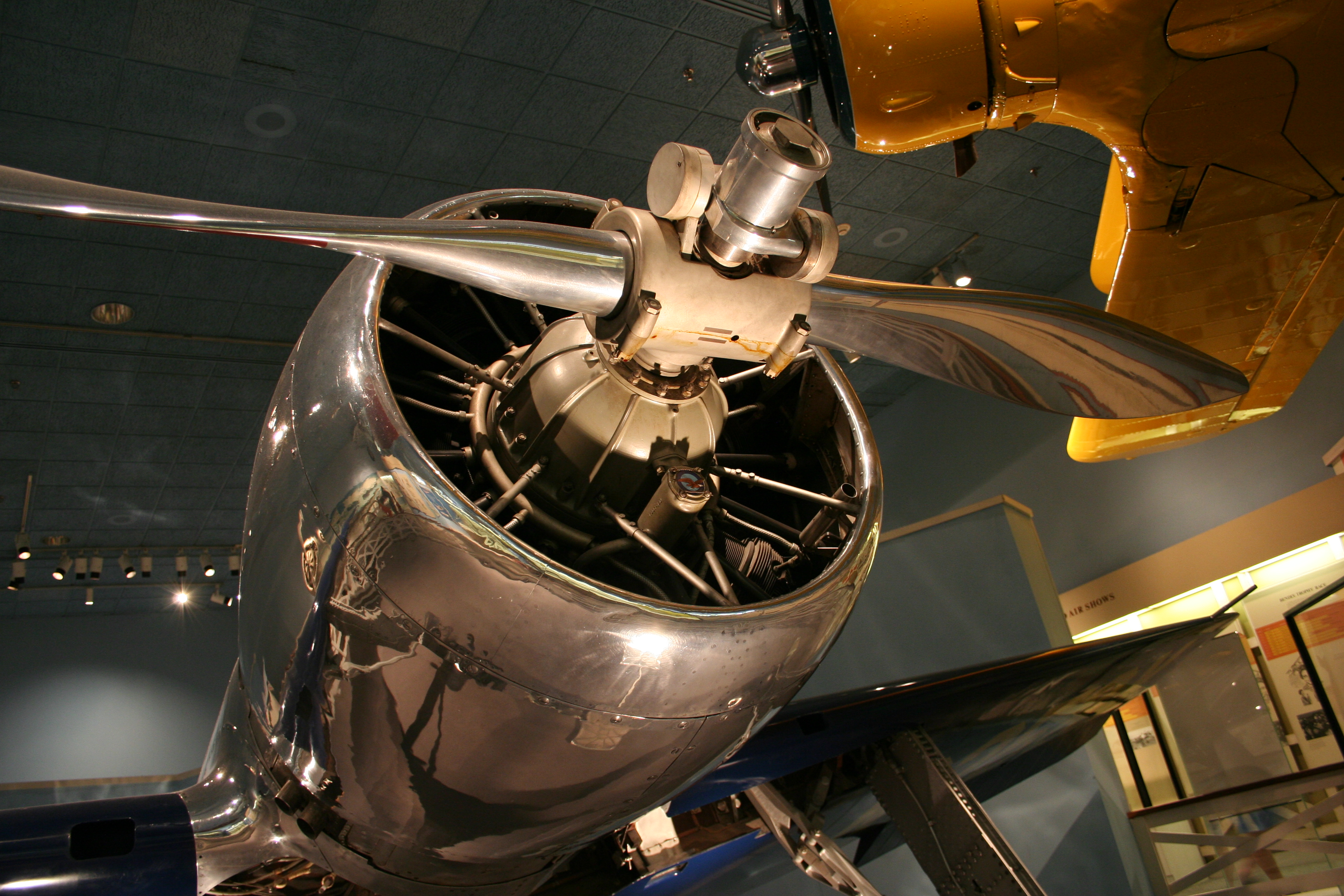
A streamlined all-metal low-wing monoplane, with an enclosed cockpit, powerful radial engine and a retractable undercarriage was absolutely cutting edge configuration when the H-1 appeared in 1935. Only the Polikarpov I-16, then the best fighter in the world, could boast such a sleek combination of technologies, but Howard Hughes was never a man to do things by halves. This racing plane was also, in many ways, the most advanced aeroplane of its time. Huge efforts were made to make it as aerodynamically efficient as possible, Hughes even pioneered the use of individually machined flush rivets to keep the aluminium skin as smooth as possible. Everything was done in the name of speed, and it paid off. Hughes smashed the world landplane speed record in the H-1 in1935, clocking an impressive 352.39 mph (567.12 km/h). This was the last time an air speed record would be held by a private citizen and the last time it ended with a crash in a beetroot field. Had this been developed into a fighter, USAAC would have had a worldbeater, but for some reason (Hughes believed a reactionary fear on new technology) they declined Hughes’ overtures. Instead, the United States would enter the War with mediocre indigenous combat aircraft, and not have a world-class fighter until the P-51 of 1942.

https://upload.wikimedia.org/wikipedia/commons/b/b0/HughesH1RacerTailTip.JPG


Maximum speed: 352 mph
Spiritual equivalent: everything from the IAR 80 to the Republic P-47 Thunderbolt.

8. Granville Gee Bee Models R & Z

Gee Bee R1 Racer | Aircraft |


Air racing is a bit of a blood sport. Testimony to that is the Gee Bee family of racers. Freakishly superlative, they were simply too hot to handle. The following footage from 1931 may cause distress to some viewers.


Maximum speed: 294 mph
Spiritual equivalent: everything from the Boeing P-26 Peashooter to the Focke-Wulf Fw 190A

7. Caudron-Renault C.450/561


The two decades between 1919 and 1939 were mad rollercoasters of high hopes, heartbreak and nihilism for the entire continent of Europe. Perhaps that explains some of the attraction to air racing during those years? Or perhaps air racing was just very exciting. It certainly was exciting when it involve the Caudron, this long-nosed French classic looked very fast even when sitting still on the tarmac waiting to race.  Not a rivet on these aircraft is wasted on anything other than turning tightly and going as fast as possible for as long as possible. The Caudron’s claim to fame is the Coupe Deutsche de la Meurthe races.  By 1936, entrants in this event were reaching speeds of 300 mph across a thousand-kilometre run,  a considerable increase from the first race in 1912 covering one hundred kilometres with a best speed of 75 mph. The Caudron also gave rise to a lightweight fighter family– the C.710 series.


Maximum speed: 310 mph
Spiritual equivalent: Messerschmitt Me 209

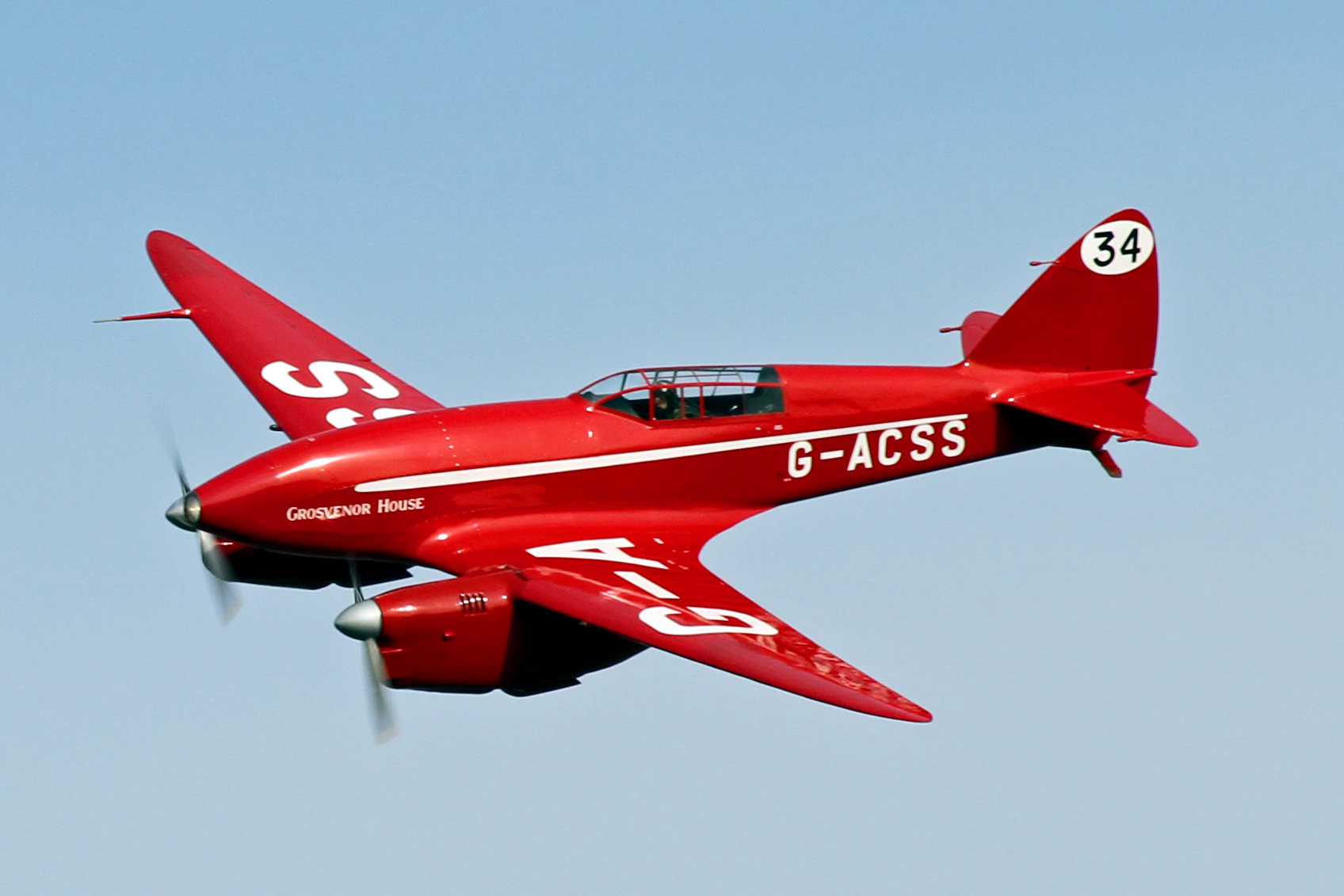
6. De Havilland DH-88 Comet

https://www.baesystems.com/en-media/webImage/20210402153546/1434592519539.jpg


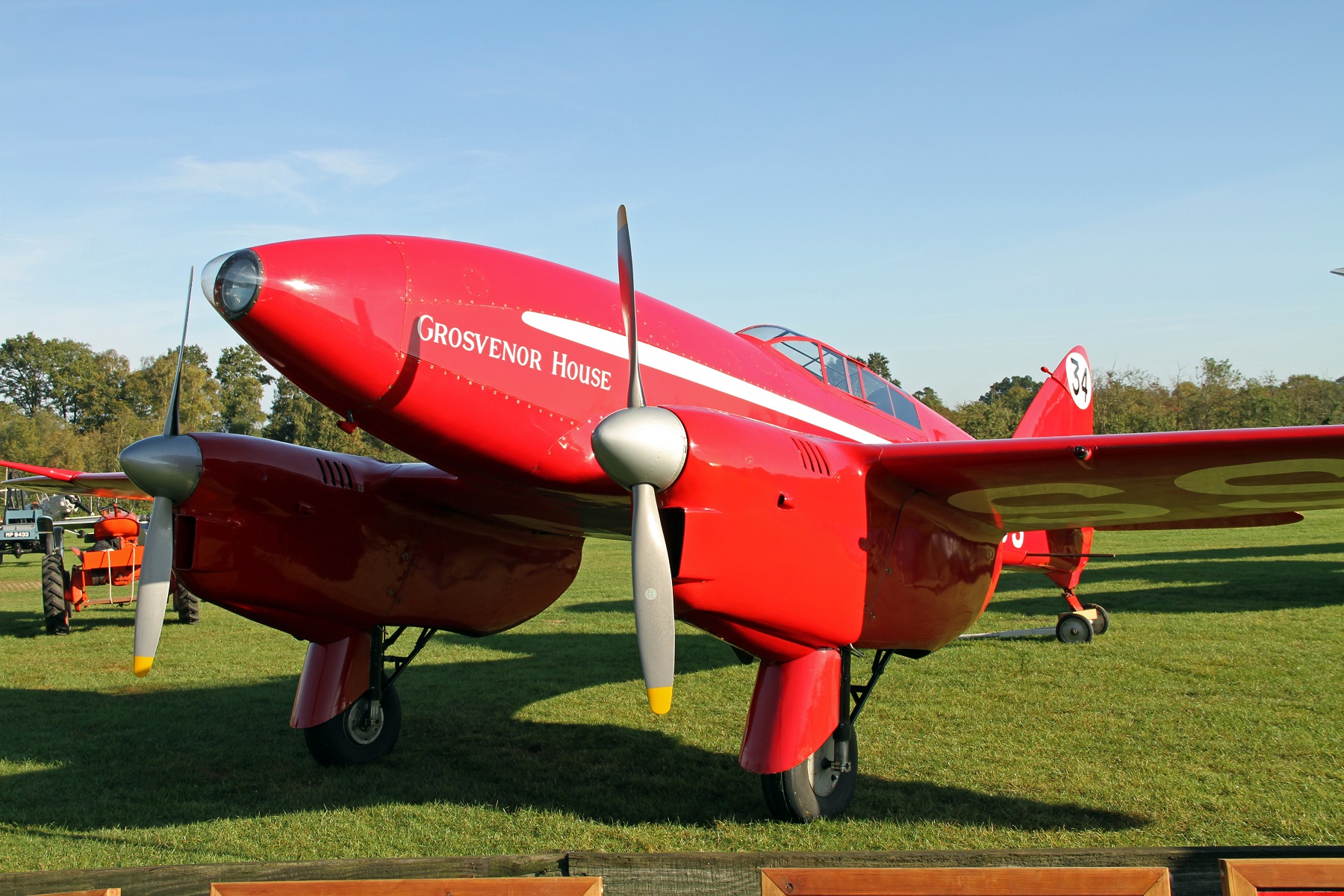
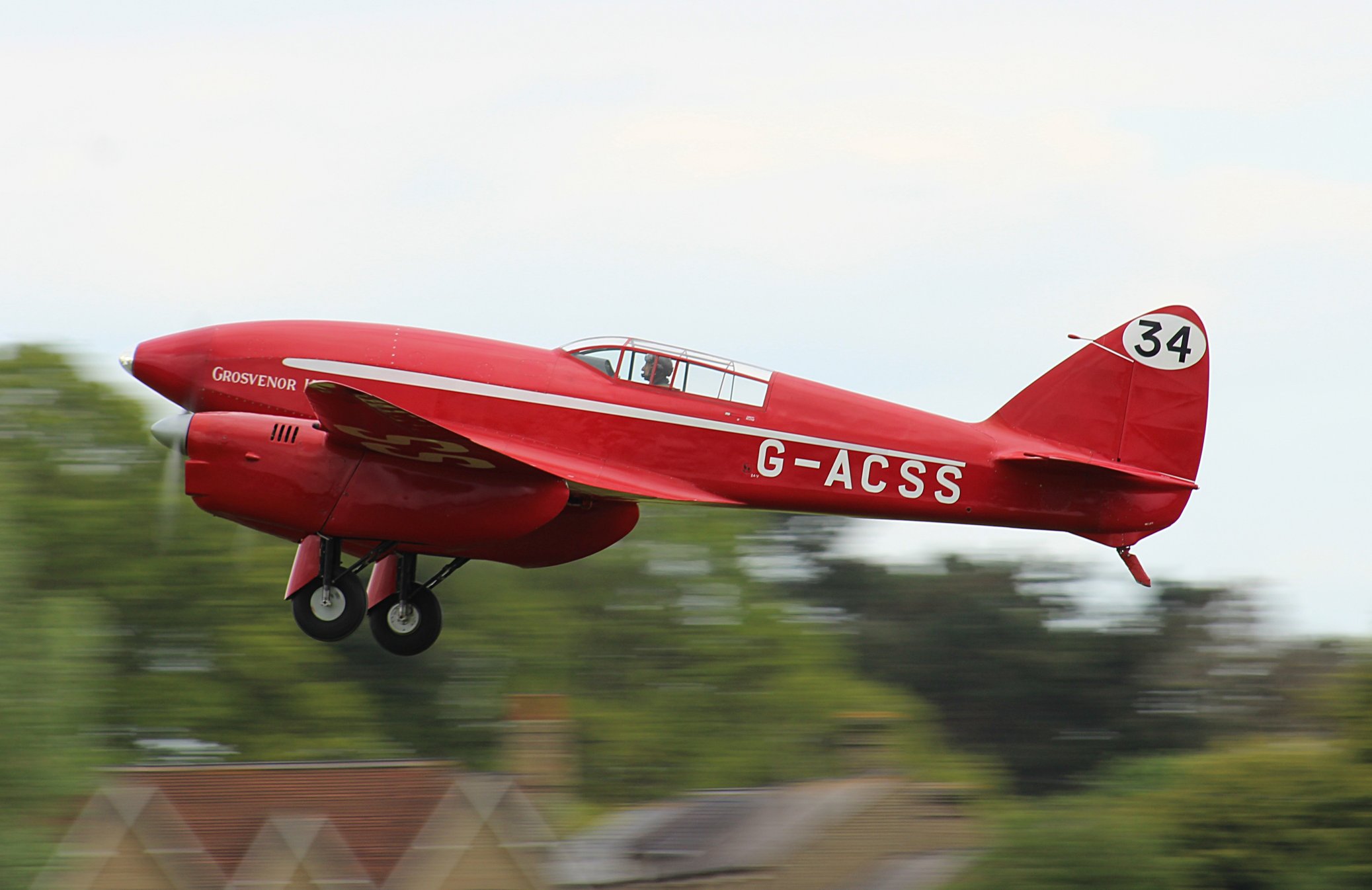
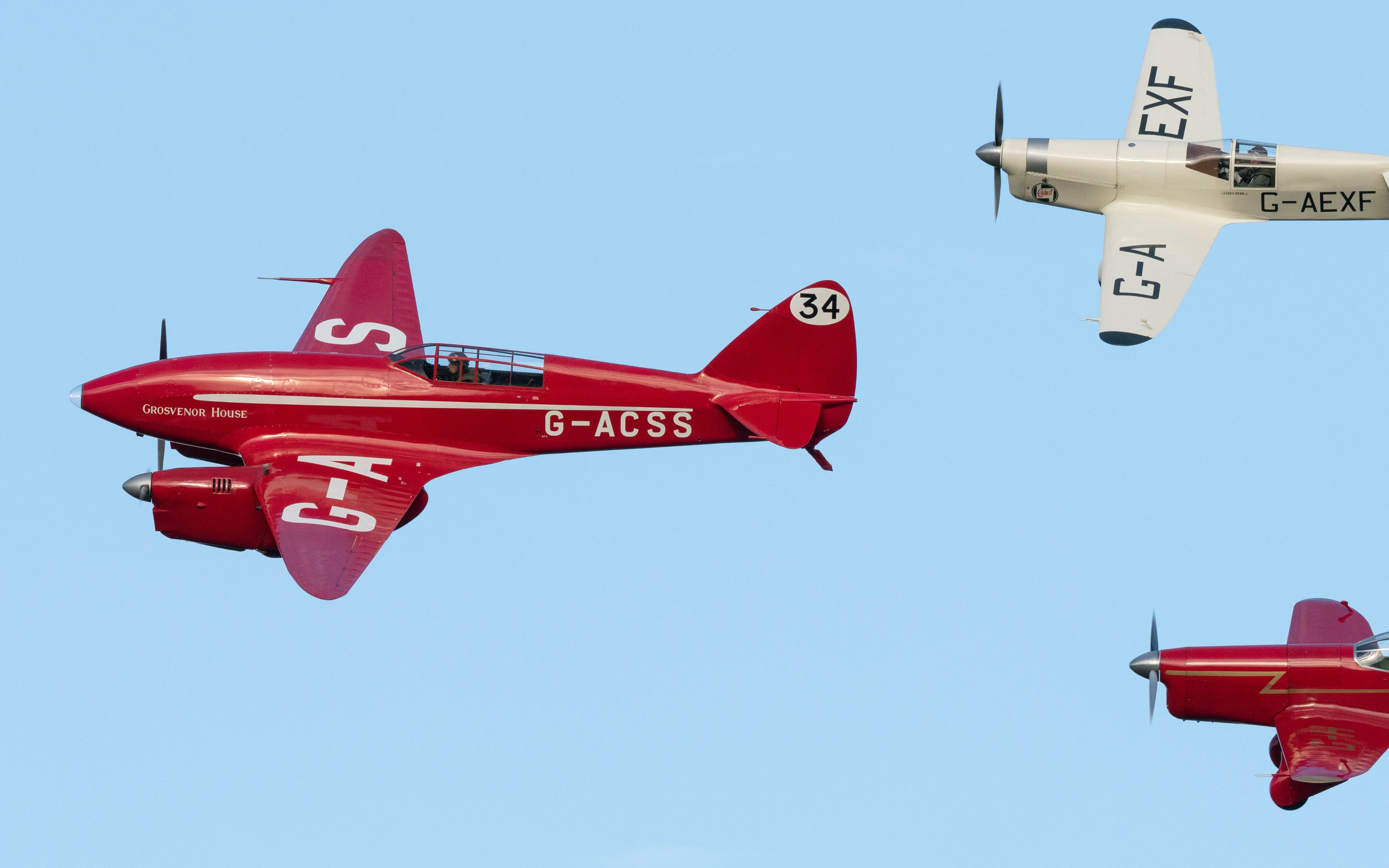
Some extroverted racers roar around the pylons thrilling the crowds, others are lonely soloists performing feats of navigation and endurance out over the dangerous seas, mountains and deserts. The Comet was an utterly elegant example of the soloist. Every time this pretty thing left the ground it seemed to set new records. In fact, the word ‘pretty’ hardly does justice to the most beautiful manmade object ever made. Its supreme achievement was the 1934 England-to-Australia MacRobertson Trophy Air Race.  Barely half a dozen were built, including modern replicas, yet the impression this aircraft left on aviation is remarkable. The Comet is an achingly gorgeous marvel that perfectly encapsulates the look and dynamism of the Art Deco era in living breathing flying form.         
Image
Roger

@Roger_Nock


Image
Ron Smith


Maximum speed: 237 mph
Spiritual equivalent: DH-98 Mosquito 


5. Hawker Sea Fury
https://upload.wikimedia.org/wikipedia/commons/c/c9/HawkerSeaFury_%284544662619%29.jpg

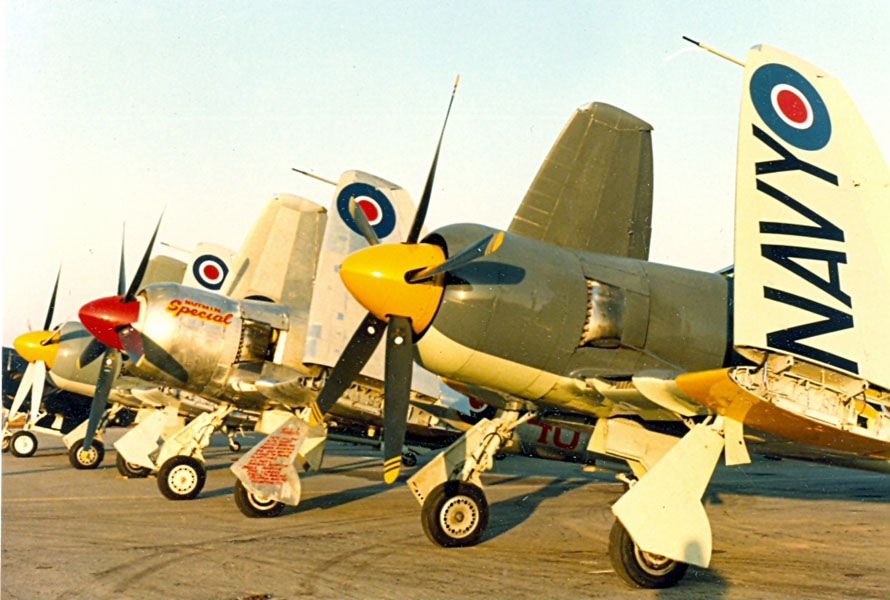
The finest British prop fighter ever built and probably the most potent from any nation, the Sea Fury demands your respect. Built at the zenith of the prop fighter age it was (and still is) one of the fastest piston-engined and blessed with extremely fine handling characteristics. It was an obvious choice for air racing. A dozen or so Sea Furies have been active at the National Championship Air Races held near Reno, Nevada for decades. 

https://upload.wikimedia.org/wikipedia/commons/e/e4/The_Sea_Fury_%22Ruff_Stuff%22_%282826931814%29.jpg

These racing Sea Furies have unique colour schemes and are significantly modified. At various times they have sported clipped wing tips and rudders and lowered cockpit canopies to reduce drag.  Also, their original sleeve-valved Bristol Centaurus powerplants were swapped out years ago for more reliable Pratt & Whitney R-4360 Wasp Majors.  Remember, this engine produces 4,300 horsepower compared to the Centaurus’s output of 2,520.  It was hardly weedy before this soup-up, even with the Centaurus, a Sea Fury was already one of the fastest piston-engined aircraft ever built!

https://upload.wikimedia.org/wikipedia/commons/5/5c/SeaFury8revsd_%284479795854%29.jpg
HUSK-KIT_PACKSHOT_withtrumps_copy.jpg
https://upload.wikimedia.org/wikipedia/commons/b/bb/CPonte_September_Fury_Reno1.jpg


Maximum speed: 403.274 mph (2019 Reno Unlimited Gold category winning speed)
Spiritual equivalent: Grumman Bearcat


4. Scaled Composites Model 158 Pond Racer

Scaled Composites Pond Racer (A race aircraft designed to match WW2  warbirds' speed and replace them in races so that the historical warbirds  weren't lost in race-related races -- 1991): WeirdWings


Warbird enthusiast Bob Pond was horrified at the use of increasingly rare warbirds like the Bearcat, Corsair and Sea Fury in the dangerous world of racing. The enormous stresses placed on modified airframes and engines by racing (to say nothing of crashing) struck Pond as reckless and wasteful. Pond, looking for a solution, turned to aviation freethinker Burt Rutan to build him a prop-driven hot rod that would match the excitement of the old warbirds. Commissioned in the late 1980s the resultant machine was a single-aircraft project powered by two supercharged Nissan automotive racing engines. Sadly, a fatal crash after an oil leak terminated the programme early on, though there was a ton of potential in this exciting design. 


Maximum speed: 400 mph  
Spiritual equivalent: Lockheed P-38 Lightning

3. North American P-51 Mustang

https://upload.wikimedia.org/wikipedia/commons/8/88/Voodoo_P_51_2014_Gold_Champion_photo_D_Ramey_Logan.jpg

Individual Mustangs have been absolute legends of air racing since 1945.  Tweaked here and there, the Mustang remains a natural racer. Clean aerodynamics, near laminar-flow wings and a Packard-built version of the Rolls Royce Merlin contribute to its beastly good performance. Fifteen thousand were built during the war and afterwards, a handy supply of them and their bits and pieces was available.  There was also a community of technicians and enthusiasts able and more than willing to support air racing.  Among competition warbirds only the North American T-6 Texan/Harvard has outnumbered the Mustang. 

A Mustang named ‘Voodoo’ is currently the world’s fastest piston engine plane. It hit a 531.64mph average over two runs in 2017. Hurrah for Merlins! Though due to a clerical quirk the Bearcat still holds the record despite it being slower. Did it have a normal Merlin? Not a very normal Merlin no. It was apparently producing 3100hp (and it broke). I think the key to the Mustang is how slippery it is. And they did a load of fluid dynamic work on the record plane to improve the streamlining further, it has an altered wing profile for instance that apparently raises the critical Mach number allowing for an extra 28mph. The clerical quirk was that Rare Bear flew 528mph in 1989 and garnered the ‘unlimited’ piston engine record. That class of record no longer officially exists, having been replaced by 23 weight categories each with its own record holder. The Mustang gained a record in its own category of 531 but for the ‘unlimited’ record to be declared null and void it had to exceed the previous speed by over 1%. Thus it is the fastest aircraft ever flown but didn’t break Rare Bear’s record. Incidentally, the 531 was an average over two runs – the first run was clocked at 554.69mph (!) over 3kms. That’s pretty quick. The record was flown at about 100 feet!


Maximum speed: 554 mph
Spiritual equivalent: Supermarine Spitfire F. Mk. 24

2. Zivko Aeronautics Edge 540

https://upload.wikimedia.org/wikipedia/commons/2/28/Zivko_Edge_540_at_Red_Bull_Air_Race_on_Langley_Park_Monty-1.jpg


An Edge 540 can climb at ferocious 3,200 feet per minute, which is 400 feet per minute more than a Messerschmitt Bf-109G-6 fighter of World War II. It can turn through a rather alarming 420 degrees in one second. For 15 years the Red Bull Air Races jazzed up the world of air racing and instigated a revival of the sport among the wider public, before its sad ending in 2019. Red Bull’s pylon races combined aerobatics and timed runs over water in exotic locations (and London’s Docklands) with a crowd slightly on edge from the ingestion of free energy drinks. Yes, there was a lot of hype, but the most common aircraft during Red Bull’s heyday was very much the real thing and the pilots were some of the best in the world.

Maximum speed: 260 mph
Spiritual equivalent: Yakovlev Yak-3

1. Condor Aviation White Lightning

Condor Aviation White Lightning - program supplier guide | Airframer


The White Lightning is the first electric aircraft to appear in a Hush-Kit Top 10, and there are many other amazing things about this machine, too. Not only does each set of props contra rotate, but each of the motors driving them also does too! The White Lightning is a heavily modified version of a Cassutt Special, a hot little racing number in its own right. The White Lightning debuted at the Dubai Airshow in 2020 ahead of a much-anticipated all-electric air racing series. 

White Lightning: the worlds first electric racing airplane - ElectricWhip

Industry giant Airbus had thrown its weight behind the Air Race E World Cup before the plague ruined everyone’s fun. Expect to see more of the White Lightning, and its potential rivals, as the world returns to some kind of normalcy.

Maximum speed: 300 mph
Spiritual equivalent: K5054
Image
Chris

@Yellow_Ferret


Analysis of FC-31 stealthy naval fighter

Image

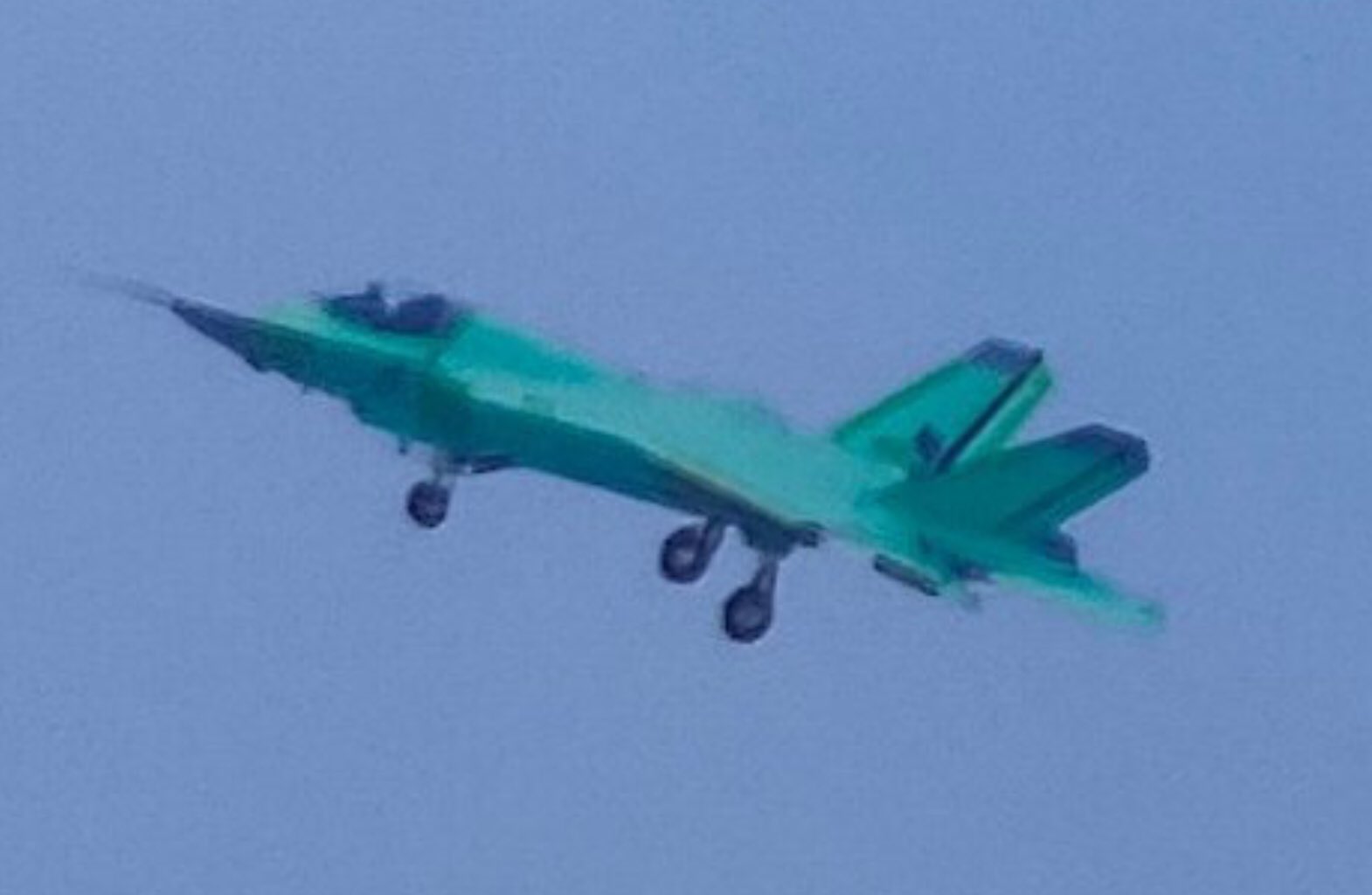
There has been a recent upsurge in social media attention to the Shenyang FC-31, prompted by the release of a photograph of a new carrier-capable variant, with what appears to be folding wings, and a nose undercarriage compatible with a carrier catapult system.

The FC-31 has been variously described in the past, as the J-31 and J-35, designations generally reserved for aircraft in production for the PLAAF or PLANAF. F-60 has also been used, in presentations suggesting that the aircraft would be available for export to Nations unwilling or unable to acquire the Lockheed Martin F-35 Lightning II.

The FC-31 designation is that used by Shenyang, and may change, should the aircraft be ordered into Chinese service. It is used in this article to describe both the prototype aircraft, and the recent carrier-capable variant.

On its first appearance, the FC-31 was greeted by a chorus of suggestions that it was simply a copy of the F-35. I’m not going to weigh into that debate – there are a number of twin-engine concepts and projects, as well as the FC-31, which share common features with either, or both of, the US F-22 and F-35. How much of this is convergence in design given similar requirements, and how much is replication seems, to me to be a moot point.

In the end, the external lines of these aircraft will have a relatively minor impact on their performance as air combat systems. The propulsion system, radar and other sensors, air-to-air and air-to-surface weapons, and their integration, along with external data feeds, into the man-machine interface will be the key to combat effectiveness. Similarly, the integration of defensive aspects, including signature, electronic combat and protection systems, and missile warning and countermeasures systems will be critical in determining survivability. While the aircraft shape will influence its signatures, the electromagnetic tailoring of the aircraft, including treatment of its surface, its intake and exhaust system, and the integration of its sensors and apertures, will all be critical if low signatures are to be achieved.

How does the FC-31 stack up on all these aspects? Well at this stage, I’d suggest much attention is likely to be required. How much, depends on how closely the PLAAF and PLANAF have been engaged, in what has been presented as an independent design by Shenyang. That said, it should also be noted that the development program for the J-20 aircraft appears to have been relatively rapid, although perhaps its operational capabilities have still to be fully revealed.

Since the appearance of quality photographs of the prototype FC-31 appeared, there has been some evidence of ongoing design refinement, which, in this case, may have been spurred by the PLAAF decision to adopt the J-20. This decision may have prompted Shenyang consideration of the development of a carrier-compatible aircraft for the PLANAF, or a version that might be exported.

Carrier-compatible FC-31

The recent photograph shows a new variant of the FC-31, with modifications including a catapult launch bar and folding wings. An Electro-optical Targeting System (EOTS) has also been fitted below the aircraft nose. The modifications are clearly directed at achieving aircraft carrier compatibility, presumably with the new Type 003 carrier, and its systems including the Electro-Magnetic Aircraft Launch System (EMALS) which is fitted, aircraft lifts and hangar spaces. 

The changes to strengthen the undercarriage for carrier launches and landings, and the introduction of folding wings, have increased the weight of the aircraft, and other increases in weight are likely as additional operational capability is introduced in development. As a result, the maximum take-off weight (MTOW) of the aircraft is reported to have increased from 25 tonnes to 28 tonnes. This 12% increase in MTOW is perhaps less than might have been expected, suggesting that provision for some navalisation has been included in the initial design. The twin nosewheels of the prototype may be an example of this, as this design is compatible with a catapult launch bar.

The aircraft, in its development,  is also reported to have had a change in engine from the 86 kN Guizhou WS-13 to the 110 kN WS-19 engine, a significant increase in thrust. Looking at the impact of this, we can compare the Thrust to Weight ratio (T/W) of the earlier and latest aircraft. Given the reported weapons load capability of 8000 kg, 2000 kg of which is internal, and making the assumption that a realistic strike configuration would have maximum fuel and carry only internal stores, we can compare the prototype with WS-13 engines to the carrier-compatible aircraft with WS-19 engines. With these assumptions, the T/W of the prototype is 0.92, and for the heavier and more powerful carrier aircraft, T/W is 1.02. With a lighter air-to-air loadout, the WS-19 powered aircraft would have a T/W in the region of 1.07.

These figures suggest reasonably competitive performance should be achieved, bearing in mind that the figures assume full internal fuel, and internal weapons carriage. Considering the systems aspects, with an Active Electronically Scanned Array radar, the EOTS, and a weapons loadout which is likely to include the long-range, Meteor-like, PL-21 Beyond Visual Range AAM, or a variety of air-to-surface or anti-shipping weapons, an FC-31 carrier-compatible aircraft could well be a very attractive option to equip the new Type 003 carrier.

The work still to be done to develop the full operational capability of the aircraft and its systems, and then to integrate that capability into the broader maritime battlespace would be considerable. That said, such a system would be a very useful asset if required to provide tactical Air Defence and Control over an area such as the South China Sea, or to project power elsewhere, if required.

The time taken to fully realise this potential will depend on how closely Shenyang has been working with the PLANAF in the development of the aircraft. Given the need to complete, fit out, integrate and trial the Type 003 carrier, the FC-31 would appear well placed to equip that vessel, should the PLAN decide to select the FC-31.

In the absence of such an order, the future of the FC-31 does look questionable. A land-based export version would appear to be a better option, given the small number of aircraft-carrier-equipped Navies that would be likely to select a Chinese combat aircraft as their primary Naval Air capability.

Or, to put it another way, the extensive work, and the cost, required to develop the carrier-compatible version of the FC-31, suggests that the PLAN is anticipating ordering the type, and might already be contributing to its development.

– Jim Smith


Top Ten Italian Aircraft of World War Two

Derided by their foes and patronised by their major ally, the armed forces of Italy during World War II have not been given the subsequent level of historical attention they deserve. The Regia Aeronautica entered the war (a little late) fresh from a spectacularly successful campaign in the Spanish Civil War where Italian aircraft had proved to be amongst the world’s best. Second World War Italian aircraft design was often brilliant but was unfortunately dependant on Italian industrial output, which was not. Here is a totally subjective top ten of these relative rarities. Che figo!

10. Fiat G.50 Freccia (‘Arrow’)

Colourization by Michael Jucan

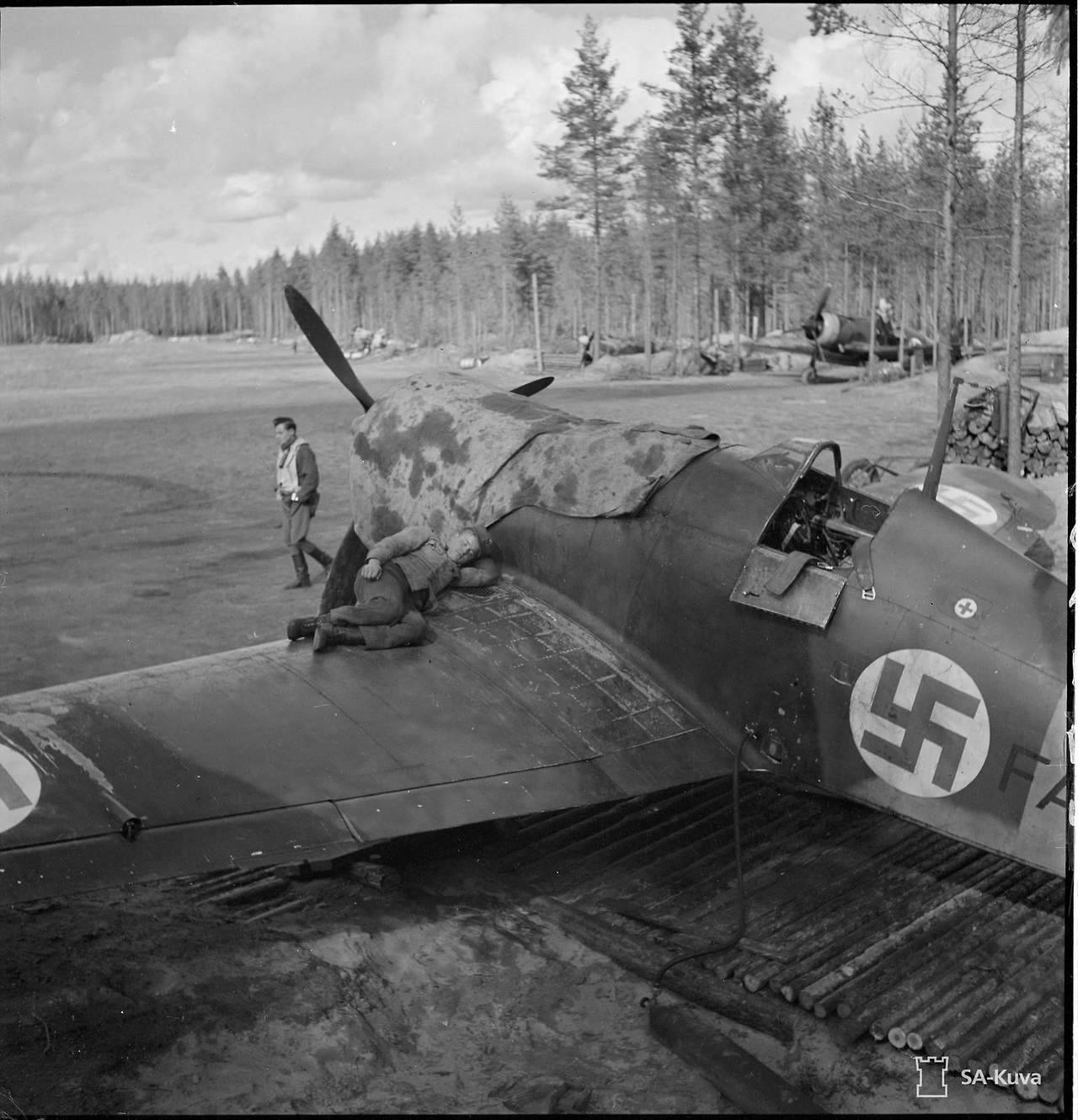
How many Italian fighters achieved a 33/1 kill loss ratio during the Second World War? If your answer to the second question is ‘none’: well, you’re half right – as we shall see. Designed by Guiseppe Gabrielli, who would later rustle up the pretty G.91 jet for NATO use, the Fiat G.50 was the first Italian monoplane fighter and fitted with such amazing novelties as retractable undercarriage and an enclosed cockpit. The latter feature was discarded fairly rapidly, though not, as has often been suggested, due to the highly conservative nature of Italian fighter pilots but rather because it was virtually impossible to open in flight. Even the most forward-thinking and radical fighter pilot is generally in favour of the idea of escaping the aircraft in the event of, say, a massive terrifying fire. Dangerous canopy notwithstanding, 12 examples of the G.50 were sent to Spain to be evaluated under combat conditions although none actually took part in any fighting so this evaluation could be considered inconclusive at best. Gifted to Spain at the end of the conflict these G.50s would later see combat in Morocco but by that time the Freccia had been in action against both the French and British. A few G.50s were committed to the Battle of Britain but despite flying 479 sorties failed to intercept a single British aircraft. The little Fiat did better with Italian forces in North Africa but its career could hardly be described as spectacular.

Sadly for Italy, the amazing kill to loss ratio mentioned above was actually achieved by the Freccia in service with the Finns who operated 33 G.50s from the end of the Winter War, through the Continuation War and on until 1944 when these now quite aged aircraft were withdrawn from the front line. Finnish Fiat pilots shot down 99 Soviet aircraft for the loss of only three of their own, representing the best ratio of victories to losses achieved by any single fighter type in the service of a specific air arm during the war. Despite this amazing achievement Finnish pilots apparently still preferred the MS.406, Hurricane and Brewster Buffalo, not least as the open cockpit of the G.50, whilst pleasant on a Spring day over the Mediterranean was not a particularly attractive place to be in the depths of a Finnish winter – at least they didn’t have to worry about opening the canopy to bale out though. After the G.50s were phased out of service they remained operational as trainers until the end of 1946 when the spare parts supply ran out. The G.50 was, in fairness, a fairly lacklustre aeroplane but who could reasonably ignore that insane 33 to 1 success rate?

Image

9. Savoia-Marchetti SM.79 Sparviero (‘Sparrowhawk’)

https://upload.wikimedia.org/wikipedia/commons/3/3b/Savoia-Marchetti_SM.79_in_formation.jpg

A bit an oldie (in 1940s terms) having first flown way back in 1934, the Gobbo maledetto (‘damned hunchback’, the nickname deriving from the SM.79’s pronounced hump just behind the cockpit) was one of aviation’s great survivors. After setting a swathe of records in the mid 30s the SM.79 became likely the best bomber committed to the Spanish Civil War, outlived the aircraft specifically designed to replace it (the now obscure SM.84) and ended its war as the Axis’ most potent torpedo bomber before relaxing into a surprisingly long postwar dotage. All this whilst enjoying a cosmopolitan existence in some quite unexpected air forces (Brazil anyone?) and like the best old stagers, the Sparviero defied expectation – although it has become aviation history’s archetypal trimotor bomber, the wonderfully ugly Romanian built SM.79JR was a twin (and the fastest of the lot). Although very fast by world standards during the conflict in Spain, the SM.79’s primary attributes during the Second World War were its sturdy construction and excellent reliability, neither of which represented a quality associated with Italian engineering in general.

Savoia Marchetti SM 79 Sparviero in volo.jpg

In action during the Spanish Civil War the Sparviero proved highly effective and more or less immune to interception, which was lucky as the Italians did not possess a fighter fast enough to escort it. Of the 100 or so aircraft committed to Spain only four were lost on operations. Early operations during WWII were quite successful but the SM.79’s great speed advantage had evaporated by 1940, operating against the latest British fighters over North Africa and Malta, the SM.79’s reputation for apparent invulnerability was lost. Nevertheless, it remained a reliable if unspectacular medium bomber for the duration of Italy’s involvement in the war. However, as a torpedo bomber the SM.79 suddenly found itself in intense and effective action, gaining considerable fame at home in the process. The torpedo version of the Sparviero dispensed with the draggy ventral gondola containing the bomb aimer and resulted in a faster aircraft and although able to carry two air-launched torpedoes, only one was ever carried on combat missions. The SM.79s sank a considerable amount of Allied shipping and damaged much more, notably the battleship Nelson, and the best year for the Aerosiluranti torpedo units was 1941 when during the course of 87 attacks, nine ships totalling 42,373 tonnes were sunk and another 12 were damaged. The top Sparviero torpedo pilot was Carlo Emanuele Buscaglia, credited with over 90,718 tonnes of enemy shipping sunk and much decorated. Buscaglia was shot down and presumed dead on 12 November 1942. As a result, after the Italian armistice, an anti-shipping unit, the 1° Gruppo Aerosiluranti, was named in his honour by the Fascist Aeronautica Nazionale Repubblicana (ANR). Ironically however Buscaglia had actually survived, and was serving in the Co-Belligerent Air force, fighting alongside the Allies. The SM.79 continued to operate as a torpedo aircraft until late 1944 when the last two surviving ANR Sparvieros flew the final mission on 26 December, bowing out with a flourish by sinking a 5000-ton vessel off the Dalmation coast.

In addition to Italy the SM.79 flew with Yugoslavia against the Germans, in twin-engine form with Iraq against the British and with Brazil. Romania went the whole hog and licence-built their own twin-engine version which they used against the Soviets. Probably the most surprising operator was the RAF, four SM.79s flew in British colours with 117 squadron from May to November 1941. After the war the tiny nation of Lebanon (an SM.79 could traverse the entire country from west to east in 14 minutes) bought four Sparvieros and flew them until 1965, representing the last Italian WWII aircraft in service anywhere in the world. Both surviving SM.79s are ex-Lebanese aircraft.

You can still order Volume 1 here

As an interesting but totally irrelevant aside, one of the Sparviero‘s wartime pilots was Capitano Emilio Pucci who would later gain considerable fame as one of Italy’s most successful fashion designers. As well as producing the first one-piece skiing outfit, Pucci bridged the fashion/aviation divide when he designed six complete collections for Braniff Airways’ hostesses, pilots and ground crew between 1965 and 1974. Marilyn Monroe was also a fan, ultimately she was interred in a Pucci gown. Pucci died in 1992 at the age of 78 but the design house that bears the name is still going strong.

8. Fiat CR.42 Falco (‘Falcon’)

CR.42 Falco

A ludicrous, conceptually outdated dinosaur or a fighter ideally suited to the specific operating conditions in which it found itself? The CR.42 was, like its great adversary the Gloster Gladiator, arguably both. Fiat had been happily building a succession of effective and successful biplane fighters bearing the initials of designer Celestino Rosatelli since the CR.1 of 1923. All featured distinctive w-shaped warren-truss struts which eliminated the need for virtually all bracing wires and the CR.42 was the logical culmination of this line, a line that would likely have continued had not the Second World War cruelly stamped out any future for the biplane as a viable combat machine. Featuring a radial engine in place of the V-12 unit of its immediate predecessor, the CR.32, the Falco appeared too late to see combat use in the Spanish Civil War, a conflict which had already made plain the shift from biplane to monoplane fighters was effectively inevitable. Despite this, and proving Fiat’s canny awareness of the world fighter market, the CR.42 enjoyed considerable export success with significant orders being placed by Hungary, Sweden and Belgium, the latter two nations operating the Fiat alongside the Gloster Gladiator and it was in Belgian service that the CR.42 first fired its guns in anger. In the brief Belgian campaign Falcos scored five confirmed kills, including two Bf 109s, before the country fell to the Germans but this would not be the last time the Fiat flew against Axis forces. In the meantime there followed an extremely busy couple of years for the Fiats with their nation of origin.

In June 1940, Mussolini’s tardy (and ultimately fatal) decision to join Germany in the invasion of France saw the CR.42 committed as an escort fighter to a brief series of spectacularly successful bombing raids on French airfields. In air-to-air combat with French monoplanes the Falco fared adequately: five CR.42s were lost in exchange for eight (though possibly as high as 10) French fighters. Later the same year the East African campaign saw the pinnacle of the Falco‘s career as the three squadrons committed to the theatre tangled for the first time with the RAF and came out decisively on top, for example on one occasion in November CR.42s tangled with RAF Gloster Gladiators and destroyed seven for no loss. The top-scoring biplane ace of the Second World War, Mario Visintini, scored all but two of his 16* officially credited victories during this campaign. Over North Africa and Malta the Falco proved adequate, capable of dealing with the Hurricane if well handled (RAF units were forced to come up with tactics specifically to deal with such a manoeuvrable foe), and during the invasion of Greece the CR.42s demolished the defenders: officially destroying 162 aircraft destroyed for the loss of 29 of their own. Slightly later the Royal Hungarian Air Force took its CR.42s into action on the Eastern Front and during six months of action the Hungarian Fiats shot down 24 Soviet aircraft for the loss of only two CR.42s. Over the course of 1941 however, it was becoming increasingly clear that the Falco simply did not have the performance necessary to deal with modern monoplane fighters and it increasingly switched, very successfully, to the ground attack role. The fine handling and outstanding manoeuvrability of the CR.42 allowed it to evade both fighter attack and ground fire at low level and the Falco proved a highly accurate close support asset. So effective was the aircraft that after the Italian capitulation of 1943 German authorities had the CR.42 returned to production for Luftwaffe use as light night attack bombers: an order for 200 CR.42LWs, purpose-built for nocturnal use was placed with Fiat in Turin of which around 112 were completed. Meanwhile some CR.42s flew operationally with the Italian Co-Belligerent Air Force alongside Allied forces in the Balkans. Most Co-Belligerent use was as a training aircraft but the Falco became one of very few combat aircraft to have fought alongside the Luftwaffe, fought as a part of the Luftwaffe, and fought against the Luftwaffe

Swedish Air Force Fiat CR.42/J 11 Falco (Fv 2543) at the Swedish Air Force Museum (Flygvapenmuseum) near Linköping

In contrast to the Gloster Gladiator which was built in comparatively small numbers, the seemingly outdated Fiat was manufactured in greater numbers than any other Italian aircraft of the war with just over 1800 known to have been built. One of only three serious contenders for the title of best biplane fighter of WWII, the CR.42 was more useful and effective than its manifest conceptual obsolescence would have one believe.

*Subsequent research by aviation historian Christopher Shores, suggests that Visinitini’s total was higher than that officially recognised at the time and that he actually destroyed 20 enemy aircraft.

7. Macchi MC.200 Saetta (‘Lightning’)

Ground crew adding ammunition to the C.200 Saetta.

In the late 1980s, I was a very young aviation enthusiast and still believed all the jingoistic popular myths bandied around about most of the aircraft of WWII, such as ‘all Italian aircraft were shit’. It came as a great shock to me therefore to read in Bill Gunston’s ‘Combat Aircraft of World War II’ (Salamander Books 1978) the words “in combat with the lumbering Hurricane it proved effective, with outstanding dogfight performance and no vices”. Lumbering Hurricane?! Outstanding dogfight performance?! I was aghast and amazed and although I didn’t realise it at the time, the concept of history being subject to nuance, interpretation and outright falsehoods had been subtly introduced into my brain. The aircraft inadvertently responsible for this Road to Damascus style aviation-history awakening was the Macchi MC.200 and it remains, (probably coincidentally, though who knows?), one of my all-time favourite aircraft. Possessed of a charmingly bumblebee-like aesthetic the Saetta was, like the Spitfire, the fighter follow-on to a swathe of fast, radical and highly successful seaplane racing aircraft built to compete in the Schneider Trophy air races. Unlike Reginald Mitchell’s Spitfire, which resembles its floatplane ancestors quite closely with Rolls-Royce V-12 engine and slender airframe, the Saetta was radial powered and looked nothing like its Macchi MC.72 forebear despite both being the work of the great designer Mario Castoldi. Powered by the Fiat A74 radial, like the slightly earlier G.50 Freccia, the MC.200 made much better use of this reliable but only modestly powerful engine. A relatively small aircraft, the MC.200 followed the precedent set by the G.50 by initially appearing with a cutting edge enclosed cockpit but having this feature discarded in short order. The armament was typical of contemporary Italian fighters in that it was pathetic, two 12.7 mm (.50-in) machine guns, but this was actually double the armament specified in the original specification. At least the pilot had an indicator in the cockpit showing how much ammunition was left. An unusual feature was that one wing was slightly longer than the other to cancel out the rotation of the propeller. Rather than simply counteracting the torque, the enlarged left wing put the asymmetric force created by the airscrew to useful work by generating lift. Initially the Saetta was something of a handful, prone to entering an unrecoverable spin, but adoption of a different wing profile solved the problem before Italy entered the war and the aircraft’s handling was effectively viceless.

Entering service in the summer of 1939, the MC.200 was either the third or fourth best operational fighter in service anywhere in the World at the outbreak of war (after the Bf 109, Spitfire and depending on your opinion, the lumbering Hurricane) but by the time Mussolini stopped dithering and jumped in on the side of Germany a whole bunch of new fighters had appeared that were at least as good, such as the Curtiss P-36 and Dewoitine D.520. Italian industry had suffered in the past from a lack of standardisation and as a reaction to this the MC.200 remained in production virtually unchanged from the first examples in 1939 all the way through to Italy’s capitulation in 1943 (the final examples produced as a back-up to more advanced fighters that were held up by shortages of the Alfa Romeo R.A.1000 Monsone engine) and as such the Saetta was overtaken and then gradually left behind by the pace of fighter development. The worldbeater of 1940 was a distinctly pedestrian performer by 1943. Nonetheless during the three years the Regia Aeronautica were in action in WWII the Saetta flew more combat sorties than any other Italian type and, initially at least, was highly successful. Over North Africa the Macchi could outmanoeuvre both the P-40 and Hurricane, the most numerous Allied fighters in the theatre, the airframe was rugged and performance was roughly equivalent, especially in the case of the Hurricane which had its speed impaired by the adoption of a large dust filter necessary for operations in the desert. Like many early war fighters the Saetta saw its role shift to the ground attack role and it first saw action as a fighter bomber in North Africa. Bomb armed MC.200s managed to sink the British destroyer Sikh off Tobruk in 1942. Over the Eastern Front the MC.200 made up a significant part of the Italian Expeditionary force which downed 88 Soviet aircraft in exchange for 15 of their own. 

After 1943 Saettas saw service briefly with the Co-belligerent Air Force in the close support role but both Italian factions employed the MC.200 as a trainer, a function the Macchi would fulfill until 1947. 

6. CANT Z.506B Airone (‘Heron’)

What could be better than a slender Italian trimotor bomber? Why, a slender Italian trimotor bomber on floats of course. Although in the Z.506’s case, it was one of the vanishingly few seaplanes to be developed into a successful landplane rather than the other way round, in 1939 a developed version of the design entered service (on land) as the Z.1007 Alcione. Designed by Filippo Zappata, the Z.506 was one of the last frontline aircraft to utilise classic wood construction for the majority of the airframe. Starting life as a 12-seat commercial aircraft, the Z.506 which immediately set a bunch of speed, range and payload records. Fifteen examples of the original airliner saw service with Ala Littoria. The Z.506B was the military version with more powerful engines, a raised and enlarged cockpit, and featuring a long ventral gondola which contained the bomb aimer, the bombload itself and a defensive gun position at the rear. The Z.506B then followed up the record breaking feats of the civil version by setting a few records of its own including an impressive nonstop 7020km flight from Cadiz to Carravelas. A few saw service in the Spanish Civil War thus starting a twenty four year frontline career, almost unheard of for an aircraft of this vintage. 

Despite its wooden construction, the Airone was noted for its ability to operate in unusually rough seas and was kept busy throughout the Second World War, raiding coastal installations, attacking shipping with torpedoes, engaging in long range maritime patrol and reconnaissance and occasionally acting as a transport and communications aircraft,a role for which its commercial origins made it well suited. A dedicated air-sea rescue version was developed, designated the Z.506S (S for Soccorso ‘rescue’) and these were responsible for saving 231 people during 1940-42. Despite being marked with large red cross markings, the rescue Airones were regularly attacked and shot down by British fighters. After the Italian capitulation, Z.506s were operated by both sides in Italy with the Luftwaffe using them for patrol duties over the Baltic, based at Peenemunde, and air sea rescue out of Toulon. After 1945, the Z.506 soldiered on well into the Cold War, despite its wooden structure and outdated performance, it remained highly effective in the air sea rescue role due to its excellent endurance and seaworthiness, the last examples were retired as late as 1959. The longevity of the Airone was reflected in the life of its designer, Fillipo Zappata was 100 years old when he died in 1994.

Despite its many years of yeoman service, the Z.506B is probably best known these days, in the anglophone world at least, as the only aircraft in the west to be successfully hijacked by prisoners of war. On 29 July 1942 a Z.506B rescued the crew of a ditched Bristol Beaufort. During the subsequent flight to Taranto the British airmen overpowered their Italian rescuers and flew the aircraft to Malta instead, it subsequently entered RAF service, joining two other captured Airones on RAF strength. 

5. Macchi MC.205V Veltro (‘Greyhound’)

https://upload.wikimedia.org/wikipedia/commons/f/f8/Macchi_MC-205V_Veltro%2C_Italy_-_Air_Force_JP6942435.jpg

The culmination of a distinguished line of Macchi fighters that began with the MC.200, the Veltro combined the excellent Daimler-Benz DB.605 engine (in licence built form as the Fiat RA.1050 R.C.58 Tifone) with the beautiful handling of the Macchi MC.202 Folgore (itself essentially a Saetta re-engined with a DB.601 V-12) to produce an airframe well up to world standard. It was also the first Italian fighter of the war to feature an armament that wasn’t pitiful, boasting instead a standard fit of two 20-mm cannon and two 12.7mm (.50 in) machine-guns. Although inferior to both of its contemporaries, the Re.2005 and G.55, the Veltro was still a magnificent performer, well up to international standards and, – importantly, as a developed version of an aircraft already in mass production (or what passed for mass production in wartime Italy), was able to be produced in decent numbers immediately: 146 examples of the MC.205V made it into Regia Aeronautica units before the Italian capitulation compared with 35 Fiat G.55s and less than 50 Re.2005s. Ultimately more examples of the G.55 would be built but the MC.205V saw much more service while Italy was still a single nation and wholly part of the Axis.

In action Veltro pilots were very successful. As a developed version of an extant type, the aircraft’s handling was a known quantity to many of its pilots who were already flying the MC.202 – and the Macchi handled exceptionally well. Noted British test pilot Eric Brown stated “One of the finest aircraft I ever flew was the Macchi MC. 205 … It was really a delight to fly, and up to anything on the Allied programme.” In its ‘Serie V’ form sported one of the world’s best aero-engines and it was well armed. The top-scoring MC.205 pilot was Sergente Maggiore pilota Luigi Gorrini who officially destroyed 14 aircraft in the Veltro and Italy’s most successful WWII fighter pilot Major Adriano Visconti shot down 11 of his 26 confirmed victories in the MC.205. At the time of the Italian armistice only 66 MC.205s remained airworthy, six of these flew to join the Allies, the remainder being taken into the service of the Aeronautica Nazionale Repubblicana, the air arm of the Italian Social Republic. Macchi built a further 72 Veltros for ANR service. The Luftwaffe also flew a few MC.205s for a couple of months in late 1943 but were not hugely enthusiastic about the aircraft. Despite praising the speed and handling of the Veltro, they were scathing of its unreliable radio and the slow refuelling and rearming times. Only one confirmed ‘kill’ was made by a German operated MC.205V when a P-38 Lightning was downed on 1 December 1943. 

The Veltro served on in postwar Italian service until 1955, the last being built as late as 1951, and a few new build aircraft were constructed for supply to Egypt. An act that provoked the bombing of a hangar in Italy by Israeli secret services, destroying three MB.308s and one MC.205. Revenge of a sort came during the 1948 Arab Israeli war, when an Egyptian Veltro downed an Israeli P-51D on 7 January 1949. 

4. Piaggio P.108

https://i.redd.it/u4l6di2hjiyy.jpg

Curiously, none of the Axis nations showed any great interest in strategic bombing. Germany and Japan both viewed military aviation as primarily a tactical adjunct for armies in the field (or navies in the case of Japan) and the only heavy bomber to be built in numbers was the Luftwaffe‘s problematic Heinkel He 177 Greif. However, another large strategic bomber was built by the Axis: the Piaggio P.108B (B for Bombardiere), and it was lucky indeed for the Allies that it was manufactured in trivial numbers, for it ranked amongst the world’s best. First flown in 1939, one of the P.108’s test pilots was Bruno Mussolini, son of Benito, who lost his life in 1941 when he crashed one of the brand new bombers into a house. Despite this unfortunate accident it was clear that Piaggio’s heavy bomber was an outstanding aircraft, comparing very well with the latest Allied ‘heavies’. With a top speed just under 300 mph it was slightly faster than a Lancaster or a B-17, carried a bombload about halfway between the two and boasted a similar range capability. Unlike most Italian aircraft it sported a powerful and technically advanced defensive armament, including remotely controlled turrets on the outer wings. The aircraft was also immensely strong, having been built to a 6G load factor, a level more appropriate to contemporary fighters (the Spitfire I’s wing was partly built to this very specification) than a 32 metre span four engined bomber. This level of over-engineering led to an aircraft with an arguably overweight structure but the sheer strength of the airframe undoubtedly contributed to crew confidence in their unusually robust machine.

Support this site and have a gorgeous book. Pre-order here.

The P.108’s single greatest fault was its scarcity. Only 24 examples of the bomber variant were ever constructed and missions were undertaken in a rather desultory fashion. Flying against well-defended Allied targets such as Gibraltar and bases in Algeria occupied in the wake of Operation Torch, several P.108s were on the receiving end of Beaufighter night-fighter attacks. In total, five (or possibly six) of the Piaggios were lost to enemy action, the last two in attacks on Allied forces during the invasion of Sicily. However, the bomber was only a part of the P.108 story, as the aircraft was also produced as a transport aircraft and, somewhat surprisingly, as a pressurised transatlantic airliner. The latter aircraft was the P.108C, ordered in 1940 and intended to carry 32 passengers. It first flew in 1942 and despite both Piaggio’s inability to deliver the bomber variant and the fact that Italy was now at war with the USA, the very nation it was intended to fly to, five production examples were ordered. More sensibly the P.108 was produced as a straightforward military transport, the P.108T, which could carry up to 60 troops and boasted the impressive ability to carry two partially dismantled MC.200 fighters (or 12 tonnes of less exciting cargo). Production of the transport variants under German control and most of the 12 P.108C and Ts constructed saw extensive use with Transportfliegerstaffel 5 of the Luftwaffe, proving particularly invaluable during the withdrawal from Crimea, and surviving examples saw service until the end of hostilities.

Most spectacular of all was the P.108A (A for Artigliere) which mounted a 102-mm gun in the nose for the anti-shipping role. Though the gun and its anti-recoil equipment functioned well in testing, the wisdom of attacking ships at low level in a 30-tonne, 32-metre span heavy bomber seems questionable at best. The armistice of 1943 ultimately put paid to the programme and the sole P.108A was likely destroyed by Allied bombing at the German test centre at Rechlin.

3. Reggiane Re.2005 Sagittario (‘Archer’)

https://www.asisbiz.com/il2/Re2005/Reggiane-Re2005-Sagittario/images/Reggiane-Re2005-Sagittario-MM092352-Northern-Italy-1944-01.jpg

Had Mussolini not thrown in his lot with Hitler and invaded France in May 1940, Reggiane would have built 300 Re.2000 Falco fighters for the RAF, which seems somewhat crazy given that a mere three years later the much more potent Re.2005 Sagittario was besting the Spitfire over the skies of Sicily. In stereotypical fashion, underwhelming Italian industrial performance saw the exceptionally promising Sagittario produced in pathetic numbers (of 750 ordered, 54 were built) and flown in combat by only one unit. The most exciting looking of the Serie V fighters powered by the Fiat built Daimler Benz DB 605 engine, the Re.2005 was a logical development of the slightly humdrum Re.2001 Falco II which was slower than it looked and outperformed by contemporaries on both sides. The Re.2005 also maintained an unfortunate feature of the earlier aircraft in that it was a complicated airframe, both time consuming and expensive to build which is small potatoes if you had the massive industrial capacity and wealth of, for example, the US but Italy in the 1940s was industrially puny and seriously strapped for cash. What Italy had no shortage of though, then as now, was design flair and the Re.2005, whilst being absolutely the wrong fighter for its nation of origin in a pragmatic sense, possessed the effortless thoroughbred chutzpah of a mid-60s Maserati. And the looks seem to have been borne out in action for although the Sagittario‘s combat career was unsurprisingly brief, it made quite an impression on friend and foe alike. Officially rated the best flying of the trio of similar looking Italian contemporary fighters fitted with the DB.605, the Fiat G.55 was preferred as it offered only minimally inferior performance whilst being considerably easier to mass produce (hence too the G.55’s higher rating on this list), both being considered superior to the MC.205V. 

The Re.2005 saw combat for the first time on 2 April 1943 when the prototype was used to intercept B-24 Liberators attacking Naples. The first confirmed kill scored by a Sagittario occurred on 28 April and Italy capitulated on 8 September so the handful of Re.2005s saw essentially four months of operational use. During that period they proved superior to contemporary MC.205 fighters in attacking high flying American bombers. Both aircraft had the same engine but the Reggiane had a considerably greater wing area allowing it to manoeuvre more effectively at altitude. The only fault the aircraft possessed was a propensity to experience flutter in the tail at speeds above 680km/h. Work undertaken to solve the problem was apparently successful as test pilot Tullio de Prato allegedly dived an Re.2005 to the incredible speed of 980 km/h with no loss of control and experienced no flutter in July 1943. Italian pilots loved it and German test pilots were (grudgingly) impressed. Meanwhile on the Allied side RAF Wing Commander Wilfrid Duncan Smith said “The Re.2005 ‘Sagittario‘ was a potent aircraft. Having had a dog-fight with one of them, I am convinced we would have been hard-pressed to cope in our Spitfires operationally, if the Italians or Germans had had a few Squadrons equipped with these aircraft at the beginning of the Sicily campaign or in operations from Malta.” Praise indeed. Ultimately of course it didn’t matter how amazingly good the aircraft was, like many other Italian types the fact that production didn’t even make it into triple figures rendered the Re.2005 essentially irrelevant. 

2. FIAT G.55 Centauro (‘Centaur’)

https://hushkit.net/wp-content/uploads/2013/12/fiat_g55_centauro.jpg

The best Italian fighter of the war, the Fiat G.55 was so good that a team of German experts came to the conclusion that it was the best fighter in the Axis, possibly the world. Kurt Tank, designer of the Fw 190 had nothing but praise for the G.55 and went to Turin to look at its potential for mass-production. Sadly for the Axis it was pointed out that the Fiat took three times as long to build as a Bf 109, and whilst the Centauro was a better fighter, it wasn’t three times better and production plans were abandoned. Compared to its Reggiane and Macchi contemporaries, the Fiat suffered fewer teething issues, was easier to build than the complicated Re.2005 and demonstrated better altitude performance than the MC.205. A mere 35 were delivered before the armistice of 8 September 1943 and the few pilots lucky enough to fly these aircraft in combat were delighted with the new Fiat fighter. The 353a Squadriglia commanded by Capitano Egeo Pittoni and charged with the defence of Rome was the only Regia Aeronautica unit to operate the G.55 for longer than a few days and over the summer of 1943 this unit utilised the Centauro‘s excellent altitude performance to good effect against American bombers. The Fiat featured three 20-mm cannon supplemented by two 12.7 mm (more familiar to the metrically challenged as .50-cal) machine guns which represented a terrific punch for a mid war single engine fighter and totally overturned the stereotype of the underarmed Italian fighter. More relevantly it was more than adequate to bring down an American heavy bomber.

After its brief but eventful Regia Aeronautica service many examples were confiscated by the Luftwaffe and the G.55 continued to be used by the Fascist Aeronautica Nazionale Repubblicana (except for a single example that flew south to join the Allies) and remained in production at Fiat’s Turin factory. Ultimately 274 examples were built during the war and the Centauro formed the equipment of four ANR frontline fighter squadrons, details of Luftwaffe usage remains obscure but the type was apparently flown operationally by German pilots. After a year or so it was replaced in Italian units by the Bf 109G, much to the chagrin of pilots.

The end of hostilities did not see the end of the G.55 for, like its great rival the MC.205, but in contrast to nearly all other Axis combat aircraft, the G.55 returned to production in 1946, a further 74 examples of the original wartime design being built. These served with the postwar Italian air force as well as with Syria, Egypt and Argentina. Syrian and Egyptian G.55s seeing combat against Israeli aircraft. Stocks of the Fiat RA.1050 engine (a licence-built Daimler Benz DB 605) were running low so the decision was made to develop a Rolls-Royce Merlin powered version of the aircraft which entered production as the G.59. The new version proved successful enough that all remaining G.55s were converted to G.59 standard and the Merlin-powered aircraft served as an advanced trainer in Italy from 1950 to 1965. This represents an astonishing longevity of production and service for an Axis fighter, rivalled only by Spain’s Bf 109-derived lash-up, the Hispano Buchon (similarly Merlin powered) but the G.59 was a better engineered design and a much nicer aircraft to fly than the Buchon. At least two examples of the G.59 remain in airworthy condition in 2021. At the time of writing one of them was up for sale, so if you happen to have a spare million or so Euros, an example of the ultimate development of an Italian WWII fighter could be yours

1. Savoia-Marchetti SM.82 Kanguru (‘Kangaroo’)

https://upload.wikimedia.org/wikipedia/commons/7/70/Savoia-Marchetti_SM.82_02.jpg

This corpulent machine was the best transport aircraft of the Axis to see production in any numbers. So useful was it that after 1943 large numbers served both the Allies and Germany and the Kanguru remained in service with the Italian air force until the early 1960s. Neither glamorous nor particularly attractive, the SM.82 was however likely the most useful aircraft produced by Italian industry during the conflict. First flown in 1939, the SM.82 was a development of the earlier SM.75 Marsupiale airliner, itself a highly capable trimotor transport which saw considerable wartime service, including several extremely long-range flights such as a 6000km non-stop flight from German occupied Ukraine to Japanese occupied Mongolia. The Kanguru maintained the inexplicable antipodean naming convention but lost the svelte lines of its elegant predecessor. A double-deck fuselage was adopted with seats for 32 passengers on the upper deck and room for freight on the lower. The Kanguru was also the last example of a very 1930s design trend: the bomber-transport. Other examples of this dual-role type included the Handley-Page Harrow, Bristol Bombay and the other major transport design of the Axis, the Junkers Ju 52/3m. Combining two roles in one made sound fiscal sense during the economically dark years of the 1930s and was particularly attractive for a not-particularly wealthy nation like Italy. As such the Kanguru sported large bomb bay doors which doubled as a handy access feature for loading heavy freight into the capacious lower deck, nine sections of its wooden floor were detachable to facilitate this ability. If called upon to function as a bomber it could carry an impressive bombload of up to 4000kg. Its modern external appearance belied a quite old-fashioned construction, no fancy monocoques or stressed skin here, the SM.82’s fuselage consisted of a steel tube framework covered in sheet metal over the forward fuselage but plywood and fabric elsewhere, much like a massively enlarged Hawker Hurricane. The wing however, was almost entirely constructed of wood. 

In the same year as its first flight the prototype SM.82 caused something of a stir by flying for 10,000km non-stop in 56 hours 30 minutes. Production aircraft began to be received by the Regia Aeronautica during 1940 and the type was in great demand for the duration of the war, not least as there were never enough of them thanks to typically dismal rates of industrial output. The Kangurus were kept busy throughout 1940 and 41 supplying Italian forces in East and North Africa, one of the most notable transport actions taking place during the latter half of 1940 as SM.82s supplied 51 complete CR.42 fighters with a further 51 spare engines to East Africa. The early war years also saw the Kanguru perform several audacious bombing missions such as attacks on Gibraltar but the most spectacular of all was a raid on British-controlled oil refineries at Manama in the Persian Gulf. This required a 15 hour 4200km round trip, the longest bombing raid yet undertaken by any nation. Although the raid consisted of only four aircraft carrying 1500kg of bombs each and comparatively little material damage was caused, they achieved total surprise and the attack was a huge shock to the British who had considered the refinery out of range. This resulted in a costly upgrade of defences in the area that Britain could ill afford at the time. Further long range missions were planned but the limited number of SM.82s available restricted what could be achieved, nonetheless some raids were carried out, notably against Alexandria in the autumn of 1940. Its incredible range capability also led to the SM.82’s use as a civil airliner (despite the war being in full swing). Services to Brazil were flown via Spain and West Africa for nearly a year between 11 September 1940 until Brazil declared war on the Axis in August 1942.

Our shop is HERE selling t-shirts, mugs and other unique items you need in your life. Our Twitter account here @Hush_Kit. Sign up for our newsletter HERE The Hush-Kit Book of Warplanes will feature the finest cuts from this site along with exclusive new articles, explosive photography and gorgeous bespoke illustrations. Pre-order The Hush-Kit Book of Warplanes HERE

Hey! If you’re enjoying this pre-order volume 2 of the Hush-Kit Book of Warplanes here

As a transport aircraft with considerably more capacity than the Ju 52/3m the SM.82 also caught the eye of the Germans and the Kanguru would become the most numerous foreign aircraft to serve in the wartime Luftwaffe. From 1942 onwards FliegerTransportGruppe “Savoia” operated 100 of the big trimotors and after the Italian capitulation Savoia Marchetti continued building SM.82s under German contract, eventually building 299 aircraft for the Luftwaffe. Sadly, little is known of the aircraft’s extensive usage in German hands as records were either lost, deliberately destroyed or non-existent. Meanwhile the Kanguru continued to be flown by Italian units on both sides of the conflict, about 60 in the air force of the Italian Social Republic in the North, 40 of which were operating on the Eastern Front. Although fewer in number, much use was made of the 30 or so SM.82s operated by Co-Belligerent forces under Allied control in Southern Italy. After hostilities ceased, the Italian Air Force continued to fly the SM.82 until at least 1960, postwar aircraft receiving Pratt & Whitney Twin Wasp engines which were simultaneously more reliable and more powerful than the Alfa Romeo 128s originally fitted.

The Kanguru was slow, underpowered and vulnerable to fighter attack but this was hardly unusual for a transport of its era. It was also capacious, capable and versatile. Its range capability was unmatched for most of its career and its practicality is borne out by its widespread adoption by Nazi Germany, a regime notoriously chauvinist in its opinion of other nations’ technical abilities. It is ironic that the most effective wartime aircraft produced by a country best known in WWII for producing beautiful, precocious fighter aircraft should be a lumbering transport workhorse of prodigious size and less-than-inspiring aesthetics. Yet the 726 SM.82s built were probably the best aircraft produced in Italy during the war and contributed meaningfully to the conflict (on both sides) to an extent that cannot be matched by any other Italian aeroplane. 

https://upload.wikimedia.org/wikipedia/commons/b/b8/Savoia_Marchetti_SM_82_Vigna_di_Valle.jpg

Flying the C-17: Interview with RAF Globemaster III pilot

A C-17 of 99 Squadron at RAF Brize Norton is enroute to a flypast over Buckingham Palace for the Queen’s Birthday. It’s not known if she’s more of an A400M gal or not.

Weighing nine times more than a fully loaded Lancaster bomber, the C-17 is an absolute behemoth of an aircraft. Andy Netherwood flew the Globemaster III for Britain’s Royal Air Force, he spoke to us about what it is like to fly the mighty ‘Moose’

Describe the C-17 in three words

Rugged. Powerful. Workhorse.

What is the main role of the RAF’s C-17s and are they effective?

Air transport. They are highly effective, able to carry large loads long distances and operate from small, austere airfields. They are also an excellent aircraft for aeromedical evacuation, offering medics a spacious and stable platform to care for patients while flying them direct to the UK from thousands of miles away. The RAF simply could not support global operations without it.

What is the best thing about the C-17?

“On final approach its huge blown lift flaps mean it flies ‘backside’ i.e. pitch controls speed and power glidepath.”

Its capacity, range and ability to operate from short runways on austere airfields.

…and the worst?

The avionics were excellent for the 1990s, and the extra situational awareness was a revelation after the C130K, but they’re a bit clunky by modern standards. It’s also quite thirsty

Complete this sentence: “The C-17 is better than the C-130J because…

Complete this sentence, “The C-17 is better than the A400M because…

The C-17 can carry more, further & faster than either the A400M or C-130J, but the fact is that each aircraft brings a different set of capabilities required for a varied set of tasks

What was the weirdest or most notable thing you carried?

Marine One.

Trump: Globemaster Marine One at Palm Beach International Airport

Do transport aircraft have similar relationships with their aircraft as fighter pilots do?

It’s different I think. Crews never get their ‘own’ aircraft and the nature of air transport flying is that is optimised to keep the aircraft flying is so you are often picking an aircraft up from one crew and then handing it on to another. The other difference is that we are always operating as part of a crew, it’s never just you and the aircraft as it is with say a Typhoon or F-35. One of the best things about a transport aircraft though is that wherever you are in the world, it is a little piece of ‘home’. That familiarity, and the fact that it is often getting you and your passengers out of some pretty unpleasant places mean the crews feel an affection towards them.

What was your most notable mission or exercise and why?

This is a tough one as there are many that were notable, memorable or poignant for different reasons. The ‘Op Pabbay’ repatriation flights were extremely moving and each has stayed with me, as have the aeromedical evacuation flights bringing broken young men back from war. Some missions were notable because of enemy action, being attacked by rockets on the ground or, one occasion, having my aircraft hit by enemy fire. Some were notable because of the high-profile nature of the cargo, such as flying Marine One to Rome when the Pope died, or a passenger such as flying Prince Harry home from Afghanistan. I was fortunate enough to fly on the C-17s ‘million-hour mission’ as part of a mixed crew representing all the C-17 users at that time: the USAF, Air National Guard with me representing the RAF; that was pretty notable, operating with a fantastic bunch of people.

What are your feelings about refuelling?

Not something the RAF does with its C-17s, but widely employed by the USAF. I have to confess that despite being an instructor I never really enjoyed boom air refuelling. Probe & drogue is jousting – the sport of kings – but boom always felt like trying to balance on a basketball.

Tell me something I don’t know about the C-17

On final approach its huge blown lift flaps mean it flies ‘backside’ i.e. pitch controls speed and power glidepath

How does it handle when it is heavy?

Very well. The automatic flight control system means there aren’t any trim issues and the aircraft is pretty agile for its size.

What should I have asked you?

What comes after the C17. I don’t know the answer but it’s something we need to start thinking about.

The first indigenous jet aircraft of each jet nation

Was your country late to the jet-set? Find out in this pleasingly swift guide to the pioneering aircraft of every nation we can think of that has created its own jet. If we’ve missed out your nation, let us know the details in the comments section below.

Romania Coandă-1910

A controversial one here, some label this the first jet to fly – others believe it was neither strictly a jet aircraft nor did it fly. The inventor Henri Marie Coandă unsuccessfully tried to make nazi jetskis in World War II using the same method of propulsion as the 1910 aircraft. The Coandă effect describes the attachment issues a body of moving air of leaving a surface, the Canadians later tried to harness this effect to build flying saucers.

Coanda 1910.png

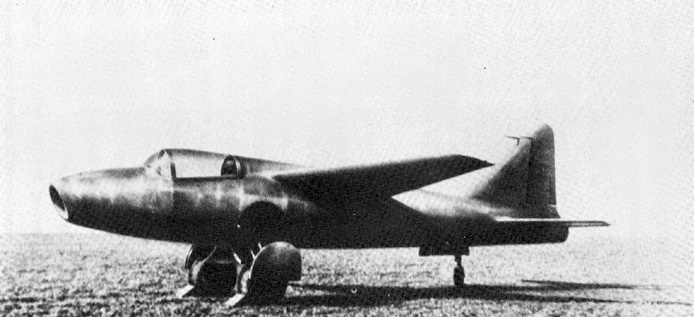
Germany Heinkel He 178 – 27 August 1939

https://upload.wikimedia.org/wikipedia/commons/1/1e/Ohain_USAF_He_178_page61.jpg

The Germans flew the first jet aircraft and then celebrated four days after by invading Poland.

Italy – Caproni Campini N.1 (featuring first afterburner) 27 August 1940

Caproni Campini N.1: World's Second Jet Aircraft - Comando Supremo

The N.1 was powered by a motorjet (also known as thermojet), is a rudimentary type of jet engine with the compressor driven by a piston-engine. The motorjet was originally a French idea, refined and patented by the British and first flown by the Italians. Their first pure jet was the Fiat G-80 of 1951. Damn if we allow this in we’ll have to include all the weird Soviets.

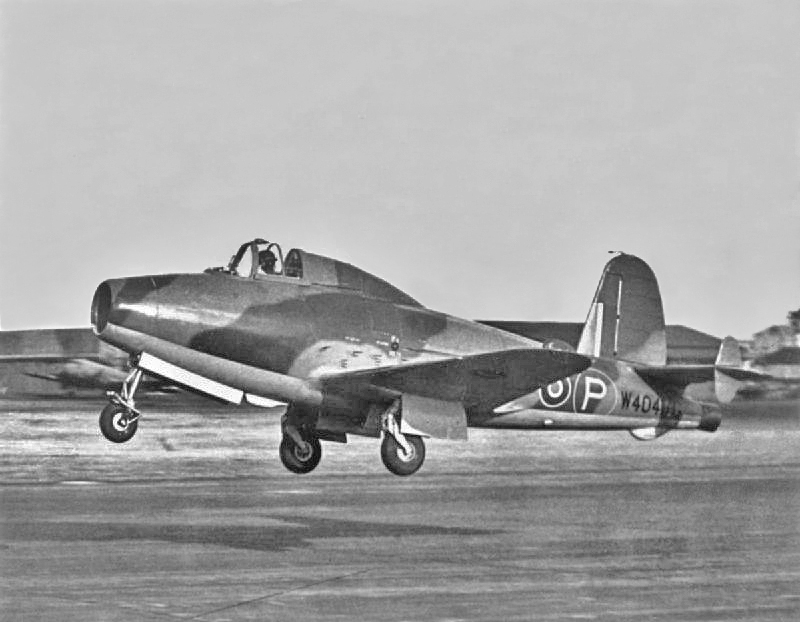
Great Britain – Gloster E.28/39 May 15, 1941

Gloster E.28/39 - Wikipedia

The British invented the jet engine but were second to put one in a flying aeroplane.

USABell P-59 Airacomet 1942

https://upload.wikimedia.org/wikipedia/commons/c/c1/Bell_P-59_Airacomet_060913-F-1234P-013.jpg

The USA made 66 of the disappointing P-59. One was given to the RAF. It used a General Electric J31, a souped-up variant of a British engine.

USSR – Mikoyan-Gurevich I-250 – 3 March 1945

IL2 1946 Mikoyan-Gurevich I-250 - YouTube

Not quite a jet, think Caproni N1 but with a propeller.

Japan – Nakajima Kikka 7 August 1945

The story of the Nakajima Kikka, the Japanese Messerschmitt Me 262 Schwalbe  that never was - The Aviation Geek Club

Despite a superficial resemblance to the 262, the Kikka was a Japanese product though the designers had access to Me-262 imagery and a cutaway of its BMW engine.

After this none of the aircraft are strictly indigenous and each involve a degree of foreign technology

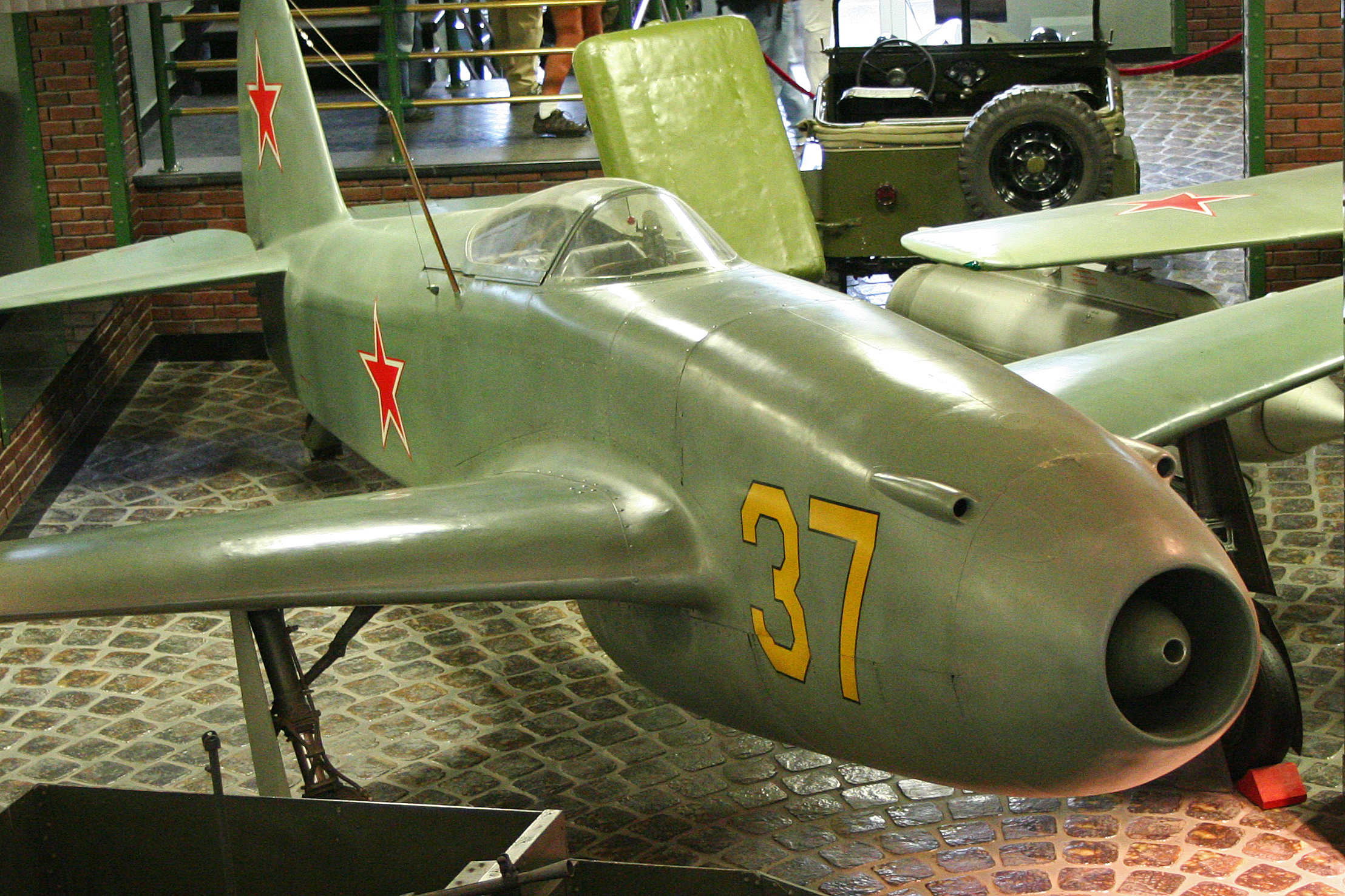
USSR Mikoyan-Gurevich I-300 24 April 1946 Yak-15 24 April 1946

File:WofRussia03 MiG I-300.jpg - The Internet Movie Plane Database
MiG: Learning By Trial and Error

The Yak was ready earlier but lost a coin toss to the MiG. The MiG was the first true Soviet jet to fly, using a reverse-engineered BMW engine. The Yak was a converted Yak-3 fitted with a reverse-engineered German Junkers Jumo 004.

https://upload.wikimedia.org/wikipedia/commons/3/38/Yakolev_Yak-15_37_yellow_%288454539446%29.jpg

France Sud-Ouest SO.6000 Triton – 11 November 1946

https://upload.wikimedia.org/wikipedia/commons/1/11/Triton_Musee_du_BOurget_P1020096.JPG

Sweden – SAAB 21R 10 March 1947

Sticking a jet in a piston-engined aircraft worked for the Soviets so why not? Not as elegant as a Vampire but pretty lovely.

We do dope merch of the piston version here

Argentina – FMA I.Ae. 27 Pulqui I 9 August 1947

https://upload.wikimedia.org/wikipedia/commons/e/ec/FMA_IAe27.jpg

With a design team led by a Frenchman, Émile Dewoitine and a British engine the Pulqui was still the first Latin American jet aircraft.

Canada – Avro Canada C102 Jetliner 10 August 1949

Does anyone remember Canada's Avro C102 Jetliner? - TravelUpdate

Only the Canadians would think to enter the jet age with an airliner.

Austrailia – GAF Pika 1950

https://upload.wikimedia.org/wikipedia/commons/4/40/GAF_Pika_C-2_A93-2_Pt_Cook_22.03.88_edited-3.jpg

A crewed prototype for an uncrewed target drone, the delightfully cute Pika.

Our top cute aeroplances are here

Netherlands – Fokker S.14 Machtrainer 19 May 1951

FOKKER S-14 MACHTRAINER - BROCHURE AND PILOT'S NOTES | eBay

Insert joke about Fokker sounding like ‘fucker’ here.

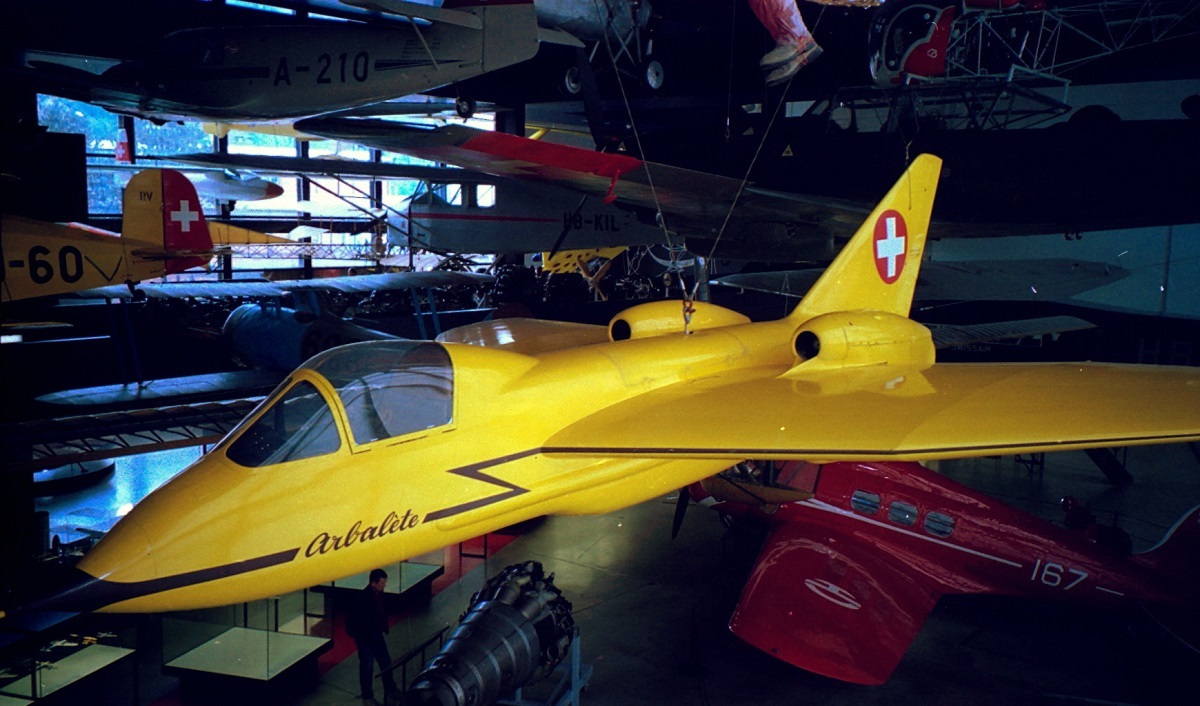
Switzerland – EFW N-20.02 Arbalète 16 November 1951

https://i0.wp.com/www.aviationmuseum.eu/Blogvorm/wp-content/uploads/2019/01/FW-N-20-Arbalete-2.jpg?ssl=1

Wait… Switzerland flew a jet aircraft before China? Bonkers.

Yugoslavia

Ikarus 451M –  25 October 1952

Followed by

Ikarus 452 – 24 July 1953

Ikarus 452-M - Yugoslav prototype fighter from 1950s: WeirdWings

Wait…Yugoslavia flew a jet before China?

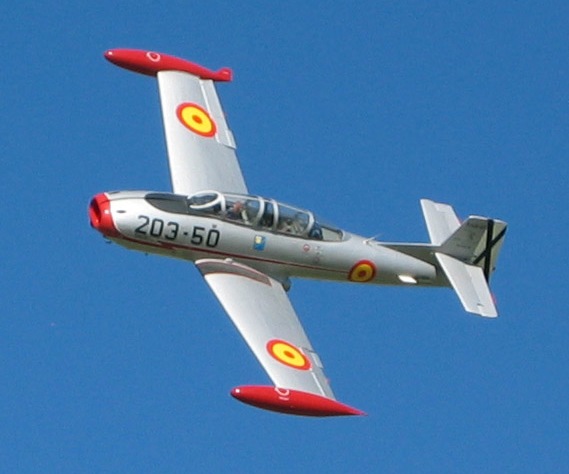
Spain – Hispano HA-200 12 August 1955

https://upload.wikimedia.org/wikipedia/commons/4/4b/HA-200_Saeta_%28recortada%29.jpg

With a bit of help from Willy Messerchmitt, Spain made this little beauty.

China Shenyang JJ-1 26 July 1958

Shenyang JJ.1.jpg

China is a tricky one to nail down. This was preceded by the J-2 and J-5, but they were both versions of MiGs.

Czechoslovakia Aero L-29 Delfín 5 April 1959

https://upload.wikimedia.org/wikipedia/commons/8/8c/Aero_Vodochody_L-29_Delfin_Beetle_3rd_Pass_04_TICO_13March2010_%2814597429704%29.jpg

A real cutie this one.

PZL TS-11 Iskra 5 February 1960

https://upload.wikimedia.org/wikipedia/commons/d/df/PZL_TS-11_Iskra_aircraft.JPG

India HAL HF-24 Marut 17 June 1961

Flying & fighting in the HAL HF-24 Marut: Interview with IAF pilot  Vijainder K Thakur | Hush-Kit

Designed by Kurt Tank, creator of the superb Fw 190, the gorgeous Marut proved a disappointment and put India off creating its own jets for 50 years. We interviewed a Marut pilot here.

Egypt – Helwan HA-300 7 March 1964

The Helwan HA-300; Egypt's Messerschmitt - - Military Matters

The first African and Middle Eastern jet aircraft, the project had at earlier times been Spanish and Indian. The design was led by Willy Messerschmitt.

Taiwan – AIDC AT-3 Tzu Chung 16 September 1980

AIDC AT-3 Tzu Chung (ROCAF) - Passed for Consideration - War Thunder -  Official Forum

It’s the 80s now, so everything non-Soviet will have some US involvement. Northrop helped with this.

IsraelIAI Lavi 31 December 1986

Lavi

Isreal had already created licence produced and pirated jet aircraft but it’s probably fair to call the Lavi the first indigenous type though there was much US assistance.

Brazil – Embraer ERJ145 August 11, 1995

Embraer ERJ-145 - Aerospace Technology

Insert joke about mowing the side of the runway ‘Brazilian-style’

Russian Federation – Yakovlev Yak-130 25 April 1996

https://upload.wikimedia.org/wikipedia/commons/f/f0/Yakovlev_Yak-_130_%28modify%29.jpg

A bit Italian, and studies may have predated the end of the USSR, but the ‘Mitten’ is probably the first new Russian (we’re more certain the French/Russian MiG AT design was older so more Soviet in origin).

You know you want this lovely lovely book. Pre-order here.

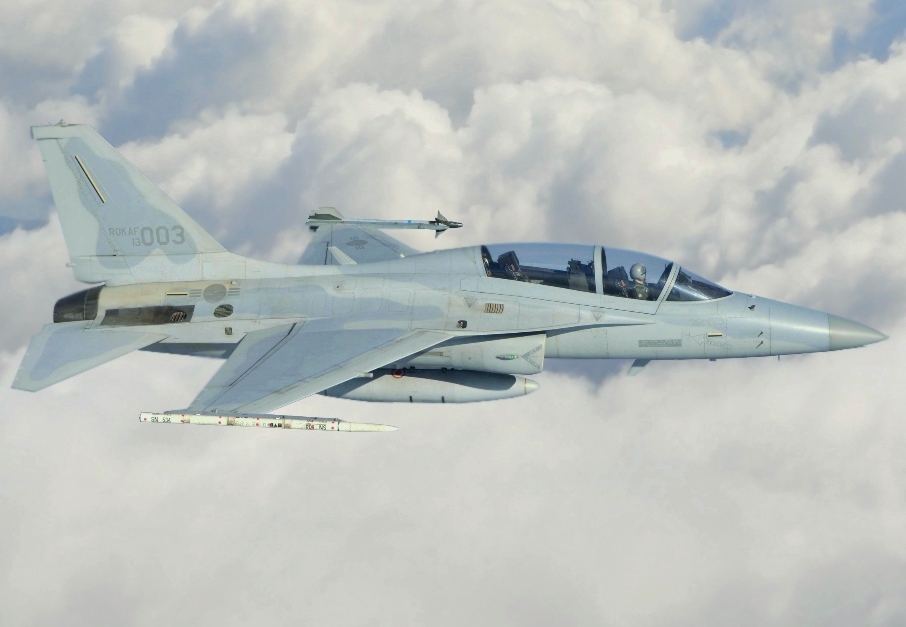
South Korea KAI T-50 20 August 2002

https://upload.wikimedia.org/wikipedia/commons/8/80/RoKAF_T-50_Golden_Eagle.jpg

Lots of help from Lockheed Martin but let’s say this is South Korean.

Ukraine – Antonov An-148 (2004)

Russian Authorities Ground Antonov An-148 Passenger Airliners - Aviation  News

Or if you prefer, the An-72 of 1977 (as other Soviet Antonovs were built in Russia too)

Why support The Hush-Kit Book of Warplanes Volume 2 before I have book 1? An explanation here

Supermarine Spitfire (Griffon-powered variants) - Wikipedia

I’m getting asked this a lot at the moment and it is a very fair question. Why should anyone support the second volume before receiving the first? I’ll give a quick answer. I should add that I’m not in charge of the schedule, that is with Unbound, the publisher. I’m very busy with both the site and the books so please don’t send your queries to me, send them directly to the publisher. Huge thanks for all your patience and support, this will be a very special book. Ok, so here’s the short answer:

Quickish answers

  1. Most important answer here: you of course don’t have to. You will however see some tweets and things promoting it. If you don’t wish to support volume 2 , but have supported Volume 1 then a big thanks. Sorry about the promo but I need to do this. I will always endeavour to make the promo entertaining and informative in its own right. We’re starting book 2 to get it out as fast as possible and to ensure the minimum time between volume 1 and 2.
  2. If it doesn’t hit funding targets it won’t happen. If it hits targets late it will be created very late. I’ve asked for assurances from Unbound of a far speedier turnaround for volume 2 which they’ve agreed to, but this is dependent on hitting 100% funding in a reasonable time.
  3. This model of book creation (crowd funded) means development of the book doesn’t start until funding reaches 100%, this is part of the reason it seems to take so long: the supporter is hearing about the book for up to four months before work has begun (often the opposite to the conventional model). The good news is the crowdfunding gives me full editorial control, nothing is diluted.

Again, enormous thanks. I’m as hungry as you to see this on the shelf. I’ll be sharing the latest spreads from the book soon so you can see how beautifully it is shaping up.

HUGE THANKS TO ALL OF YOU

Preorder Volume 2 here and make this happen. Pre-order volume 1 here.

What is the significance of the recent Chinese and American tests of Boost-Glide Vehicles? We demystify them

US Military to Develop Hypersonic “Tactical Boost Glide” Weapon

Boost-Glide vehicles (BGV) have been around for quite a while, but have suddenly been catapulted (or more accurately, rocketed) into the news by some recent successful and less successful test events. Now, I have to state a disclaimer here – I am not an expert in the field, and have never been involved in any BGV programmes, which, in the context of this article is a good thing, because my comments are based on observations and inferences from open-source material, and cannot be considered to disclose anything classified. Jim ‘Sonic’ Smith reports:

I have, however, been interested in BGV and their related technologies for quite a while, and indicated in earlier articles for @Hush_Kit that BGV were an emerging defence capability that it was important to watch. The first BGV hardware I encountered was at a US Aerospace Materials Conference in 1990 (yes, 30+ years ago). This was a simple, very slender conical structure in Carbon-Carbon, exhibited in an open Conference by Martin-Marietta, and labelled, with no further explanation “BGV nose cone”. So BGVs are real, even if not everyone knows what they are.

Looking into this field from the outside can be somewhat confusing. A number of capabilities are dependent on similar technologies, and, as some of those capabilities are strategic in nature, there tends to be quite substantial obfuscation going on about the purpose of various technology demonstration and maturation activities.

In this article, I will attempt to clarify some aspects of the various programmes which appear to be being pursued; clarify some of the language; and explain the importance of BGV, and how they differ from other hypersonic programmes.

Image

Definitions

Here I am defining what I mean by various terms in this article. Other sources my use different definitions.

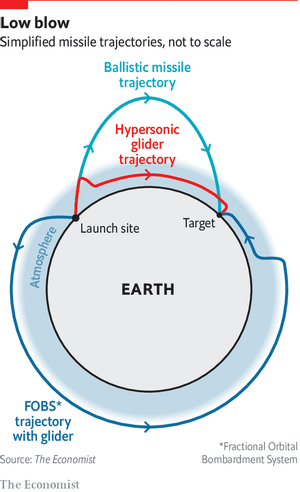
Hypersonic: The word hypersonic is used to describe high-speed flight, typically at Mach numbers greater than 5. Flight at such speed brings potential advantages, but comes with specific technology challenges. The principal advantages are reduced warning time, a more difficult interception by defensive system, and high kinetic energy.

The technical difficulties stem from the interaction of a flight vehicle and the atmosphere at high speeds. These difficulties include thermodynamic heating of structures, requiring the use of advanced materials; predicting, managing and controlling flow behaviour to reduce thermal effects and control and manoeuvre flight vehicles; and managing propulsion, particularly if this is to be air-breathing, rather than rocket-based.

Hypersonic Weapon:  A system designed to achieve ‘kinetic effect’, and to operate at hypersonic speeds. Such a weapon may be air or surface-launched, and may be directed against a variety of targets ranging from the fleeting and tactical to the fixed and strategic.

Armour-piercing fin-stabilized discarding sabot - Wikipedia

Some examples may help to de-mystify this. The simplest operational hypersonic weapon is the APFSDS (Armour Piercing Fin-Stabilised Dispensing Sabot) anti-tank weapon, otherwise known as a long rod penetrator. These are typically fired from Main Battle Tank guns against other tanks, and fly at about 1.8 km/s, which is a little over Mach 5 at sea level. No guidance after launch or warhead is required – the kinetic effect is achieved through speed and APFSDS mass, which is enhanced through the use of high-density materials.

Moving away from land warfare, recent conflicts have shown that there may be significant tactical advantages in effective guided weapons which are highly reactive, or in other words have a short flash-to-bang time. Other requirements leading to potential hypersonic solutions might include high-speed and long-range anti-air weapons. Hypersonic weapons may vary from the unguided short-range APFSDS, through high-speed cruise missiles and to air-launched ballistic missiles.

Boost-Glide Vehicle: A flying vehicle that is accelerated to very high speeds, but is then un-powered.

This is an intentionally broad definition, and is intended to indicate that BGV concepts have been around for a very long time, and are already in use. The APFSDS is a short-range, unmanned BGV of a sort, with the boost phase provided explosively. The North American X-15, a 1960s rocket-propelled research aircraft able to operate at speeds greater than Mach 6, was an early manned-BGV.

The aim and intent of current BGVs extends well beyond the aspirations of the X-15 program, and I will explore possible current objectives later in this article. BGVs are a special class of hypersonic weapon systems that may prove to be particularly de-stabilising.

Programmes

The two sections that follow are a quick look at some hypersonic weapons and BGV programs, and these are followed by a discussion of recent US and Chinese BGV test activity. This is an overview. It’s not comprehensive, and doubtless misses some of the reader’s favourite programs, particularly if they are not being reported in the open literature. However, there should be sufficient here to discriminate between hypersonic weapons and BGV programs; to indicate the activities in these areas; and to indicate why BGV might be of broader concern, rather than merely of technical interest.

Hypersonic Weapons

Looking at the development of air-to-surface strike capabilities over the last several decades, one can determine two trends of interest. Those targets which cannot be readily moved, including for example, airfields, command centres, communication hubs and so on, have been buried or hardened where possible. This has led to continuing efforts to improve the capability of (largely) conventional weapons against hardened targets.

Where hardening is not achievable to a sufficiently effective level, effort has been put into making key assets mobile, or moveable at short notice and in unpredictable ways. This has created a class of targets which are high-value, yet for which the engagement opportunities may be short-lived, or “fleeting”. The advent of conflicts prosecuted by non-state actors, insurgents, and other unconventional forces, has further increased the pressure to be able to locate and take rapid action on the occasions when targets are apparent and can be engaged.

This type of issue has become a strong driver for real-time and near real-time reconnaissance and intelligence systems, capable of alerting the command structure to the presence of such targets. Responding to such targets is another matter, and depends on the availability of suitable weapons systems; their presence in or near the engagement area; and a sufficiently flexible and responsive command structure to ensure a timely engagement. In a word, having a hypersonic strike weapon is not enough – the rest of the target discovery, identification, command and authorization chain has also to be in place.

That said, by maintaining standing strike patrols of B-1B aircraft, with precision guided weapons on board, the US has achieved very rapid response times when targets have become apparent. However, this may not be practical in circumstances where weapons platforms themselves are threatened by ground or air threats, and a long-range, high-speed strike weapon may be required. This appears to be the objective of the majority of visible US programmes.

Other nations see the world somewhat differently. The Russians appear to me to be rather more defensively minded than the US, but are also perpetually nervous about NATO, the US and various other perceived threats. The strength of US Naval Forces, and their mobility, is a particular concern, so it is no surprise that the Russians appear to have a strong interest in hypersonic anti-shipping weapons. In addition, it is clear that much NATO and US Air capability is dependent on high-value air assets such as AEW&C aircraft, air-to-air refuelling tankers, and high-flying and long endurance reconnaissance systems. To counter these, it is possible that future hypersonic anti-air systems will be developed.

In respect of China, key potential flashpoint areas appear to be in the South China Sea, on the island of Taiwan, as well as a generally difficult relationship with several of its neighbouring countries. Area denial would appear to be a strong driver for recent military developments, and it is possible that the large and capable J-20 will eventually be equipped with hypersonic air-to-surface and anti-air weapons, to have at least a deterrent, and possibly an area-denial effect. China is also said to be concerned that recent US hypersonic technology developments may threaten its nuclear deterrent.

Some hypersonic weapons programess are identified below:

USA

· U.S. Air Force—Hypersonic Attack Cruise Missile (HACM);

and · DARPA—Hypersonic Air-breathing Weapon Concept (HAWC, pronounced “hawk”).

The USAF program is presumed to derive from the DARPA demonstrator, and relies on a Supersonic Combustion Ramjet (SCRAMJET) to provide sustained hypersonic propulsion. SCRAMJET technology is one of the high-risk areas for hypersonic weapons, and significant international efforts are underway to demonstrate viable systems. The benefit gained through the use of air-breathing propulsion is that the weapon is smaller, and could perhaps be carried by the F-15 as well as the B-52. An additional advantage is that it may be easier to integrate sensors and seekers into hypersonic cruise missiles, suggesting that these are intended to achieve more tactical effects.

The Air Force is also examining proposals for the Expendable Hypersonic Air-Breathing Multi-Mission Demonstrator Program, alternatively known as Project Mayhem, which is seeking to achieve significantly longer range than current systems.

Russia

The detail below has been derived from a report Hypersonic Weapons – Background and Issues for Congress – Congressional Research Service https://crsreports.congress.gov R45811

Russia is developing the Avangard BGV and the 3M22 Tsirkon (or Zircon) hypersonic cruise missile, and has reportedly fielded the Kinzhal (“Dagger”), a maneuvering air-launched ballistic missile. 

Russia Test Fires 'Kinzhal' Nuclear-Capable Air-Launched Ballistic Missile  – The Diplomat

The Tsirkon is a ship-launched hypersonic cruise missile capable of traveling at speeds of between Mach 6 and Mach 8 (Russian sources state Mach 8 to 9, and claim a range of up to 1000km). Tsirkon is reportedly capable of striking both ground and naval targets. Tsirkon can be fired from the vertical launch systems mounted on a number of Naval vessels as well as 885 Yasen-class submarines, and other platforms.

Russia has also fielded Kinzhal, a maneuvering air-launched ballistic missile, which was successfully test fired from a modified MiG-31 fighter in July 2018—striking a target at a distance of approximately 500 miles. Russian media has reported Kinzhal’s top speed as Mach 10, with a range of up to 1,200 miles when launched from the MiG-31. The Kinzhal could eventually be fitted with a nuclear warhead.

China

China Successfully Tested a Hypersonic Missile and the US Was Caught  Completely by Surprise | SOFREP

According to U.S. defense officials, China successfully tested Starry Sky-2 (or Xing Kong2), a nuclear-capable hypersonic vehicle prototype, in August 2018. China claims the vehicle reached top speeds of Mach 6 and executed a series of in-flight maneuvers before landing. Starry Sky-2 is described as a “waverider” that uses powered flight after launch and derives lift from its own shockwaves.

Other Programmes

There has been, and continues to be, very extensive international interest in hypersonic technologies, and related programs are in place in (at least) Australia, France, Germany, India, and Japan.

Boost-Glide Vehicles

When I first encountered the term BGV, it was in the context of one of those forward-looking papers the USAF occasionally put out on technology trends and aspirations, indicating that the USAF had a desire to achieve Global Reach, and, moreover, to be able to deliver capability anywhere on the Globe in two hours. This would be in around 1990, and this highly ambitious target was to be approached through testing and development of Boost-Glide Vehicles.

As time has passed, events have demonstrated the need for systems capable of reacting quickly to respond to rapidly changing military situations, or to attack high-value fleeting targets. Recent aspirations suggest the desire is now to be able to strike anywhere on the globe within one hour rather than two. Current BGV systems offer the prospect of being able to do that, and moreover, using delivery systems that are much less predictable than ballistic missiles, and hard to counter.

The key aspect is the use of the space and near-space environment. Two alternative approaches have been described, the first of which may be thought of as a hypersonic glider. Such a vehicle is launched using a booster rocket and delivered at high speed into the upper atmosphere or near-space environment. After separation from the booster, the BGV descends and transits for significant distances in the upper atmosphere at hypersonic speed.

In this cruise mode, the vehicle can manoeuvre to change course, and, although in the upper atmosphere, will be below the target radar horizon for much of its flight, which might extend for a few thousand miles. This increases unpredictability, reduces warning time, and makes defensive engagement more difficult.

Placeholder for insertion of FOBS vs Hypersonic Glider figure

The second approach is more ambitious, and requires a launch system capable of putting the BGV into low-earth orbit. Re-entry may be achieved at a location of choice, which may be extended by a skipped re-entry, allowing cross-track manoeuvre and increasing unpredictability. Because a partial orbit is used to deliver the flight path, systems like this are referred to as Fractional Orbit Bombardment Systems or FOBS. The nature of the flight path provides truly global reach.

Pairing a BGV hypersonic glider payload with a FOBS delivery system massively increases unpredictability because of the range and manoeuvrability of the BGV after it has entered the atmosphere, coupled with the global reach and unpredictable flightpath of the FOBS delivery vehicle.

Naturally, there is nothing to prevent the BGV carrying a nuclear payload, rather than a conventional strike warhead.

Some Boost-Glide Vehicle programs are identified below:

USA

· DARPA—Tactical Boost Glide (TBG);

· DARPA—Operational Fires (OpFires);

The DARPA programs are closely related. TBG is Air Force and air-launched in focus, but is also looking at compatibility with Navy Vertical Launch systems, while OpFires is focussed on ground-launched, vehicle-based systems for Army.

· U.S. Navy—Conventional Prompt Strike (CPS);

· U.S. Army—Long-Range Hypersonic Weapon (LRHW), otherwise known as ‘Dark Eagle’;

The US Army and Navy programs are intended to use a Common Hypersonic Glide Body (C-HGB) with a Navy developed booster. The Navy system would be submarine based, while the Army would use a mobile launch platform. The Army system is stated to have a range of “more than 1725 miles”

· U.S. Air Force—AGM-183 Air-Launched Rapid Response Weapon (ARRW)

The USAF program builds on the DARPA Tactical Boost Glide program, with the BGV being derived from the Falcon

Interestingly, US hypersonic programs have been described as being “mostly non-nuclear”, which is scarcely reassuring.

The programs appear to be based around the hypersonic glider rather than FOBS concept – but given the unclassified nature of the paper describing them, this is no surprise. Given US space capability generally, it would be surprising if a US FOBS program does not exist.

Russia

The detail below has been derived from a report Hypersonic Weapons – Background and Issues for Congress – Congressional Research Service https://crsreports.congress.gov R45811

Russia is developing the Avangard BGV and the 3M22 Tsirkon (or Zircon) hypersonic cruise missile, and has reportedly fielded the Kinzhal (Dagger), a maneuvering air-launched ballistic missile. 

Avangard is a hypersonic glide vehicle launched from an intercontinental ballistic missile (ICBM), giving it “effectively ‘unlimited’ range.” Reports indicate that Avangard is currently deployed on the SS-19 Stiletto ICBM, though Russia plans to eventually launch the vehicle from the Sarmat ICBM. Avangard features onboard countermeasures and will reportedly carry a nuclear warhead. Russian news sources claim that Avangard became operational in December 2019.

China

China has conducted a number of successful tests of the DF-17, a medium-range ballistic missile specifically designed to launch BGVs. U.S. intelligence analysts assess that the missile has a range of approximately 1,000 to 1,500 miles and may now be deployed. China has also tested the DF-41 intercontinental ballistic missile, which might also be modified to carry a conventional or nuclear BGV.

China has tested the DF-ZF BGV (previously referred to as the WU-14) at least nine times since 2014. The U.S. officials have identified the range of the DF-ZF as approximately 1,200 miles and have stated that the vehicle may be capable of performing “extreme manoeuvres” during flight.

Recent test activity

US

Recently, the US attempted a BGV test from Alaska. The material disclosed by the US suggests that this was a test of the Common Hypersonic Glide Body (C-GHB), in support of the Army Dark Eagle and Navy Conventional Prompt Strike Programs.

The test apparently failed due to a problem with the booster rocket, and it appears likely that this booster was new, and differed from the USN booster rocket used previously. It may be that this is the first test of a three-stage booster with the C-GHB payload. 

Previous reporting has suggested a range of 1725+ miles for the Dark Eagle system, using a two-stage booster, but the trial warning and airspace notification for the failed test identified possible landing zones for three booster stages, and an overall range of about 4000 miles. This suggests that new longer-range applications are being sought for the C-GHB and its launch system, and coming, as it does, a few days after a successful Chinese BGV test, one cannot help wondering whether new scenarios for the use of such systems are being examined.

China

China was recently reported in the Financial Times as having conducted a successful BGV test in August, using a Long March 2C rocket as the launch vehicle, and presumably carrying the DF-ZF BGV as payload. The system was reported as completing an orbit of the Earth before re-entry of the BGV, which landed near its intended target.

Although the miss distance was of the order of 40 km, this might not be regarded as too significant, particularly if the intended future application is nuclear weapon delivery.

The significance of this test is immense, as it confirms the capability of combining a FOBS delivery with a manoeuvring hypersonic BGV payload. The upshot, were this to be developed into a fully capable system, would be a Chinese ability to deliver global nuclear reach using hitherto unpredicted and undefended flightpaths.

Assessment

In an environment of increasing tension between three global super-powers, the US, China and Russia, it is a matter for concern that all three are actively developing BGV-based strike systems. It is highly likely that all three are considering the use of such systems in the context of both conventional and nuclear conflicts. To describe these developments as de-stabilising seems a mild use of the term.

There would, of course, be extreme dangers should any Nation seek to deploy and use even a conventional variant of a future FOBS-BGV capability. The unpredictable flightpath, coupled with low warning time available, would be likely to result in any target Nation regarding such an attack as Strategic in nature, and responding accordingly, with very high risk of escalation.

It is perhaps no coincidence that these capabilities are becoming public at a time when the US DoD will be seeking funding for detection, tracking and defensive systems capable of defeating such threats, particularly as defensive concepts remain largely to be defined.

It is also no coincidence that proliferation is an immediate concern. Given the technologies required to possess a ballistic missile-delivered nuclear system, it is perhaps a relatively minor step from there to add a BGV capability to the payload. One need only consider the list of states, outside the big three, that are known to possess nuclear weapons, to recognise the danger that the relevant technologies could represent if developed elsewhere.

Extremely Sexy Spaceplanes

Spaceplane concept art. Lockheed Photo LN 5009

By Garrett O’Donoghue

It is hard to fall in love with rockets, they are just over-zealous pencils, but a spaceplane is something else. Garrett O’Donoghue leaves the confines of the Earth’s atmosphere in search of extremely sexy spaceplanes.

STAR Clipper: The Sexiest Spaceplane That Never Flew

Lockheed’s proposal for the USAF/ NASA ILRV project, STAR (Space Transport and Recovery) Clipper was a stage-and-a-half spaceplane derived from the USAF Flight Dynamics Laboratory’s LSC-8MX. Max Hunter, Lockheed’s chief designer – proposed a sleek spaceplane that would launch vertically, a V-shaped drop tank arranged along its leading-edge providing fuel for its internal engines at launch. The external tank would be jettisoned when the fuel was exhausted, and the Clipper would continue into orbit on internal fuel. 

In February 1969, NASA awarded Lockheed a Phase A study contract to develop the STAR Clipper for the Shuttle Program. In December that year, Lockheed unveiled their LS-112 proposal: a fully reusable spaceplane, launched from either a flyback booster or as part of a triamese arrangement. In Phase B, Lockheed partnered with Boeing, with the latter developing the booster vehicle. The Lockheed/Boeing submission wasn’t selected for further development, but NASA – concerned that a fully-reusable vehicle might not be technically feasible after all – funded continued development of the Star Clipper as an alternative concept, resulting in the L-200 design of 1971.

McDAC Alternate A: The Drawbridge Orbiter

In November 1969 McDonnell-Douglas proposed this novel design to meet the Air Forces’ requirement for a high cross-range capability for military shuttle missions. The Air Force wanted to achieve a polar orbit for satellite deployment, with launch and recovery from Vandenberg AFB, also on the Air Force’s wish list was the ability to launch the occasional snatch-and-grab of a Soviet satellite within a single orbit. The shuttle would have re-entered with folded wings during high-cross range military missions. With extended wings, the cross range would have been lower but the heat loads on the airframe would have been less extreme.

Douglas Astro: The Ass-To-Mouth Orbiter

In 1962 NASA funded several studies for a space station support vehicle, one of the study contracts was for a Reusable Ten Ton Orbital Carrier Vehicle or RTTOCV. A key requirement was that the vehicle would use off-the-shelf engine technology. Douglas proposed the Advanced Spacecraft Truck/Trainer/Transport Reusable Orbiter or ASTRO, a two-stage nose-to-tail vehicle, both stages being manned lifting body craft. Launched from a mobile gantry, after separation from the orbiter, the booster would make an unpowered landing downrange of the launch site while the orbiter continued into… well orbit. 

Boeing X-20 Dyna-Soar: The Strangled Infant

The Dyna-Soar story really begins in 1936 when a thesis written by Eugen Sänger attracted the attention of the German Air Ministry, who saw military potential in his research. The Air Ministry funded a development team that, led by Sänger, proposed the Silber Vogel in 1942. The sled-launched Silber Vogel would be powered to an altitude of 145 km by rockets where it would gradually descend into the stratosphere, lift generated by its flat bottom would cause it to skip back to altitude extending its range. Using this boost-glide method, Sänger’s suborbital bomber would be able to launch from a site in Europe, deliver a 4000 kg bomb to the continental US and continue on to a landing site in the Pacific.

In 1952 fellow Ze Germans Walter Dornberger and Krafft Ehricke, now at Bell, proposed a vertical launch version of Sänger’s design that became known as BoMi. The proposal generated enough interest that by 1956 it had evolved into three separate programmes: a rocket bomber, a long-rang reconnaissance vehicle, and a hypersonic weapons research system.

In October 1957, the USAF Air Research and Development Command (ARDC) consolidated the programmes into the Weapon System 464L Project or Dyna-Soar.

Despite the heavy lifting done by Bell, Boeing was awarded the final contract for the X-20 in 1959 from a group of nine competing companies. Their design outlined in 1960 had a low-wing delta shape, with winglets providing control and directional stability. The high cost of the programme, coupled with an absence of a clear goal on the part of the Air Force led to its cancellation in 1963 by Secretary of Defense Robert McNamara. Had it not been cancelled, Dyna-Soar would have begun test flights from Cape Canaveral in 1964 with an orbital launch in 1965. Instead, the astronaut group was disbanded, the prototype and mockup were scrapped, along with the tooling for the initial production line.

Bell’s Orient Express

Bell proposed this sleek boost-glide transport in 1960. Launched from a carrier vehicle, the glider could achieve a suborbital trajectory resulting in a brief spaceflight. Up to thirty passengers could be transported from Los Angeles to Paris in a little over an hour, enjoying weightlessness along the way.

The Goodyear METEOR

In 1954 Goodyear Aerospace revealed their design for a fully reusable spacecraft and launch system. The METEOR or Manned Earth-satellite Terminal with Earth Orbital Rocket service vehicle proposed by Darrell Romick consisted of three nested reusable spaceplanes, that could be converted to conventional aircraft after landing by attaching turbojet pods and flown on their own power back to the launch site. Once proven, Romick planned to use the third stages of the METEOR as the building blocks for a rather grand space station that would accommodate 20,000 people, with hotels, stores, a movie theatre, an auditorium and churches so the residents could experience “comfortable, satisfying, convenient living conditions.”

. 

We’ve taken the very finest articles on this site, combined them with new unpublished material and a heap of beautiful bespoke illustrations and created The Hush-Kit Book of Warplanes 2. Pre-order your copy of this exquisite coffee table book today. This project can only happen with your support, simply order your copy and you’ve done your bit to make this happen (and your name will be included in the book). The sooner this hits 100% funded the sooner it will enter the production phase and onto your shelf. Many thanks from all of us at Hush-Kit. Pre-order here.

Bono’s Mars Glider

In 1960, Boeing funded a study led by Philip Bono to examine if their 1957 design for a station support vehicle – a common ancestor of the X-20 Dyna-Soar – could be modified for interplanetary missions. Bono enlarged the vehicle and made it an integral part of a single-launch manned Mars mission. While the study proved feasible, there are number of issues that would have doomed the mission had it proceeded.

  • Arriving at Mars, the glider separated from a living module where the astronauts had spent the previous 259 days and headed for the surface. The living module would brake into Martian orbit on autopilot. The crew had no way to abort their landing if less than ideal conditions presented themselves below.
  • The glider itself was designed to fly in an assumptive Martian atmosphere that was 8% of that on Earth. As revealed by Mariner IV, the true composition of Mars atmosphere is closer to 1%. In other words: the glider would not have been able to generate lift in the thinner Martian atmosphere, the 42 meter drag chute provided to slow it to maneuvering speed was far too small and the glider would still be supersonic 2000 feet from surface, where Bono expected the seventy-ton spaceplane to fire retrorockets that would slow it to a gentle hover down to the surface.
  • Having had 459 todays to enjoy all that Mars has to offer, on departure day the crew would angle the glider 15 degrees from vertical and lift-off using the aft portion of the glider as a launch pad. Again, in the thinner atmosphere its unlikely the glider would have been able to generate enough lift to attain orbit before its fuel was exhausted.
  • In orbit, the glider would dock with the living habitat for the return journey to Earth where the crew would attempt their second landing after being away from home for 980 days.

The HL-10: The Six Million Dollar Man’s Ride

NASA proposed upscaled versions of the HL-10 and M2-F2 as station support vehicles in 1964. When flight testing of the three original heavyweight lifting body designs began in 1966, the other being the X-24A, the Northrop built HL-10 was judged to be the best handling. NASA considered launching a space-rated version of the HL-10 into orbit in the early seventies. The vehicle would have been taken into orbit by a Saturn V, occupying the lunar module’s housing. The astronaut would spacewalk to the HL-10 for a pre-entry check of its systems. In the first of two planned flights, the pilot would return to the Apollo CSM and the HL-10 would re-enter uncrewed. If the re-entry was successful, a manned flight would be attempted. The plan was cancelled on cost grounds. The HL-10 made its last test flight in July 1970.

TRW JANUS: The most Thunderbirdiest Spaceplane ever!

Blunt Blunt lifting bodies handle poorly at low speed and are difficult to land. Winged vehicles will have better handling and can be designed to have good landing qualities, but re-entry poses significant design challenges. What better way to simplify the design process for everyone by making everything doubly complicated? That’s exactly what TRW did in the early sixties with the JANUS, which they were granted a patent for in 1966. JANUS was a staged re-entry vehicle. The lower part of the vehicle was a blunt lifting body pod. The upper part of the vehicle was a 21-foot-long delta winged jet. Mated, the jet sealed the open top of the pod, creating a pressurized cabin. During launch and re-entry, the crew would sit on couches in the pod under the jet fuselage. During the re-entry phase, at about 50,000 feet and slowed to subsonic speed the crew couches would be lifted on motors in the jet cockpit. Hatches in the floor would close beneath astronauts’ feet, sealing the fuselage. Explosive bolts would release the latches connecting the craft, and pneumatic rods would separate the stages. As the pod fell away, the jet’s engines would ignite for a controlled landing at a convenient airfield. The reusable pod would automatically deploy parachutes and recover at sea.

SAVE THIS SITE!

If you wish to see more articles like this in the future please donate >here<. We are extremely grateful to all those who choose to donate. Hushkit.net depends on donations to carry on. The more you donate, the more you will get.

Another way to support us to pick up some treats from our shop >here< and sign up for our newsletter >here<

Lockheed Space Taxi: Splash Mountain to Orbit

Spaceplane concept art. Lockheed Photo LN 5009

Lockheed proposed this reusable three-stage launch system in 1963. The first stage would launch from a steam-powered water sled. After separation at altitude the second stages’ engines would fire, taking it to a suborbital trajectory where the third Dyna-Soar style “taxi” would deploy, taking crew and cargo into space.

Book reviews: Aeroflot & Russian Aircraft of World War II: Technical Guide

I

Aeroflot – Fly Soviet | Current | Publishing / Bookshop | FUEL

t’s October so I thought I’d go ‘red’ and review two Soviet aviation themed aircraft books.

Aeroflot – Fly Soviet, By Bruno Vandermueren published by Fuel Design

Aeroflot – Fly Soviet | Current | Publishing / Bookshop | FUEL

Like almost every Western member of X-generation I love Soviet memorabilia. I can’t stop buying it when I’m on holiday in Eastern Europe, but where do you put it? Every corner of my flat is infested with obscure tin badges of Soviet aircraft which I frankly don’t need. With this beautiful book you can enjoy hundreds of fabulous pieces of Soviet design without having to actually own them.

I haven’t finished this book but I already love it, the writing is well informed, engaging and visually the book is an absolute treat. Strongly recommend. Buy it here.

Aeroflot – Fly Soviet 8422

Russian Aircraft of World War II: Technical Guide by Edward Ward published by Amber Books

Edward Ward is a regular contributor for this site and an extraordinarily knowledgeable man. I’ve been to a pub quiz with him and it was like Slumdog Millionaire. He was an absolute fact machine. This book is typical of Ward’s work, fastidious research combined with an enjoyably readable style of writing.

As many Western classic works on aviation were written before Soviet records were made available, modern books tend to be more accurate than those from before around 2000. For example, The great Bill Gunston had to rely on a lot of guesswork for the majority of his work on Soviet aircraft. With the benefit of far more information, Ward has created an impressively comprehensive guide. The book offers tremendous bangs for your buck.

Ukrainian readers may not be too happy with the title, as Ukrainian Antonov designs are included (as are foreign-built types operated by the Soviet air force) despite the use of the word ‘Russian’ for the title. I’m guessing that the title was chosen for marketing reasons.

My minor gripes are perhaps not fair, as without these economical measures it may not be possible to produce such a book for the price, they are as follows: Many of the profile artworks are old and ropey, on the positive side this gives it quite a reassuringly retro feel but in today’s world of readily available digital work does seem a trifle cheap. Also the text size is slightly too small for comfortable reading with my X-gen eyes. As I say though, these are minor gripes.

This is an excellent book that not only features the well known Il-2 Sturmovik but a wealth of utterly obscure wonderful aircraft, some with new excellent artworks. It also features classic Western aircraft with exotic (to me anyway) Soviet schemes. An extremely handy guide and a must-have for the World War II aviation reader. Much recommended. Buy it here.

Top 10 Supersonic Transport Aircraft

Boom Supersonic XB-1 Rollout

Joe Wilding was the co-founder of Boom Supersonic, an independent company attempting to build a supersonic transport aircraft. They have already unveiled a small scale demonstrator, the XB-1 ‘Baby Boom’ (left). I met Joe in a field full of tanks in the middle of the English countryside, within minutes we were talking about supersonic inlet designs, here was a man I wanted to hear more from. I asked Joe to take us for a fast flight through 10 supersonic transport aircraft projects.

Here they are, in rough chronological order with a recurring crazy idea at the end.

1. Concorde

We will start this list with the first and only successful supersonic transport in history. Concorde really was revolutionary, it was years ahead of its time. Its uniqueness begins with its origins. Being a joint venture between Britain and France, it was their flagship project during the (aero)space race of the 1960s. It’s remarkable the project went anywhere given that most previous Anglo-French joint ventures had been wars.

Many new technologies were developed and certified on Concorde. The engines were afterburning turbojets with the reliability and longevity to be usable in airline service. To this day the Olympus 593 is the largest aerospace jet engine core ever built. The engines were fed by two-dimensional, variable geometry inlets. These inlets slowed the incoming air to subsonic speeds with incredible efficiency. They also were stable under all conditions through a combination of an active and passive control system, which prevented potentially deadly engine “unstarts”. Concorde could supercruise without afterburners. This is a feat modern fighters can just barely pull off, and even that is for a brief duration.


The aircraft was the first to certify a full authority fly-by-wire flight control system. It also had a complete manual backup in case the new-technology system should fail. Although the aircraft had stability augmentation to ease pilot workload, it was statically stable and could be hand flown with the augmentation system disabled.


Concorde used fuel transfer to shift the aircraft center of gravity at supersonic speeds, thus reducing trim drag to near-zero.

Concorde was certified to fly up to 60,000 feet, where a rapid decompression would instantly kill all on board. To prevent this the aircraft contained very small passenger windows, which provided a survivable cabin environment with the complete failure of up to two of the cabin windows.


Heat dissipation is a big problem for supersonic aircraft. At Mach 2 (twice the speed of sound), the aircraft heat soaks around 100°C. This temperature rise is due to the compression of the air at high speed and exponentially increases at higher Mach number. At Mach 3the temperature increases to 275°C. Concorde mitigated this thermal load with a complex environmental control system that transferred excess heat to the jet fuel before it was burned in the engines. Even with this system, cabin windows were hot to the touch in flight.


It is most remarkable that all of this was accomplished before the age of digital computers. Concorde was completely designed using slide rules, drafting tables, and physical testing. Yet Concorde was certified and flew successfully for 27 years. Ticket prices were high, partially due to its fuel economy, but also due to maintenance costs and a limited fleet size. Despite this, Concorde was profitable on certain routes including New York to London.

2. Tupolev Tu-144 ‘Concordski

You can’t talk about Concorde without referencing the Soviet Tupolev Tu-144, which was given the belittling nickname ‘Concordski’. Many believe this aircraft was a reverse-engineered Concorde, copied from data obtained through industrial espionage. Though rather larger than Concorde, the general performance and configuration would seem to support this assumption. However, a lot of differences exist between the two aircraft, pointing to it being far from a carbon copy. The Tu-144 had a different wing planform and airfoils. It used a retractable canard for low speed control. The landing gear arrangement is significantly different, being housed within the engine nacelles. The cooling system, inlets, and engines also diverge from the Concorde design. The Tu-144 required afterburners for long range cruise, where Concorde used them only for takeoff and transonic acceleration. The final piece of data is that the original Tu-144 actually flew before Concorde did. Granted, it flew only a few months before, and much data still could have been obtained and used.

Ultimately the Tu-144 was not a successful aircraft in service. Its mission performance limited its range to under 2,500 nautical miles. This is sufficient for travel across the wide expanses of Russia, but insufficient for most trans-oceanic flights. Additionally the aircraft suffered from reliability issues and was used only briefly for passenger flights.

3. Early American Concepts

Seeing what Europe and the Soviets accomplished with supersonic transports, what was the American aerospace up to during this time? The answer is a lot. Sort of. An immense amount of funded research and proposed programs were launched in the US in the 1960s. Unfortunately, none of them ever turned into a flying prototype. American aerospace was anxious to develop a supersonic transport during this time, not wanting to be left behind in the modern airliner race. Unfortunately for these programmes, the US had another little project underway that severely limited the funds and talent that could be applied to supersonic aircraft design: the Apollo program and sending humans to the moon. That said, the US government did significantly fund a series of programmes through the 60s, 70s, and 80s in support of an American Supersonic Transport. Programmes such as Supersonic Commercial Aircraft Technology (SCAT), Supersonic Commercial Aircraft Research (SCAR), and High-Speed Civil Transport (HSCT), despite their questionable acronyms, did produce a lot of valuable research, wind tunnel testing, design tools, and even a prototype engine in the GE-4. A plethora of designs and configurations evolved during this period including swept wings, delta wings, swing wings, canards, tailless, and three-surface aircraft. Much of the research and evolution paralleled developments in the military supersonic realm with new findings being shared in both directions..

The most likely reason a flying prototype evaded these teams can be traced to over-ambition. Boeing, Lockheed, and North American were all working on credible designs that could have potentially been developed into a commercial product. However, most of these were designed for Mach 3, trans-Pacific range, and 300+ seats. Concorde was being developed in parallel, and its design goals were much more practical (Mach 2 and 100 seats). As the Concorde programme began to look more real, the American teams decided they needed to differentiate their potential products and thus completely eclipse Concorde upon entry into service. Unfortunately it ended up being an aircraft too extreme. Between the technical challenges of Mach 3, and the scale and cost of an aircraft with a weight approaching 1,000,000 pounds, there just wasn’t enough funding for a project of this scale. NASA (and some of the aerospace companies) still have teams with direct lineage to these decades-old programs working on the possibilities of a large future commercial supersonic transport. Only time will tell if there will ever be an appetite for one of these mammoth cruisers.

It should be noted that the Soviet Union also had larger conceptual programs in work during this same time. Most notable is the Tupolev Tu-244, a much larger and faster sibling of the Tu-144.

4. Supersonic Business Jets of the 1990s

The decade of the 1990’s brought a surge of companies working on supersonic business jets. The project scale and budgets of the previous decades influenced this new trend. Many started to look at an incremental approach to supersonic transport development as a viable path. While similar in mission, a business jet can be much smaller than a commercial supersonic transport. Five to ten seats is sufficient, and the small size of the passenger cabin is very attractive for an aircraft configuration layout that provides adequate space for other systems and minimizes drag through optimized shaping. The target market for a supersonic business jet is the ultra-wealthy, a customer that is not typically sensitive to aircraft purchase price and/or operating cost. Leading the charge in this category was Gulfstream. Their existing (and current) products are as close as you can currently come to an ultra-luxury, long-range, high-speed aircraft (which also comes with a very large price tag). Most of their development ideas and efforts have never been made public. But a glimpse of their concept can be seen in the proposed X-54 research aircraft. This aircraft never flew, but much effort went into its design, with a few details being published over the years. The aircraft was intended to be a “quiet boom” aircraft, with technology to attenuate the objectionable sonic boom that is produced when an aircraft flies overhead at supersonic speed. This boom follows the aircraft along its continuous flight path, and unfortunately high altitude does little to minimize its impact on the ground. Gulstream workedwith NASA to produce two technology demonstrations in support of the X-54 aircraft. These experiments (Quiet Spike and the Shaped Sonic Boom Demonstration) used fighter aircraft with altered external shapes to test boom mitigation ideas and get full-scale flight test data. Progress on the X-54 in recent years has faded with no further updates being issued by Gulfstream.

Another project started in the late 1990’s is the Supersonic Aerospace International (SAI) QSST. This company was started by the son of the Gulfstream founder, Allen Paulson . Any direct ties to Gulfstream were unclear. The QSST was also a business jet targeting the quiet boom market. Despite credible preliminary design effort and collaboration with the Lockheed Martin Skunk Works, a prototype never emerged.

We love aeroplanes as much as you do and with your help we can make The Hush-Kit Book of Warplanes Vol 2 a reality, simply pre-order here and when we get to 100% we’ll start. CLICK ON BOOK TO PRE-ORDER. A sequel to the Hush-Kit Book of Warplanes. Plucking the best from over 1,000 articles from the highly respected Hush-Kit blog, Volume 2 takes an even deeper dive into the thrilling world of military aviation.
A lavishly illustrated coffee-table book crammed with well-informed and utterly readable histories, listicles, interviews, and much more. Beautifully designed, with world-class photography, we reveal the bizarre true story of live bats converted to firebombs, the test pilot that disguised himself as a cigar-smoking chimpanzee, and an exclusive interview with the aircrew of the deadliest aircraft in history.
Here is an utterly entertaining, and at times subversive, celebration of military flying!
The spectacular photograph of the F-4 Phantom we have used on the cover was taken by Rich Cooper from the Centre of Aviation Photography.

About Hush Kit . . . 
‘Hush-Kit is stupendously brilliant – irreverent and witty but also backed up by phenomenal knowledge and a completely fresh take. It’s completely addictive and, without doubt, the best aviation magazine in the world. The Hush-Kit Book of Warplanes is a thrilling read quite unlike any other aviation title’ James Holland
‘Funny, brilliant, and extremely well informed, Joe Coles’s Hush-Kit is my favourite aviation site and I’m utterly addicted. Nothing else is quite like it. The extremely handsome Hush-Kit Book of Warplanes is an absolute must-have for anyone who has ever looked at an aeroplane with a little too much intensity!’ Al Murray
‘Joe Coles has written the most explosive book about aircraft ever’ Jim Moir (Vic Reeves)
“Joe Coles is one of the brightest, funniest people I know, and the only writer who makes aviation interesting to me. He manages to find something human in the cold, war-spattered world of planes, and brings light to the darkest subjects.” Eva Wiseman, Observer

A final 1990’s development project was the Sukhoi S-21 business jet. This project was originally a joint venture between Sukhoi and Gulfstream with the latter parting ways after funding proved to be elusive. Sukhoi continued the effort on their own. Few details have been published on this aircraft beyond the rough specification and a few models and renderings. The aircraft predated the quiet boom era and was intended for over-ocean supersonic travel.

A few other organizations also worked on supersonic business jet projects in this era including Tupolev, Dassault, and JAXA (the Japanese aerospace research agency). Designs are plentiful, prototypes are rare.

5. Aerion

Aerion was formed in the early 2000’s as the next credible company in the supersonic business jet space. Aerion had a potentially winning formula of a marketable design specification, an impressive team of aerospace engineers/designers, and a wealthy founder willing to fully invest in the program.

The original wing design proposed by Aerion was quite unique and strived for low drag in several different ways. In a break from high-speed aircraft tradition, the wing had virtually no sweep. Most transonic and supersonic aircraft have considerable wing sweep, which accomplishes two things. First, the angle of the wing leading edge to the oncoming airflow reduces the strength of the shockwave created by the wing, and thus reduces drag from this source. Secondly, a swept wing has lower effective thickness relative to the airflow, which also reduces shockwave drag. Another advantage of a non-swept supersonic wing is a relatively short wing chord which minimizes skin friction drag. An unswept supersonic wing can work great, as long as the leading edge is relatively sharp, which prevents the formation of a large drag-inducing bow shockwave on the front of the wing. This type of wing was used with great success on the Lockheed F-104. That aircraft was a contemporary of the F-100 and F-102A. All three aircraft used a similar engine, yet the F-104 was roughly 50% faster at Mach 2.0. (To be fair, it was also smaller and lighter.)

A second wing innovation on the original Aerion was a laminar flow wing design. Laminar flow, contrasted to turbulent flow, is an elusive condition that is possible with the right wing shaping and attention to detail. All wings have a small amount of laminar flow at their leading edges. A laminar flow design extends this region to a majority of the wing surface and can reduce the drag produced by an incredible 25%-50%. Aerion did extensive research and wind tunnel testing of this idea in the early days. Unfortunately, very few aircraft have shown reliable capture of this effect in long-term service, mostly due to wing contamination and other real-world constraints.

The Aerion design went through several iterations over a time span of almost two decades. The final design showed a much more conventional swept wing planform, and references to laminar flow were dropped. Other changes included the number of engines, cruise Mach number, and sonic boom strength. In recent years, the company was advancing rapidly, including separate partnerships with Airbus, Lockheed Martin, and Boeing, and an engine deal announced with General Electric. Their executive leadership was also fortified with heavy hitters from the commercial aircraft world. Unfortunately the company shut down earlier in 2021 after failing to close a critical round of funding. It appeared they were on the cusp of building a production prototype, so this company closure was both a surprise and a blow to many in the world of supersonic development.

6. Boom Supersonic

Boom Supersonic launched their proposed product, Overture, in 2015. Overture is a unique development as it was the first project in several decades to solely target the commercial airliner market. Overture is a tri-jet design with a similar approach and configuration as Concorde. The company has gained a lot of traction since launch including raising several rounds of funding, signing an development agreement with Rolls-Royce engines and signing aircraft deals with several international airlines including Virgin Group, Japan Airlines and United Airlines.

The company has stated the desire to bring back the capabilities of Concorde, but with updated materials, engines, and aerodynamics. The goal is an aircraft that meets current takeoff noise standards and has operating economics comparable to business-class travel on existing subsonic airliners. Boom has decided to not pursue quiet boom technologies on their first product, and the company name is a (slightly provocative) nod to that decision. The aircraft is a little smaller and slower than Concorde, cruising at Mach 1.7 with a seating capacity of up to 88 seats.

Boom’s first prototype is a 1⁄3-scale technology demonstrator called XB-1. Although the project does not exactly represent the full-scale shaping of Overture, the project will demonstrate the aircraft efficiency and engine installations in a piloted, large-scale flying prototype. The company plans to use the aircraft as a testbed to further evaluate design ideas for systems and aerodynamic features and gather flight test data in real-world conditions. The demonstrator was unveiled last fall and first flight is slated for later this year.

Boom Supersonic XB-1 Rollout

7. Late 2010’s Supersonic Explosion

In addition to Aerion and Boom, the late 2010’s saw an increase of other emergent supersonic companies similar to the 1990’s. These companies are focusing on a mix of the business jet and commercial airliner markets.
Spike Aerospace launched the S-512 project soon after Boom emerged. The aircraft will have a quiet boom and moderate cabin size. The project started as a business jet, but Spike has promoted a small airliner version in recent years as that market has started to gain momentum. Like many early-stage supersonic projects, Spike is trying to fund the project and cross the transition from early conceptual studies to preliminary development and prototyping. Spike released a press release in 2018 claiming to have flown a remotely-piloted subsonic demonstrator, but further details or photos were not released. An interesting design detail on the S-512 is the lack of passenger windows. Spike plans to install large-area digital displays on the cabin walls and ceiling to give the illusion of looking outside the aircraft. If accepted by passengers, this could significantly reduce the weight and cost of the fuselage, while increasing the high-altitude reliability. The passenger reception to this idea is still to be determined. Another recent entrant is Exosonic. Their aircraft specification is similar to Boom in size and speed. Very few other details have been released. They are advertising sustainability and quiet boom.

A final recent project is the Virgin supersonic project. The idea of billionaire Richard Branson, the aircraft is being developed at his Virgin Galactic company, which is also developing a suborbital spaceplane for space tourism. Richard took a flight on this space vehicle a few months ago and the company plans high-frequency tourist flights in the near future. Virgin’s combined experience of designing and building high-Mach spaceships and operating subsonic airlines gives them a lot of advantage in this field of commercial supersonic development. Their conceptual design is slated to fly at Mach 3, and they have signed a development agreement with Rolls-Royce for engines.

8. Hermeus

Hermeus Aerospace is a recent supersonic company with a rather impressive design concept. With a top speed in excess of Mach 5, the aircraft is technically “hypersonic” rather than supersonic. Very few aircraft have been designed to fly this fast. The primary challenges above and beyond supersonic are the extreme airframe heating experienced at hypersonic speeds (>1000°C) and the complexity of the propulsion system. The Hermeus conceptual design looks more like a space plane than a traditional supersonic transport, and it should! The aircraft will likely have no windows (they would melt) and the plane will fly at altitudes approaching 100,000 feet, which is two and a half times higher than a subsonic airliner. The aircraft will be painted black, similar to the famous SR-71 spy plane. At hypersonic speeds and temperatures, the plane can effectively dissipate heat through blackbody radiation.

We love aeroplanes as much as you do and with your help we can make The Hush-Kit Book of Warplanes Vol 2 a reality, simply pre-order here and when we get to 100% we’ll start. CLICK ON BOOK TO PRE-ORDER

Hermes is currently focussing on their biggest developmental challenge: the propulsion system. They also recently were awarded a research contract from the US Air Force to develop an autonomous or remotely piloted subscale hypersonic demonstrator nicknamed the “Quarterhorse”. The development goals of this demonstrator will equally benefit both the commercial and military interest in this realm of flight. If successful, the Hermeus aircraft would provide trans-Pacific flights in as little as a few hours, compared to twelve hours or more today.

9. QueSST

A second demonstrator (in addition to the Boom XB-1) currently in the fabrication stage is the NASA X-59 QueSST aircraft. This is not meant to be a commercial product, but is a technology demonstrator and research aircraft intending to move forward the state of the art in this category of aircraft. The demonstrator is primarily focused on quiet boom technologies and will serve as a testbed to produce sonic booms of variable strength. This can be used to perform community flyover studies and gather more data on the acceptable sound pressure levels for establishment of a sonic boom standard.

The aircraft is being designed and built by Lockheed Martin and will be operated by NASA. The aircraft is mostly built and first flight is planned for 2022

10. You can just convert a bomber to carry passengers. Right?

The final entrant in this top-ten list of commercial supersonic aircraft projects has to be the crazy idea to convert supersonic bombers to carry passengers. There were a multitude of bombers for which this was proposed, using both American and Soviet bombers. None of these ever went beyond the conceptual stage. Generally these were proposed for military transport purposes, but occasionally there were thoughts given to possible commercial viabilty. Generally a military bomber would not make a good supersonic transport for reasons including cost efficiency, takeoff noise, and certification standards, to name a few. The various bombers would not carry a high number of people without major modification. Bombs tend to be more dense than human cargo, and thus bomb bays are not conducive to a satisfactory passenger experience. So the craziness of this idea is grounded in a lack of practicality. It is fun to sketch though!

And don’t think this is just a crazy idea from the 1960s. Russia was proposing to convert old Tu-160s for passenger service as recently as 2020.

Joe Wilding (@joe_wilding) | Twitter

Joe Wilding has 25 years of aircraft development experience including business jets, military transports, small and large UAVs, light sport aircraft and sailplanes. Joe has BS and MS degrees in Aerospace Engineering from Wichita State University. He has worked on several programs from initial concept through regulatory certification. His responsibilities have included composites structural development, aircraft loads, flutter analysis, conceptual aircraft design, flight test engineering, and programme management. Joe has been a co-founder in four startup companies and he is currently splitting his time between engineering consulting, technical mentoring, and communications coaching for engineers.

Image