WG 47Yesterday we revealed information about the previously classified British WG 44/47 studies for an advanced stealthy helicopter gunship. Today, thanks to former Head of Future Projects at Westland Helicopters,Dr Ron Smith, we have gleaned further information on this intriguing, and potentially word-beating, project.Â
Save the Hush-Kit blog. Our site is absolutely free and we have no advertisements. If you’ve enjoyed an article you can donate here. Your donations keep this going. Thank you.Â
The WG 37’s boat-like hull is reminiscent of later US stealth aircraft, was research information being shared?Â
I have no knowledge of sharing of such data from the US. There was (at
that time) a combined UK Industry and government discussion group that
exchanged data between all parties. I was a member of that group.
The Hush-Kit Book of Warplanes will feature the finest cuts from Hush-Kit along with exclusive new articles, explosive photography and gorgeous bespoke illustrations. Order The Hush-Kit Book of Warplanes hereThe study resembles the Eurocopter Tiger, are the two projects linked?Â
There was no link to Tiger, although I subsequently was much involved
with that.
The UK at this point was interested in using technology to produce a
Light Attack Helicopter (LAH). Ultimately, the Army wanted Apache and
the requirements changed somewhat over time. At this time, we had
already been looking at pre-feasibility studies and were in discussion
with the late Alan Jones at RAE (Head of Materials & Structures
Division – which also looked after Rotorcraft), so were aware of their
contemporary thinking.
WG 45WG 45
The then interest in an LAH put the focus around the same weight class
as PAH-2 / Tiger, rather than Apache and was reflected in the
subsequent four nation funded study of A129LAH in which I played a
central role.
What was the primary intended role and armament of the WG 44/47
Primary role anti-armour – missile choice TBD. (There were options at
the time ranging from TOW and HOT through to Hellfire (not at that time
in UK inventory) and LR Trigat (then at a very early stage).
Save the Hush-Kit blog. Our site is absolutely free and we have no advertisements. If you’ve enjoyed an article you can donate here. Your donations, how ever big or small, keep this going. Thank you.Â
ave the Hush-Kit blog. Our site is absolutely free and we have no advertisements. If you’ve enjoyed an article you can donate here. Your donations, however big or small, keep this going. Thank you. Want to see more stories like this: Follow my vapour trail on Twitter: @Hush_kit
Dr Ron Smith joined the British helicopter company Westland in 1975, working in Research Aerodynamics, remotely piloted helicopters, before becoming Head of Future Projects. He had a strong influence on the design of the NH90, and was involved in the assessment of the Apache for Britain. He also explored a variety of exotic future technologies for Westland. One such exotic machine was a previously secret stealth attack helicopter. In our exclusive interview he revealed some fascinating insights into the shadowy world of advanced military helicopters.Â
Which of the advanced concepts you worked on would you have most liked to see fly?
Â
There are a number of concepts that were not formally issued with WG numbers that my team worked on, including a purely commercial large transport helicopter with a clean streamlined fuselage and an S-76 style retractable undercarriage.
Five options were put forward as WG30 developments to address the payload range limitations inherent in retention of the existing dynamic system (rotor and main gearbox). These all featured five blades and an increased rotor diameter, coupled with a new advanced technology main gearbox using high ratio conformal gears.
The WG30-300 was built, but retained the existing gearbox and rotor diameter, it being judged that the development costs of a new gearbox and rotor design were unaffordable at the time. I do not have any copies of drawings of these concepts.
Stealth attack helicopters
A number of attack helicopter studies were carried out building on technologies being developed by Advanced Engineering and associated work coming from the MoD/RAE Applied Research budgets. These started with a low signature attack helicopter (WG44) based on Lynx dynamics, that evolved into the larger WG45 and WG47, which also featured low signatures and anticipated in some respects features of the Boeing Sikorsky Comanche project. Â
The WG44 project dated from 1982 – and was presented at a highly classified conference during the Falkland’s War. WG44 was an in-house project in response to a request from the then Research Director asking where we would go to demonstrate our technology in the context of an attack helicopter based on Lynx dynamics. The other derivatives flowed from that starting point and included wind tunnel and radar models. Although initially in-house, some of this material was reported to UK MoD, but their procurement route ultimately favoured adaptation of a proven design, rather than development of a new type.
Â
The project moved through several stages:
Light Attack Helicopter (LAH) and Light Combat Helicopter (LCH)
WG44 using Lynx dynamics with
Shaped fuselage, coated canopy and retractable weapons for reduced radar signature
WG45 – new dynamic system and greater emphasis on IR signature reduction
WG47 – WG45 with revised canopy shape to reduce specular reflection (glint) I should have liked to have seen WG45 fly.
Another concept I should have liked to see is an Advanced Compound Technology Demonstrator. Here, I would have started with the speed record G-LYNX with a small auxiliary wing (possibly with planned incremental steps to lift augmentation via circulation control) and variable cycle engines to provide propulsion.
If you were to design a new generation helicopter gunship, what would it look like and feature?
I guess that this depends on the role / threat. Today you need to operate in asymmetric conflict as well as in templated warfare against high end threats. Crashworthiness is an essential for all designs and a number of other features would be standard (e.g. ability to detect and avoid wires and survive wire strikes as far as possible).
Asymmetric warfare means taking out threats without killing civilians and non-combatants. Cannon and maybe rockets are required, with good ballistic protection against small arms and heavy machine guns. A capability for target designation is essential.
In coalition operations, positive discrimination of friendly forces is essential – not just by placing reliance on geographical boundaries. (Not everyone at all levels knows what their own special forces are up to (let alone those of coalition partners) and where they are operating).
Against top end threats, sophisticated anti-armour weapons are required, able to defeat ERA and (potentially) active countermeasures. This implies tandem charge warheads and (probably) top attack capability. Terminal laser designation (or imaging IR sensors) is likely to be required for target discrimination and precision. Missile launch signatures and any active seekers will potentially be detected by active protection systems.
Radar sensors can detect targets rapidly and at long range, but even today, this capability is likely to reach out further than the capability of IR sensors for positive target identification. To minimise the risks of friendly fire and civilian casualties, the positive ID capability should, if possible, reach out to the full engagement range.
This may not in reality be achievable, leading to the need to cooperate with forward ground units (special forces or manned armoured reconnaissance), reconnaissance helicopter and/or unmanned systems that can achieve positive recognition, identification and designation – dependent on the applicable rules of engagement. This makes anti-armour operations hard to orchestrate and potentially puts more personnel in harm’s way.
Against top-end threats, low helicopter thermal, acoustic and radar signatures will be required, together with robust design against electromagnetic pulse environments and consideration of directed energy threats. Mast mounted sensors are likely to be required for both reconnaissance and target engagement.
The design should anticipate future in-service growth at least in respect of systems bandwidth and processing capacity, ease of integration of new systems and mass growth over an extended in-service life. System architectures need to be partitioned appropriately for safety and resilience and robustness against possible cyber, EMC and EMP environments.
The aircraft will require sufficient agility to operate in the nap of the earth environment and will need to be able to operate and be maintained in world-wide extremes of both altitude and temperature. Engine particle separators will allow operation at low level in dusty and sandy environments.
Features driven by these requirements can be seen in current and proposed attack helicopters, but not all of the issues touched upon have yet been satisfactorily and robustly addressed.
As an aside, asymmetric warfare has shown the vulnerability of rear areas (operating bases and logistic supply chains). This lesson will, by now, have been learned by the more conventional forces, who may see value in attacking these areas, as well as the conventional approach of attacking the Command, ISTAR and air defence assets. Attack of the enemy rear infrastructure and / or defence of one’s own rear area may become a subsidiary attack helicopter role.
A further, if somewhat contentious aspect, might be in the provision of local air superiority against enemy unmanned air systems. (Although my experience of discussions, in both a helicopter and AFV context, suggests that the RAF would be reluctant for the Army to take on a significant anti-air role).
Save the Hush-Kit blog. Our site is absolutely free and we have no advertisements. If you’ve enjoyed an article you can donate here. Your donations, however big or small, keep this going. Thank you. Want to see more stories like this: Follow my vapour trail on Twitter: @Hush_kit
Dr Ron Smith joined the British helicopter company Westland in 1975, working in Research Aerodynamics, remotely piloted helicopters, before becoming Head of Future Projects. He had a strong influence on the design of the NH90, and was involved in the assessment of the Apache for Britain. He also explored a variety of exotic future technologies for Westland. In the first part of our fascinating interview, we ask him about the future of faster rotorcraft.Â
Save the Hush-Kit blog. Our site is absolutely free and we have no advertisements. If you’ve enjoyed an article you can donate here. Your donations, however big or small, keep this going. Thank you.Â
HK: Of the various new efforts to produce faster helicopters, which are the most promising?
“In addition to the compound helicopter configurations, Sikorsky has flown a co-axial helicopter with nearly rigid rotor. This was first flown under the description of Advancing Blade Concept or ABC as the Sikorsky XH59A.
The XH-59A Advancing Blade Concept (ABC) rotor system aircraft.
Rather than maintain a lateral balance between advancing and retreating blades, the retreating blade is unloaded and the lateral imbalance is cancelled out between the two contra-rotating rotors. Auxiliary propulsion is required to achieve high speeds.
The XH59A flew in 1973 and achieved a maximum speed of 274 mph in level flight.
The Sikorsky S-97 Raider, which first flew in 2015, is a modern development based essentially on the same principles. It followed the 2008 Sikorsky X2 technology demonstrator, which achieved speeds up to 290 mph in level flight. The S-97 Raider is promoted as having cruise speeds in excess of 220 kt (253 mph). Sikorsky are also teamed with Boeing on a larger concept, the SB-1 Defiant, due to fly in 2018, which is aimed at speeds up to 290 mph.
The ABC principle on which Sikorsky’s design is based is pretty much their proprietary technology, which means that evolution of other compound helicopter concepts (for example the Airbus RACER successor to the X3) is likely to be more straightforward for other manufacturers to investigate.
The Airbus RACER. Looks like this game should be called Grand Theft Heli.
The main competitor to these concepts would be tilt rotor designs, which are not strictly helicopters), such as the AW609, Bell V-280.”
The Hush-Kit Book of Warplanes will feature the finest cuts from Hush-Kit along with exclusive new articles, explosive photography and gorgeous bespoke illustrations. Order The Hush-Kit Book of Warplanes here
Helicopters rarely seem much faster than 200mph, what limits the top speed of helicopters?Â
“There are two considerations: drag and rotor performance. Power increases with speed cubed and the helicopter, with its generally boxy fuselage and complex rotor head is not a very aerodynamic shape. My brother’s reaction to the Sikorsky MH53E was to say: – A spokesman for the air said “Aargh!”
The MH53E: A flying brick.
A rotor rotates at tip speeds typically between 650-700ft/sec. On the advancing side the forward speed of the aircraft adds to this to produce transonic Mach numbers at the rotor tip. On the retreating side, the local speeds are reduced, which in combination with interactions with the vortices in the helicopter’s rotor wake can result in blade stall and stall flutter.
Stall flutter is associated with a rapid increase in fluctuating dynamic pitch loads in the rotor control systems, which can cause fatigue damage and limit the operational lives of key rotor system components.
The flight envelope has to be restricted to remain clear of stall flutter and the tip speed is restricted to limited external noise (and power penalties due to transonic wave drag).
Selection of aerofoils, knowledge of their dynamic stall characteristics, and modified tip shapes can be used to extend the operational envelope, but as stated, this would rarely extend beyond 200 mph.
Relieving the rotor of some of its lift and propulsion requirements by fitting an auxiliary wing and thrust devices also delays the onset of retreating blade limits, extending the flight envelope to perhaps 250 mph (think Fairey Rotodyne, Eurocopter X3 and so on). This configuration is known as a compound helicopter. It can be lift compounded (wing only), thrust compounded (additional propulsion only), or thrust and lift compounded.”
What do you believe is the future of tilt-rotors?Â
“Westland has a tilt rotor background going back to the WE-01 of the 1960s. When WHL were working with France and Germany on the GARTEUR studies, WHL favoured Advanced Compound Helicopters, whereas the French favoured tilt rotors. Subsequently, we find Agusta Westland / Leonardo picking up the Bell 609 tilt rotor, whilst Eurocopter / Airbus are looking at the Advanced Compound Helicopters.
The Westland WE-01 study of the 1960s.
The Osprey has demonstrated that a military requirement, Congressional backing and sufficient funds over a long period can bring a new rotorcraft configuration into operational service, albeit taking 18 years between first flight and operational deployment.
The Bell V-280 potentially offers a route to large scale military orders for a new tilt-rotor configuration, which is likely to be supported, if it goes ahead, with a sustained development funding stream.
The Bell V-280 Valor. It is hard to believe that crews or soldiers won’t come up with a nickname that will replace the terrible name.
The question for me, and I do not know the answer, is how fully de-risked is the AW609, in terms of its ability to gain world-wide commercial certification.
The loss of the second prototype is a concern, but is not untypical in a new rotorcraft development programme.
My question would be whether or not there are sufficient funds and commitment available from Leonardo to carry this project through to certification on a purely commercial basis. Once certificated, there remains the question of market fit (purchase / operating costs and mission performance versus competitors).
On the plus side, the high cruising speed of the AW609 means that it is something of an enabler in terms of medium range point to point operations. This is exemplified by the flight of the AW609 prototype covering the 1,161 km (721 mi) from Yeovil, UK, to Milan, Italy, in 2 hours 18 minutes.”
Save the Hush-Kit blog. Our site is absolutely free and we have no advertisements. If you’ve enjoyed an article you can donate here. At the moment our contributors do not receive any payment but we’re hoping to reward them for their fascinating stories in the future.
Want to see more stories like this:Â Follow my vapour trail on Twitter:Â @Hush_kit
Jim Smith had significant technical roles in the development of the UK’s leading military aviation programmes from ASRAAM and Nimrod, to the JSF and Eurofighter Typhoon. We asked his opinion on what we can learn from looking at China’s next superfighter, the Chengdu J-20.Â
“The J-20 and the Su-57 are generally described as F-22 Raptor-class aircraft. In many ways this is true, but I think the J-20 is particularly interesting because of its rather different configuration.
The J-20 has a canard-delta rather than the (essentially) tailed-delta of both the Raptor and the Su-57. Additionally, unlike Typhoon, the canard is not closely coupled to the wing.
What might be the trade-offs here? I think the main benefit to be gained from this arrangement is the carriage of significantly more fuel, coupled with the scope for use of a longer weapons bay. The overall outcome could be a remarkable multi-role aircraft, with a particular strike role, carrying area-denial weapons. These might include, but are unlikely to be limited to, anti-ship missiles. The additional fuel could confer either additional range, or long combat persistence, and this suggests that, if armed with a long-range AAM a role as an anti-AWACS or anti-tanker system.
The large weapons bay might also provide sufficient volume for a wide range of strike weapons, but I would suggest this as a secondary role compared to the conflict-shaping area-denial role. Future internal carriage of high-speed weapons is a speculative possibility.
What of the compromises? I would suggest less energy manoeuvrability, as the configuration is likely to have somewhat higher transonic drag. In addition, signature (other than head on) looks likely to be a bit greater. Head on signature could be comparable to competing systems if appropriate engine installation and airframe treatments are used. The canard, I am assuming, will be held at low deflection for supersonic flight, especially if Su-35-like thrust vectoring is available to trim the aircraft. It is not clear from open source literature if this is the case, but if I were a PLA customer, I would be looking for it.”
_________
Hush-Kit notes
Some have speculated that the J-20 design may have been based on the Russian MiG project 1.44 tactical fighter design of the 1990s. MiG had been working on new generation fighters since the 1980s, and MiG’s 1.44 technology testbed flew in support of this effort, taking its first flight in 2000.
The theory goes that China bought research data and possibly worked with MiG to create the J-20. Though it is true that several Chinese aircraft (notably the Kamov designed CAIC Z-10 attack helicopter) were Russian designs never ordered by their parent state, the idea that MiG helped with the J-20 does raise some big questions. The first is ‘where did the money go?’ If MiG did provide vital work for a massively important programme they must have negotiated a very poor deal. MiG has been in a perilous state for years, in the 1990s in the chaotic early days of the Russian Federation, it fell out of favour. Despite its impressive history, it was at the mercy of officials friendly to the rival Sukhoi design bureau. The company limped on in the 1990s and early 2000s, and certainly didn’t seem buoyed by mysterious funds. The MiG 1.44 was killed for good in 2000, so presumably the Chinese relationship would have happened around this time. It could have happened before, as anything was possible in Russia in the 1990s, but selling high-tech secrets while trying to pitch the same projects to your own government seems a risky strategy. We also have the question of when this collaboration could have happened. According to Western sources, development of the J-20 began in the late 1990s, and it was officially announced by the Chinese in 2002. Things were still pretty terrible for MiG at this time, later still MiG were caught trying to palm off old (or ‘inferior quality’) MiG-29s as new aircraft to the Algerian air force. The infuriated Algerians returned the initial fifteen aircraft. This move severely damaged MiG’s reputation – would a company with lucrative secret deals have bothered with such dangerous chutzpah?
There’s also the question of what the design similarities are. Though superficially similar the two designs have a great deal of differences. They do indeed have a similar tailplane configuration, and are both canard deltas — however we then start running out of physical similarities. Now at this point it should be noted that the the Russian aircraft was a testbed and the eventual aircraft may have been different in key details, though MiG has never confirmed this was the case. So lets look at the differences:
The J-20 uses the Lockheed Martin model for reduced radar conspicuity. The Raptor-like forward fuselage, angle alignment and F-35-style inlets are a far cry from the squashed forward fuselage and underslung box intake arrangement of the MiG. The canard foreplanes also seem to have a different relationship to the wing. The MiG’s foreplanes are far closer to the main leading edge of the wing, the J-20s meet a leading-edge root extension. The MiG’s foreplanes are mounted higher than the wing, the J-20’s start at the same height as the wing and at a pronounced dihedral angle. Not everything can be judged from the outline of an aircraft, and is possible that much in the way of internal structure or materials was directly informed by the Russian aircraft. If this was the case, then much Lockheed Martin DNA was also spliced into the programme. The LM stealth solution could have been arrived at completely independently, but this seems unlikely: a look at the other entrants to the ATF contest reveal there is more than one way to skin a cat. If American allegations of Chinese espionage relating to the F-35 are grounded, the similarities to the US’ fifth generation fighters may be more than skin-deep.
In conclusion, the evidence is far from damning, and appears to lead back to the Skunk Works as much as it does to Moscow.
“Two Up is a collection of anecdotes and stories drawn from our more than 50-year experience of photographing, flying, analysing, designing and generally working with aircraft. The 26 episodes in the book cover everything from schoolboy expeditions to photograph aircraft in England; to Ron’s visit as Westland’s Chief Future Project Engineer to Russia and Poland to examine their helicopter industry; my learning to fly aerobatics in the Chipmunk; Ron’s flight to Oshkosh on Concorde; and many more.
Save the Hush-Kit blog. Our site is absolutely free and we have no advertisements. If you’ve enjoyed an article you can donate here. At the moment our contributors do not receive any payment but we’re hoping to reward them for their fascinating stories in the future.
Want to see more stories like this:Â Follow my vapour trail on Twitter:Â @Hush_kit
Jim Smith was working in a technical liaison role in the British Embassy in Washington during the high stakes competition between the YF-22 and YF-23 to provide USAF with its next super fighter. In this role, he attended the YF-22 roll-out, and also wrote an analysis of the two aircraft.
Save the Hush-Kit blog. Our site is absolutely free and we have no advertisements. If you’ve enjoyed an article you can donate here. At the moment our contributors do not receive any payment but we’re hoping to reward them for their fascinating stories in the future.
Why did USAF choose the F-22 and was this the right choice?
My analysis observed the obvious differences in size, planform and shaping for two aircraft designed to meet the same requirements. From material available at the time, it was evident that the performance and range requirements were as demanding as the signature requirements, exceeding those of the F-15 while having a signature of the order of 1% of that aircraft.
I concluded that the YF-23 design looked to have been optimised for low signature, and that to achieve this, the wing design had been compromised, resulting in a less efficient wing design, and ending up with a larger, heavier design. At the time Aviation Week reported a wing area of 950 sq ft compared to 830 sq ft for the YF-22.
The high-risk of thrust vectoring
The use of the 2-D vectoring nozzle, integrated with the FCS is an essential enabler for the YF-22, as this allows the agility and manoeuvre requirements to be met with a smaller airframe. At the time, this represented a significant risk for the design, as no current US exemplars existed although thrust-vectoring experimental systems had been flown using external paddle arrangements, incompatible with a low-signature solution. Apart from low-speed manoeuvre, thrust vectoring can also allow supersonic trim drag and signature to be reduced, as control surfaces can remain un-deflected and in line with the wing to reduce head-on RCS.
The YF-22 looked to me to have been designed to meet the manoeuvre and range requirements, and then shaped, packaged and integrated to have the lowest signature that could be achieved with the selected configuration. The fuselage shaping and planform appears less sophisticated than that of the YF-23, but I judged at the time that Lockheed had the know-how to meet the signature requirements, and, in delivering a smaller, lighter solution, stood well-placed in the competition provided the 2-D thrust-vectoring nozzles could be integrated successfully with the fcs.
In making this judgement, I was aware that there is a strong correlation between mass and cost at a given technology level. Although the technology decisions made by the designers were somewhat different, the smaller, lighter Lockheed design was likely also to come in at a lower cost (at least as viewed through the lense of this cost-mass correlation).
Was this the right decision? It is of course, impossible to know. But in my judgement, USAF expectations do appear to have been met by the developed F-22 Raptor.
Two Up
“Two Up is a collection of anecdotes and stories drawn from our more than 50-year experience of photographing, flying, analysing, designing and generally working with aircraft. The 26 episodes in the book cover everything from schoolboy expeditions to photograph aircraft in England; to Ron’s visit as Westland’s Chief Future Project Engineer to Russia and Poland to examine their helicopter industry; my learning to fly aerobatics in the Chipmunk; Ron’s flight to Oshkosh on Concorde; and many more.
Two Up Down Under focuses on a visit Ron made to Australia to enjoy an aviation and photographic road trip around the Riverina, leading to our visit to the Australian Antique Aeroplane Association’s fly-in at Echuca, Victoria. There is something for everyone in here, whether you are interested in Volkswagen kombis, recreational and antique aircraft in Australia, flying, photography or classic cars. In his later career, he was a well-regarded analyst working primarily on Land Systems for BAe Systems. Both Ron and I have been private pilots. He has owned a number of interesting aircraft, including a 1938 Tipsy B, and is also a winner of the Dawn to Dusk Trophy. My flying experience highlights include Chipmunk aerobatics and flying recreational aircraft in Australia.”
Save the Hush-Kit blog. Our site is absolutely free and we have no advertisements. If you’ve enjoyed an article you can donatehere.At the moment our contributors do not receive any payment but we’re hoping to reward them for their fascinating stories in the future.
Want to see more stories like this: Follow my vapour trail on Twitter: @Hush_kit
Jim Smith had significant technical roles in the development of the UK’s leading military aviation programmes. From ASRAAM and Nimrod, to the JSF and Eurofighter Typhoon. We asked him about the concept behind the Advanced Short Range Air-to-Air MissileÂ
Why did Australia choose the ASRAAM?Â
“I had a significant role in this program. As manager of the Air Superiority and Anti-Air weapons research program, and then as Science adviser to the MoD Customer, technical lead for the UK on the UK-Aus collaborative Group, and latterly as a member on that Group for Australia, I have a good understanding of both the technical capability, and of the partnership between Industry, Governments and research agencies underpinning the programme.
However, my past roles make it not possible for me to be very explicit on ASRAAM matters.
I will, however, observe, that the collaboration between UK and AS on ASRAAM has been one of full disclosure and access at the deepest technical level. This has been of benefit to both Nations. Australia has added new capabilities to the weapon, and has worked in cooperation with UK MoD and research agencies to ensure the capability of the weapon against advanced countermeasures.
This level of cooperative development is simply not available elsewhere.”
Does it need a thrust vector control to be effective against future threats?
“No. The missile seeker and kinematic capabilities make it highly capable at much greater range than other systems. It also has demonstrated all aspect capability.”
How is it different in concept to say- AIM-9X and IRIS-T?
“Primarily in the high-speed low-drag airframe coupled with highly advanced processing enabling long range all aspect engagements against targets deploying countermeasures.”
Is it effective?Â
“Known as ‘the death dart’ in the F3 community. Stated to be well-ahead of any competing IR weapon. The weapon brings a pre-merge capability to the ‘SR’ AAM.”
Two Up
“Two Up is a collection of anecdotes and stories drawn from our more than 50-year experience of photographing, flying, analysing, designing and generally working with aircraft. The 26 episodes in the book cover everything from schoolboy expeditions to photograph aircraft in England; to Ron’s visit as Westland’s Chief Future Project Engineer to Russia and Poland to examine their helicopter industry; my learning to fly aerobatics in the Chipmunk; Ron’s flight to Oshkosh on Concorde; and many more.
Two Up Down Under focuses on a visit Ron made to Australia to enjoy an aviation and photographic road trip around the Riverina, leading to our visit to the Australian Antique Aeroplane Association’s fly-in at Echuca, Victoria. There is something for everyone in here, whether you are interested in Volkswagen kombis, recreational and antique aircraft in Australia, flying, photography or classic cars. In his later career, he was a well-regarded analyst working primarily on Land Systems for BAe Systems. Both Ron and I have been private pilots. He has owned a number of interesting aircraft, including a 1938 Tipsy B, and is also a winner of the Dawn to Dusk Trophy. My flying experience highlights include Chipmunk aerobatics and flying recreational aircraft in Australia.”
Save the Hush-Kit blog. Our site is absolutely free and we have no advertisements. If you’ve enjoyed an article you can donate here. At the moment our contributors do not receive any payment but we’re hoping to reward them for their fascinating stories in the future.
Want to see more stories like this:Â Follow my vapour trail on Twitter:Â @Hush_kit
Jim Smith had significant technical roles in the development of the UK’s leading military aviation programmes. From ASRAAM and Nimrod, to the JSF and Eurofighter Typhoon. We asked him about the concept behind the Eurofighter Typhoon.Â
What was your role on this project?Â
“I worked on Typhoon advising the Project Office on Mass and Performance. This involved understanding and validating data from the project, and advising both the UK and NETMA (NATO Eurofighter/Tornado Management Agency) on compliance with requirements for mass and point and mission performance. As part of this role, I was delegated UK airworthiness sign off for the Performance System for first flight of the aircraft. This was not as grand as it sounds, as for first flight the concerns are take off and lading distances, brakes and brake parachute. Moving into the Chief Scientists area, I also wrote the Mass and Performance chapters of the Chief Scientist’s review of the programme”
Was Typhoon the right concept, what is the airframe optimised for?
“The aircraft, or more properly, the system, was designed to meet a variety of requirements from the partner nations. These are classified and I will not detail them. The mission performance requirements from most partners emphasised air superiority, but there were also some air to surface missions. Point performance requirements were owned by specific Nations and included requirements on climb performance, acceleration, instantaneous and sustained turn rates and specific points required by the Nations.Â
I would summarise the intent as providing the best possible air superiority aircraft within weight and affordability constraints, and against the need to replace then in-service systems like Tornado F3. Acceleration in the transonic and supersonic regime was a high point, as was supersonic manoeuvrability. The aircraft is required to be able to pull significant g at a Mach number a clean F-35 cannot achieve in level flight.Â
From a UK perspective the aircraft was seen as primarily an air defence and air superiority fighter, but with a strong capability to transition to swing roles, where both air-to-air and air-to-surface capability can be delivered if required. The UK considered the Typhoon and F-35 to be complementary, with F-35 delivering primarily a strike role.
I think Typhoon has proven itself to be an excellent choice for the RAF, given that it is in service with proven capability, has replaced the Tornado F3, and has increasing capability in all roles as radar and weapons development and integration continue.”
 What was most interesting about this project?Â
“The complexity of working in a 4-nation collaboration, with 4 National Industries, 4 National Governments, and Industry Joint Venture, and a NATO Management agency. Any significant review meeting would have many participants, and a focussed approach was required.
The interaction of the flight control system, the load management system and the aircraft aerodynamics, coupled with the highly unstable configuration resulted in a flight-test program which focussed on identifying any difference between predicted and observed flight behaviour. The emphasis was on validating the Aerodynamic, FCS and Loads models to ensure safety while expanding the flight envelope.
Also, as with all modern weapons systems, development takes time; this should not be a surprise.”
Is it an issue that Typhoon has inferior High Alpha performance compared to twin-tailed rivals/potential threats?
“I don’t regard this as significant. The most likely result of close-in combat these days is a mutual kill, and it does not make sense to compromise the system to favour high alpha performance. If you are in that type of combat, you have effectively lost both the BVR combat and the merge. Integration of Meteor on Eurofighter, coupled with the capabilities of ASRAAM should make this type of engagement unnecessary.”
Why did the cranked delta wing of early concepts change to the conventional delta?
“I was not involved in EF configuration design decisions. Because I was not involved, I can speculate a bit.Â
The essentials for EF were keeping the weight low (maximising thrust to weight) and minimising transonic and supersonic drag to achieve outstanding energy manoeuvrability. This is the ability to engage, manoeuvre, shoot, disengage, accelerate and re-engage at high energy, and the aircraft is quite exceptional in this regard. Other key factors are high instantaneous turn rate delivered through a highly unstable configuration and a smart fcs which delivers pilot intent while managing airframe loads; and good sustained turn rate, delivered through low weight and wing loading, and an aerodynamically optimised close coupled canard configuration.
Why might the cranked delta of EAP not have been used? Some possibilities are:
– A straight leading edge should lead to a simpler and lighter wing structure (Weight, Cost/Complexity);
– Maintaining a higher sweep on the outboard leading edge rather than having a reduced-sweep cranked planform should reduce wave drag, improving both acceleration and supersonic performance (Drag);
– Aerodynamic interaction with the canard may have been more favourable, either through having more linear characteristics at incidence, and/or allowing the fcs to manage a greater degree of instability (Drag, fcs design);
It is possible either more favourable or more linear aerodynamic cross coupling characteristics are obtained. For highly manoeuvrable unstable designs the cross terms such as rolling moment and yawing moment due to sideslip can have a big impact on handling qualities (fcs design).
What might have been traded away?Â
Perhaps an impact on low-speed, high alpha qualities. The value of extreme high alpha flight to a modern fighter is questionable, and EF performance already benefits from low wing loading, loads management from the FCS, and high thrust to weight.”
With an unlimited budget, how would you upgrade Typhoon?Â
For the Air Defence role, integrate the active e-scan radar, Meteor and conformal fuel tanks. All planned, but sooner rather than later would be good.
For the swing role/strike role, continue integrating stand-off weapons. Conformal tanks as above. Look hard at maximising interoperability with JSF.”
Two Up
“Two Up is a collection of anecdotes and stories drawn from our more than 50-year experience of photographing, flying, analysing, designing and generally working with aircraft. The 26 episodes in the book cover everything from schoolboy expeditions to photograph aircraft in England; to Ron’s visit as Westland’s Chief Future Project Engineer to Russia and Poland to examine their helicopter industry; my learning to fly aerobatics in the Chipmunk; Ron’s flight to Oshkosh on Concorde; and many more.
Two Up Down Under focuses on a visit Ron made to Australia to enjoy an aviation and photographic road trip around the Riverina, leading to our visit to the Australian Antique Aeroplane Association’s fly-in at Echuca, Victoria. There is something for everyone in here, whether you are interested in Volkswagen kombis, recreational and antique aircraft in Australia, flying, photography or classic cars. In his later career, he was a well-regarded analyst working primarily on Land Systems for BAe Systems. Both Ron and I have been private pilots. He has owned a number of interesting aircraft, including a 1938 Tipsy B, and is also a winner of the Dawn to Dusk Trophy. My flying experience highlights include Chipmunk aerobatics and flying recreational aircraft in Australia.”
Save the Hush-Kit blog. Our site is absolutely free and we have no advertisements. If you’ve enjoyed an article you can donate here. At the moment our contributors do not receive any payment but we’re hoping to reward them for their fascinating stories in the future.
Want to see more stories like this:Â Follow my vapour trail on Twitter:Â @Hush_kit
Recently released footage from a US Navy Super Hornet’s sensor pod (above) shows a currently unexplained aerial phenomenon or aircraft. Hush-Kit spoke to former UK Government and Ministry of Defence UFO expert Nick Pope for his opinion. What happened, and what does the footage tell us?
Save the Hush-Kit blog. Our site is absolutely free and we have no advertisements. If you’ve enjoyed an article you can donate here. At the moment our contributors do not receive any payment but we’re hoping to reward them for their fascinating stories in the future.
There’s still a lot about this footage that we don’t know. The film does appear to be genuine (which isn’t always the case with UFO footage), but while some media reporting makes it sound as if this was an official release by the Pentagon, it was actually released by former Blink-182 rocker Tom DeLonge’s To The Stars Academy, which is essentially a commercial venture. The fact that footage like this exists formed part of a story in the New York Times on December 16, revealing that the Pentagon had a UFO investigation program, and that it focused on sightings from the military. This is a big deal, not just because of the footage, but because for many years the US government has consistently and very specifically denied that there was any official interest or involvement in the subject. It turns out that there was.
 What was the 2004 case and is this similar?
We probably know more about the 2004 case than the other footage, mainly because it caught the attention of the New York Times, who ran a second story focusing specifically on this incident, naming Cmdr. David Fravor and Lt. Cmdr. Jim Slaight as the two Navy airmen involved. Once this information was in the public domain the airmen themselves spoke out and this filled in a lot of the blanks. Both these cases tell the media and the public what government UFO investigators have known for many years: pilots sometimes encounter things that they can’t identify, and these things are sometimes tracked on military radar. Pilots have chased them, footage of these chases exists, and on occasion these objects seem to be capable of extraordinary speeds and maneuvers. Unfortunately, none of this footage tells us what these things actually are. Conspiracy theorists believe the government knows all about UFOs and is covering up the truth. The reality – as we see in these videos – is that the government doesn’t know either. There’s something going on, but we don’t know what it is.
Some have said that the gimbal footage case is a result of a misreading of the IR sensor imagery, does this make sense to you?
When I worked at the UK Ministry of Defence on their UFO project (1991 to 1994) I had access to various imagery analysis resources and capabilities. Specifically, I was able to task DIS (Defence Intelligence Staff) and JARIC (Joint Air Reconnaissance Intelligence Centre) experts with analyzing any photos and videos of UFOs that we acquired. However, I wasn’t an imagery analyst myself, and had to rely on the advice of the deep specialists who I consulted. Accordingly, I know what I don’t know. It may be that there’s a misreading of the imagery here, but I don’t have the specialist knowledge to call this either way. I’m wary when non-specialists – whether they’re true believers or die-hard debunkers – get their hands on this sort of evidence and undertake what I call a ‘conclusion-led analysis’, trying either to validate it or debunk it, depending on their existing belief system. I genuinely don’t know what to make of this footage, but I’m happy to adopt a wait-and-see approach, listen to genuine experts, and see where the data take us.
What do you think the US Navy ‘gimbal footage’ was? Or wasn’t?
The basic instinct of pilots and air force intelligence officers will be to assume that these sorts of sightings are attributable to drones, missiles, or some sort of atmospheric plasma phenomenon that science doesn’t yet fully understand. This is why those of us who have investigated UFOs from within government tend to use soundbites like ‘more likely Russian than Martian’ when we look at such things. That said, few people who’ve looked at this issue officially are prepared to entirely rule out other more exotic options. ‘Never say never’, in other words. There are some intriguing clues here. We should bear in mind that these aren’t leaked videos. The footage has been reviewed, declassified and released by the Pentagon, albeit by or at the request of Luis Elizondo himself, in one of his last acts before leaving government service. This latter point may open him to investigation, given that these videos are seemingly a key part of Tom DeLonge’s commercial venture, in which Elizondo is involved, presumably as a paid consultant and/or shareholder. However, the key point to me is that given that the Pentagon declassified the footage, it’s unlikely they think it shows a new drone or missile, irrespective of whether it’s American, Russian or Chinese. Similarly, if the Pentagon genuinely thought this was the smoking gun that proves UFOs are extraterrestrial, it’s unlikely they’d authorize public release of the footage. The public release implies the authorities regard this material as unclassified. Sadly, this suggests a prosaic explanation.
What do you make of the recent Iranian claims?Â
My gut feeling is that any unexplained aerial activity in the vicinity of Iranian military facilities is likely to be connected to US or Israeli reconnaissance flights, involving spy planes or drones. That said, I think we’d have to look at just how this story got out in the first place: was it leaked, was it the result of investigative journalism, or did the Iranian authorities themselves have a hand in things? If the latter, we need to consider the possibility of some sort of Iranian deception/disinformation operation – though I confess the strategic aim of such an operation escapes me.
Save the Hush-Kit blog. This site is in peril, we are far behind our funding targets. Our site is absolutely free and we have no advertisements. If you’ve enjoyed an article you can donate here.Â
We gave the people what what they wanted. What did they want? A calendar with pictures of aeroplanes with gently sexualised images of the aircraft’s designers. But what did the public think of our calendars? We asked our beloved readers to find out…Â Â
“I missed out on the 2017 calendar and I had an awful year. I will not make the same mistake again.”
— Chris Disraeli, Berlin
“What the hell is this? Oh, it’s got planes on it – the pictures are great, but why the old men in underwear?”
— Harold Herman, Uxbridge
“The puns are terrible and confusing, but I want this calendar”
— Gemma Winkler, Catolonia
“How do I get it? By emailing hushkiteditorial@gmail.com? Why isn’t there an online shop? I haven’t time to copy and paste an email address. Alright then, I’ve changed my mind. When will you get a proper online shop?”
— Dr Thomas Mann, Cockermouth
“Is there a Lightning on this? The English Electric one. There is? I’m in.”
— Dawn Fecundity, Egremont
“Oh! A really good Blackburn Skua cutaway…amazing!”
— Bertha Cowling, Madrid
Order your calendar while stocks last, yes it’s real. Email hushkiteditorial@gmail.com and support your second favourite aviation site.
The Grumman F11F-1F Super Tiger out performed the Saab Draken, Lockheed F-104 Starfighter, Dassault Mirage III and Fiat G.91 in a tender to equip the Swiss Air Force. The Mirage III was finally chosen as a safer alternative. As Dassault can testify from more recent experiences, winning a Swiss fighter evaluation is no guarantee of anything. The Super Tiger never entered production.
Many of the finest fighter aircraft ever made were consigned to the scrapheap of history. Sometimes they were defeated in evaluations by superior opponents.  Sometimes bribery, intrigue or plain bad luck killed these unlucky warriors. Here is a mouth-watering selection of ten fighters which didn’t make it to squadron service.
Dear aviation lunatic, save the Hush-Kit blog. Our site is absolutely free and we want to stay free, without adverts or restrictions- this is where you come in: send a donation here. The more we get, the more we can give you. Thanks for your time.Â
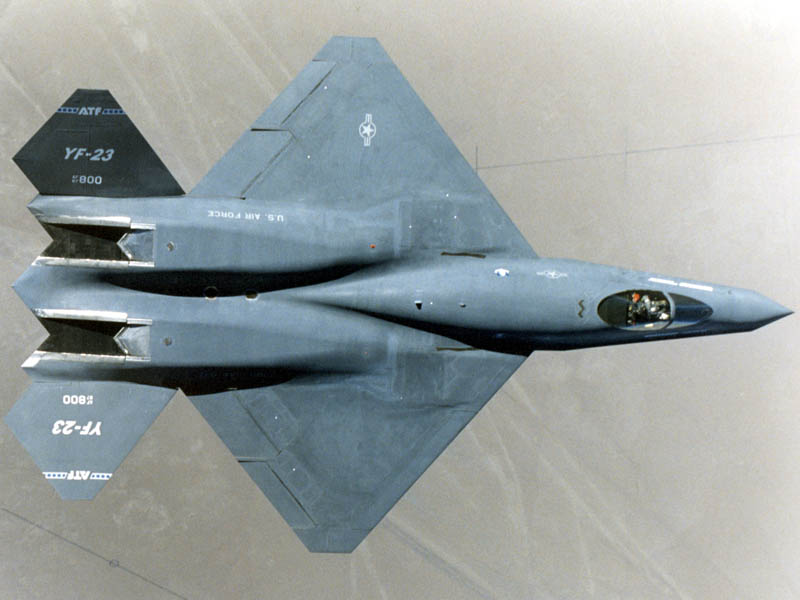
10. Â McDonnell Douglas/Northrop YF-23 Black Widow II (1990)Â
The 1980s Advanced Tactical Fighter programme sought to replace the F-15 with a fighter that combined the new technology of radar stealth with advanced avionics and engine technology. The fighter was needed to counter a generation of Russian fighters that threatened the US’ traditional technical superiority. The stakes to win this contest were extremely high, with the winner expecting a $65 billion contract. No expense was to be spared in producing a stealthy fighter to dominate the skies. All the major US aerospace companies submitted designs, but only two teams were downselected to produce prototype designs for a competitive fly-off. One was a Lockheed/Boeing/General Dynamic team and the other was Northrop/McDonnell Douglas. The YF-23’s pedigree was impeccable, Northrop had built the most advanced stealth aircraft in the world, the B-2, and McDonnell Douglas was the most experienced fighter house in the world having developed the supremely capable F-15 and the cutting-edge F/A-18. The YF-23 was a sleek masterpiece, quite unlike anything else flying before or since. It was probably both stealthier and faster than the F-22, which is astonishing considering that the F-22 can maintain a speed of Mach 1.82 without resorting to reheat (afterburners). Lacking the large conventional tail surfaces and thrust-vectoring (a risky technology) of the F-22 it was likely that the YF-23 was less agile, and it may also have been harder to maintain. The Black Widow was also larger than the F-22 which was likely to have translated into it being more costly to procure and operate. The YF-23 lost the evaluation, and today the F-22 Raptor is in service with USAF. What is certain is the YF-23 was the most formidable fighter never to have entered service.Â
9. Avro Canada CF-105 Arrow (1958)
The phrase ‘Canadian superfighter’ sounds odd, but that’s what the CF-105 was. Fast, long-ranged and fitted with advanced avionics, it would have proved devastatingly proficient at destroying incoming Soviet bombers. It was extremely innovative, and was the first ‘fly-by-wire’ fighter, flying with electric signal control as far back as 1958! The world would not catch up with this technology until the teen fighters of the mid 1970s. The initial aircraft was Mach 2 capable but plans were afoot for a Mach 3 variant. The Arrow was to be fitted with weapon systems that exceeded the contemporary state of the art: it was intended to be armed with internally carried Sparrow II missiles, an ‘active’ beyond visual range weapon (essentially they wanted an AMRAAM thirty years early). The Arrow was to operate as part of a vast fully automated, integrated air defence system intended to protect Canada from its communist neighbour.
The ‘Super Arrow’ was proposed by Bourdeau Industries in 2012. The extremely optimistic projected $11.73 billion cost to develop and produce a new heavy stealth fighter raised more than a few eyebrows. In light of recent US-Canada relations perhaps it would have had some merit!
The whole project was axed in 1959. It is still mourned by Canadians today, and it is probably this proud nostalgia that led to the bizarre recent proposal for a production line to be opened in the near future to create modern stealthy CF-105s. Though conspiracy theories abound of US interference leading to its cancellation, it’s likely that it was actually the budget book that killed a hugely ambitious, and wildly expensive project.
8. Martin-Baker MB5 (1944)
The MB5 The full potential of the Griffon 83 engine was harnessed by a six bladed contra-rotated propeller.
The best British piston-engined fighter ever flown. Well armed, very fast and easy to maintain. Flight trials proved it be truly exceptional, with a top speed of 460mph, brisk acceleration and docile handling. Its cockpit layout set a gold standard that Boscombe Down experts recommended should be followed by all piston-engined fighters. A multitude of access panels made it far easier to maintain than its contemporaries, and its tough structure (a more advanced version of the load-bearing tubular box type favoured by Hawker) would have given it greater survivability. The only thing the MB5 lacked was good timing, it first flew two weeks before the Allied Invasion of Normandy. Born at the birth of the jet age, with readily available Spitfires and Tempests this masterpiece of British engineering didn’t stand a chance.
Save the Hush-Kit blog. This site is in peril, we are far behind our funding targets. Our site is absolutely free and we have no advertisements. If you’ve enjoyed an article you can donate here.Â
7. Commonwealth CA-15 ‘Kangaroo’ (1946)
A strong contender for the title of the ultimate piston-engined fighter is the Australian Commonwealth CA-15 ‘Kangaroo’. The RAAF wanted a fighter superior to the highly respected P-51 Mustang, so accordingly issued an exceptionally demanding requirement. The specification called for a machine with a high rate of climb, excellent manoeuvrability including a high roll rate, and a generous range. The resultant Kangaroo delivered on all promises, and boasted a top speed of 458mph, and a range on internal fuel of 1,150 miles! The addition of drop tanks allowed for 2,540 mile flights. These remarkable figures were attained with the Griffon 61, even more impressive figures would have been achieved if the desired Double Wasp or three-speed Griffon had been fitted. Like the MB5 it was just too late to the party.
6. Dassault Mirage 4000 (1979)
France’s Mirage 2000 has been described by many fighter pilots as the perfect flying machine. Its ferociously high performance and almost telekinetic responsiveness have left pilots of many nationalities giddy with love and respect for the ‘Electric Cake Slice’. So imagine a ‘2000 with twice the power and you have a pretty spectacular aeroplane; the 4000, which first flew in 1979 was a just such an aircraft, in the same heavyweight class as the F-15 and Su-27. The Mirage 4000 was one of the first aircraft to incorporate carbon fibre composites (to keep weight down)- and was probably the very first to feature a fin made of this advanced material. Thanks to its light structure and powerful engines it had a thrust-to-weight ratio that exceeded 1: 1 in an air-to-air load-out. On its sixth test flight it reached 50,000 feet at Mach 2 in 3 minutes 50 seconds. The 4000 would have been agile, long-ranged and able to haul an impressive arsenal. Its capacious nose could have held an advanced long-range radar. The French air force didn’t want it, Iran — another potential customer- had a revolution, and Saudi Arabia, also on the look-out for a heavy fighter, opted instead for the F-15. Despite its obvious potential, the Mirage 4000 failed to find a customer, which was an enormous kick in the nuts for Dassault, as the company had privately funded the type’s development.
5. IAI Lavi (1986)
In the mid-1970s Israel began work on an indigenous fighter-bomber to replace its A-4s and Mirage derivatives. Development of the very advanced design was aided by US technological assistance. The highly agile canard delta first flew in 1986 and showed great potential. Similar to the F-16 but with greater manoeuvrability at higher speed (though it had a lower maximum speed of Mach 1.6) and altitudes it was also to be fitted with Israel’s widely respected guided munitions and electronic warfare equipment. But the Lavi project was too expensive for such a small country and it was cancelled in favour of a F-16C order. The degree to which the design influenced China’s J-10 is much disputed but it is generally agreed that Chengdu learned much from Israeli industrial visits. Had the Lavi gone into production it would likely have been a potent multirole aircraft, somewhat like a larger Gripen.
4. Northrop F-20 Tigershark
The F-20 was the ultimate US F-5 derivative. However unlike the twin-engined Tiger II and Freedom Fighter, the F-20 was powered by a single engine. It was intended to serve the needs of US client nations not cleared for fighters as advanced as the F-16. The F-20 had similar performance to the F-16 but would have been easier to maintain and cheaper to operate. Flight trials went extremely well and Chuck Yeager became an enthusiastic advocate of the type. When restrictions on F-16 exports relaxed, the F-20 lost its raison d’etre. An attempt to provide F-20s for the US aggressor fleet proved unsuccessful perhaps as General Dynamics and some in the F-16 community feared the F-20 reaching production status. In the end this privately funded fighter fell by the wayside, but did serve to distract attention away from Northrop’s secretive work on the nascent B-2 stealth bomber.
The F404 engine that had powered the F-20 did find gainful employment in the light fighter world, going on to power the Saab Gripen, KAI FA-50 and Tejas Mk 1.
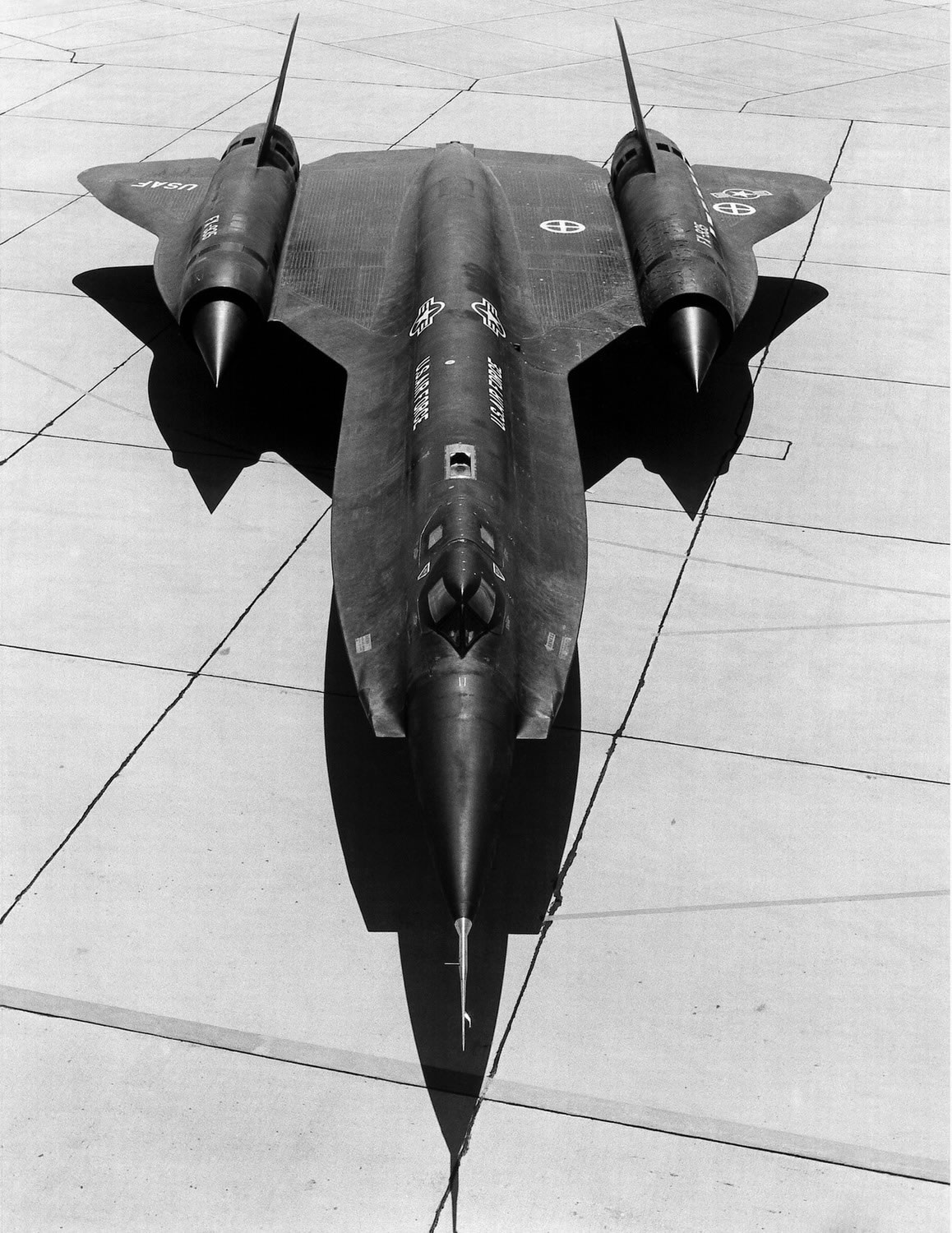
3. Lockheed YF-12 (1963)
Until the late 1950s each generation of fighter interceptors was faster than the last. It stood to reason that the Mach 2.3 capable F-106 would be replaced by something even faster, and work on the the F-108 Rapier began accordingly. Somewhat unsurprisingly, a fleet of Mach 3 fighters that each weighed twice the weight of a loaded Lancaster bomber proved too expensive to develop. It seemed a shame to waste the expensive radar, missiles and fire control system developed for the F-108 so they were fitted to the only available airframe of comparable performance, the extremely secret Lockheed A-12 reconnaissance aircraft. The cost of the war in Vietnam and a less defensive military posture saw the funding for the 93 aircraft USAF wanted scrapped. Elements of this weapon system eventually found their way onto the F-14 Tomcat.
2. Focke-Wulf Fw 187 (1937)
The American P-38 Lightning was a single-seat twin-engined fighter and it proved a great success, but the idea was novel for its time. By keeping the frontal cross section to the absolute minimum, this class of aircraft could be as fast as a single-engined fighter but with far greater range, and if required, firepower. The Germany company Focke-Wulf also tried this idea, and the result was the superb Fw 187. The Fw 187 was an extremely clean design aerodynamically, everything being done to keep the frontal cross section to the absolute minimum; the cockpit was tiny (even by German standards), the dashboard of which was so small that some of the instruments had to be mounted externally on the engine nacelles. The result of this strict adherence to aerodynamic slickness was an extremely fast manoeuvrable fighter with an impressive range. With the original Jumo 210Da engines, a compromise unwanted by the designer, the prototype clocked 326 mph, which was 50mph faster than the much hyped Messerschmitt 210. When the desired DB 600As were added in 1939, the Fw 187 hit a level flight speed of 394mph, an astonishing figure for the time. Armed with two cannon and four machine-guns, the type would have proved a huge thorn in the side for the RAF’s Fighter Command if employed as an escort fighter in the Battle of Britain. Despite a small operational evaluation, the type never entered series production. The Me 210 lobby had greater political clout than the exponents of the Fw 187, and Focke-Wulf was devoting its resources to the development of the Fw 190.
1. Vought XF8U-3 Crusader III (Reader’s choice, suggested by Rowland White)
As ‘phabulous’ as the Phantom was, in the F-4, the US Navy may have picked the wrong aircraft. Had they gone for the Crusader III instead, the Vought machine would have made mincemeat of the MiGs over Vietnam.
The XF8U-3 first flew on 2 June 1958. The prototype reached Mach 2.39, and demonstrated a zoom ceiling well over 76,000 ft (23,170 m). Fly-offs against the F4H (the early Phantom), demonstrated that the Crusader III had vastly superior manoeuvrability. John Konrad, Vought’s chief test pilot, noted that it “fly circles around the Phantom II”. Its combat thrust-to-weight ratio (T/W ratio) was approached unity (0.97), an almost unprecedented figure for the 1950s (the F4H reached around 0.86). The F8U-3 program was cancelled after five aircraft built, but not all was wasted: NASA appreciated the type’s remarkable high altitude performance and took three of the test aircraft for research purposes. These NASA Crusaders routinely intercepted and defeated U.S. Navy Phantom IIs in unrequested mock ‘bounce’ dogfights. The Navy did not enjoy this bullying and ordered NASA to stop it.
Though the XF8U-3 was a better dogfighter, the Phantom had a crew of two, which was a huge advantage considering how hard it was to operate contemporary radars and missiles, and could carry a weapon-load twice as big. The F-4 also had the advantage of two engines, a prime consideration for an operator at sea. Still, there is little doubt that the Crusader III would have been a formidable air superiority fighter or interceptor. With the advent of 1970s technology, allowing effective single crew operations, it could have matured into an exceptionally potent fighter.Â
Save the Hush-Kit blog. This site is in peril, we are far behind our funding targets. Our site is absolutely free and we have no advertisements. If you’ve enjoyed an article you can donate here.


![WE-01[1]](https://i0.wp.com/hushkit.net/wp-content/uploads/2018/01/we-011.jpg?resize=400%2C240&ssl=1)

 Save the Hush-Kit blog. Our site is absolutely free and we have no advertisements. If you’ve enjoyed an article you can donate