The End of Fighters?

Sukhoi-T-50-protótipo-foto-Sukhoi

By David Hare

The people of Switzerland recently voted against buying new fighter planes for their air force on the grounds of cost. To put this into context, a country ranked 20th in the world in terms of gross domestic product (it sits between Saudi Arabia and Iran) said no to a small fleet of one of the cheapest fighter aircraft, Saab’s Gripen.

The twenty two Gripen E/Fs would have replaced Switzerland’s geriatric F-5E fleet and eventually its F/A-18C/Ds. Though the referendum result was only won by a narrow margin it leads to the question, could this be the start of a trend? Have high performance manned fighters priced themselves out of the future?

In the 1940s-50s the RAF operated around 60 Gloster Meteor squadrons (even Belgium ordered 355 aircraft), and Britain’s total order (including FAA aircraft) surpassed 2700 aircraft. Today the RAF has five Typhoon squadrons, from around 2020 (when the Tranche 1 aircraft will be retired) it will have 107 Typhoons. Best not to think about the estimated £37 billion it will have cost the UK taxpayer by the time it retires. A comparison between the US F-86 and the later F-22 show an even more extreme example of the reduction in fighter fleet sizes. The size of fighter forces has declined for most nations since the 1950s. What will happen at the end of the next generation cycle in forty years time? In terms of development, Europe has no next generation fighter planned, the US has nothing firm beyond the F-35 (which is leaving a bad taste in the mouth of US procurement bodies, if you can forgive this rather weird imagery), and the Navy’s F/A-XX is far from definite. Considering that fighters take around thirty years from concept to operational readiness it appears that fighters are on the way out. So what of the PAK FA, J-20 and J-31? Do they not prove an international desire for this most high prestige of weapon’s platform? It could be argued that these aircraft represent a rather conservative response to the US so-called ‘5th Generation’ force, and instead point to a wish to continue a slow and careful arms (and technology) race between nations with no real wish for ‘peer’ war.

Time will tell if  the referendum will lead to Switzerland abandoning the fighter role (as New Zealand did in 2001), and if it is a significant moment in a trend that could see small and medium-size air forces killing their most glamorous types.


Airbus Defence test pilot Chris Worning gives us the low-down on Typhoon’s super-cruising abilities

GLD-081502

Photo copyright: Eurofighter-Geoffrey Lee

I had the pleasure of speaking to Airbus Defence test pilot Chris Worning about Typhoon’s performance.

Have you encountered any aircraft that out-climb Typhoon?

The Raptor might be able to, but that’s it, it’s the same story with acceleration. It is a true supersonic aeroplane. Even with tanks on.

The speed quoting for Typhoon’s maximum supercruise varies in press releases, what figure would you put on it?

It’s around 1, 1.2 (Mach), you can figure it out yourself because the supersonic drag peaks at up around Mach 1 or 1.05, and then it comes down, and the other side of this is where we normally settle down.

And how long can it cruise at Mach 1.2?

It mostly depends on the atmosphere. On a standard day you sit down at M1.15 or M1.2- but if it’s really cold up high you get more out of it that day. Aeroplanes are quite susceptible to temperatures. You can sit there till you run out of gas, and because you’re in dry power you don’t use a lot of gas. I’ve never had enough space to travel that far in one direction, but you certainly sit there for 15 or 20 minutes.

Favourite aircraft No. 37: Airbus A320

Nachrichten_105_35


Kick-started by vast military orders, the US company Boeing wisely invested a great deal into developing very fine airliners. With great products, a big home market and governmental support it wasn’t surprising that Boeing soon dominated the civil marketplace. It was sheer madness to take this titan on, but that’s exactly what Airbus did. This upstart from the Old Continent smashed the door open with the A300 in 1974, but it was the A320 (entering service in 1988) that established Airbus as the ‘other’ big plane-maker. The A320 was the F-16 of the airliner world, introducing both the side-stick controller and fly-by-wire to the commercial world. The A320 scared the bejesus out of Boeing: at last the 737 had a worthy adversary. The A320 family grew, and soon Airbus was selling as many airliners as Boeing. By late May 2014 Airbus had produced 6,092 members of the A320 family. This year the lean and green A320neo will join the series. The future looks bright for the neo: In 2011 Malaysia’s AirAsia ordered 200 for 12.7 billion. By late 2013 Airbus was happily holding an order book for 2,523 neos. By becoming the Pepsi to Boeing’s Coca-Cola, Airbus powered an efficiency ‘arms race’ that benefited the holiday-maker and airlines alike. We salute the A320!

Marie Boustani


This week’s crush: the kidneys, eyes and lips of the BAC 221

IMG_6083

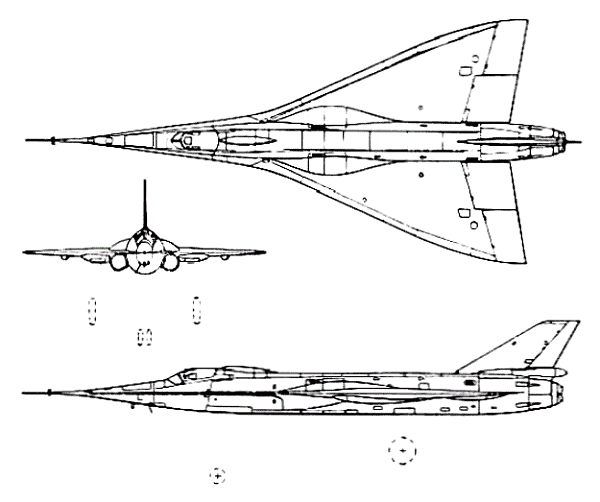
Today I fell in love with the BAC 221. Created to explore the ‘ogee’ wing shape for Concorde, the 221 was converted from the Fairey Delta 2. Nestled beneath the Fleet Air Arm Museum’s Concorde, in a dashing ‘Bugatti’ blue, it is an extraordinarily attractive aeroplane (I know adverbs are the devil’s work, but I’m tired).

There are so many handsome parts to the 221 that it’s hard to know where to begin. As well as the overall harmony of the shape, it is a delightful memory prompt, causing the lucky onlooker to recollect a bevy of other designs that appeared both before and after the 221. The 221’s elegant kidney-shaped air intakes are a delight to the eye. They were less of a delight to the engineering team and small ‘lips’ had to be added to control disruptive air flows. The lips give the intakes a strangely familiar look- is it the JF-17 they remind me of (the rapid taper of the intake ducts are also a little reminiscent of the AIDC F-CK-1 Ching-kuo)? The intakes also call to mind the legacy Hornet. Speaking of the Hornet, the very long LERX on the 221 that go all the way to the nose are gorgeous. To ensure an even flow to the compressor face the air duct snakes up through the wing giving a little hump like a late-F-16 CFT. The rear fuselage of the aircraft is rather French, or maybe it’s fairer to say it looks like a Avro-Canada designed Mirage, either way it’s superb. From some angles it even calls to mind the (very batty) Convair F2Y Sea Dart.

IMG_6077

The wing is the aircraft’s defining feature and just as on Concorde, the shape is sublime. A graceful compound curve that speaks of a natural high-speed, not the macho, penetrating shape of a 50s Convair or the paper-dart form of a Mirage; it does not look like it was made in a factory, in fact if anything, it looks like it evolved.

bac-221

With its concealed compressor face and steeply-raked back wing, I couldn’t help but wonder what kind of a radar cross section this aircraft would have had. Maybe it could have formed the basis of a stealth technology demonstrator in the 70s, or maybe I’m just dreaming because I’m in love.


IMG_6090

Haile Selassie’s Guide to Air Defence

Image

On 19th October 1935, Ethiopian Emperor Haile Selassie gave orders to his Commander-in-Chief detailing the best response to raids from Italian military aircraft: “When an aeroplane is sighted, one should leave large open roads and wide meadows and march in valleys and trenches and by zigzag routes, along places which have trees and woods.” he continued “When an aeroplane comes to drop bombs, it will not suit it to do so unless it comes down to about 100 metres; hence when it flies low for such action, one should fire a volley with a good and very long gun and then quickly disperse. When three or four bullets have hit it, the aeroplane is bound to fall down. But let only those fire who have been ordered to shoot with a weapon that has been selected for such firing, for if everyone shoots who possesses a gun, there is no advantage in this except to waste bullets and to disclose the men’s whereabouts. Lest the aeroplane, when rising again, should detect the whereabouts of those who are dispersed, it is well to remain cautiously scattered as long as it is still fairly close.”

Image