How to draw a Spitfire

SpitP2nowords
One of the hardest aeroplanes to draw well is the Spitfire. We turned to WestlandWyvernophile and aeroplane drawerer par excellence Ted Ward to show us the way.

“Don’t bother, they’re impossibly difficult, that’s my advice.

Actually, although everyone always goes on about the wings, beautiful though they are, they are not an overly complicated shape to render convincingly. The main stumbling block in my opinion is the fin and rudder on the early models. It’s a really odd shape. Griffon marks are easier to draw.

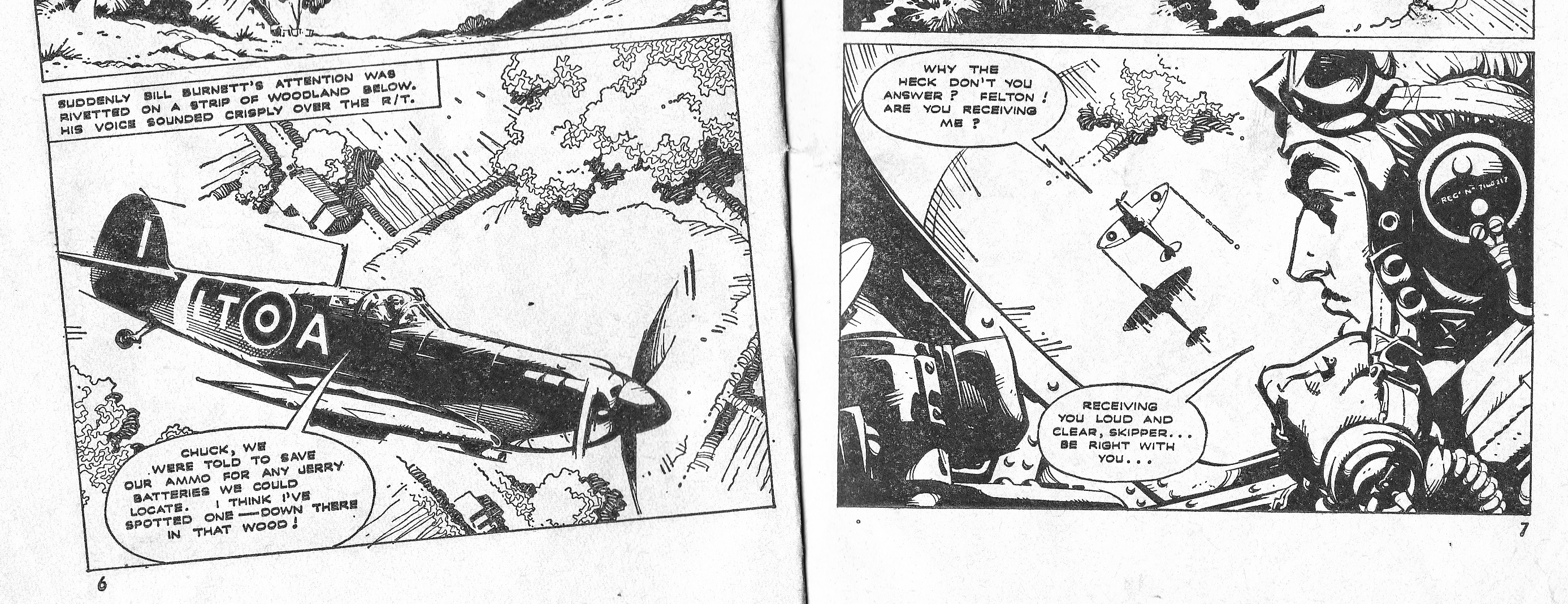
The other thing I think that people should take into account is that the Spitfire has a quite pronounced dihedral angle on the wing and there is a tendency amongst some to flatten them. You see it a lot on built model kits. And in the less well-drawn Commando picture libraries. Here’s a good example:
Image
To be fair virtually everything is wrong with that image but dihedral is one of those things.
However one of the Fleetway artists (no idea of name – they never get credited) drew some of the most consistently pleasing Spitfire drawings I have ever seen.
Image
Perhaps the most useful resource I have for you though is Frank Wootton’s splendid little 1941 volume How to Draw ‘Planes. Scans depict how to draw a Spitfire.

Image

And ‘Spitfires against Alto-Cirrus’ which is a painting. No idea where this painting might actually be though. Furthermore I contend that it is a lot more difficult to draw alto-cirrus than any aircraft from the 1939-45 period.
Image
It’s funny, since writing that about the Fleetway artist doing consistently good Spitfires, I have noticed that on the one on the left he (I’m guessing it’s a man, but I’m not sure) has put the tailwheel in completely the wrong place. Huh. He still shits all over the competition though. Apparently he just wanted to fuck and burn!”
Check out Ted’s fabulous art here

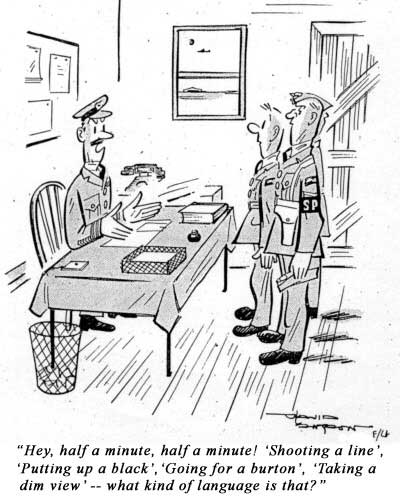
Brief guide to RAF slang from World War II : Part 2

SLANG2


Arse-End Charlie: the rear gunner, also known more politely as Tail-End Charlie

Crump Dump, The: the Ruhr.

Chatterbox: machine-gun.

Flaming onions: anti-aircraft tracer rounds.

Humdinger: a fast aircraft

Hurry: A Hawker Hurricane

Kipper kits: aircraft tasked with protecting convoys in the North Sea.

Midwaaf: a bossy NCO of the Women’s Auxiliary  Air Force (from midwife).

Mouldy: a torpedo.

Screaming downhill: making a power dive.

Shagbat: a Supermarine Walrus.

Snargasher: a training aircraft (such as the North American Harvard), from tarmac-smasher.

Part 1 can be found here.

The Mystery of the P-996 Lazer Fighter Jet from Grand Theft Auto 5

The Mystery of the P-996 Lazer Fighter Jet from Grand Theft Auto 5

Fans of the nihilist hell of Grand Theft Auto 5 have the option of stealing a fighter aircraft. The aircraft is the ‘P-996 Lazer Fighter Jet’, clearly a derivative of the F-16. The most visible change to the F-16 is the replacement of the single vertical fin with twin canted-out tails. This is not an unheard of modification; Iran’s HESA Saeqeh is essentially an F-5 with twin canted tails. So what is the reason for the P-996’s F-35-style tails surfaces? Could it  be for frontal radar cross section reduction, or improvements to the F-16’s already impressive High Alpha performance?

Unknownfighterjet-GTAV
The theory that the twin tails are a RCS-reduction feature is questionable though, as the aircraft has no provisions for internal carriage of munitions and does not even carry CFTs, instead relying on external tanks in its portrayed configuration of six missiles (similar to the AIM-120) and two tanks. The fins also feature two pods in the front base (probably containing defensive electronics of some kind) which do not appear to be shaped for minimal radar return. Interestingly, in the real world Lockheed Martin has offered a twin-tailed, straight LERXed F-16 derivative to South Korea, which in many ways resembles the P-996.

The new bifurcated intake is also a mystery; though some aircraft, like the Mirage F1, Hunter and F-20 do feed one engine from two intakes, a split dorsal intake is a unique feature, the purpose of which is unknown. It would seem that the obvious intake configuration to go for if RCS reduction was the key would be a divertless intake similar to that of the J-10B. In fact, a F-35 Diverterless Supersonic Inlet was tested on the F-16 in the 1990s and this would seem a good place to start in producing a new stealthier intake.

F-35_Divertless_Supersonic_Inlet_F-16

Perhaps the bifurcation is used to mask the compressor face or facilitate faster top speeds? This second possibility is backed up by the new lower-drag canopy. The heavily riveted finish seems incompatible with stealth, maybe they it is made from a new lightweight steel alloy suitable for prolonged high-speed flight? Or could it be armour-plating?

The designation is also puzzling, is this harking back to Northrop’s nomenclature which included the P.530 Cobra or a Hawker project from the 1950s? Was Northrop Grumman involved in the development of this aircraft? Is it an alternative to the F-35, or a lower cost supplement? Could the ‘P’ herald a return to the days of Pursuit fighters?

The twin cannon armament is also unusual (I can’t think of a fighter since the abortive F-20 to feature this), and suggests it was developed with the Close Support role in mind, which would fit the theory that the highly riveted skin is heavily armoured.

The ‘Lazer’ of the name appears to be a product name rather than being indicative of a laser weapon.

The P-996 is a mysterious aircraft that begs many questions. The conventional take-off P-996 replaces a VTOL variant from the Beta version of the game which had a Harrier-like appearance.

P996_lazer

Ten helicopters that changed history

World-Best-Military-Helicopter-Wallpaper-62b1a71

Helicopters are there for all your needs. For over a lifetime, helicopters have been busy – from rescuing drowning sailors, chasing stolen cars across cities to vaporising poor people in Asia. Here we celebrate the ten most significant choppers. 

10. Messerschmitt-Bölkow-Blohm Bo 105

Image

The cheeky ‘105 was the first light turbine twin and became the basis for Eurocopter’s subsequent success in the light twin market with the BK117 and EC135/145. It was the first operational chopper with a hingeless rotor system, contributing to its insane agility. Over an almost 30 year production run more than 1,500 were built, serving with 27 armed forces and 10 government agencies.

9. Robinson R22

Robinson_R22_Helicopter_hovering

Cheap, cute and simple. The piston-powered R22 has the same amount of power as a Fiat 124 Sport Spider. It’s perfect for herding cattle (which it does a lot of in America and Australia) and teaching pilots the basic of rotor-craft skills.

8. Boeing CH-47

chinooks-in-flight

7. SNCA du Sud-Est/Aérospatiale Alouette II

BAF-ALII-A49-c

The Kaman K-225 was the first turbine-powered rotor-craft, but the first practical application was the Alouette II. This French helicopter demonstrated the enormous advantages of the turbine over the piston-engine. It wiped the floor with every one of its piston-engined rivals and lead to today’s situation where all but the lightest helicopters are turbine-powered.Aerospatiale Alouette II

Have a look at this fab model here

6. Bell 206

Bell-Jet-206-Ranger-HD-Wallpaper

5. Bell AH-1 Cobra

Image

With its narrow fuselage, tandem-place cockpit and nose-mounted gun, the Cobra was the first real helicopter gunship. In the Vietnam War it demonstrated how effectively helicopters could be used in the fire support role. Despite its success it suffered a high attrition rate; well over a quarter of the Cobras deployed to Vietnam were destroyed by enemy fire or lost in accidents. Its design influenced the Mi-24, AH-64, Tiger, Mangusta and almost every other gunship helicopter. Despite its first flight being almost fifty years ago, the Cobra remains in production today. The latest family member, the AH-1Z, is one of the best of its class in the world.

4. Sikorsky S-61 Sea King

TOPEX 1-87

The muscular Sea King may well have saved more people from drowning than any other helicopter. The helicopter featured a raft of helicopter innovations including: a foldable five-blade rotor with interchangeable blades, a flying-boat hull, an auto-pilot, all-weather navigation systems and hydraulically powered flying controls. These combined to produce a tough chopper that could withstand the extremes of life at sea. If this wasn’t enough the Sea King set a world speed record of 170 mph and flew non-stop across the USA without refuelling! Despite its enormous age it remains in service today.

Thank you for reading Hush-Kit. Our site is absolutely free and we have no advertisements. If you’ve enjoyed an article you can donate here. At the moment our contributors do not receive any payment but we’re hoping to reward them for their fascinating stories in the future.

3. Sikorsky S-51

HO3S-1 Dragonfly 15

The first practical helicopter. It also deserves a place for its pioneering work including rescue, naval and combat ops. Another good Sikorsky candidate for this list, had space allowed, would have been the H-60 series.

2. Mil ‘Hip’ series

Ukrainian_MChS_Mil_Mi-8_Belyakov

The ‘Hip’ is almost omni-present. Few wars or aid operations in the last 30 years have not been graced by the presence of ‘Khrushchev’s flying truck’. Mi-8/17/171s have been produced in greater numbers than any other helicopter. Though it first flew well over 50 years ago, it achieved a new world record in August 2013; a Ukrainian Mi-8MSB reached an altitude of 9150 metres.  The ‘Hip’ is also here to represent the Mil design bureau, which have produced the biggest and heaviest helicopters ever to have flown.

1. Bell UH-1 Iroquois 

The UH-1‘Huey’ defined the modern military transport helicopter in both form and use; more than that it was also the first modern helicopter. The most important design feature was the placing of the turbine engines and the rotor gearbox on the roof, leaving room for a large cabin.

Real news footage combined with a spate of Vietnam films, including the Wagnerian charge of ‘Apocalypse Now’, have established it as the defining visual symbol of the Vietnam War. It is the most common military helicopter in Hollywood films and over 16,000 were produced in the thirty years from 1956.

UH-1D_helicopters_in_Vietnam_1966