Out of the closet and on to the runway: gay pilots

Wing tips apart

Lately there has been quite a bit of discussion about the first person to achieve heavier-than-air flight. Gustave Whitehead has entered in the headlines again refuting the broad conception that the Wright brothers were first in flight.  While the historians are debating the issue, we’re going to throw a wrench into the conversation. Have you heard of Alberto Santos-Dumont? If not, he’s another aviation pioneer who has also been credited for being first in flight.  

Santos-Dumont was born in Cabangu, Minas, Brazil on July 20, 1873.  From a young age, science and technology fascinated him, especially flight.  At the age of nineteen, Santos-Dumont traveled to Paris to study mechanics and engineering to help further his research into flight.  He first started with hot air balloons before transitioning to the design of steerable balloons, or dirigibles.  In 1901, he flew from Parc Saint Cloud to the Eiffel Tower and back in less than thirty minutes with a round-trip distance of 6.8 miles (11 km) and thus winning the Deutsch de la Meurthe and 125,000 francs, which he donated to the poor people of Paris and his employees.

SI-2001-11584~P

As he continued to work on his dirigibles, Santos-Dumont interests turned to heavier-than-air aircraft.  After several attempts, he successfully built the XIV-bis, a heavier-than-air aircraft.  On October 23, 1906, Santos-Dumont piloted the XIV-bis for a distance of 197 feet (60m) at an altitude of approximately 15 feet (5m).  This event proved to be the first flight of a powered heavier-than-air machine in Europe.

Image

The XVI-bis flight has sparked some controversy.  The Wright brothers used a launching rail for their 1903 flight as well as a launch catapult for their 1904 and 1905 aircraft.  Meanwhile, the XIV-bis had a wheeled undercarriage and thus did not require any assistance in lifting in the air.  According to the Fédération Aéronautique Internationale, which was founded in France in 1905 for the purpose of verifying aviation records, the rules specified that an aircraft should be able to take off under its own power to qualify for any type of record.  Under these terms, supporters of Santos-Dumont maintain that the XIV-bis was the first successful fixed-wing aircraft.  We’ll leave you to decide which pioneer was actually first in flight.

Image

The topic of Santos-Dumont brings up another interesting topic in aviation.  Many are unaware of the idea that Santos-Dumont was gay.  The history of homosexuality and aviation is not widely researched or for that matter acknowledged, yet there is a rich history involving this quiet group in the field starting with one of the first pioneers.  The aviation community is starting to focus on this group of individuals starting with the National Gay Pilots Association (NGPA).  Formed twenty years ago, the NGPA’s mission is to encourage gays and lesbians to enter into the field of aviation through education, outreach programmes and social events.  According to NGPA Executive Director, Steven Moore, “Milestones have been made” in the aviation industry; however, “we still have a long way to go before equality is achieved.”  Unfortunately this rings true as gays and lesbians still fight for social equality.  NGPA President, Steve Walker, commented in a 2011 GA News article on the pilot shortage, “So networking is key.  You don’t have to be gay to be part of the organisation, but you need to be supportive of the lesbian and gay community.”  The NGPA provides an avenue for forming alliances with businesses and airlines within the aviation community while maintaining a comfortable environment for gays and lesbians to reach out for support.


Unfortunately not everyone supports the NGPA and their cause.  Critics voice their opinions while others make it difficult for them to partake in aviation-related events. One such incident occurred when the NGPA hosted a booth at a major aviation event.  The NGPA had attended for several years as members but it was not until 2010 that things really started to turn south. The event lasted a week and the NGPA found their presence created mixed reviews. Some were happy to see the NGPA and expressed their support; yet others who were less than enthusiastic about the idea also made sure to let the booth staff know their opinion.  When it came time to renew for the next year’s event, the organiser of the event told NGPA that there were many complaints about their presence and that they wanted to be sure that the NGPA understood that it was an air show and not a sex show and that “any sort of inappropriate touching would not be tolerated.”  Of course this infuriated the individuals at NGPA. They were attending the show for promoting civil rights not to promote sex. The NGPA have since decided to exclude themselves from this negativity and find other avenues to promote their cause.

 Image

Regardless of your views as a reader, it is important to note that we are all here to pursue our dream in aviation.  It is no different than when the Tuskegee Airmen or the Women Airforce Service Pilots pushed to break the barriers that had barred them from flying. Please remember that aviation is a progressive field and we are here to help it grow. History has shown that anyone who puts their mind to it can succeed in aviation, regardless of their race, gender or sexual preference.

By Melanie Rivera who runs the superb Public Historian blog, ‘Aviation History as told by a Public Historian’

Image

Old Versus New: Round 1 EE Lightning V S-300 SAM

We pit old technology against new.

Image

Round 1

English Electric Lightning (1959-88)

Versus

S-300 surface-to-air missile (1978-present day)

Which of these would be more effective at defending a target from enemy bombers?

Thomas Newdick: “The Lightning has met its match. Even in its most basic form, the S-300 system can detect a target (using the Tin Shield radar) at 360km, and a battery can engage a minimum of 4 targets (increasing to up to 36 with later versions of the system). Using shoot and scoot tactics, dispersed system components, and with mutual protection from Tor and Tunguska SAM and SAM/SPAAG, the S-300 presents a relatively low risk to the crew. It is reusable, of course. Altitude limits are from 25m up to 30,000m. A single battery should cost around $150 million.”

Winner: S-300

Top speeds: S-300 2,500-5,400 mph /EE Lightning 1500 mph

Image

F-100 Super Sabre: a fighter pilot’s perspective

f-100d_63304

Former fighter pilot Scotty Wilson gives you the low-down on flying the magnificent ‘Hun’.

1. What were you were first impressions of the F-100?

I transitioned to the Hun right out of UPT after flying the T-38. The T-38 was small, sleek, white and sexy. The Hun was, by comparison, huge, camouflaged, grimy and a workhorse. Best of all -it only had one engine and one seat. It was the most beautiful thing I had ever seen!

2.  When did you fly it? With which units?

I flew the Hun (C/D/F) from 1973 to 1979 for about 1500 hours, mostly with the 178 TFG (Ohio) and 131 TFW (Missouri) Air Guard units.

3. What was the best thing about it?

It was an “honest” airplane with excellent control harmony and good visibility. It was simple and reliable.

4. What was the worst thing about flying it?

Pilots like to say the Hun invented adverse yaw, and one did have to be careful with lateral stick input at high AOA. Final approach speeds were relatively high (166 KIAS + fuel in the D; higher in the C). It was underpowered – like a lot of the early Century-Series airplanes – and we had two power settings: “not enough” (military power); and “just okay” (afterburner). It was hard to fly really well.

5. Was it an effective weapon system?

I never flew the Hun in combat, so I’m not the best one to ask. I have several friends who flew as “Misty FACs” (Forward Air Controller, a very dangerous mission) in South East Asia; I never heard them say a bad thing about the plane. In training missions, it was a stable bomb and gun platform.

Image

6. Did you ever fly mock dogfights against any other types, what was this like and which types were the most challenging?

We were commonly called-upon to do duty as MiG-15/17/19 simulators and as training partners in DACT with more advanced fighters such as the F-4, F-14 and F-15. We often flew “canned” scenarios or profiles specific to another unit’s training requirements.

“Huge, camouflaged and grimy…the most beautiful thing I had ever seen!”

Occasionally, we’d get an opportunity to do anything we wanted. A “clean” Hun – even the heavier D model – could climb to above 45,000 and get up to Mach 1.3 in a shallow dive. No one looked for us up that high, and we could usually engage from above unseen – the first time. We could generally win a 1-vs-1 guns-only or rear-aspect missile fight against a hard-winged F-4 and break even against a slatted E, unless the Phantom pilot was very good (Ron Keys comes to mind) and didn’t fight our fight. Same with the F-14. Best tactic was to go single-circle, co-plane. We’d give up knots for angles and out-rate the other guy, who would honor your nose position and become defensive immediately. (I have 2000 hours in F-4C/D/E and know those airplanes pretty well.)

The F-15 was a superior airplane in every respect and it was rare you got the advantage on one unless the pilot was a doofus (and there were a few).

F-84F_F-100D_F-101B_F-102A_from_ANG_in_flight_c1970

7. What three words best describe the F-100?

Honest, reliable, predictable.

8. What was your most memorable flight in a F-100?

14 hours in the cockpit / 12 hours flight time during a winter-time redeployment from Ramstein AB Germany to Richards-Gebaur AFB, Missouri. We strapped in and started-up, then shut-down and waited in the cockpit while our tankers at RAF Mildenhall fixed a problem. After we got airborne and mid-way across the Atlantic both tankers lost their drogues (equipment, not pilot error). We found another tanker – this one scrambled out of Canada – using UHF-ADF and Air-to-Air TACAN while IMC in 1 NM visibility conditions. When we finally joined with two more tankers we flew…and flew…and continued flying westward because the weather at every AFB east of the Mississippi was below landing minimums. (The F-100D didn’t have ILS at the time.)

I don’t think we ever saw groundspeeds in excess of 360 knots the entire route. Only if you have worn the old-style poopy suit* can you appreciate how enjoyable the last four hours of that flight was like.

Scotty Wilson built a flyable Bugatti 100P. Tragically he died flying it in 2016.

Thank you for reading Hush-Kit. Our site is absolutely free and we have no advertisements. If you’ve enjoyed an article you can donate here. At the moment our contributors do not receive any payment but we’re hoping to reward them for their fascinating stories in the future.

Have a look at 10 worst British military aircraft, Su-35 versus Typhoon, 10 Best fighters of World War II , top WVR and BVR fighters of today, an interview with a Super Hornet pilot and a Pacifist’s Guide to Warplanes. Was the Spitfire overrated? Want something more bizarre? The Top Ten fictional aircraft is a fascinating read, as is The Strange Story and The Planet Satellite. The Fashion Versus Aircraft Camo is also a real cracker. Those interested in the Cold Way should read A pilot’s guide to flying and fighting in the Lightning. Those feeling less belligerent may enjoy A pilot’s farewell to the Airbus A340. Looking for something more humorous? Have a look at this F-35 satire and ‘Werner Herzog’s Guide to pusher bi-planes or the Ten most boring aircraft. In the mood for something more offensive? Try the NSFW 10 best looking American airplanes, or the same but for Canadians. 

Famous planes matched to songs

First there was cinema, then 3D cinema..now at long last jet-a-sound!

I’ve matched aeroplanes to appropriate songs. The aircraft have been matched to songs which sum them up. The connection may be been an obvious one or maybe something more subtle.

Please add your suggestions to comments and I’ll include them to make the ultimate aircraft mix tape! BOOM!

It’s a simple game:

1. Turn down the volume on the plane clip

2. Turn up the volume on the song clip and start playing it.

3. Watch the plane clip.

Convair B-58 Hustler

Hustler song clip

Hustler plane clip

Messerschmitt Me 163 Komet

Me 163 plane clip

Me 163 song clip 

Lockheed Constellation 

Constellation plane clip

Constellation song clip

Blohm & Voss BV 141

BV 141 Plane clip

BV 141 song clip

de Havilland Comet 

Comet plane clip

Comet song clip

Sukhoi ‘Flanker’

‘Flanker’ plane clip:

song clip

Lockheed Martin F-22 Raptor 

Plane clip:

song clip

Gloster Javelin

Plane clip

Song clip

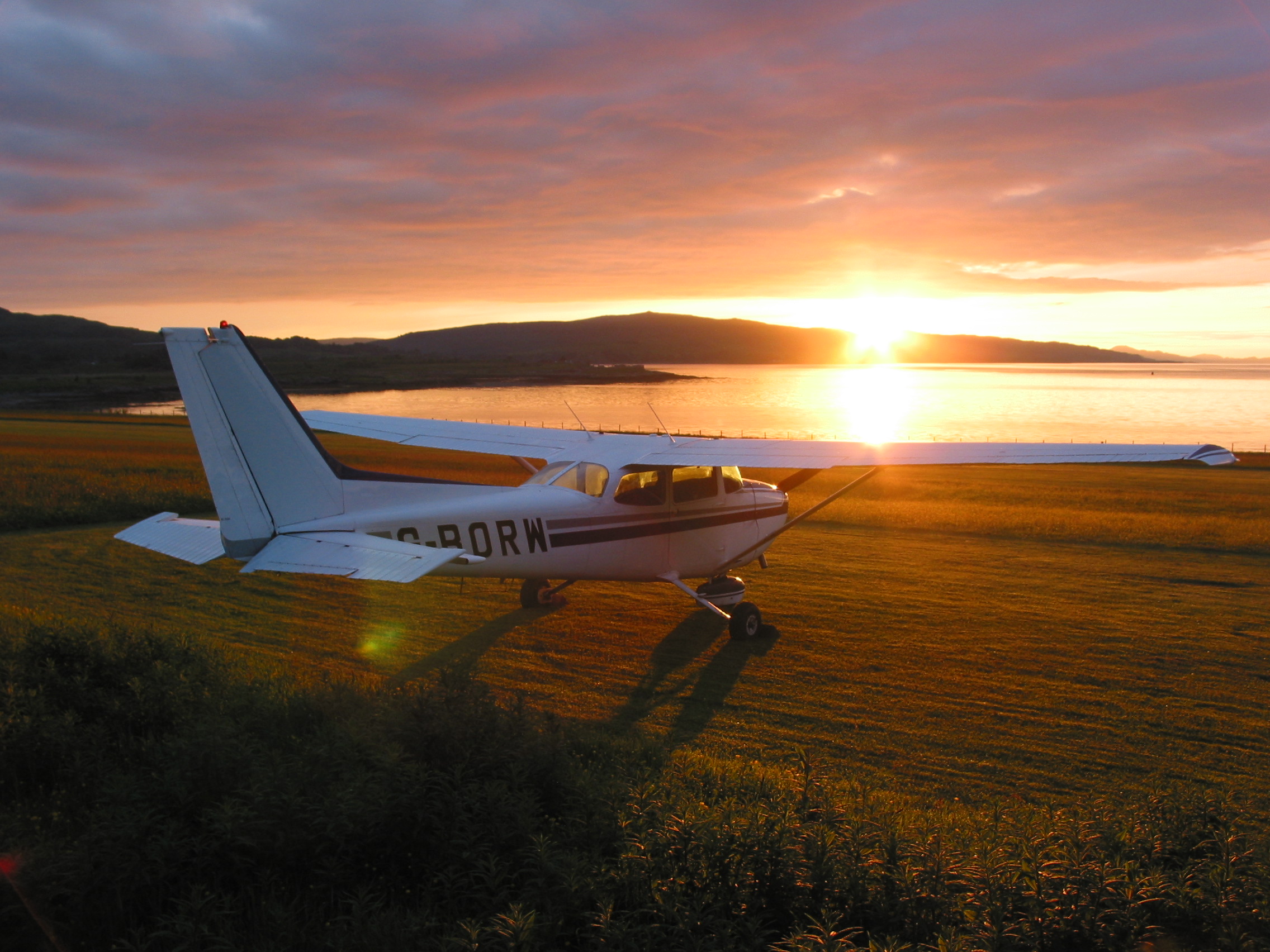
MY FAVOURITE AEROPLANE IN 200 WORDS #33 Cessna 172 by Jakob Whitfield

Image

I couldn’t tell you my favourite aircraft type – how to choose? But I could immediately tell you my favourite individual aircraft: on the 14th of September 2002 a Cessna 172, N9017H, won my heart. I’m probably not alone; with over 48,000 built, the 172 is the most produced aircraft in history (I just asked Cessna so I know this figure is right).

 Image

I encountered my Skyhawk on a summer internship in the US as a local flying school was offering a half-hour taster lesson for $49. The control panel seemed somehow familiar (as a teenager I’d clocked up countless hours flying Cessnas in Microsoft Flight Simulator on my ancient PC).

cessna-sunset

As we taxied out I realised that real flight offered an excitement that simulations could not even hint at. Everything was pure sensation- every bump and movement through the seat. Pedestrian though the Skyhawk might seem to some, for the duration of two circuits and bumps I was transformed. I was Blake, the pagan bird-man from JG Ballard’s story ‘The Unlimited Dream Company’. I was a godling at one with the aircraft.

Landing was as much an emotional as a physical come-down.

I never had a second lesson; Lack of funds and my return home meant a return to silicon-bound flying. But I still smile whenever I see a 172.

Jakob Whitfield has been obsessed with aeroplanes from a very early age. He keeps an occasional blog about the history of technology at http://thrustvector.wordpress.com

Find out about the latest Hush-Kit articles on Twitter: @Hush_kit

Who was Sweden’s flying farm girl?

Want to submit an article for Hush-Kit? Contact: hushkiteditorial@gmail.com

05pistons-skyhawka

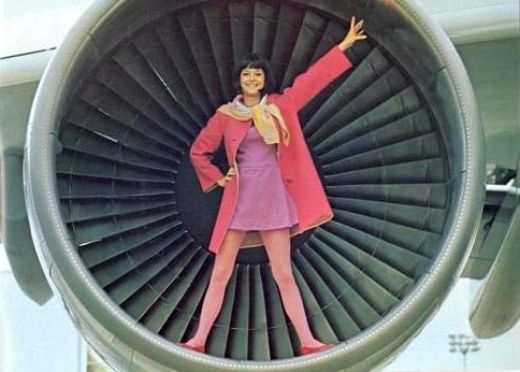
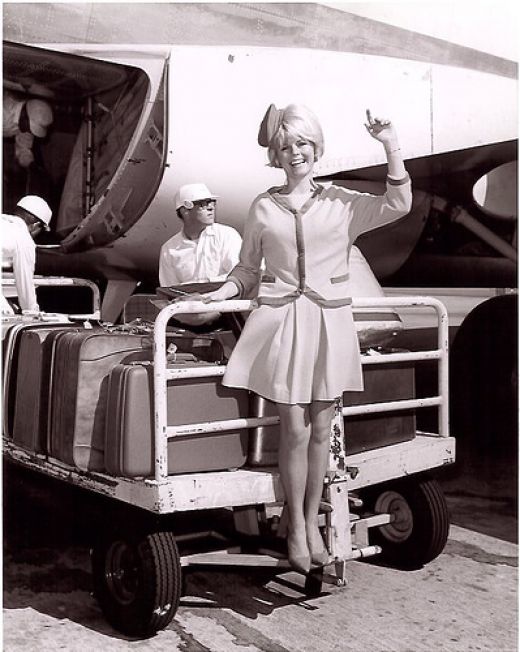
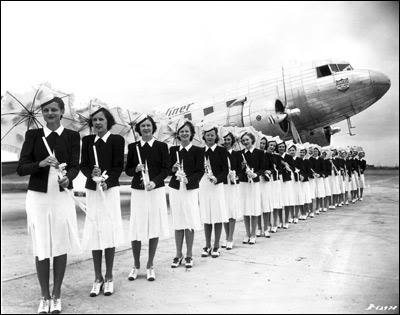
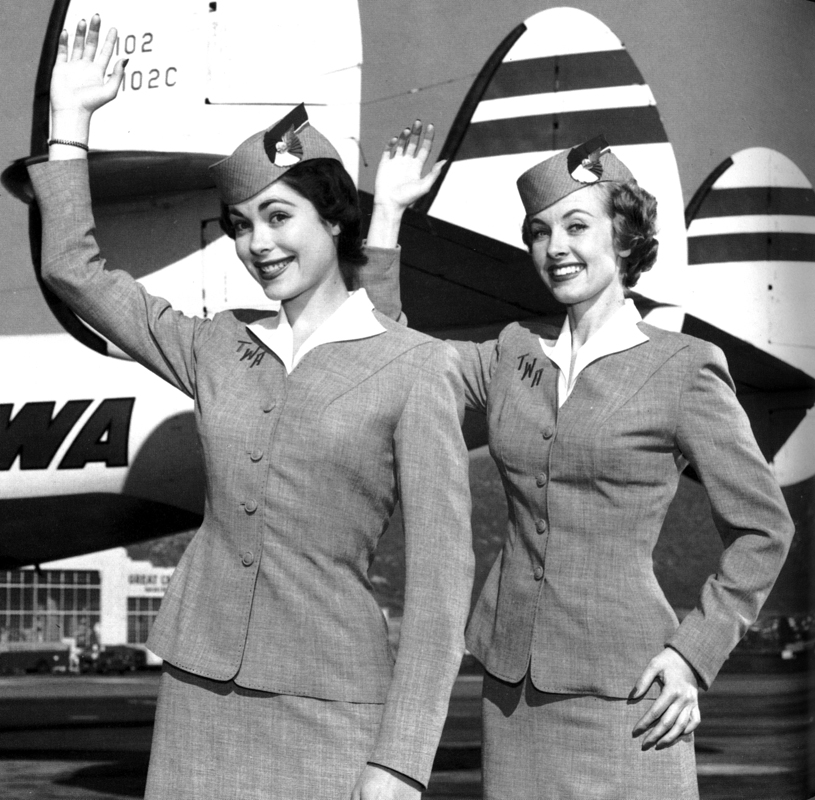
Air Hostesses! A gallery: 1940s-1970s

In 1912 Heinrich Kubis became the first flight attendant. It wasn’t until 1930 that a nurse called Ellen Church became the first female flight attendant or ‘air hostess’. By 1936 women were in the majority in this position, in the same year the New York Times reported “The girls who qualify for hostesses must be petite; weight 100 to 118 pounds; height 5 feet to 5 feet 4 inches; age 20 to 26 years. Add to that the rigid physical examination each must undergo four times every year, and you are assured of the bloom that goes with perfect health.”   With such patriarchal guidelines it was unsurprising that by the 1960s the air hostess had become a popular sexual fantasy figure. Women applying for this  job were abhorrently discriminated against for their appearance (predominately their weight, height and perceived attractiveness) as well as their marital status (in many airlines, only single women were offered the position).  Despite this, the career offered an exciting adventure at a time when many paths were closed to women. Some air hostesses from the 1960s speak of a ‘golden era’ before regulations were effectively enforced; a Rock ‘n ‘Roll life time of hard-drinking, promiscuity and glamorous locations. For better and for worse the age of the air hostess is over. Please fasten your seatbelt, close your table and prepare for your flight.

This slideshow requires JavaScript.


Duty Free: an aeronautical poem by Heathcote Ruthven

Image

Airports, Augé’s perfect non-place. Airplanes, Aeroplanes, the sublime made banal. Aviator, on iPlayer now. The research done by environmental psychologists into the impact of airports on local residents is contested, but there is definitive evidence linking proximity to airports with exposure to high-intensity noise – associated with complaints of “headaches, nausea, instability, irritability, anxiety, sexual impotence, and changes in affect or mood”. More or less the most recent flight I took was to New York. Lost, we walked from my house in Ladbroke Grove to Heathrow airport, that’s another story, but when we got there we met a Hungarian employee who let us sit in the VIP section of the waiting area for the night. I was listening to him just the other day actually (the evening was dictaphoned). He was an alcoholic who discussed with us the pitfalls of mixing beers and spirits. On the flight I watched Bonnie and Clyde three times (it was my first time) and when I came out the other side, I walked JFK to Chelsea (unoriginal I know). The first palm reader I ever met took $20 to offend me. Whilst breastfeeding, she told me that I was in transit…on a journey of some kind…and that, I attracted negative energy – lots of it. The solution was an absorbent negative energy crystal sponge. I refused this point blank, as it cost $130, and haul my menacing freight to this day. I fell asleep/and missed the moon/for this want/I darkened a room/lit a candle/with many moon-like angles/and wondered while this handle/gave me such gloom.

by Heathcote Ruthven

More on aviation poetry here follow my vapour trail on Twitter: @Hush_kit

Image

All helicopters blow up: The Hollywood guide to aviation

Image

Airliners are inhabited by lovers whose timing is all wrong – unless they never make it to the plane as they are intercepted at the airport by their other half running in at the last moment. Airliners are full of lovely family people whose lives will be savagely cut short by the crash. They are full of sweating terrorists and inexplicably awful folk to sit next to. Air hostesses may want to have sex with you, or they might just want to be heroic in an emergency. Your plane is far more likely to crash if the pilot is an excellent husband.

 Image

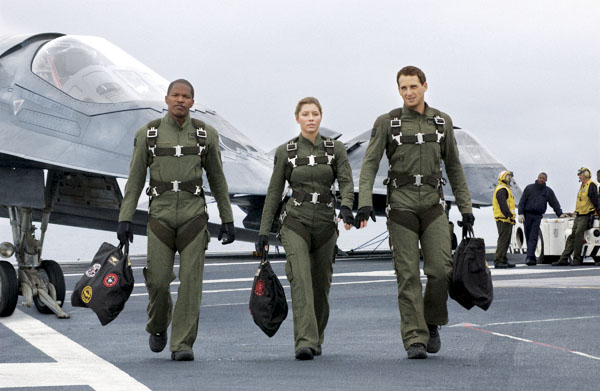
Fighters are flown by handsome men with unprofessional attitudes and innate skills. Their main use is to kill space ships, communists or Nazis. Wingmen die. Every fighter plot has an equally skilled nemesis and a psychological flaw. Formations are always close, pilots can be white, black or fat, occasionally female, but not East Asian. Fighter pilots celebrate surviving a dangerous mission by flying in a dangerous way. Here’s some great fictional aircraft.

All helicopters blow up, unless they are transporting the hero home at the end of the film. If so they are likely to be bathed in a gorgeous sunset. Helicopters can be shot down easily with small hand-held weapons, but the easiest way is to confuse the pilot into flying into a natural obstacle. They like landing on skyscrapers. The skids are often held onto by heroes (whose arms are often trampled on by baddies). Helicopters can also be used by repressive governments, cool American special soldiers or by thoughtful and damaged souls in Vietnam. Very hi-tech helicopters are used by really kick-ass good guys. Helicopters often stalk lone escaping blokes who hide behind rocks.

Seen the trillions spent on axed aeroplanes?

Surface-to-air missiles are used by arseholes. They can generally be defeated by hard manoeuvring, but the third is likely to be the one that downs you (or kills your wingman). They almost killed Superman and they are used by cowards, not manly enough to punch flying things out of the sky with their own fists.

Bombers are flown by brave young men, unless they’re enemy and then they’re flown by pale men in goggles. The oldest guy is the boss, and one of the aircrew has red hair. They’ve been hand-selected as they’re the best crew. Dive-bombers and ground attack aircraft are normally used by pricks or nasty regimes.

Private jets are generally flown by dickheads, usually criminals. They are used for escaping quite a bit. People who have them tend to have harems of busty women.

 Image

Transport (military cargo) aircraft have a ramp that is ideal for fighting. They tend to be in Africa and crewed by people with foreign accents. A flight rarely goes by without someone being thrown out in a punch-up (our man has a parachute). These aircraft can also contain troubled Westerners who’ve been immersed in the hell and chaos of foreign places.

Ohh, and biplanes tend to fly upside down… it is often necessary to leave the cockpit in all aircraft types and do something dangerous by crawling around on the plane, it’s OK though as this normally works.

Follow my vapour trail on Twitter: @Hush_kit

Thank you for reading Hush-Kit. Our site is absolutely free and we have no advertisements. If you’ve enjoyed an article you can donate here– it doesn’t have to be a large amount, every pound is gratefully received. If you can’t afford to donate anything then don’t worry.

At the moment our contributors do not receive any payment but we’re hoping to reward them for their fascinating stories in the future.

As a thank you….


Those who donate more than £50 may ask for a short article on a particular subject.

Those who donate more than £100 may ask for a long article on a particular subject.

Image