Hush-Kit Top Ten: The ten best-looking French aircraft

Bonjour. As we all (should) know, the first people to fly were French; Jean-François Pilâtre de Rozier and François Laurent d’Arlandes popped aloft in 1783. On completing the world’s first flight by humans, they drank champagne, and were soon forgotten by the non-French world.  To this day France continues to be a nation that’s good at building flying machines. Whereas Britain was great at piston-engined aircraft and crap at jets, France was the opposite and only really came into its own in the 1950s.

Today, France is one of only two European nations that build indigenous high performance aircraft (the other is Sweden). Let’s take two minutes to look at some of the extraordinarily beautiful aeroplanes that France has made.

If you enjoy this, have a look at the top ten British, Australian,  Soviet and German aeroplanes. Wanting Something a little more exotic? Try the top ten fictional aircraft.

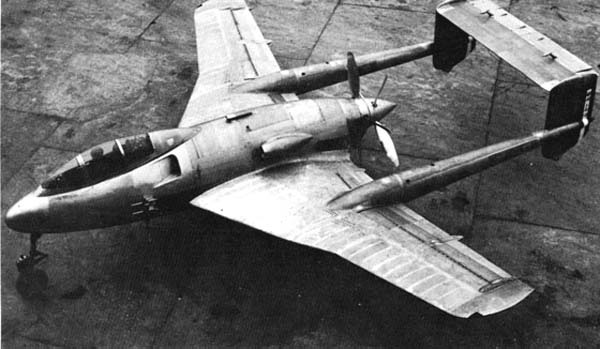
10. Breguet 1001 Taon

9. Dassault-Breguet Mystère 20

8. Dassault Rafale

DNkDaEfX0AAIsaP

7. Sud-Ouest SO.8000 Narval6. SNCASE SE.161 Languedoc

5. Dassault Mirage 4000

4. Bugatti Model 100P Racer

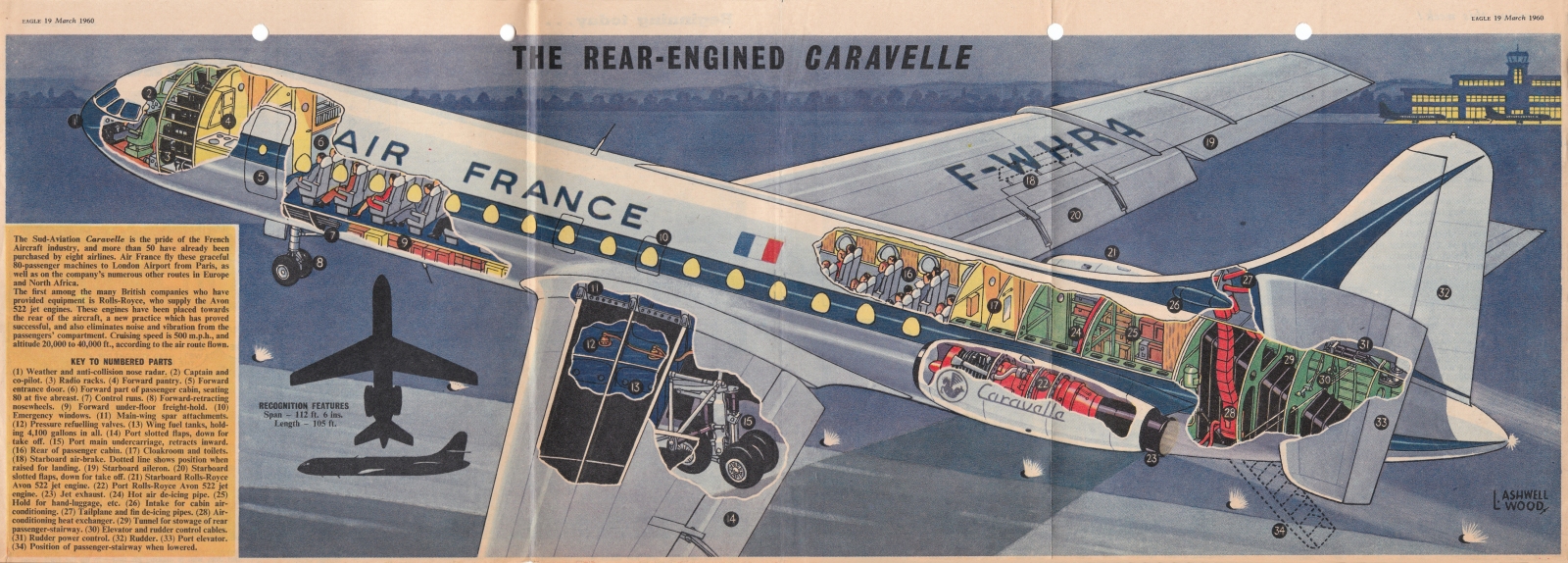
3. Sud Aviation Caravelle

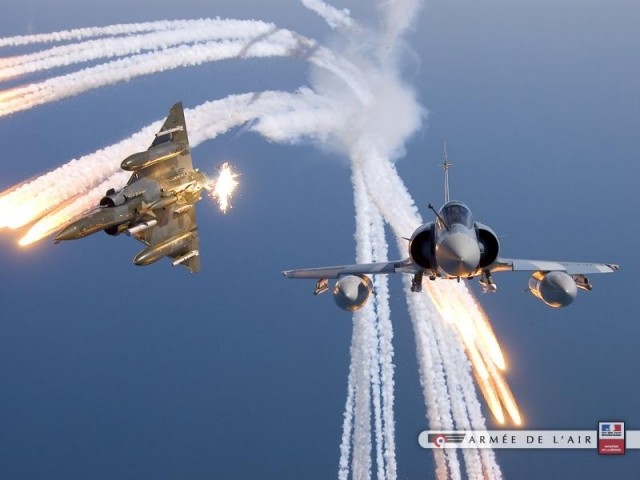
2. Dassault Mirage 2000

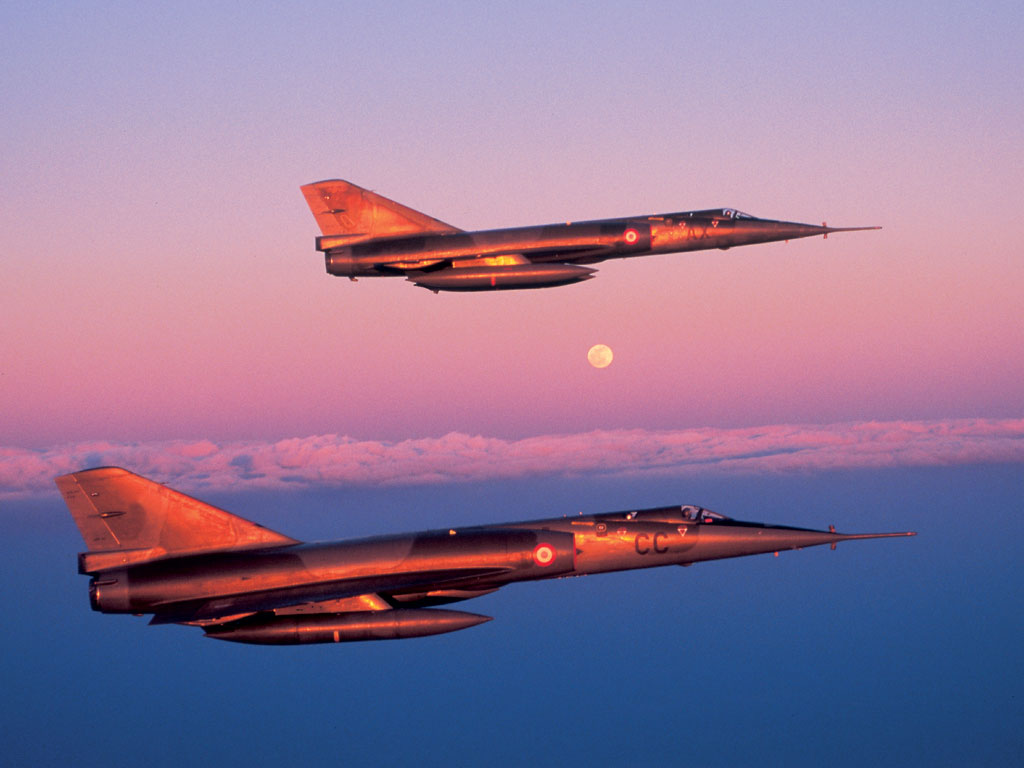
1. Dassault Mirage IV

  If you enjoyed this, have  a look at the top ten British, French, Swedish, Australian,  Soviet and German aeroplanes. Wanting Something a little more exotic? Try the top ten fictional aircraft.

Interview with Super Hornet pilot: F/A-18E versus F/A-18C- the final word!

Image

Hush-Kit grilled Hornet fighter pilot Dave Buonerba to find out what was the hottest fighter in the US Navy. Buonerba has a wealth of experience flying the old F/A-18C (‘Charlie’) Hornet. Two years ago, he began flying the Super Hornet, making him the ideal man to give us the low-down on Charlie’s big sister and how she compares with the legacy ‘Bug’. If you enjoy this article, check out the F-35 review.

To keep this blog going – we need donations. We’re trying to do something different with Hush-Kit: give aviation fans something that is both entertaining, surprising and well-informed. Please do help us and click on the donate button above – you can really make a difference (suggested donation £12). You will keep us impartial and without advertisers – and allow us to carry on being naughty. The donate buttons are on this page. Many thanks. 

“On the one hand it’s very similar; you could almost, as a Charlie pilot, jump in and figure it out. There are some differences, it’s got a lot more capability. The APG-79 AESA radar is much more capable, it’s got all the bells and whistles. We’ve been slowly upgrading the legacy Hornet Charlies, giving them the helmet-mounted sight, Link 16, the AIM-9X, I mean those are the big upgrades now, they all carry ATFLIR now. But the Super Hornets come with all that stuff. The digital displays are that little bit nicer, they’re all colour. Whereas on some,  especially the older F/A-18 Charlies, it’s just a green display. The WSO (the backseater) of the Foxtrot, he’s got a really nice, huge display in the back. It’s totally missionised in the back. Most of the mission we can do single-seat, but there’s some, like Forward Air Control where the back-seater earns his keep.”

“Most of the other fourth gen’ fighters have all been touted as multi or swing role. Which is true, and its pretty much a push-button to switch between air-to-air and air-to-ground. But this is the first one that can do both at the same time. I can be in the front painting the air picture as pilot and my WSO can be doing the air-to-ground picture back, painting a  SAR image of our target area, getting some coordinates. Meanwhile I can be watching the air picture, whether its enemy, or frankly sometimes friendly, you gotta watch out for other traffic. It’s a nice airplane.”

Image

In terms of handling how does it compare with the C model?

“The engineers will tell you, that the flight control software in the two airplanes they tried to make as similar as possible. But you can feel some differences. As the pilot, it feels just a little heavier. I think that’s to be expected. It’s bigger, its got a bigger wingspan, much bigger leading extension extension on the wings. It’s heavier. Everything is just a little thicker. The legacy Hornet, to me, feels just a little more nimble, just a little sportier.”

“Landing on the ship, this one is definitely easier. They’ve made the approach speed slower, and it’s just a little bit more forgiving if you deviate from glide slope. You can recover a little more gracefully in a Super Hornet than you can in a Hornet. The Hornet is a lot less forgiving coming aboard the ship, it’s totally do-able, but if you get yourself low or underpowered you can get yourself in trouble pretty quick. Whereas the Super Hornet is about a 10 knot slower approach speed, to begin with, and it’s just a little more responsive and to me it’s an easier plane to fly.”

There’s a very cool die-cast model you can get of the Super Hornet here

How does the E compare to the C in terms of acceleration?

“I think down on the deck it’s better, and then up at altitude, the higher you get, then it’s maybe a little less responsive.”

“The legacy Hornet, to me, feels just a little more nimble, just a little sportier.”

Have you flown against dissimilar types?

“Since flying in the Super Hornet, I’ve only flown against other Hornets, Super Hornets and F-5s. When you get slow, the handling characteristics are a bit better than the Hornet. You’ve got pretty good nose authority, it is really good at high Alphas. It’s damn near impossible to depart the thing from controlled flight- the computers help me out there. But, it’s a solid, solid airplane.”

Check out this interview with a F-100 pilot

In terms of threat platforms, which would you rate as the most capable? The Su-30 for example?

“I’ve not flown against those, we tried to arrange some training with the Malaysians when we were passing through there with the carrier last year. But unfortunately they just sent out F/A-18Ds at us. Something we’re quite used to, still it was good to turn with those guys. The Chinese are investing a lot in that Sukhoi airframe, and from what I understand it’s pretty darn capable.”

Find out how the Super Hornet ranks in the Top 10 of BVR fighters. 

Which aircraft would most like to fly against in a training exercise?

“Any of the Sukhoi products (‘Flanker’ series), it would be pretty fun to turn with those guys and see what they can do. We’re definitely not going to keep up with those guys in drag race, but it would be nice to mix it up in the BFM environment.”

“The biggest advantage the Super Hornet would have against the ‘Flanker’ would be the pilot-machine interface. I mean that was great on the Hornet, but even better on the new aircraft. It fuses your radar information, your link information, all the different sources are brought together for the pilot. This is combined with the HOTAS capability, allowing you to do anything pretty much.  There isn’t voice control though and I don’t know if there are any plans to integrate that. But I’m pretty happy with the way the interface is now.”

Thank you for reading Hush-Kit. Our site is absolutely free and we have no advertisements. If you’ve enjoyed an article you can donate here– it doesn’t have to be a large amount, every pound is gratefully received. If you can’t afford to donate anything then don’t worry.

At the moment our contributors do not receive any payment but we’re hoping to reward them for their fascinating stories in the future.

“The HOTAS for the most part is pretty good. On a lot of the things, you can either use HOTAS or push button functionality on a menu. In some cases it’s pilot preference, there’s somethings I like to do HOTAS and there’s somethings I like to do just hitting a manual button. We’re going more to touch screen now, as opposed to the original Hornet. Most of the displays on this jet, you got the display with roughly twenty buttons going around. Today data entry is done via touchscreen and this took me a little time to get used to, as it’s different when you’re used to feeling a button. On the original Hornet I could do a lot of data entry without even looking at the keypad, just resting my hand there and I could feel what I’m doing.”

“And with this one, I’ve got to look at and touch it, to make sure I’m hitting the right button and occasionally I get into fights with it..I’m doing loops and it will error out..because I’m going too fast and it can’t keep up or whatever. It’s just like trying to teach an old dog new tricks.”

Thank you for reading Hush-Kit. Our site is absolutely free and we have no advertisements. If you’ve enjoyed an article you can donate here. At the moment our contributors do not receive any payment but we’re hoping to reward them for their fascinating stories in the future.

Have a look at 10 worst British military aircraft, Su-35 versus Typhoon, 10 Best fighters of World War II , top WVR and BVR fighters of today, an interview with a Super Hornet pilot and a Pacifist’s Guide to Warplanes. Was the Spitfire overrated? Want something more bizarre? The Top Ten fictional aircraft is a fascinating read, as is The Strange Story and The Planet Satellite. The Fashion Versus Aircraft Camo is also a real cracker. Those interested in the Cold Way should read A pilot’s guide to flying and fighting in the Lightning. Those feeling less belligerent may enjoy A pilot’s farewell to the Airbus A340. Looking for something more humorous? Have a look at this F-35 satire and ‘Werner Herzog’s Guide to pusher bi-planes or the Ten most boring aircraft. In the mood for something more offensive? Try the NSFW 10 best looking American airplanes, or the same but for Canadians. 

Will Super Hornet be able to steal potential F-35 operators?

Are there particular upgrades you’d  like to see?

“In this day and age, it’s mostly software upgrades. Getting all the capabilities out of the radar, installing new systems. You can always work on improving the radar and the FLIR, I mean that technology is always moving. Though we haven’t currently got a dedicated IRST, you can use the ATFLIR to cue what you’ve got on the radar.”

How frequently do you take the Super Hornet to its maximum stated speed?

“You’ll do it on functional check flights; so, acceptance flights or after maintainance, especially on the engines. You’ll do Mach runs, and there’s different systems to check. In training, a lot of times you’re limited on your airspace. Even in the US, there’s very few places where we can go supersonic. There is particular ranges and what-not. There’s more freedom when you’re operating off the ship, over the water, when you’re outside, roughly, 30 miles of the coast. Then you really don’t have those restrictions. So if you have the airspace, you’ve then got to have the luxury of the gas to do it and sometimes you do and sometimes you don’t.”

Is the aircraft comfortable at Mach 1.8, or is that an absolute maximum that is achieved for very brief durations?

“That is the top end speed.”

I’ve also seen the figure of Mach 1.6  listed as its top speed, is that a speed the aircraft is more comfortable in attaining?

“If you’ve got enough fuel! I mean at that speed its burning a lot of fuel. obviously it depends on its configuration, what you got hangin’ on the airplane. This aircraft right here could get there (Dave points to the aircraft behind him, which is fitted with two AMRAAMs, one on each wing, and one AIM-9X on each wingtip). You start sticking drop tanks on, or a lot of laser-guided bombs and stuff like that hangin’ off, you’re going to be hard-pressed to get up to those top speeds. It’s easy to go supersonic at forty five thousand feet. In a light configuration, it’s supersonic at sea level. In Hawaii we did a demo for friends and families and did a supersonic fly-by at 300 feet with both Super and regular Hornets.”

“But let’s face it, in any fighters, 95% of your time in the tactical regime will be spent at 400-500 knots and you can manage that without any issues, with a large air-to-ground load-out. The only time you’re really going to go supersonic is if you’re going to try get up there and intercept somebody or if you’re trying to get away from somebody.”

Dave Buonerba is the Operations Officer of the Strike Fighter Wing Pacific Fleet. He was previously Operations Officer at Carrier Air Wing 14

Hush-kit is reminding the world of the beauty of flight.

What was Italy’s ultimate fighter?

follow my vapour trail on Twitter: @Hush_kit

To keep this blog going – we need donations. We’re trying to do something different with Hush-Kit: give aviation fans something that is both entertaining, surprising and well-informed. Please do help us and click on the donate button above – you can really make a difference (suggested donation £12). You will keep us impartial and without advertisers – and allow us to carry on being naughty. The donate buttons are on this page. Many thanks. 


safe_image.jpg

“If you have any interest in aviation, you’ll be surprised, entertained and fascinated by Hush-Kit – the world’s best aviation blog”. Rowland White, author of the best-selling ‘Vulcan 607’

I’ve selected the richest juiciest cuts of Hush-Kit, added a huge slab of new unpublished material, and with Unbound, I want to create a beautiful coffee-table book. Pre-order your copy now right here  


TO AVOID DISAPPOINTMENT PRE-ORDER YOUR COPY NOW

From the cocaine, blood and flying scarves of World War One dogfighting to the dark arts of modern air combat, here is an enthralling ode to these brutally exciting killing machines.

The Hush-Kit Book of Warplanes is a beautifully designed, highly visual, collection of the best articles from the fascinating world of military aviation –hand-picked from the highly acclaimed Hush-kit online magazine (and mixed with a heavy punch of new exclusive material). It is packed with a feast of material, ranging from interviews with fighter pilots (including the English Electric Lightning, stealthy F-35B and Mach 3 MiG-25 ‘Foxbat’), to wicked satire, expert historical analysis, top 10s and all manner of things aeronautical, from the site described as:

“the thinking-man’s Top Gear… but for planes”.

The solid well-researched information about aeroplanes is brilliantly combined with an irreverent attitude and real insight into the dangerous romantic world of combat aircraft.

FEATURING

        • Interviews with pilots of the F-14 Tomcat, Mirage, Typhoon, MiG-25, MiG-27, English Electric Lighting, Harrier, F-15, B-52 and many more.
        • Engaging Top (and bottom) 10s including: Greatest fighter aircraft of World War II, Worst British aircraft, Worst Soviet aircraft and many more insanely specific ones.
        • Expert analysis of weapons, tactics and technology.
        • A look into art and culture’s love affair with the aeroplane.
        • Bizarre moments in aviation history.
        • Fascinating insights into exceptionally obscure warplanes.

The book will be a stunning object: an essential addition to the library of anyone with even a passing interest in the high-flying world of warplanes, and featuring first-rate photography and a wealth of new world-class illustrations.

Rewards levels include these packs of specially produced trump cards.

Pre-order your copy now right here  


I can only do it with your support.

BRUCE LACEY EXHIBITION SPECIAL: THE FLYING WITCH-DOCTOR; EXHIBITION REVIEW

20120709-120820.jpg

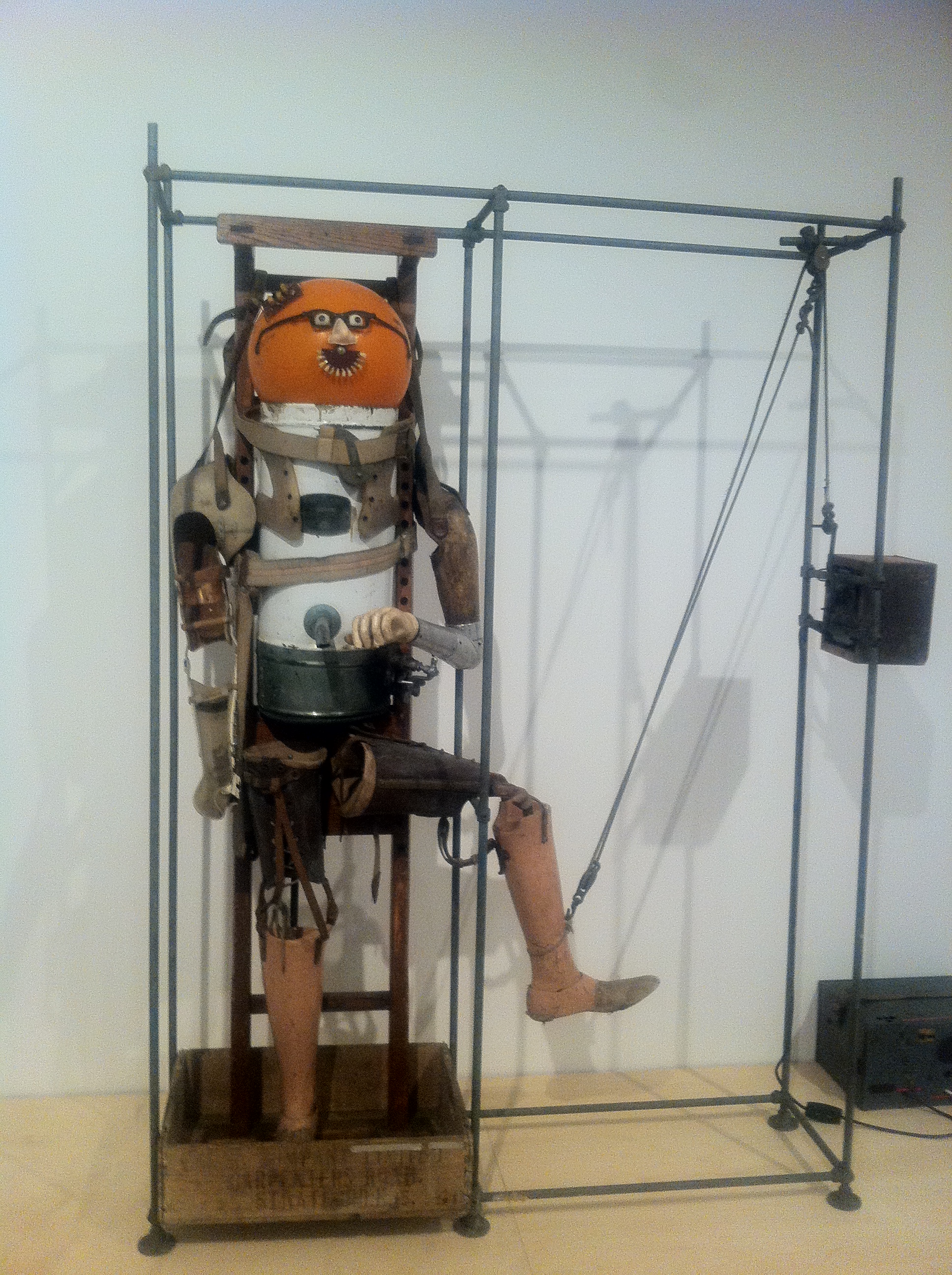
On arriving at the Camden Arts Centre, I was delighted to see they were giving out free cake, sandwiches and tea. After munching down in the garden, I was in a good mood as I entered the exhibition. The world I entered was very familiar. It was very British and very of its time. It was a mangled and happy jumble of mid-20th Century English culture. Lacey was almost killed by a V2 rocket in Enfield, which brutally smashed off the wing of his toy Hawker Hurricane.

It is an England of bizarre humour and arsing about, of parlour games and fancy dress. Everything is tinged with the colour brown, a shed-like quality that even reaches into Lacey’s later psychedelic period (was that him at the exhibition in a tye-died gown?). His work has the scruffy home-made darkness of penny arcades, automaton’s jaw-bones laughing away, and the doom of hospitals (from back when they were Victorian death museums). Like Monty Python or Spike Milligan, it ridicules authority, and it is thick with Spitfire nostalgia. He pukes out the English subconcious with ease, doing for us what The Cramps and John Waters did for mid-20th Century Americana.

While in the Air Training Corps he built a working flight simulator in his bedroom- not the modern kind but the 1940s device, a simple rocking construction largely made of wood. The world is viewed as a boy would, full of fun red indians and astronauts and planes. His work which involves magick rituals, seems no more complex than a happy make-believing, real play.

The amount of work is impressive and I grew jealous of how well he has spent his life. Why have I not performed diabolical rituals at night? Or built spacesuits?

Though I said this work was very English it also fits into another world, the side of aviation explored by Joseph Beuys and the Belgian artist Panamenrenko (who has a Fokker 50 named in his honour); that is, an aeroplane as a one-off machine that allows a person to take flight. As if children playing had accidently flown.

As you sit in your white plastic easyJet (lower-case e) bombarded with audio adverts for boring crap this may not readily come to mind.

20120709-120808.jpg

20120709-120957.jpg

20120709-121014.jpg

20120709-121024.jpg

20120709-121033.jpg

20120709-121058.jpg

Reunited with a source book of aircraft

20120708-170628.jpg

I lost my favourite book over twenty years ago. I could not remember its title or the author’s name so it seemed unlikely I would ever see it again. But this week, by chance, I rediscovered it.

I had arranged to meet my friend to watch an circus performance on London’s Southbank. She was delayed, so I watched the performance by myself. I moved to the front to join 30 confused and delighted school children. The show was outside, on one of those sunny days when the Southbank is the happiest place on Earth.

The two performers climbed and spun from tall flexing poles- swinging in dramatic switchblade movements- for the climax they wrapped themselves in reels of clingfilm, which reminded me of the funniest book I’ve ever read, ‘Ulrich Haarburste’s Novel Of Roy Orbison In Clingfilm’. This contains short stories, written in the voice of an Orbison clingfilm fetishist. Each story is a contrived set-up, leading (inevitably) to Roy Orbison being wrapped in clingfilm.

20120708-171122.jpg

20120708-171444.jpg
The show ended and my friend still hadn’t arrived, so I went to the book market under Waterloo Bridge. Being a mono-maniac with time to burn, I immediately looked for books about aeroplanes. The first I came across was entitled ‘Air Shows’, and was a rather dry guide from the early 1980s.
As I walked toward the next stall, I spotted a small landscape book with the image of a BOAC VC10 taking-off on the cover. Within seconds of opening it, I realised it was THE MISSING BOOK.
There have been two books that have changed my life, directly and profoundly. The second was The Wild, Wild World of The Cramps by Ian Johnston. The one I was now holding was the first.
I double-checked. It was the book. I hadn’t held a copy in twenty years. Every photo I could recall in absolute detail. I ran to the book-seller and paid the £3 pencilled in the inside cover.

Lowercase book

I have tried to avoid looking at it until now. I want to share with you my reunion feelings as they happen.

Ok, I’m ready now. First impressions- my initial copy had no dust jacket, the cover image, in the dismally dreary colour reproduction of 1970, was new to me. The title ‘a source book of aircraft‘. The lowercase ‘a’ was strangely progressive, it made the little book appear friendly. As I look at the cover, I hear thunder outside. Written and compiled by m. allward (all lowercase). The reviews inside are lovely:

“For transport enthusiasts of any age…clear illustrations and and neatly laid out vital statistics for instant identification of the beloved objects.” The Sunday Telegraph

Beloved objects, how marvellous. Beloved indeed.

The Irish Independent said:

“easy reading in a survey ranging from the first perilous contraption to the latest droop-snouted supercilious model. There also grows on the reader a profound respect to those who flew the early machines or even believed the machines would fly.”

SUPERCILIOUS! Ha ha, a little bitchy snipe at Concorde, at a time when it was a fashionable target of criticism. I was just about to open the first page when my mobile phone barked (remind me to change my ringtone). I have a visitor. Well, I’ve waited twenty years, I can wait another couple of hours. Time for tea with the artist Katie Horwich.

I’m back. My first copy I marked with crosses and ticks, showing my approval or disapproval of each type. I was about five when I first saw the book. It introduced me to aeroplanes. I fell in love with aeroplanes from seeing them in this book.

20120708-171150.jpg
The book is organised chronologically, starting with the Wright Brothers 1903 Flyer I. As a child I did not like the early machines. They were not sleek, they resembled piers or bridges or fences. The first sexy aircraft was the Nieuport 17 Scout of 1915. On the side is a skull and crossed bones on a heart, a tattoo-like artwork which brings the ’17 to life.
The locations of the aeroplanes in the pictures were mysterious. Large empty airfields, woods and lakes. The Empire of 1936 was on a body of water next to a castle, a frothy wake streaming from its hull.

The Spitfire was unique in having two pictures- surely this made it the king of the aeroplanes?

The handsome Boeing 314 sat on a sunlit ocean and was photographed from the air- where was it? What was it doing? The absence of captions forced my imagination to make up the story.

Rocket-propelled nazis and jet Christs
When good quality photos could not be found (or copyrights granted?) the aircraft were shown in exciting, but naïve, paintings. The paintings were crudely over-painted photos, each seemingly completed in five minutes. This naïvety could not conceal the mad excitement of the Messerschmitt Me.163; a rocket-propelled nazi fighter and the first aircraft in the book with raked back wings. If that wasn’t titillating enough, the opposite page showed a gorgeous image of the Tempest fighter. As a boy this high-sided machine reminded me of a knight’s charger, the shape speaking of massive power and nobility. The Salamander of 1944 was cool, but incomprehensible, with a black boiler trying to mount it like a randy labrador.

The Sea Hawk of 1947 was a pure, uncluttered shape. The shape of the aircraft resembling a jet-propelled Christ on the cross.

The Sabre carried USAF markings, happy and garish, and familiar to me from toys and comics. The Comet of 1949 shared the same Christian looks as the Sea Hawk. A mass of well-balanced compound curves, the Comet had the gentle look of a deer.

Flying daggers!

In striking contrast to this- the Draken and F-104 were flying daggers! They looked to me like swords or battle-axes. They were speed, aggression and purpose. I loved them, maybe the most of all. The HS 125 and Trident 2E (I have used the aircraft titles and designations from the book), were further Christians, but this time with pally, dog-like snouts.

20120708-170925.jpg
The MiG-23 was a revelation. It was Soviet, and therefore little was known about it. The painting showed a duet of zooming spaceships. They looked invincible. The designation ‘MiG-23’, later proved to be wrong. The aircraft was actually the MiG-25, the legendary ‘Foxbat’.

The world in the pictures was now looking more like the world I knew in 1983. The Harrier of 1966, with its ventilator-like nozzles and oversized tyres was apparently landing in Hampstead Heath, behind were winter-stripped trees. The setting familiar to a British child. The Viggen of 1967 earned a big tick; a gothic cathedral that had transformed into a fighter and flown off over some enigmatic misty landscape.

In 1969 the world ends. Concorde comes into land, in all its supercilious droop-snouted glory.

Seeing the book again was a main-lining of nostalgia that I will be unable to feel again, even if I bury this book for another twenty years.
I dedicate this article to Beatrice Brown, as without her terrible experiences on the London Underground that summer day, I would not have been reunited with this old childhood friend.


Want to see more stories like this: Follow my vapour trail on Twitter: @Hush_kit

Thank you for reading Hush-Kit. Our site is absolutely free and we have no advertisements. If you’ve enjoyed an article you can donate here. At the moment our contributors do not receive any payment but we’re hoping to reward them for their fascinating stories in the future.

Have a look at 10 worst British military aircraft, Su-35 versus Typhoon, 10 Best fighters of World War II , top WVR and BVR fighters of today, an interview with a Super Hornet pilot and a Pacifist’s Guide to Warplanes. Was the Spitfire overrated? Want something more bizarre? The Top Ten fictional aircraft is a fascinating read, as is The Strange Story and The Planet Satellite. The Fashion Versus Aircraft Camo is also a real cracker. Those interested in the Cold Way should read A pilot’s guide to flying and fighting in the Lightning. Those feeling less belligerent may enjoy A pilot’s farewell to the Airbus A340. Looking for something more humorous? Have a look at this F-35 satire and ‘Werner Herzog’s Guide to pusher bi-planes or the Ten most boring aircraft. In the mood for something more offensive? Try the NSFW 10 best looking American airplanes, or the same but for Canadians. 

Hush-Kit Top Ten: The Ten best-looking British aircraft


20120706-171050.jpg

This list should be considered the objective and definitive guide to the ten best-looking British aircraft. All aircraft have been assessed using the Aesthomater to determine its exact beauty rating. We have left one vacant slot for you, dear reader, to fill. If you would like to vote for a particular British aircraft for inclusion in this list, please cast your vote at the poll at the base of the page. Please do not submit international aircraft (like Concorde). 

After this you may want to read Dave Eagles telling you how to fly a Sea Fury.

10. Supermarine Southampton

20120706-163554.jpg

9. Hawker Hunter

20120706-164328.jpg

8. Hawker Sea Hawk

20120706-164931.jpg

7. de Havilland DH.106 Comet

20120706-165041.jpg

6. Westland Whirlwind

20120706-165419.jpg

5. de Havilland DH.88 Comet

20120706-165531.jpg

4. Vickers VC10

20120706-170512.jpg

3. Bristol Britannia

20120706-170617.jpg

2. Supermarine Spitfire

20120706-170710.jpg

1. de Havilland DH.103 Hornet READER’S CHOICE

20120716-120845.jpg

If you enjoyed this, have  a look at the top ten French, Swedish, Australian,  Soviet and German aeroplanes. Wanting Something a little more exotic? Try the top ten fictional aircraft.

How British company Airspeed designed the Predator & Reaper

There are many things that the US Military Industrial Complex don’t want you to know. One of the things it doesn’t want you to know is that two of its much vaunted drones are developments of a rather peculiar line of British aircraft development dating from the late 1950s.
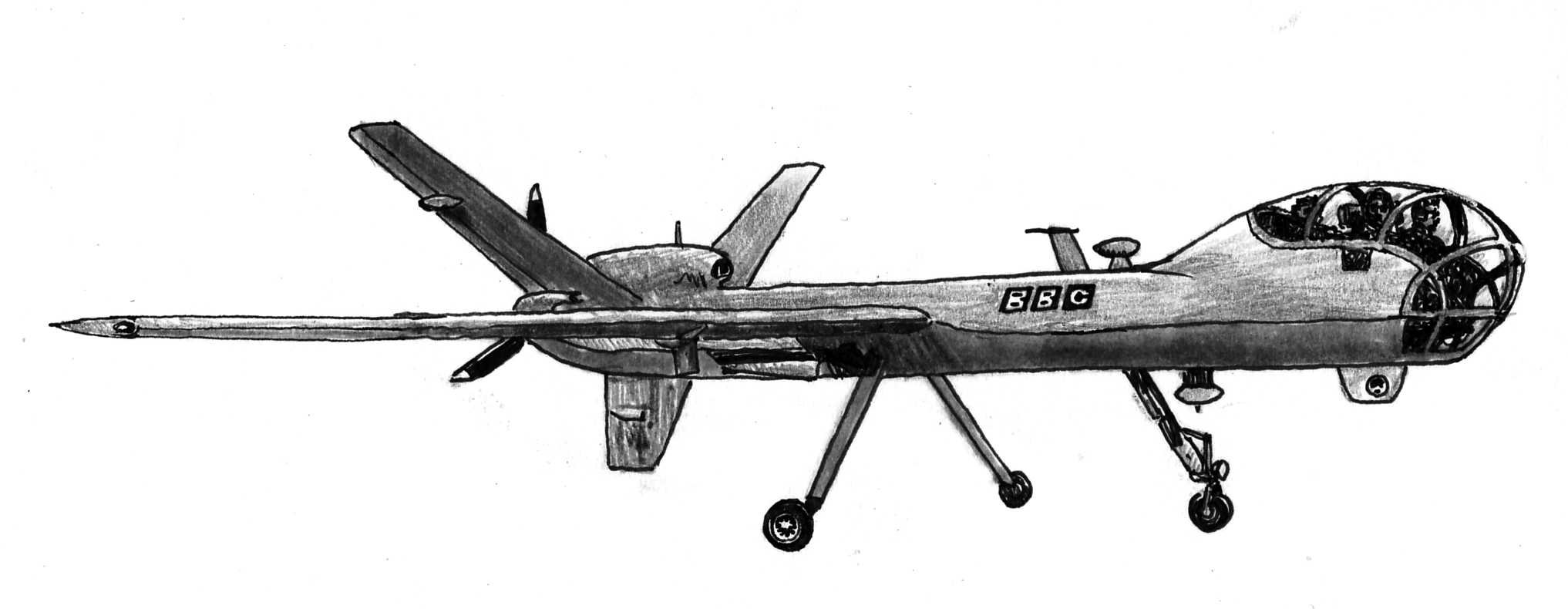
In 1955 the BBC approached the struggling aircraft company Airspeed Ltd to provide it with a dedicated aerial camera platform. It was to have excellent low speed handling and exceptional endurance to enable its crew to film sporting events or appropriate news items with maximum efficiency. A crew of three was envisaged: pilot, camera operator and director/producer. For such items as football matches it was intended that a commentator might be carried in the place of the director and the capability for live audio transfer from the aircraft was a requirement from the very beginning. A helicopter design was considered but rejected due to endurance and noise concerns.

Peeper
The Airspeed AS66 ‘Peeper’ was the result. Powered by a small and quiet Turbomeca turboprop derived from the Astazou, the Peeper made its first flight on the 6th July 1962 and proved an immediate success. BBC cutbacks meant that the initial order was cut from 126 to 4 but this quartet of aircraft would provide sterling service for the next forty years. Amazingly, according to a BBC correspondent, one is retained in mothballed condition at Brooklands aerodrome in Surrey ‘just in case’.
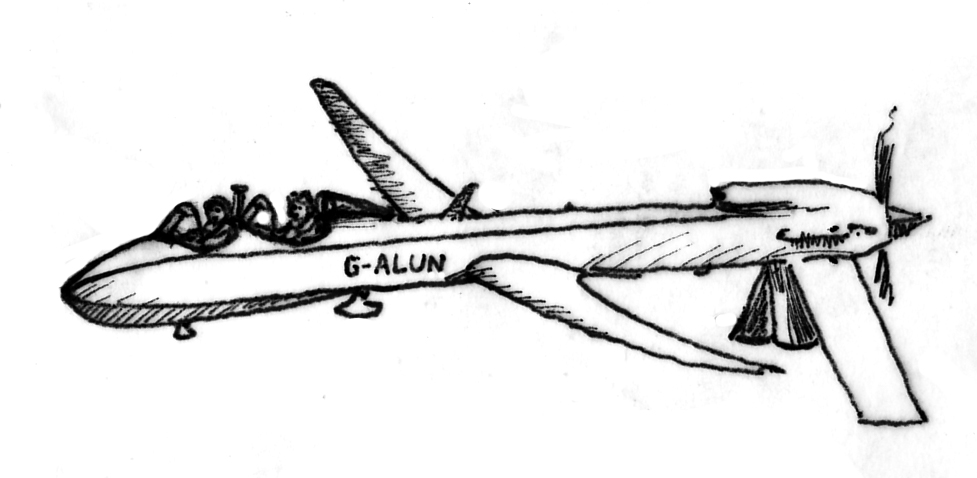
Despite its great success the Peeper did present its pilots with some rather peculiar handling characteristics so a training version was developed. This, the piston-engined AS67 ‘Editor’ was much cheaper to operate but effectively mimicked the larger aircraft’s characteristics. The economical Editor was a charming aircraft to fly and cheap to operate but the asking price was high and, despite a herculean sales effort, Airspeed managed to sell a mere five examples, two going to the BBC.

Looking back without a man

Fast forward thirty odd years and General Atomics is charged with developing a reliable, quiet unmanned aircraft with a good loiter time to spy on America’s enemies. Unwilling to bother developing a new airframe from scratch for a requirement that might turn out to be a dead end, General Atomics looked around for a suitable base airframe for its UAV. By this time Airspeed was long since defunct, having initially merged with de Havilland which in turn was absorbed into Hawker Siddeley and thus ultimately becoming part of British Aerospace. To cut a long story short General Atomics approached BAe with their requirements, BAe dug out Airspeed’s drawings for an aircraft designed to carry cameras with a great loiter time and the rest is history. The prototype General Atomics MQ-1 ‘Predator’, an unmanned Airspeed Editor took to the sky from Brooklands aerodrome in July 1994 followed by the larger turboprop MQ-9 ‘Reaper’ in 2001. Both have proved of great worth to US forces and are despised and feared by all manner of people the world over.

In a curious footnote to this tale it was discovered in 2005 that Neville Shute, Director of Airspeed, had postulated a radio controlled ‘Queen Peeper’ in 1961 when a lost notebook of the designer/author turned up at an auction in Devon. His idea was that it could be used to film newsworthy events where a human crew would be put at risk – his example being a tactical nuclear battlefield situation. Available technology at the time simply could not provide the necessary remote control for such a vehicle but thirty years of radio and TV improvement have resulted in the ‘Queen Peeper’ becoming a reality, though not (thankfully) in a nuclear war.

No. 39 Squadron RAF currently operates the MQ-9 Reaper in Afghanistan, they will be joined by No. 13 squadron during 2012.

If you enjoyed this, you may like our other ULTIMATE WHAT-IF AIRCRAFT, like this one: http://hushkit.net/2012/06/12/the-ultimate-what-if-fighter-the-griffon-powered-hawker-hurricane-mk-xiv/

EUROFIGHTER TYPHOON BOON! THE LUFTWAFFE TAKE ON THE F-22 RAPTOR AT RED FLAG

Eurofighter GmbH, producer of the Typhoon fighter, is beginning to emerge from a period of serious self-reflection. Recent sales campaigns have ended in bitter defeat. Eurofighter has watched big prized contracts being dished out to all of it rivals. It lost in Switzerland to the Swedes, in Japan to the United States and in India to the French. Rafale, Typhoon’s closest rival, had emerged victorious in India, the biggest fighter contest in the world. Future enhancements to Rafale are almost certain to be bank-rolled by India, as well as making sales to additional customer more likely for the French fighter. This was disastrous news as the Rafale is very similar in capability to the Typhoon. Could the shrinking fighter market support two such near rivals?

Added to this gloom was the F-35’s seeming invincibility to cancellation. The F-35 is set to become the first massed-produced stealth fighter, available to all (well, almost all). Many air forces have been envious of the US’ stealth technology since the F-117’s star-turn in the 1991 war with Iraq. As well as the promise of stealth, the F-35 has enormous political backing and Lockheed Martin’s incredible mastery of the black arts of military hardware promotion. Despite the F-35’s dire development problems, customers are still clinging to the notion that the F-35 will be the Model-T of stealth and will make ‘aluminum’ aeroplanes obsolete overnight. However, the F-35’s problems have given Eurofighter an extended time window in which large sales have been possible, but these opportunities have been repeatedly squandered. To many observers it was looking like Typhoon was a dead duck, that would fail to achieve any more significant export sales.

 Typhoon boon?

After several years of misery for Eurofighter, the last week has brought a little bit of sunshine. The most conspicuous piece of good news was from the Luftwaffe regarding Typhoon’s performance over in Alaska. A detachment of 8 German Typhoons from JG74 were deployed to Red Flag 2012 in Eielson AFB in June. During the exercise they took part in basic fighter manoeuvres (BFM) against the F-22. Now before I go any further, we all know the usual disclaimer: without details, and in particular without rules of engagement specifics, not much can be inferred from BFM anecdotes. But…the following exciting titbits did emerge-

  • According to the Col. Andreas Pfeiffer, commander of JG74 “Typhoon is a superior dogfighter” to the F-22 in within visual range combat.
  • Typhoon can out-climb the F-22
  • Typhoon can out-accelerate the F-22

These are all very interesting claims. The latter point reminds me of a conversation I had with a Eurofighter representative a few years ago. I asked him if Typhoon could out-climb the F-22. He replied it could. Two days later he withdrew this comment.

The confident statements by Pfieffer are significant for two reasons:

  1. The F-22 is the aircraft to beat

Of course the Raptor decimated the Typhoons at Beyond Visual Range, a domain where the F-22 is still peerless. But, the Raptor is also one of the very best close-in dogfighters, thanks partly to thrust vector control (TVC). Performing well against the F-22, even if just in the Within Visual Range domain is still a notable achievement. On the subject of TVC, Luftwaffe pilots noted the F-22’s tendency to sink when employing thrust-vectoring. This echoes the experience of the F-15C pilots who flew against India Su-30s in training exercises. The USAF Eagle pilots were quick to identify counter-tactics to the energy depleting TVC moves employed by IAF ‘Flanker’s, though admittedly the F-22 is probably far better at recovering energy than the Su-30.

2.  These were German Typhoons

Luftwaffe Typhoons (for the sake of clarity I will not refer to them as ‘Eurofighters’ as the Luftwaffe generally does) are the worst equipped of the partner nations (the RAF aircraft are the best). To put it simply, if the worst Typhoons can put up a decent fight against the F-22, what could the best Typhoons do?

The defensive systems are not to the same spec as the RAF, lacking several components and featuring a smaller amount of data about potential threats. They do not have an infra-red search and track device, possibly the best way to track a low Radar Cross Section (RCS) target like the F-22.

Importantly they didn’t have the Typhoon’s advanced helmet system. The helmet displays vital information to the pilot and allows weapons to be slewed onto targets very quickly indeed and at extreme angles.

RAF Typhoons took the helmet system to a multi-national exercise in Malaysia last year. The system was deemed to be a strong contributor to the Typhoon’s domination of air combat exercises against F/A-18s, F-16s, MiG-29s and advanced F-15 variants during this training event.

The JG74 aircraft sent to the US were upgraded examples. Changes included an upgrade to the aircraft’s radar software and new radio, mission data and countermeasures software system. Other modifications were classified.

Luftwaffe Typhoons are considered behind the curve in terms of tactics and equipment, especially when compared with RAF aircraft. This success in Red Flag is thus particularly good news. Especially as Germany is keen to offload as many of its older Typhoons to export nations as possible, offering these low-mileage, early Tranche aircraft at competitive rates.

The next piece of good news, is that Eurofighter is waking up to the basics of sales. Shockingly, it emerged that the company put little or no effort into reducing unit costs to potential buyers, instead relying on the weight of high-level governmental support. The obvious example must be India, where the Typhoon bid was supported by extravagant promises and visible efforts by heads of state, but ultimately lost on cost grounds.

Guiseppe Orsi, chairman and chief executive of Finmeccanica (one of Eurofighter’s main partners), acknowledged the lessons learnt in an interview with the Financial Times. He stated:

“We will all be around the table and start from what is the competitive price to win a competition, as we do in the commercial field, then we go back and see what each company has to do in order to get that competitive price.”

The partner companies must work together to achieve this for the greater good of Typhoon sales. Clearly the united ‘front’ of Eurofighter is a smokescreen for large defence contractors viewing their partners as rivals and being unwilling to share sensitive information on costs and margins. Sadly it seems Eurofighter represents a microcosm of the EU itself, its problems analogous to a failing Europe.

However, awareness and public admission of this is a sign that this culture may change.

The aircraft itself is by all accounts excellent, the missing piece to the puzzle of its failure to achieve greater export success may have been found.

If this interests you, support Hush-Kit.net with a donation (buttons above and below). If this goes well we’ll be able to give you much more! Recommended donation £10. Many thanks for helping to keep us impartial and independent.

You may also enjoy A B-52 pilot’s guide to modern fighters, Flying and fighting in the Lightning: a pilot’s guide, Interview with a Super Hornet pilot, Trump’s Air Force Plan, 11 Worst Soviet Aircraft, 10 worst US aircraft, and 10 worst British aircraft. MiG-21s, MC-21s and the overrated Typhoon: In conversation with FlightGlobal’s Stephen Trimble, The F-35 will fail, until the US learns to share, An air force of my own #1, Top 8 Mach 3 fighters

The Twin Spitfire

Image

Save the Hush-Kit blog. This site is in peril, we are far behind our funding targets. If you enjoy our articles and want to see more please do help. You can donate using the buttons on the top and bottom this screen. Recommended donation £10. Many thanks for your help, it’s people like you that keep us going.

Want to see more stories like this: Follow my vapour trail on Twitter: @Hush_kit

Thank you for reading Hush-Kit. Our site is absolutely free and we have no advertisements. If you’ve enjoyed an article you can donate here. 

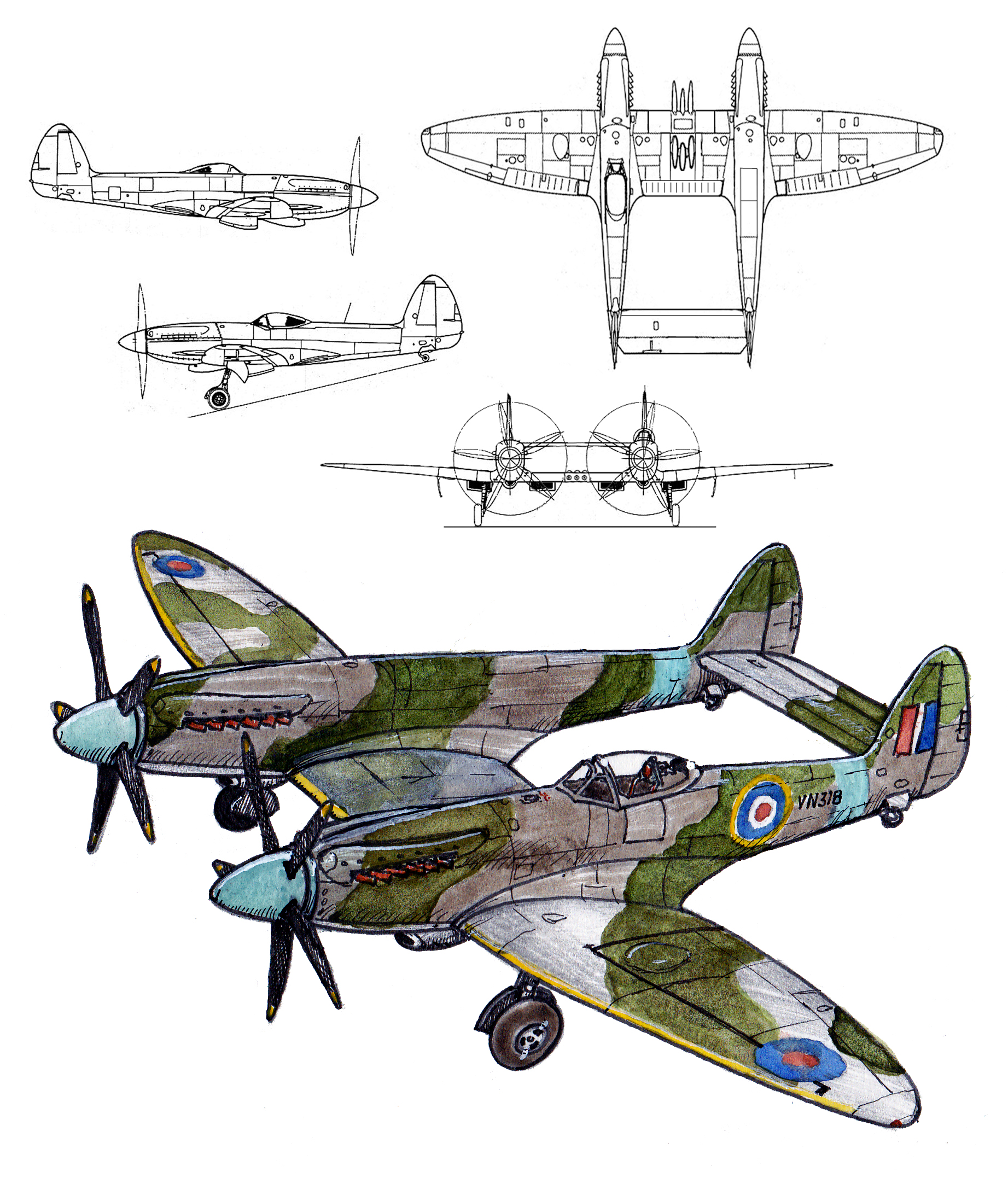
Initially intended as a very long-range escort fighter, the Twin Spitfire was designed to escort ‘Tiger Force’ Avro Lincoln bombers to Japan, missions beyond the range of any conventional RAF fighter. It was also seen as an alternative to the de Havilland Hornet should that aircraft prove unsatisfactory for its intended role in an ‘island-hopping’ campaign in the Pacific theatre.

Supermarine’s design team under Joe Smith developed a remarkably simple conversion consisting of two standard late production Spitfire Mk 22 fuselages and wings joined by a constant chord centre section and tailplane and with the cockpit removed from the right hand fuselage. Unlike its American counterpart, the P-82 Twin Mustang, the Twin Spitfire was a single seat aircraft, reflecting a peculiar British meanness with personnel and maximisation of offensive potential. The absence of the second cockpit and associated equipment made for a very great increase in fuel capacity and the range capability of the new aircraft was unprecedented. When external fuel tanks were added (the wings were equipped for drop tanks) the aircraft’s endurance effectively exceeded that of the average pilot.

Performance

With double the available power of a standard late-model Spitfire but less drag and lighter weight the performance of the new aircraft was outstanding. Maximum speed was 495 mph at 21,000 feet and the rate of climb and acceleration were similarly impressive. Although agility was not in the same league as the standard Spitfire, the aircraft was considered nimble for its size. A less desirable quality was the amount of torque generated by the two Griffons. With less wing area per engine relative to a standard Spitfire; the Twin Spitfire was infamous for swing on take off. Both the F-82 and the Hornet were equipped with ‘handed’ engines to negate torque effects but the Twin Spitfire was never so-equipped and pilots were required to apply full opposite rudder (even with the larger vertical surfaces developed for the Spiteful) and refrain from using full throttle until the aircraft was safely in the air.

Armament

Armament was, surprisingly, reduced in comparison to the Mk 22 Spitfire. Three 20mm cannon were mounted in the centre section of the wing, it being considered that the concentration of these weapons on the centre line of the aircraft increased the effectiveness over the standard four cannon dispersed outboard in the wings. This also allowed for a useful increase in ammunition capacity for each weapon. Later marks were developed to carry underwing ordnance for the strike role.

Operational History

The atomic bombing of Nagasaki and Hiroshima occurred as the first two Twin Spitfire squadrons were working up. Tiger Force was never deployed and the aircraft did not see operational service during World War Two. Orders for the type were slashed, though its relative ease of production due to the large levels of commonality with the Spitfire combined with the obvious merits of its performance (the aircraft was superior in speed, range and disposable load to the Gloster Meteor) meant that production did go ahead though in relatively modest numbers. The first Twin Spitfire F.Mk 1 squadron, was declared operational on the 1st of December 1945 and was deployed to Germany as part of the occupation forces in the spring of 1946, two more squadrons working up on the type throughout that year. Notwithstanding its handling quirks, the aircraft was generally popular with pilots as its blistering performance made it more or less the most potent aircraft in service in the immediate post war era. It is said that ex-Beaufighter pilots were particularly fond of it as the handling problems of both aircraft were similar but the Twin Spitfire’s levels of performance and agility were markedly superior.

Later marks adapted for the night fighter, ground attack and reconnaissance roles were speedily developed and produced.

An early problem with regard to the operational employment of the aircraft was identified almost as soon as it entered service. The pilot, sat in the left hand fuselage, had a largely unobstructed view to the left but his view to the right was severely compromised by the second fuselage and broad chord centre section of the aircraft. A few individual aircraft were modified at unit level to swap the fuselages and produce a ‘right hand drive’ version, which would invariably be detailed to fly on the right flank of any formation. Eventually right handed Twin Spitfires entered series production alongside their left handed brethren, though they were always something of a rarity. Similarly aircraft with a cockpit in both fuselages were produced, allowing for a radar operator to be carried in the Night Fighter version, a student in the training variant, and a winch operator for the target tug.

 Korea

Seeking a presence for itself over Korea during the escalating conflict, the RAF deployed a squadron of Twin Spitfire FB Mk 2s to Kimpo airfield (shared with RAAF Meteors) in 1951. The spectacular range and loitering capability of the aircraft was intensely attractive for close air support purposes and though no longer competitive in pure speed terms when compared to the latest jet fighters, the Twin Spitfire could still compare fairly favourably with the F-80 Shooting Star and was expected to be able to outmaneouvre any North Korean fighters that might be encountered. As it turned out this was to be the Twin Spitfire’s moment of glory. On the 4th of August 1952, Twin Spitfires dove on two Mig-15s and destroyed them both. A fortnight later they repeated the feat and the Twin Spitfire became one of the very few piston engined types to destroy a jet fighter in air to air combat.

Later Service 

For most of its operational life the Twin Spitfire was regarded as a tactical aircraft for strike and ground attack tasks. It operated in concert with Hornets over Malaya and appeared briefly over Suez in a single photographic sortie from a base on Cyprus. Long after this the aircraft served as a target tug, the drogue and winch being carried in a large fairing under the centre section. A few drone controller aircraft were in use until 1962.

Hush-Kit is reminding the world of the beauty of flight.

follow my vapour trail on Twitter@Hush_kit.  If you enjoyed this, you may also enjoy ‘A pacifist’s guide to military aircraft

Do you have an idea for a Hush-Kit article you would like to write? Contact: hushkiteditorial@gmail.com

Variants

Supermarine Type 493:   Prototype, 2 constructed.

Twin Spitfire F Mk 1:  Initial production version, long range escort fighter, 134 built.

Twin Spitfire F Mk 1(r):  As above but produced with cockpit in right hand fuselage, 32 built.

Twin Spitfire FB Mk 2:  Equipped for underwing ordnance and epitomised for the ground attack role, 203 built.

Twin Spitfire PR 3:

Reconnaissance version, 8 built, 15 converted from F Mk 1.

Twin Spitfire NF 4:  Night fighter, 58 built.

Twin Spitfire TF Mk 5:

Trainer variant, 35 built, 30 conversions from FB Mk 2.

Twin Spitfire TT Mk 6:

Target tug, 90 produced – all conversions from FB Mk 2.

Save the Hush-Kit blog. This site is in peril, we are far behind our funding targets. If you enjoy our articles and want to see more please do help. You can donate using the buttons on the top and bottom this screen. Recommended donation £10. Many thanks for your help, it’s people like you that keep us going.

Want to see more stories like this: Follow my vapour trail on Twitter: @Hush_kit

Thank you for reading Hush-Kit. Our site is absolutely free and we have no advertisements. If you’ve enjoyed an article you can donate here. 

Have a look at How to kill a RaptorAn Idiot’s Guide to Chinese Flankers, the 10 worst British military aircraftThe 10 worst French aircraft,  Su-35 versus Typhoon10 Best fighters of World War II top WVR and BVR fighters of today, an interview with a Super Hornet pilot and a Pacifist’s Guide to Warplanes. Was the Spitfire overrated? Want something more bizarre? The Top Ten fictional aircraft is a fascinating read, as is The Strange Story and The Planet Satellite. The Fashion Versus Aircraft Camo is also a real cracker. Those interested in the Cold Way should read A pilot’s guide to flying and fighting in the Lightning. Those feeling less belligerent may enjoy A pilot’s farewell to the Airbus A340. Looking for something more humorous? Have a look at this F-35 satire and â€˜Werner Herzog’s Guide to pusher bi-planes or the Ten most boring aircraft. In the mood for something more offensive? Try the NSFW 10 best looking American airplanes, or the same but for Canadians. 

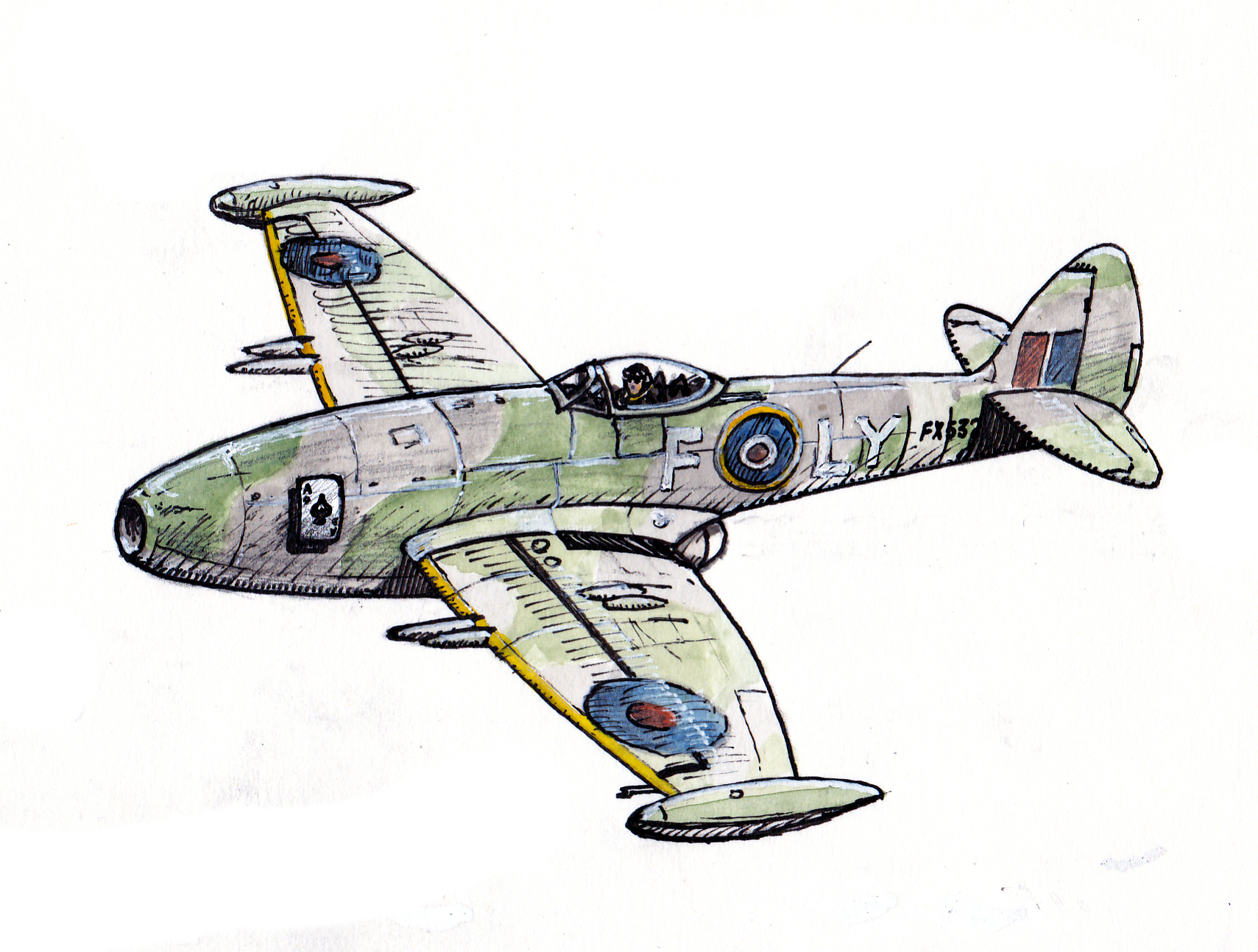
THE ULTIMATE WHAT-IF: THE SUPERMARINE JETFIRE

Following the lead of the Yakovlev Yak-15 (a delegation from Vickers Supermarine having visited Soviet aviation facilities in late 1945), the Spitfire F.Mk 25 was an attempt to obtain an effective jet fighter aircraft whilst avoiding the tiresome rigmarole of designing one from scratch. Shoehorning a bulky Derwent engine into the slender nose of the Spitfire did nothing for the aesthetic qualities of the aircraft, nor, as it proved, did it radically transform the performance. Despite its new powerplant the ‘Jetfire’ proved to be slower than its Griffon engined progenitor. It did, however, possess a superior rate of climb. Soon after the start of production its meagre range was improved by the addition of tip tanks. Although adequate as a first generation jet fighter the Jetfire offered only limited development potential and it was soon supplanted by true jet aircraft that had been designed as such from the start.

follow my vapour trail on Twitter: @Hush_kit

Do you have an idea for a Hush-Kit article you would like to write? Contact: hushkiteditorial@gmail.com

HUSHKIT EXCLUSIVE: Shenyang Aircraft Corporation J-31 REVEALED- NEW CHINESE STEALTH FIGHTER SIGHTED

Image

BREAKING NEWS: The J-31 has flown

For latest analysis on this story see: http://hushkit.net/2012/09/16/china-shows-off-new-stealth-fighter/

This week a photograph emerged of what appears to be a new Chinese fighter. The mysterious aircraft wrapped in a camouflage tarpaulin was delivered from Shenyang by flat-bed lorry to a testing location. The shape (it is possible that it is a mock-up) appears to have no tail surfaces or canopy fitted. It is likely that this is the new Shenyang Aircraft Corporation J-21 (the designation J-60 has been used by some in connection with this aircraft), the Chinese equivalent to the US Lockheed Martin F-35 Lightning II. The shape is apparently similar to that of the F-35, with faceted low-RCS shaping and a conventional wing and tail. The aircraft seems to be somewhat smaller than the F-35 (which is 15.67 m long), with an estimated length of 14-15 m, though size estimates are notoriously difficult  to get right. A good example of this is the J-20; early guesstimates put the aircraft as long as 22 metres, whereas today many analysts believe it is not much bigger than than the 18.90 m long F-22 Raptor . There is some confusion about how many engines the new aircraft will have, but this shape appears to be twin-engined, unlike the single-engined F-35. It seems likely that the aircraft will be twin-tailed, with outward canted vertical fins.

That it was transported by road and allowed to be photographed suggests a staged leak.

Image

Alternatively, the aircraft could be the rejected XXJ contender that lost out to the J-20, this aircraft may carry the designation J-19. But, this seems unlikely as the airframe appears to small for this fighter class. It seems that Lockheed Martin have set a template for what a modern low-RCS fighter looks like, and the F-35 and F-22 are likely to influence most fighters now in development (though the Russian Sukhoi T-50 PAK FA with its wide-body shares something of the YF-23, and the J-20 is an altogether different concept). Several models and artist’s impressions (above and below) have been realised purporting to show the configuration of China’s next fighter.

If the new fighter has not yet been test flown it is unlikely to enter service before 2025.

New US Fighters

Meanwhile the USAF has announced a thirty year plan, which includes a 6th generation fighter to replace the F-22. Though many see China’s fighter developments as a threat to the US’ technological lead, it is still clearly around 20 years behind the US in this field. China does not appear close to having a 5th generation aircraft in service and both the USAF and USN have begun studies into their 6th generation.

It should be noted that many do not agree with the use of the popular Lockheed Martin-defined ‘5th Generation‘ term. Eurofighter have pointed out that Lockheed Martin have manipulated the term to fit their marketing needs. If used as originally defined by Lockheed Martin- as a supercruise capable, super-manouevrable, steathly fighter with sensor fusion- the F-22 is the only 5th Generation aircraft. The F-35, which lacks the first two capabilities, is not.

See also: http://hushkit.net/2012/07/13/hushkit-exclusive-interview-with-super-hornet-pilot-fa-18e-versus-fa-18c-the-final-word/

Export success

With Russia dedicating its future efforts to heavy fighters, (the PAK FA and Indo-Russia Sukhoi/HAL FGFA) there will be a strong market gap for a lighter stealth fighter for nations wishing to avoid the US sphere of influence. Perhaps the J-21 could prove an export success and end up as the MiG-21 of the future?

The sighting of the J-31 in September 2012 led many to believe that the aircraft on the truck was not fact the ‘J-21′ but the J’-31′.

If you enjoyed this, check out our exclusive article on Britain’s P.1154 STOVL fighter: http://hushkit.net/2012/07/20/the-hawker-p-1154-britains-supersonic-jumpjet/

Image

One Boeing concept for a 6th Generation fighter. The traditional vertical control surfaces are replaced with thrust vector control.