Killing the B-2 and ‘Hitler’s Time Machine’: In conversation with Robert F Dorr

140717-F-IW159-001
‘Whose motorcycle is that?’ ‘It’s not a motorcycle honey, it’s a stealth bomber’ ‘Whose stealth bomber is that?’ ‘The American people’s, and it should be chopped’

Former USAF serviceman and diplomat, Robert F Dorr, speaks to Hush-Kit about killing the B-2, the under-appreciated C-5M and Hitler’s Time Machine.

You have been critical of certain decisions made by USAF, what would be a sensible path for it to take today? 

The United States should return to using its armed forces, as the Constitution prescribes, for the defence of these United States — and not for conflicts in trouble spots around the world. For the Air Force that means being prepared for a peer war with a modern nation state such as Russia or China. In terms of procurement, that means a crash programme to acquire a long-range strategic bomber in large numbers. On the subject of retirement, the Air Force should retire its twenty B-2 Spirit stealth bombers, which are nearly useless, and retain aircraft it needs. That means retaining the A-10C Thunderbolt II and KC-10 Extender.

What is the most over-rated military aircraft?

The most over-rated aircraft is the B-2 Spirit stealth bomber. The principles of stealth were well known for years while the U.S. government kept them secret in a ‘black’ programme, adding drama to a capability that is of marginal utility in a slow, vulnerable bomber. In 2013, the last year for which I have figures, it cost $169,313 (per flight hour) to fly the B-2. The B-1B Lancer has a reputation for being costly to operate but the comparable figure for the B-1B is $57,807. The B-2 is almost impossible to keep in operation at any location other than its home base. In 2013, the B-2 had a mission capable rate of 46%, the lowest in inventory, meaning that less than half of scheduled missions took place. Because it began as a black program (for no justifiable reason), a mystique has grown around the B-2.

 What is the most under-rated military aircraft? (historic or modern)

The Air Force has never properly understood the value of helicopters and has not given a high enough priority to developing replacements for the HH-60G Pave Hawk, MH-60W Whisky and UH-1N Twin Huey. The C-5M Super Galaxy isn’t appreciated enough, even though it has capabilities far superior to those of the newer C-17 Globemaster III.

c5mtesting_20070731
Why does no-one appreciate me?

What is the biggest aviation myth?

‘Aviation is about pilots’. If it weren’t for combat systems officers (CSOs, formerly, navigators), other flight crew members, maintainers and many others, aircraft would not fly. The Air Force needs to work harder to treat helicopter pilots as equals to fixed-wing pilots and to treat CSOs as equals to pilots. That means opportunities for good assignments, schools and command should be extended equally to all. So far, every Air Force chief of staff has been a pilot. That needs to change.

Multinational Exercise
The only thing that can replace a Viper is a better Viper. Should USAF order F-16Fs?

What is your opinion of the F-35 programme?

We’d be better off to resume production of new, advanced versions of the F-16E/F Fighting Falcon and the F-15K Slam Eagle for the Air Force, and to continue production of the F/A-18E/F Super Hornet for the Navy. The F-35 Lightning II Joint Strike Fighter is behind schedule, over cost, and doesn’t work. But what if it did work as advertised? Its stealth properties are overrated as an asset in war. It’s at best a mediocre air-to-ground attack aircraft. It’s not an effective air-to-air fighter. The emphasis on the F-35 has sucked the air out of the room when it comes to equipping our airmen with new and effective tactical warplanes.

You have to retire one USAF type tomorrow- what would it be?

As I indicated, the B-2 Spirit is my candidate. It’s effectively useless as an asset in wartime because of limitations on where it can operate. As with the F-35, its stealth properties are overrated as an asset in war.

What was your role in the Air Force, and what is your greatest memory from this time?

I was writing about the Air Force before I was in the Air Force. My first paid magazine contribution was in the November 1955 issue of Air Force magazine when I was in high school. They were building the Air Force Academy in Colorado (its first class convened in 1955; I graduated high school in 1957); I wanted to attend and become a fighter pilot. I was born with a hearing impairment which put the Academy and pilot wings out of reach.

As an enlisted airman from 1957 to 1960, I studied the Korean language at the Army Language School (today called the Defense Language Institute) in Monterey, California, and served two tours in Korea monitoring the North Korean air force. I could tell you more but I’d have to kill you. I was able to do this job well and don’t remember ever being given a hearing test for it. This work was performed at a ground station and in a C-47 Skytrain reconnaissance aircraft. I completed Air Force service in August 1960, a month before my 21st birthday. The Air Force experience led to a career as a U.S. diplomat (1964-89) and to further study of the Korean and Japanese languages.

Tell us about your new book and why people should buy it? 

I have six books currently in print including ‘Hell Hawks’, co-authored with Thomas D. Jones, a history of a P-47 Thunderbolt fighter group in combat.

My latest book is something new and different. ‘Hitler’s Time Machine’ is an alternate history of ]what might have been’ in World War II — a drama of the arms race between the United States and Nazi Germany to develop a time machine. The main characters include Barbara Stafford, an American physicist; Hans Kammler, a Nazi scientist (and a real person), and Die Glocke, or The Bell, a secret device with a secret purpose.

Why should you read this book? It’s an alternate history using as background very real events with very real people including Adolf Hitler, Franklin D. Roosevelt and Winston Churchill.

“Hitler’s Time Machine” is available for Kindle and in hard copy for British readers here

American readers can find “Hitler’s Time Machine” here 

And, of course, readers can get copies of his books directly from him: robert.f.dorr@cox.net

Top ten jump-jets

n5d7yAg Runways are undesirable locations for military aircraft. Being tied to miles of concrete gives jet aircraft a built-in vulnerability as well as restricting their flexibility. So it is hardly surprising that designers have taken great efforts in trying to produce vertical take-off and landing aircraft. These almost inevitably doomed projects have put some fascinating shapes into the sky, here are ten of them. 

Help Hush-Kit carry on by donating using the button above or below. Many thanks.

10. ‘The German Kestrel’ VFW VAK 191B 7-1 As with several aircraft on this list, the £192 million VAK-191 project was built in support of NATO’s huge competition for a supersonic VTOL strike aircraft. The propulsion system, developed with the help of Rolls-Royce, used a Rolls-Royce/MAN Turbo RB193 (similar to the Pegasus engine in concept) and two lift-jets. The aircraft had an internal weapons bay. When the NATO requirement was scrapped (after being technically won by the Hawker P.1154), the VAK-191 flew on in support of an ambitious US/West German fighter project. When this project was also canned it was hard to justify the project and the VAK-191 was axed by the West German government in 1972.

9. ‘The Pentagon Easychair’ Ryan X-13 VertijetRyan_X-13 One way approach to vertical take-off and landing was the ‘tail-sitter’. The X-13 was more successful than its turboprop tail sitting brethren but was championing the wrong approach. In an attempt to promote the aircraft, the X-13 once crossed the Potomac River and landed at the Pentagon.

8. ‘Bumbly Chancer’ Lockheed XV-4 Hummingbirdxv4b_06 This is probably the worst aircraft on this list in terms of its effectiveness. Vertical lift came from the thrust being vectored downward through multiple nozzles. But the thrust generated was far less than expected, a factor which contributed to both XV-4s crashing. The intentions were to produce a target spotting aircraft for the US Army.

7. ‘The Black Sea Harrier’ Yakovlev Yak-38 DN-SN-86-00833 The much maligned Yak-38 was only intended as an interim aircraft and shouldn’t be judged too harshly. This equivalent to the Sea Harrier served the soviet navy from 1976 and 1991, and laid the foundation for the fast, agile and considerably more impressive Yak-41.

6. ‘The Man-Eater’ Ryan XV-5A

The perky little Ryan XV-5A was built in to answer the US Army’s need for a close support aircraft. Attempts to develop it into a combat rescue capability were not encouraging; in trials a dummy was ingested one of the wings fans (out of the pot and into the frying pan). The use of a lift-fan for vertical flight is idea that is still alive today, and can be seen on the F-35B.

 10362

5. ‘Jimbo the ketamine jet’ Dornier Do 31 plane-dornier-do-31-allemagne The superbly bonkers Do 31 transport was conceived to support the dispersal of a planned NATO supersonic fighter that never entered service (see Mirage IIIV). It was powered by eight lift jets and two Pegasus Harrier engines. The drag and weight imposed by the wingtip mounted engine pods was a big issue, and the performance was disappointing. The aircraft had a fantastic appearance however, suitable for Hitler to escape to the moon in.

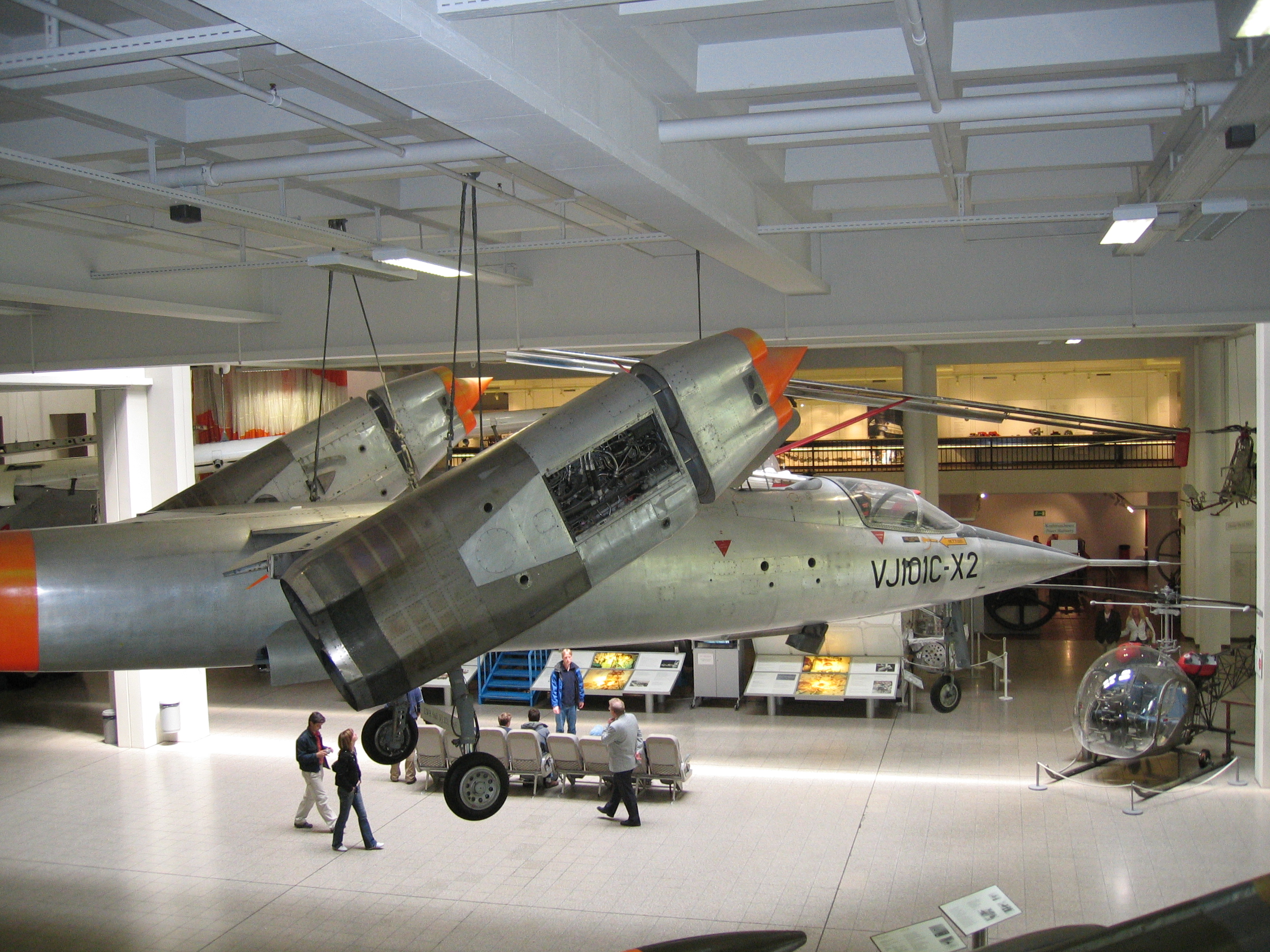
5. ‘The Manga Starfighter’ EWR VJ 101 EWR_VJ101 Heinkel and Messerschmitt teamed up with the rather less famous Bölkow to produce this six-engined tribute to the aesthetics of Roger Ramjet. Unlike other aircraft featuring small jets, this do not feature a larger main engine. The design, which was in many ways similar to the never completed Bell XF-109, achieved a speed of Mach 1.04. Christ knows what would have happened in the event of an engine failure.

4. ‘Saut Mirage’ Dassault Mirage IIIV mir3v_01 Without a doubt, the best-looking and fastest jump-jet to fly was the French Mirage IIV. This prototype fighter, based on the basic layout of the Mirage III, first flew in 1965 in an attempt to win the NATO Basic Military Requirement 3 for a common supersonic VTOL fighter. The prototype aircraft achieved Mach 2.04, but could not fly supersonically after a vertical take-off it could not carry enough fuel. The aircraft was lifted by bank of eight lift jets, the weight of complexity of which would have limited the aircraft’s practicality had it entered service.

3. ‘The prolapsing firefly’ Lockheed Martin F-35B Lighting II 

BF-4, Flt 231, Mode 4 Cross Winds at Edwards AFB, Ca., 6 May 201

Though symbolic of all that is awful about the military–industrial–congressional complex, the F-35 is a very impressive piece of engineering. The F-35B should be the first supersonic jump-jet to enter service – a greatly impressive feat following more than fifty years of failed attempts by some of the world’s greatest designers. The vertical take-off of the aircraft is a fascinating event to watch, described somewhat distastefully by one observer, as looking like, “A prolapsing firefly”.

2. ‘Perestroika Carpetburn’ Yakovlev Yak-41 original The abortive Yak-41 (the prototype was the Yak-141) was an ambitious attempt to produce a supersonic VTOL carrier fighter for defence of the Soviet naval fleet. The project began in the mid-1970s and a prototype flew in 1987. In an unusual, and at the time secretive, move Lockheed funded the project to gain propulsion experience for the X-35 (forerunner to the F-35) they were then developing. The Yak-141 used a similar propulsion system to the F-35, with a swivelling main nozzle – but differed in having two lift engines (the F-35 opted for a lift fan powered by the main engine). This impressive, manoeuvrable aircraft achieved 12 FAI records in April 1991. It’s timing was unfortunate, arriving as the Soviet Union was disintegrating and it was cancelled in 1992. Vertical take-off required the use of reheat (afterburner), necessitating the use of special steel decks.

1. ‘Four poster deathtrap’ Hawker/BAe/McDonnell Douglas/Boeing Harrier  military_fighter_jet_sea_harrier_3840x2160_wallpaper_Wallpaper_3840x2160_www.wallpaperswa.com No surprises for the number one spot. Key to the Harrier’s success is the simplicity of the propulsion concept: the engine’s thrust is steered through four movable nozzles. Unlike rival concepts, the wing and engine did not need to be swivelled for vertical flight, nor did it depend on extra lift engines (which were a weight burden in forward flight) or a specialised landing pad. The Harrier was a lower-risk brother to the aborted P.1154, initially funded in part by the US Army (which was keen to develop an in-house fixed-wing close support force) and part privately, as British companies were then prohibited from developing manned military aircraft (as they were deemed obsolete).The first generation Harrier entered service with the RAF on April Fool’s Day 1969 and remained in service until early 2016, in Sea Harrier guise, with the Indian Navy. The Harrier was replaced by the bigger and more sophisticated Anglo-American Harrier II from the 1980s. The Harrier, especially in its initial form, had a very high attrition rate for an aircraft of its generation (40% of all Harriers were lost in accidents) and was difficult for pilots to master. Landing was particularly difficult with the pilot having to control both the throttle and the nozzle lever with his left hand. Despite these limitations it is a charismatic and exciting aircraft, sadly missed in Britain (where it retired in 2010).

Help Hush-Kit carry on by donating using the button above or below. Many thanks.

Thank you for reading Hush-Kit. Our site is absolutely free and we have no advertisements. If you’ve enjoyed an article you can donate here. When we hit out funding target we will be able to give you even better and more frequent reading matter.

Have a look at 10 worst British military aircraft, Su-35 versus Typhoon, 10 Best fighters of World War II , top WVR and BVR fighters of today, an interview with a Super Hornet pilot and a Pacifist’s Guide to Warplanes. Was the Spitfire overrated? Want something more bizarre? The Top Ten fictional aircraft is a fascinating read, as is The Strange Story and The Planet Satellite. The Fashion Versus Aircraft Camo is also a real cracker. Those interested in the Cold Way should read A pilot’s guide to flying and fighting in the Lightning. Those feeling less belligerent may enjoy A pilot’s farewell to the Airbus A340. Looking for something more humorous? Have a look at this F-35 satire and ‘Werner Herzog’s Guide to pusher bi-planes or the Ten most boring aircraft. In the mood for something more offensive? Try the NSFW 10 best looking American airplanes, or the same but for Canadians.


safe_image.jpg

“If you have any interest in aviation, you’ll be surprised, entertained and fascinated by Hush-Kit – the world’s best aviation blog”. Rowland White, author of the best-selling ‘Vulcan 607’

I’ve selected the richest juiciest cuts of Hush-Kit, added a huge slab of new unpublished material, and with Unbound, I want to create a beautiful coffee-table book. Pre-order your copy now right here  


TO AVOID DISAPPOINTMENT PRE-ORDER YOUR COPY NOW

From the cocaine, blood and flying scarves of World War One dogfighting to the dark arts of modern air combat, here is an enthralling ode to these brutally exciting killing machines.

The Hush-Kit Book of Warplanes is a beautifully designed, highly visual, collection of the best articles from the fascinating world of military aviation –hand-picked from the highly acclaimed Hush-kit online magazine (and mixed with a heavy punch of new exclusive material). It is packed with a feast of material, ranging from interviews with fighter pilots (including the English Electric Lightning, stealthy F-35B and Mach 3 MiG-25 ‘Foxbat’), to wicked satire, expert historical analysis, top 10s and all manner of things aeronautical, from the site described as:

“the thinking-man’s Top Gear… but for planes”.

The solid well-researched information about aeroplanes is brilliantly combined with an irreverent attitude and real insight into the dangerous romantic world of combat aircraft.

FEATURING

        • Interviews with pilots of the F-14 Tomcat, Mirage, Typhoon, MiG-25, MiG-27, English Electric Lighting, Harrier, F-15, B-52 and many more.
        • Engaging Top (and bottom) 10s including: Greatest fighter aircraft of World War II, Worst British aircraft, Worst Soviet aircraft and many more insanely specific ones.
        • Expert analysis of weapons, tactics and technology.
        • A look into art and culture’s love affair with the aeroplane.
        • Bizarre moments in aviation history.
        • Fascinating insights into exceptionally obscure warplanes.

The book will be a stunning object: an essential addition to the library of anyone with even a passing interest in the high-flying world of warplanes, and featuring first-rate photography and a wealth of new world-class illustrations.

Rewards levels include these packs of specially produced trump cards.

Pre-order your copy now right here  


I can only do it with your support.

military_fighter_jet_sea_harrier_3840x2160_wallpaper_Wallpaper_3840x2160_www.wallpaperswa.com

A haunting image of a dying MiG-23

howplanesdie003-6

The Fall of Rome

W. H. Auden
The piers are pummelled by the waves;
In a lonely field the rain
Lashes an abandoned train;
Outlaws fill the mountain caves.

Fantastic grow the evening gowns;
Agents of the Fisc pursue
Absconding tax-defaulters through
The sewers of provincial towns.

Private rites of magic send
The temple prostitutes to sleep;
All the literati keep
An imaginary friend.

Cerebrotonic Cato may
Extol the Ancient Disciplines,
But the muscle-bound Marines
Mutiny for food and pay.

Caesar’s double-bed is warm
As an unimportant clerk
Writes I DO NOT LIKE MY WORK
On a pink official form.

Unendowed with wealth or pity,
Little birds with scarlet legs,
Sitting on their speckled eggs,
Eye each flu-infected city.

Altogether elsewhere, vast
Herds of reindeer move across
Miles and miles of golden moss,
Silently and very fast.

An interview with War is Boring’s David Axe

9bbd3f71f22b22e28cde46f538994c67_L
What is ‘War is Boring’?
War Is Boring is a collective of journalists writing about war. I launched War Is Boring as a WordPress blog in 2007. In 2013 we moved to a new platform — Medium.com.
WiB seems to have a critical, and independent, voice on military aviation subjects- how do you maintain this seeming impartiality?
We do not serve advertisers in the defense industry, and we also have imaginations and integrity. We know who we work for — our readers, not the government. Not the arms industry.
F-35A_Lightning_II_joint_strike_fighter
F-35: what should happen?
Should: cancel it. The Air Force should reopen the F-22 line and rebuild A-10s, F-15s and F-16s while doubling down on long-range drones. The Marines should buy F/A-18E/Fs and replace Harriers with helicopters. The Navy should buy more F/A-18s until it can develop a new fighter. Foreign customers should switch to other, less costly planes.
 What do you see as the most important trends in military aviation technology at the moment?
Rockwell ATF windtunnel bbtn
Drones, drones, drones and drones.
Which airframe or systems are most over-rated, and which are the most under-rated?
Overrated — the V-22. Too complex, can’t lift enough. Underrated — the A-10. Flexible, survivable and very cost-effective.
What are the most common misconceptions about aerial warfare?
The most common misconception about aerial warfare is that “stealth” is actually one thing and that it always works. Stealth is actually a range of technologies, design principles and operational methods that have serious limitations and can be countered cheaply by an imaginative enemy.
The Hush-Kit Book of Warplanes will feature the finest cuts from Hush-Kit along with exclusive new articles, explosive photography and gorgeous bespoke illustrations. Order The Hush-Kit Book of Warplanes here
How do you feel about the status of USAF A-10s?
Congress is doing the right thing in keeping them. The Air Force should be ashamed of itself for the lies, excuses and propaganda it’s promulgated in trying to retire the plane.
Hawgsmoke 2006
Which of your articles has generated the most audience feedback?
By far our coverage of the F-35 is our most popular. See here: