I flew the Harrier, Andover, Alpha Jet and 747

Former RAF pilot Matt Doncaster talks us through some of his incredible flying experiences

The aircraft that is closest to my heart

..has to be the Harrier, simply because it was an absolute honour to get selected to fly and operate such an iconic aircraft. And she just looks right as well! It’s also the only aircraft I ever had my name on the side of (ZG509/80) and that jet is now privately owned and I’ve just been invited to visit her at her owner’s house. That will be a great day out for sure. To graduate from Tac Weapons training in the Hawk, all map and stopwatch stuff with a basic weapons system, to a jet that accelerated like a scolded cat, even at heavy weights, climbed better than a Hawk, and was essentially a flying weapons system for both day and night operations, was like the jump to light-speed, to say the least. As a single-seat fast jet pilot in the ‘90s you could want for nothing more. And whilst the rest of the world’s aviators used to complain about the noise of the Pegasus engine at idle, it was music to my ears (and that of every Harrier pilot on the planet!)

What did taking off in the Harrier feel like?

OLYMPUS DIGITAL CAMERA

When you strapped into a Harrier, you knew she meant business – the cockpit was like no other in RAF service at the time because of the McDonnell Douglas influence, all HOTAS, big multifunction displays, a large HUD and a very useful ‘Up Front Controller’ just below the HUD primarily for comms management and data entry. Also, you sat very high up compared to most other aircraft, so lookout was amazing – I could also look down much further that in any previous aircraft I’d flown because of the bulbous shape of the canopy, and this was very useful as you didn’t need to drop a wing as much to see targets or features on the ground from high altitude. All in all, the cockpit was very user friendly having been designed with proper ergonomics in mind, so couple that with what I can only describe as ‘spirited’ performance, it was a joy to fly and operate, operational pressure and stresses notwithstanding. And I think in hindsight, that’s one of my most enduring memories of her – it was an intense working environment because of the tasks we were trained and training for, so there wasn’t much spare time when you were airborne to simply sit back and take in your surroundings and say ‘Wow, this is incredible!’ Which is a bit of a shame really, but when you could, say in the cruise at high level coming back from a low level sortie, or when performing a VSTOL manoeuvre that you knew looked awesome and you were comfortable with, so there was slightly less pressure than normal (hovering never had that feel if I’m honest because you had to be on top of that scenario from start to finish and the slightest error could lead to disaster very quickly – any VSTOL manoeuvre could do the same to be fair, but some were slightly more forgiving than others), it was like nothing else I’d done or have done since.

What was a typical mission?

There wasn’t a standard mission as such as the aircraft was so capable in so many areas of operation. Primarily the ground-to-air, or air-to-air threat dictated how we could fly in a given environment, plus the weather factor of course. Also, the weapon arsenal we could carry was very varied, and constantly evolving, and that drove what kind of delivery profile we would employ, which in turn dictated whether we could fly low level to the target (the preferred option to try and deny fighter interception), or had to deliver weapons such as PGMs from higher levels, or from a high angle dive because the surface to air threat dictated, and so on. So never the same day twice. And then we had the ability to do all of that off the aircraft carrier as well.

What stands out?

Without a shadow of doubt, carrier operations. My last two months on the squadron were spent at sea in 2000 on board HMS Illustrious on Operation Palliser, flying in Sierra Leone, and I thoroughly enjoyed every minute of it. We’d deployed to the ship via Malta in anticipation of a two week workup in the Mediterranean prior to a co-operative two week exercise with the French Navy in the Bay of Biscay. However, after about two or three days achieving nothing in Biscay because of the weather, we found ourselves steaming south, fast, replenishing the ship’s stores off Gibraltar before arriving in Freetown harbour some time afterwards to announce our presence. The task was to support British troops on the ground who were primarily manning the airport perimeter and the High Commission, and that support came in the form of us at very low level, literally tree top height, putting down noise in order to upset the opposing forces at the time and make them think twice about any planned actions. Normally we’d plan to avoid villages and towns in the UK for reasons of noise pollution and general military PR, but in Sierra Leone we ‘joined the dots’ and flew from one settlement to another, deliberately flying overhead to invoke communications over their radio and mobile phone network, and it worked. Very quickly the Royal Navy, sat in Freetown harbour with a Signal Intelligence Frigate listening to those communications, built up a picture of who was where in country, and we continued to operate in that way for the five weeks of operations. But flying off the carrier, for me, was the most satisfying and exciting aspect of my time with the Harrier. Luckily, flying off and back onto the ship clicked quickly for me, and I don’t want to blow my own trumpet here, but whilst it was always a challenge, knowing that I could hover alongside and land and be relatively comfortable doing so took a lot of pressure off. I found the carrier easier to land on than a pad back home because I could see it – I was never comfortable landing vertically on a pad that I couldn’t see below me. My last flight in a Harrier was an operational sortie in West Africa, landing on a carrier. Personally it didn’t get any better than that.

The thing you need to know about flying the Harrier is..

If she does something you didn’t ask her to do, undo what you last did! This was our VSTOL mantra, and one that got me, and most of my friends, out of trouble in the VSTOL environment at some point in our time of the jet. Obviously because I could move the nozzles by design to vector thrust from aft to downwards, and anywhere in between, depending on which manoeuvre I was attempting to fly, there were a myriad of aerodynamic forces at play as well as engine performance parameters to monitor and manage, and flaps moving in conjunction with nozzle angle (or not if the case dictated). So in essence, a lot going on, and with the best will in the world it was easy to move something inadvertently – the nozzle lever being the biggest potential for disaster – not select something such as the engine water injection system (absolutely vital to increase maximum engine thrust in certain scenarios) or not select the required flap schedule (there were three settings, CRUISE – fixed at 5 degrees, AUTO – anywhere between UP and 25 degrees depending on nozzle angle, and STOL – anywhere between UP and 62 degrees again dependent on nozzle angle). Hence, ‘if she does something you didn’t ask her to do, undo what you last did!’, have a think and try again.

The service or airline I feel closest to is, of course

The RAF. Twenty seven and a half years of service will do that to a person! Never a day goes by without me marvelling at what I achieved and the variety of aircraft I flew and flying roles that I undertook. I never did the same job twice, and whilst I did three instructional tours they were at Basic, Advanced Fast Jet, and the Empire Test Pilot School, so very varied. When I joined the RAF in 1991, I expected to have a ‘standard’ career path of training, probably two tours flying a frontline aircraft, maybe promotion and staff college and a staff tour, then leave after maybe one more flying job. I should have bet a day’s pay on going from training to being an Instructor on Tucanos, then the Harrier, then a Tactics and Weapons Instructor on the Hawk, then a crossover to the C17 because of a neck injury, then ETPS instructing on Hawk, Alpha Jet, Tucano, King Air and Andover, as well as flying pretty much all the types Boscombe Down had to offer including helicopters, with three ground tours woven in for good measure, as I’d be a very rich man now.

Virgin Atlantic is in there as well. I joined them in 2017 after I’d left the RAF, flying the Boeing 747. Another privilege. And despite being made redundant during the pandemic because the airline scrapped the 747, I’m back there now flying the Boeing 787 Dreamliner.

My least favourite aircraft of all that I’ve flown is the Grob Tutor. It replaced the Scottish Aviation Bulldog (a quite lovely aircraft, simple to operate and full of character) at University Air Squadrons, and, quite frankly, the Tutor is too sedate and heavy in roll, over complicated in the checks department, and really quite a bit of an underwhelming experience. Would I fly it again – yes, in the Air Experience role as I’d be giving something back to the young people who aspire to join the RAF and become pilots. Would I buy one? Not if it was the last aircraft on earth – I’ll build something from scratch, thanks!

The C-17 is…..

a truly amazing transport aircraft. Again, I was blessed in being able to operate her through a twist of fate that temporarily stopped me from flying fast jets. I sustained a very bad neck injury whilst instructing in the back seat of a Hawk in the summer of 2003 that meant I couldn’t pull high g for the immediate future, so my fast jet flying was over. I was posted to Boscombe Down on a ground tour to look after, edit and publish the Harrier Aircrew Document Set (basically, Flight Reference Cards, Aircrew Manual, and the Aircraft Operating Data Manual) whilst waiting for the RAF to decide what to do with me. Luckily it wasn’t long before my multi-engine crossover took place, and whilst I wanted to go and fly the BAe 146 and HS125 on 32 Sqn at Northolt, there weren’t any slots available that fitted the service’s timescales for me, so they offered me the C17. Having never seen one before, I asked if I could visit 99 Sqn at Brize Norton on a fact finding mission, and this ultimately turned into a trip away to North America on a training flight as an observer, and that was it – I was hooked! The aircraft’s ability to do all that it is asked to do, and more, is already legendary, but to be able to operate an aircraft that had a flight deck designed by pilots and a cargo area designed by loadmasters is simply a recipe for success, and we all loved flying her. I started on the squadron in January 2006 by flying out to Altus AFB, Oklahoma, as the USAF carried out all UK initial training under contract at that time, so that was fun. And on my return I set to with the major task that the squadron had at the time, which was manning the airbridge from the UK to Iraq and Afghanistan. Over 95% of my flying was the airbridge, carrying everything from 9mm rounds to Apache helicopters, the odd Chinook or Harrier (I’m the only Harrier pilot to fly both types and once was the Captain of a C17 bringing home a broken Harrier that was also in my logbook), and of course the critically wounded being recovered to Queen Elizabeth Hospital in Birmingham. There were the odd trips going West and not East, but they were always related to the conflicts in the Middle East, and usually we were picking up something special from the Americans. We all loved the C17 because of her reliability – we didn’t want to get stuck in theatre, nor did we want to be part of the bad PR that other RAF aircraft seemed to feed on a regular basis through either not getting out of Brize Norton, or not getting in on time. We felt safe flying in her as well, and I suppose when flying a large, very obvious and valuable asset like that, that’s important. Lights off, at night, armour on, looking at the world through NVGs and operating with a HUD to increase situational awareness is definitely the way forward.

Your worst day at work?

Probably when I was part of a large formation of around 40 aircraft, all fast jets apart from the E-3D AWACS we had in support, running around the North East of England in a ground attack vs air defence with fighter escort scenario, when we all heard ‘Wez, Pull Up, Pull Up, EJECT, EJECT’ followed by ‘Mayday Mayday Mayday’. That was horrible. I thought, as we all did, including Mike who’d put the call out, that Wez (we all had three letter abbreviations of our names and I’ll stick with his) had flown into the ground. In reality he’d glanced forward to see another aircraft coming the other way right in his face, so had instinctively pulled back on the stick, applied full rudder as a survival instinct brace position thinking a mid-air collision was imminent, but that probably saved his life as the jet pulled up and promptly departed controlled flight, such were the nature of his inputs and the speed at which he was flying at the time. He recalled all of this, but also thought it best to eject as the jet was unrecoverable at such a low height, but Mike didn’t see him go out as it was all over in a few seconds. Wez landed in trees just short of where the jet impacted the ground and exploded, so again Mike couldn’t see him, nor did Wez’s location beacon transmit such that we could hear it because of the dense foliage he was hanging in in his parachute. Only after Wez had got himself down from the tree and walked out of the wood onto open ground did we hear his signal on the safety Guard frequency. I can’t recall how long that was, but it seemed like a fortnight – I guess it was probably a few minutes but enough for us to reform the formation in preparation for recovery back to base (there were seven of us initially, Wez was out of the picture, and Mike stayed on scene to manage the search and rescue), but when we did hear his signal, boy was there relief. But those initial minutes were rock bottom, never want to go through that again, horrible minutes. Getting shot at in Afghanistan in a C-17 whilst parked on the tarmac at Kandahar Airport is a risk you accept as part of the job, but being that close to losing a mate during peacetime sucks.

Your best day at work?

Same day. Being met after landing in person by the Station Commander, Group Captain David Walker who alas passed away too young last year, to be asked if there was anything we needed in way of support, as well as being given an initial update on Wez’s condition, was leadership and a half. Apparently we all looked like we’d seen a ghost, which I guess was the aftermath of the stress of thinking a mate had just died, but that soon fell away once we were released from the immediate post-crash management processes and we drove to Nottingham to visit Wez in hospital. To see his smiling face was priceless.

How do you feel about the Andover – and what’s your claim to fame?

The Andover was an aircraft I never in a million years thought I’d ever fly. As a Combined Cadet Force cadet in the ‘80s I’d had a Summer Camp at Boscombe Down and seen XS606 during a hangar visit, but then in 2009 I joined the Empire Test Pilot School as the Fixed Wing Qualified Flying Instructor and Standards Pilot to be told that in due course I’d convert onto the Andover in order to support the delivery of test pilot course sorties that utilised her. So I do have a soft spot for her – yes she was old, but of an era when aviation was still very much the evolving science it was after the Second World War and into the ‘50s and ‘60s. Plus, big propellors and water-meth injection are a combination rarely seen or used these days, so that was something new. She had a museum quality about her because of her age, but all of us who flew her enjoyed the experience. I flew her as far as Toulouse on a visit to Airbus which was interesting since her navigation equipment was ‘60s vintage as well, so standalone GPSs were suckered to various windows on the flight deck to give us a fighting chance. On the return leg we had to fly in t-shirts, flying suits tied off at the waist, from Toulouse to overhead the Channel Islands on the return leg because the air conditioning was asthmatic – how Andover crews operated in the likes of Yemen and its heat back in the day is a miracle. My claim to fame – I was the very last RAF pilot to convert to the Andover before she was retired, and I’m very proud of that fact

Tell me something I don’t know about 747s..

Oh that’s tricky – the 747 is such a venerable old girl, and so much has been written about her over the years. I guess one lesser known fact is that under certain conditions of weight and performance, not only could she continue to destination on three engines instead of diverting in the event of having to shut one engine down due to a mechanical issue, but she could often maintain altitude as well, and in most cases climb higher later on in the cruise on a long haul sector. Now that’s performance worth having when flying over the Himalayas or the Rockies, instead of having to worry about the height of the mountains in today’s large twin-engined airliners where you’re only ever going to descend on one engine.

Alpha Jet versus Hawk?

Everyone in the last 50 years who has passed through RAF fast jet training has flown the Hawk. It’s a lovely, sports car of an aircraft, simple to start, operate and fly, with very few handling vices. I flew it as a student, as an instructor, at low level learning and teaching ground attack, at high level learning and teaching air combat and basic air defence techniques, as a bounce aircraft trying to attack formations as they tried to get to a ground target, I dropped my first weapons from a Hawk at Pembrey Range, and it was the one and only aircraft I’ve fired a cannon from, the 30mm Aden. It will always have a place in my heart as an aircraft that was honest, fun and sometimes challenging to operate – some of the best flying I ever did was as an instructor at RAF Valley.

Not many people in the RAF have flown the Alpha Jet. In fact, the number is probably less than one hundred over the time the jets were based at Boscombe Down, and that includes the ETPS students whose convertion to it for their test pilot courses I was in charge of, about 25 in total during my time there. It was a very tidy jet, compact, low to the ground, with sharper aerodynamics compared to the Hawk, and a much more purposeful look to her. Of course she was twin-engined, so in terms of power to weight she was much better placed than the Hawk – initial climb rate was akin to a clean Harrier if I’m honest as we flew the Alpha Jet at Boscombe Down with no external stores or even pylons, even though the wing could carry four. So in essence she was over powered in the role fit we flew, but that’s not a bad thing. We did fly Alpha Jet vs Hawk air combat, and on paper you’d think the Alpha Jet would win hands down due to her extra performance, but so long as you didn’t get slow in the Hawk, say less that about 300 knots, you had a fighting chance because the Hawk could pull more g (we had a training maximum limit of 7g) versus the Alpha Jet which had a limit of 6g. So you could out (turn) rate the Alpha Jet in a Hawk but you had to be careful and patient – the Hawk bleeds energy very quickly if you’re a bit over zealous and aggressive towards your opponent, and then the Alpha Jet’s ability to regain energy, but more importantly sustain a turn at slower speeds without slowing down, would be the downfall of the Hawk. I always tried to merge into combat fast in a Hawk, at least 400-450knots, and go vertical to try and get lost in the sun and then come back down on the Alpha Jet from above, assuming he hadn’t come up with me. Turning flat at the merge, even with a speed advantage was tricky because of the Hawk’s speed bleeding issue, unless the base height for the combat was lowered to 5000ft above the ground where the Hawk’s Adour engine produced more thrust, but that was a rare occasion – our normal base height was 10,000ft and that made a huge difference to the Hawk, less so to the Alpha Jet with its two engines.

Overall, it was never a ‘I’m in the Alpha Jet, I’m bound to win’ scenario – air combat should always be flown to maximise your own advantages, never those of your opponent, and that’s what we did regardless of what we were flying or what the outcome might have looked like on paper.

The most overarted and underrated aircraft I can think of – please explain

Overrated – Oh what a difficult question. I think I need your help there! Maybe we should get together and discuss this one question and see where it takes us? Good idea, let’s do that

Underrated – The Hurribomber I think. The long forgotten stalwart of The Battle of Britain that went on to become a very successful air-to-ground aircraft in North Africa prior to the arrival later in the war of aircraft such as the Typhoon and Tempest, and the family of American air-to-grounders. Overshadowed but wrongly so in my opinion. Or maybe the Tucano – I loved flying the Tucano, others didn’t, but I think it did excellent service as a basic trainer for the 30-odd years it did so. Such a shame they all got sold and shipped abroad – I’d have loved to have had the chance to put a syndicate together and buy one.

What should I have asked you?

What are your future aviation plans? I’ve got a plan to finally get a civilian flying instructor’s rating this year, which will allow me to fly with Ultimate High at Goodwood, and Aero Legends out of Compton Abbas which is only 20 minutes from my house. I need to have some more dynamic flying back in my life, and formation flying and air combat with Ultimate High will be the conduit for that. Aero Legends have recently re-established the training base at Compton Abbas following the sale of the airfield to Guy Ritchie at the end of 2022, and they also operate one of their Spitfires and Harvards there over a number of weekends in the summer months. Obviously I’d be lying if I said I wasn’t interested in flying warbirds at some point in the future, and I think I’ve got a suitable CV to allow me to do that, but the warbird scene is definitely a right place right time scenario, but I’m hopeful that by starting with Aero Legends as a PPL level instructor on their fleet of PA-28s an opportunity might present itself in the future. Fingers crossed!

MY FAVOURITE AEROPLANE IN 200 WORDS #31 Saab JAS 39 Gripen by Joanna Sjölander

"My flying experience in Gripen pushed me over the edge forever" Joanna Sjölander
“My flying experience in Gripen pushed me over the edge forever” Joanna Sjölander

I’ve always appreciated machines with plentiful horsepower.

I’ve sighed longingly upon seeing power measured in numbers. Power displayed in courageous designs. I have dreamt about Lamborghinis and Koenigseggs…

…though I usually get more excited about things I can actually get my hands on. So a whole new playground of the mind opened up, when I realised that these objects of desire did not have to be on four wheels: nothing embodied all of these traits better than Gripen.

Image

The more I learned about how it, the more I fell in love. And the more I got involved in its story and shaping its future, the more devoted I was.

My flying experience in Gripen pushed me over the edge forever.

You have no idea how smart and how efficient the design teams at Saab are in their very creative work. As a part of an engineering body, they are constantly calculating and testing the boundaries. In a humble workshop, they sweat away, because they have to. Because there is always limited time, limited resources and limited leverage. But working with limitations is something the Swedes excel at. The result is a handsome beast, with an efficiency that is envied by all. But only a lucky few get to truly enjoy it.

Joanna Sjölander, a dedicated Gripen fan and once in a lifetime Gripen pilot

Coming soon to Hush-Kit, Joanna describes her fantastic Gripen flight in detail.

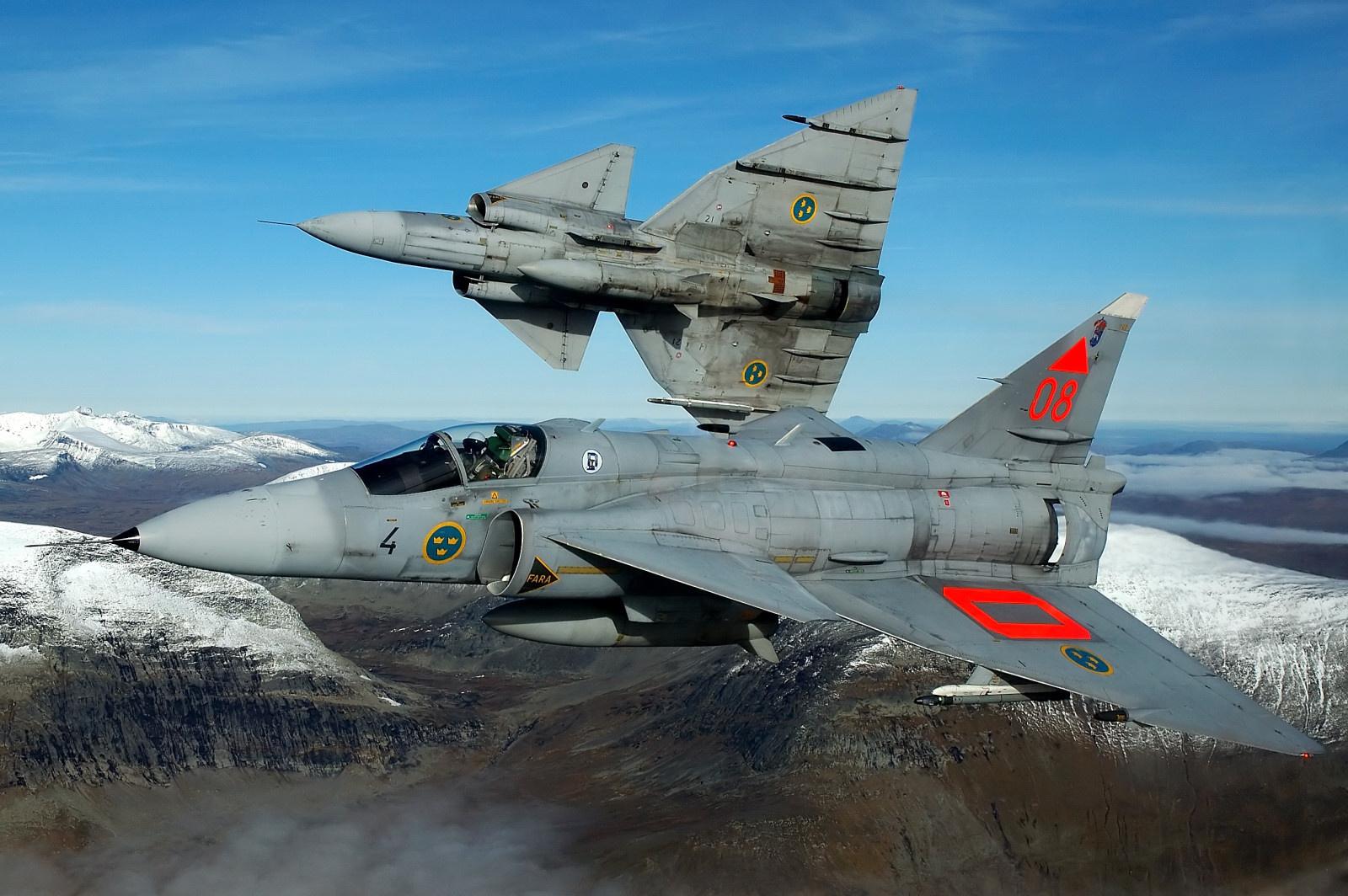
If you enjoyed this, you may get a thrill from this love letter to Swedish aeroplanes or this Viggen tribute.

joanna2

Find out about the latest Hush-Kit articles on Twitter: : @Hush_kit


MY FAVOURITE AEROPLANE IN 200 WORDS #24 Saab 37 Viggen by Alice Dryden

Your friend is running an aviation role-playing game. You need a character and an aircraft, and you don’t want to be British or American because everyone else is.

You remember an airshow, early 1990s, you and your dad gazing at a silver fighter with unusual wings. You say: OK, my pilot is Swedish, his name’s Lars, and he flies a Saab Viggen.

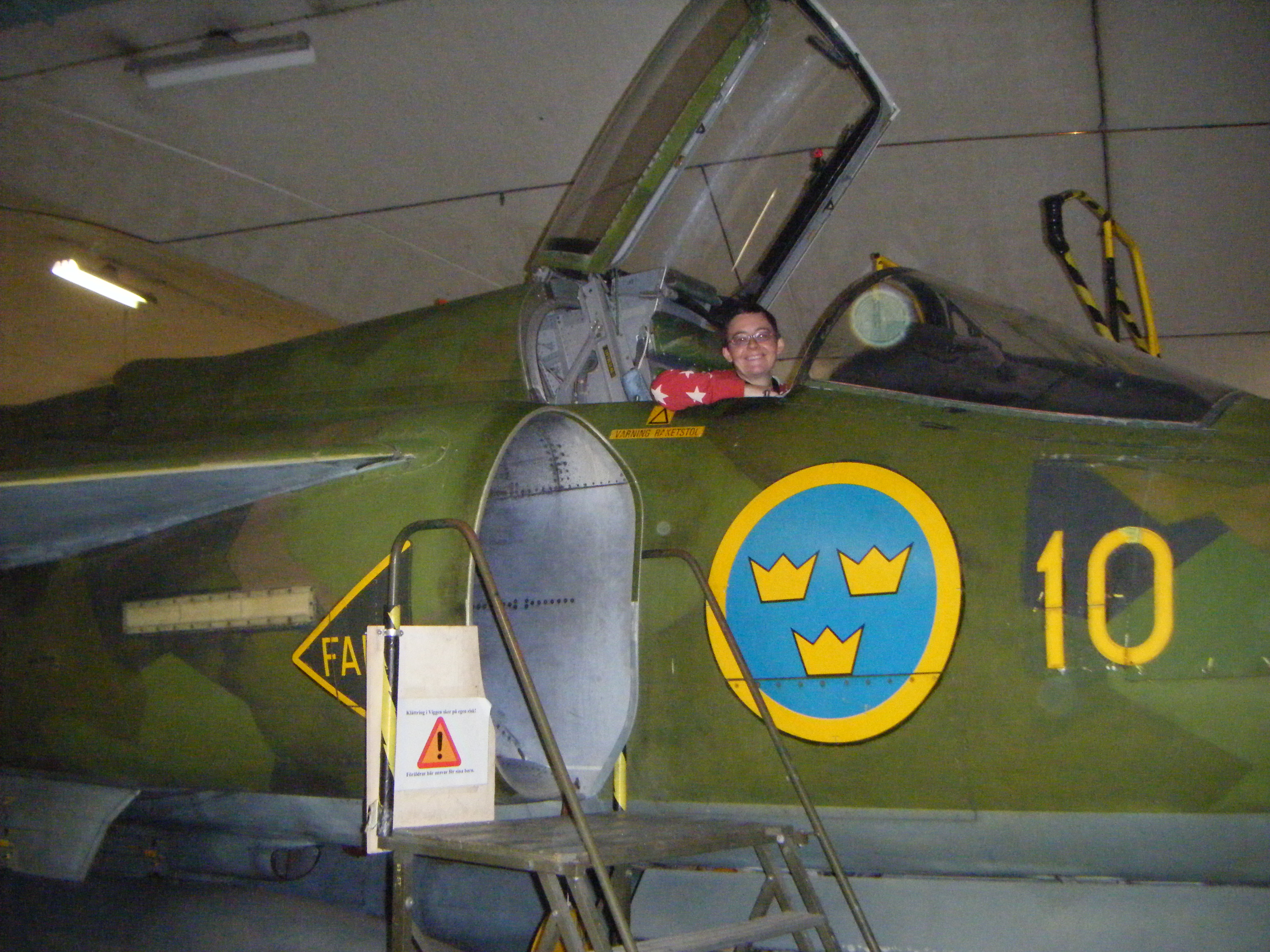
The more you research your chosen plane, the more you’re smitten. It can take off and land on motorways! It’s technically a biplane! You build the 1:144 Revell kit; find the Matchbox model at a boot sale. You visit the Gothenburg Aeroseum and sit in that huge, high cockpit, in a Cold War hangar hacked from solid rock.

In 2012, the Swedish Air Force Historic Flight restore their Viggen to flying condition and announce a display at Sanicole Airshow in Belgium. On your birthday.

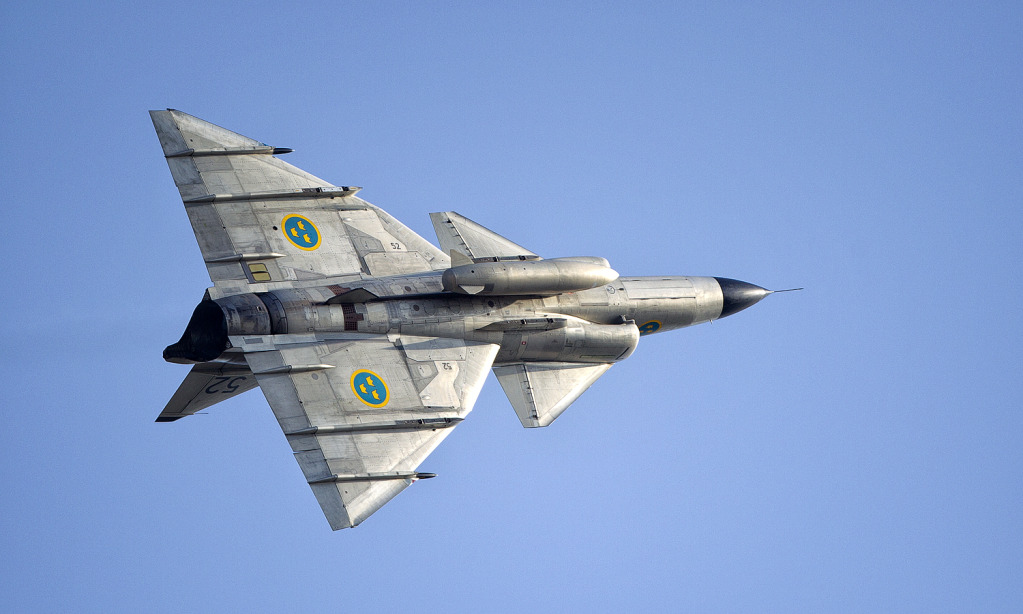
So on a sunny September Sunday you watch that silver fighter rise on the lift from its delta wing and canard foreplane, showing off its unique silhouette for you just like twenty years ago, and you learn that this particular Viggen was actually made in the year of your birth.

It’s your birthday Viggen.

 Alice Dryden [http://www.alice.dryden.co.uk] appreciates well-built Scandinavians.

If you like Swedish aircraft, you’ll love this

Follow my vapour trail on Twitter: @Hush_kit

Do you have an idea for a Hush-Kit article you would like to write?  Are you an editor with pages to fill? Contact: hushkiteditorial@gmail.com

Hush-Kit Top Ten: The ten best-looking Swedish aeroplanes

Hur mÃ¥r du? Outside of France and the superpowers, Sweden is the only nation that still produces her own fighter aircraft. From Gunnar ‘The Ghost’ to Elsa Andersson, Sweden’s aviators and aircraft have long been made of a special kind of magic. Their aeroplanes have often been technologically advanced, rivalling the best in the world, and it is only  politics (and large price tags) which have stopped them being more widely exported (Allestädes framme fÃ¥r ofta näsbränna!).


If you haven’t donated already, please do and keep this blog going: buttons above and below. If you have donated, manny, many thanks 🙂

Here is an excuse to ogle at ten wonderful Swedish aeroplanes. If you enjoy this, have  a look at the top ten British, French, Australian,  Soviet and German aeroplanes. Wanting Something a little more exotic? Try the top ten fictional aircraft.

10. Saab 91 Safir

9. Saab 29 Tunnan

8. Svenska Aero Jaktfalken

7. FFVS 22

6. Saab 18

Image

5. Saab 39 Gripen

Image

4. Saab 21R

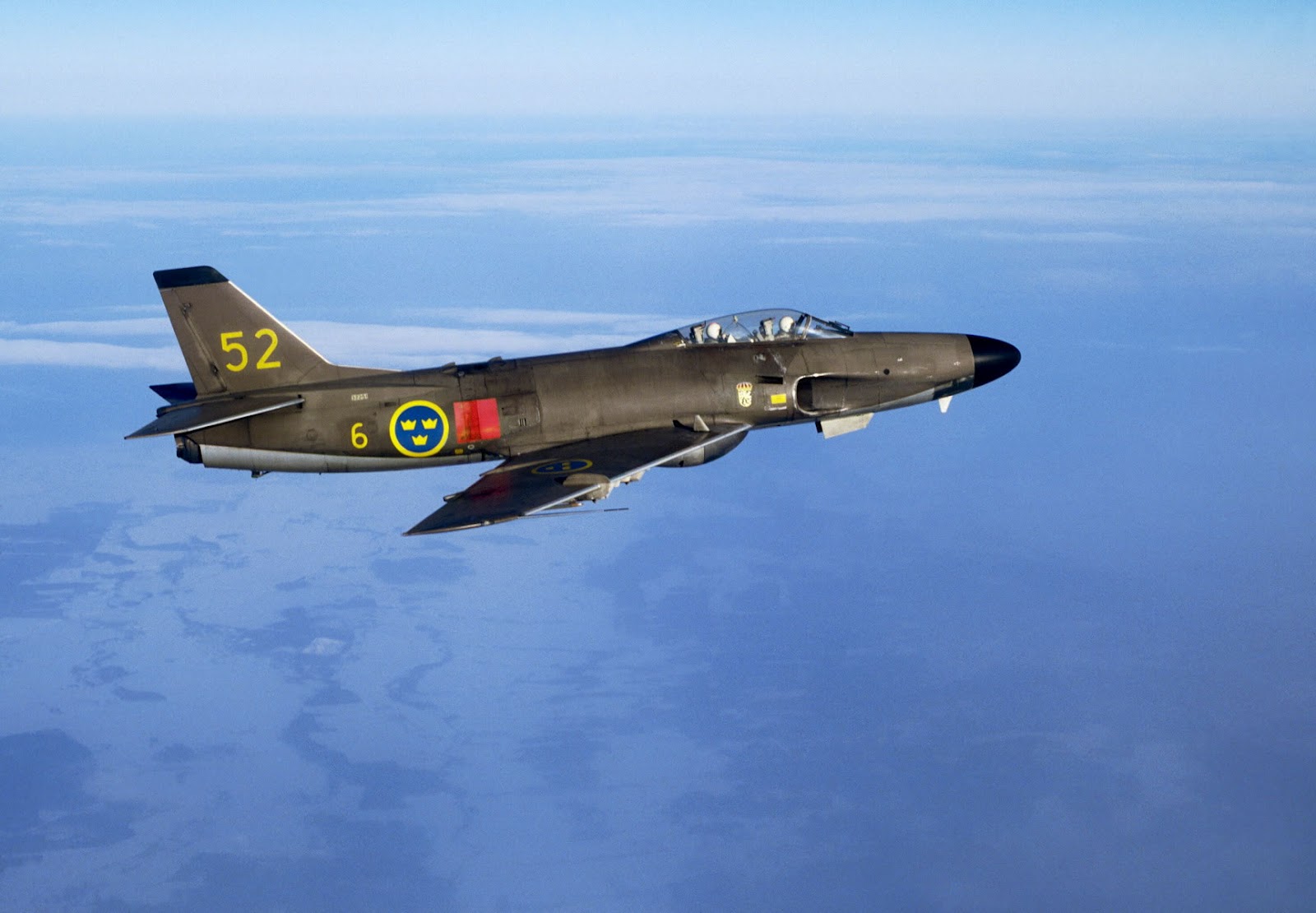
3. Saab Lansen

Image

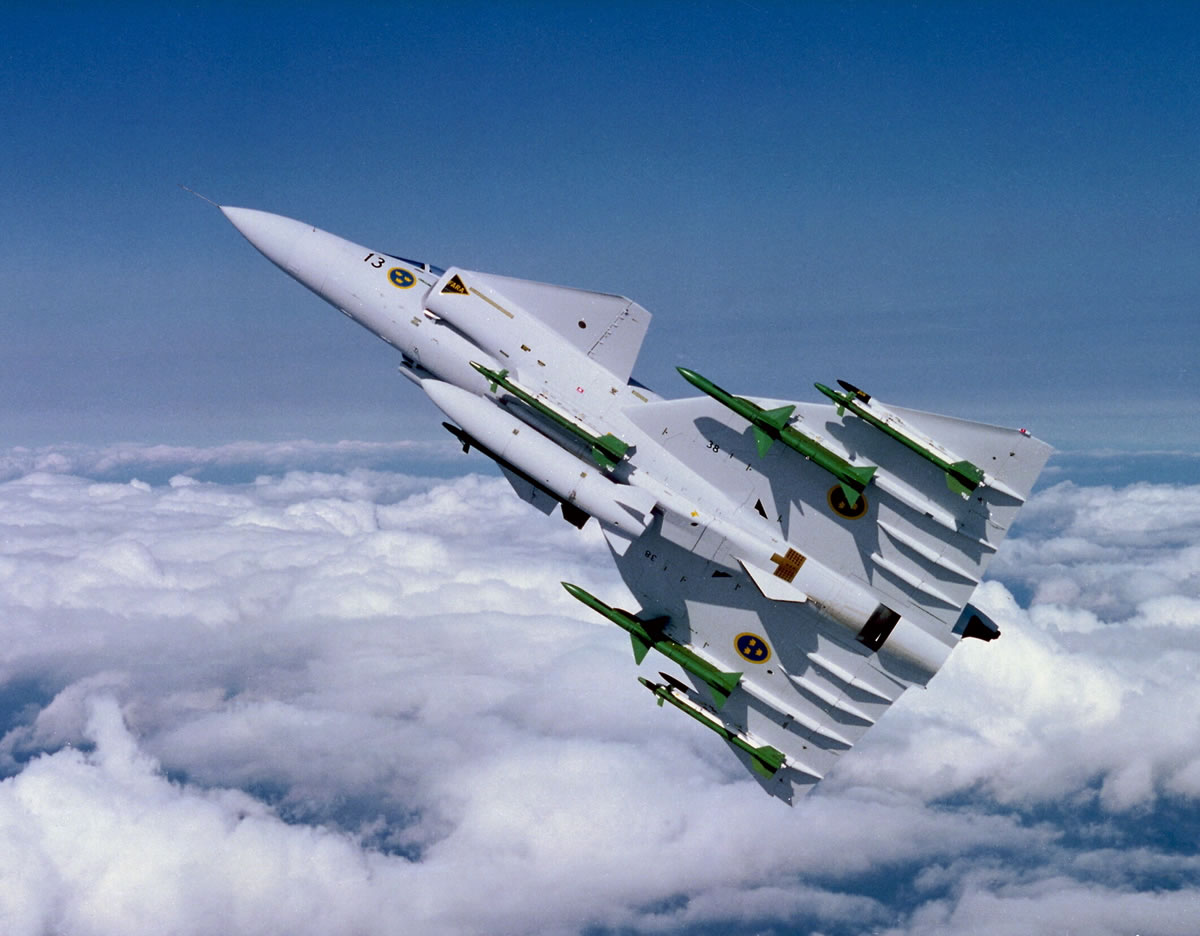
2. Saab 37 Viggen

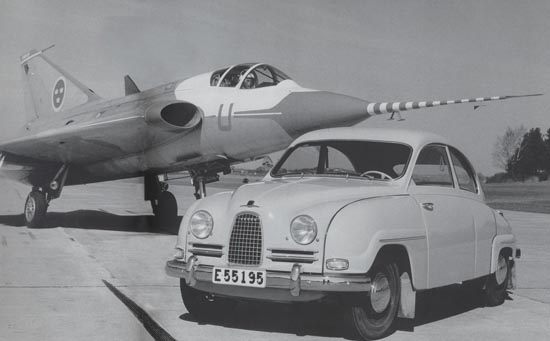
1. Saab 35 Draken

Follow my vapour trail on Twitter: @Hush_kit

Viggen love here

Follow my vapour trail on Twitter: @Hush_kit

Want to see more stories like this: Follow my vapour trail on Twitter: @Hush_kit

Thank you for reading Hush-Kit. Our site is absolutely free and we have no advertisements. If you’ve enjoyed an article you can donate here. At the moment our contributors do not receive any payment but we’re hoping to reward them for their fascinating stories in the future.

Have a look at 10 worst British military aircraft, Su-35 versus Typhoon, 10 Best fighters of World War II , top WVR and BVR fighters of today, an interview with a Super Hornet pilot and a Pacifist’s Guide to Warplanes. Was the Spitfire overrated? Want something more bizarre? The Top Ten fictional aircraft is a fascinating read, as is The Strange Story and The Planet Satellite. The Fashion Versus Aircraft Camo is also a real cracker. Those interested in the Cold Way should read A pilot’s guide to flying and fighting in the Lightning. Those feeling less belligerent may enjoy A pilot’s farewell to the Airbus A340. Looking for something more humorous? Have a look at this F-35 satire and ‘Werner Herzog’s Guide to pusher bi-planes or the Ten most boring aircraft. In the mood for something more offensive? Try the NSFW 10 best looking American airplanes, or the same but for Canadians. 

  If you enjoyed this, have  a look at the top ten British, French, Australian,  Soviet and German aeroplanes. Wanting Something a little more exotic? Try the top ten fictional aircraft.

The top ten Fictional Aircraft


A lot of thought has gone into the fictional aircraft that have appeared in books, films and TV shows. This is a tribute to the clever and imaginative people who have put their aviation know-how to use in producing flying ‘stars’. These aircraft are characters in their own right, and have entered the consciousness of millions. It was hard to select only ten, but here is Hush-Kit’s selection.

Keep this blog alive!

To keep this blog going- allowing us to create new articles- we need donations. We’re trying to do something different with Hush-Kit: give aviation fans something that is both entertaining, surprising and well-informed. Please do help us and click on the donate button above – you can really make a difference (suggested donation £10). You will keep us impartial and without advertisers – and allow us to carry on being naughty. Once you’ve done that we hope you enjoy 10 Incredible Soviet fighter Aircraft that never entered service. A big thank you to all of our readers.

Was the Spitfire overrated? Full story here. A Lightning pilot’s guide to flying and fighting here. Find out the most effective modern fighter aircraft in within-visual and beyond-visual range combat. The greatest fictional aircraft here. An interview with stealth guru Bill Sweetman here. The fashion of aircraft camo here. Interview with a Super Hornet pilot here. Most importantly, a pacifist’s guide to warplanes here. F-35 expose here. 

Hush-kit is reminding the world of the beauty of flight.

Follow my vapour trail on Twitter: @Hush_kit


10. BAC TSR.2MS

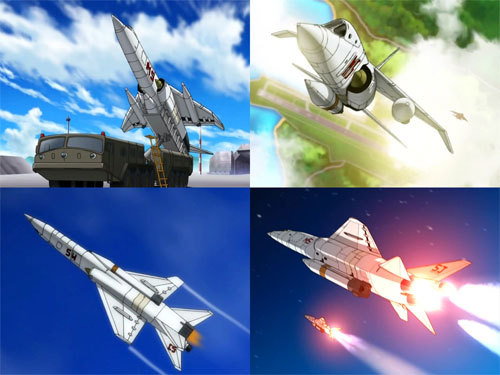
Ridiculous and wonderful, the TSR.2MS is featured in the Japanese cartoon Stratos-4. It is a  mad, rocket-assisted tribute to a real-world cancelled bomber. In Stratos-4 the TSR2.MS is an ultra-fast interceptor, that can be launched from the back of a truck. The creators also considered the CF-105 Arrow for the part! Click here for more on TSR.2

9. AT-99 Scorpion

The AT-99 Scorpion featured in Avatar, and was a chimera of several real-world aircraft. The cockpit is reminiscent of the AH-1W, the weapons are based on real types and the fuselage has elements of the Kiowa. The ducted rotors are an interesting touch, and have featured on several small UAVs as well as flying cars, including the Israeli X-Hawk (which looks like it may have been a muse for the AT-99). The tail is similar to that of the He-162 Salamander. The AT-99 is a fascinating ‘mash-up’.

8.  Blue Thunder

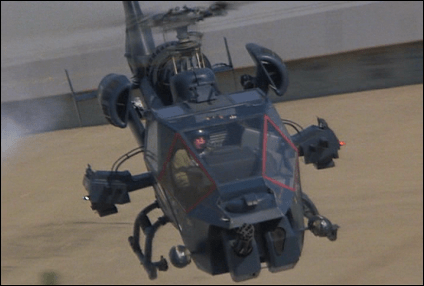
Take a Gazelle helicopter, bolt on a load of prosthetics and you have Blue Thunder. The star of the 1983 film was apparently a dog to fly due to the extra weight required to ‘dress’  it to look like an advanced gunship helicopter.

Keep this blog alive!

To keep this blog going- allowing us to create new articles- we need donations. We’re trying to do something different with Hush-Kit: give aviation fans something that is both entertaining, surprising and well-informed. Please do help us and click on the donate button above – you can really make a difference (suggested donation £10). You will keep us impartial and without advertisers – and allow us to carry on being naughty. Once you’ve done that we hope you enjoy 10 Incredible Soviet fighter Aircraft that never entered service. A big thank you to all of our readers.


7. Angel Interceptor

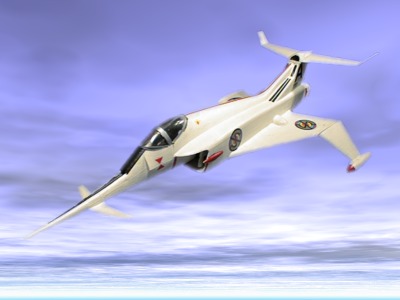
From the British puppet show Captain Scarlet, the Angel interceptor was a VTOL supersonic fighter. The type has an airspike on the nose (a good idea for hypersonic flight) and a ‘wave-riding’ wing. Clever stuff.

6. Air Wolf


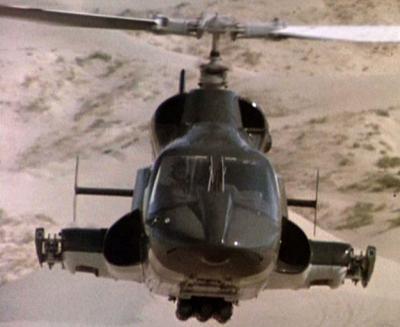
Like Blue Thunder, Air Wolf was another transvestite helicopter (I wish I could think of a good pun to describe that). Air Wolf was a 1980s TV show starring a dressed-up Bell 222. The helicopter was eventually sold after the show ended and became an ambulance helicopter in Germany. Sadly, it crashed in a thunderstorm on June 6, 1992, killing all three on board.

5. F/A-37

The 2005 film Stealth featured the F/A-37 fighter-bomber. The concept is clearly based on the ‘Switchblade’ patent filed by Grumman in 1999 for a Mach 3 capable stealth aircraft. The ‘Switchblade’ used extreme variable-geometry and was a very radical notion. The F/A-37 combines Switchblade-like  features with elements of the YF-23 to produce a visually convincing idea.

4. Mikoyan MiG-37B ‘Ferret-E’

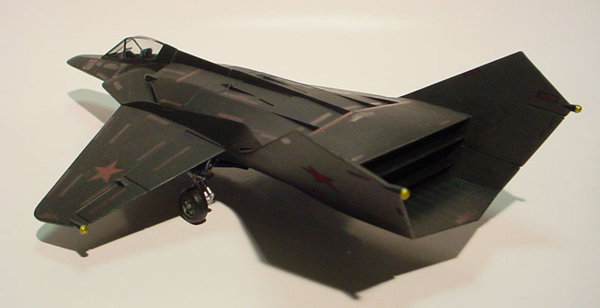
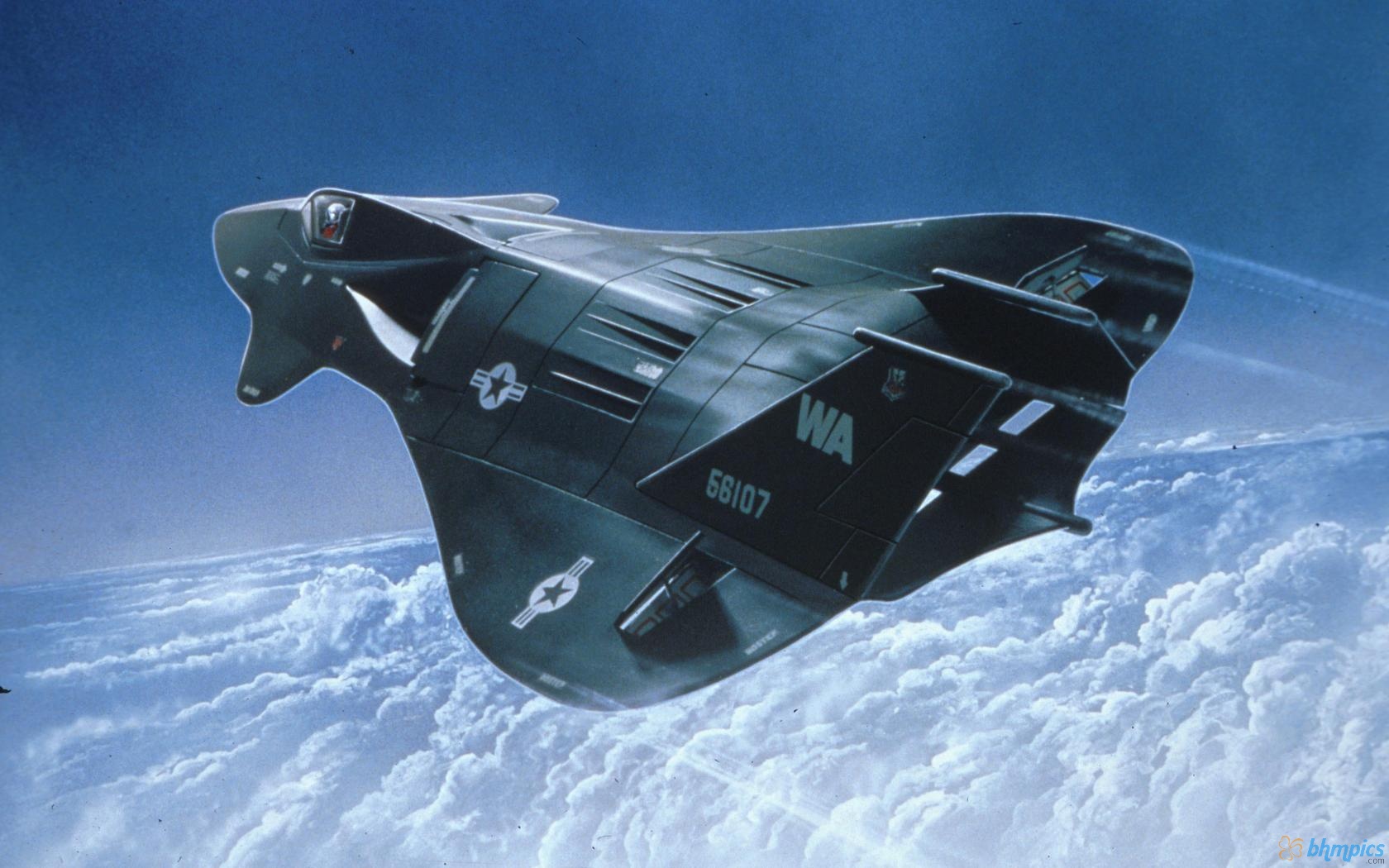
In 1987, the faceted stealth design of the F-117 was highly classified. So, there were some very unhappy people at the Pentagon when model kit maker Testor released their MiG-37. This notional Soviet stealth fighter used a faceted shape to reduce its radar cross-section and a shielding trough to reduce its heat signature, painfully close to the then top-secret F-117. A naughty and well-informed prediction! Click here for the story of Russian stealth.

3. Carreidas 160

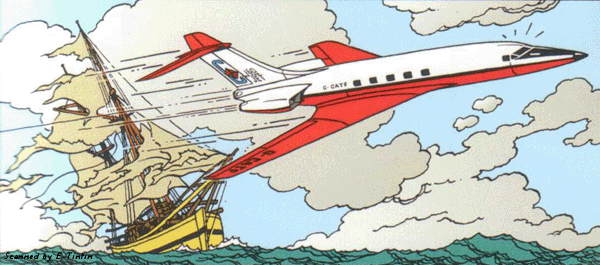
Tintin  featured  many wonderful real-world aircraft, including the Arado Ar 196 and de Havilland Mosquito, it also featured one of the very best fictional aeroplanes. The Tintin book Flight 714 featured a Hergé creation, a gloriously well conceived swing-wing supersonic business jet with three engines. Flight 714 came out in 1968, a year before Concorde flew, at a time when supersonic civil aircraft were a very hot topic. The central engine was fed through a bifurcated intake inboard of the outer inlets.

2. Lockheed F-19 Stealth fighter

In the early 1980s, observers found it odd that the F/A-18 was followed by the F-20. What was the F-19? Rumours of secret stealth aircraft were hot gossip at the time. The two exciting ideas were put together leading to the crypto-aeronautical F-19. It appeared in the 1983 ‘Deal Of The Century’ with Chevy Chase as a cranked delta, with outward canted fins. In 1986 Testor released a model kit, of an aircraft with a plectrum shaped blended wing/body and inward-canted fins, this become the archetypal F-19 image. A ‘Northrop-Loral F-19A Specter’ magazine advert did little to quell the F-19-mania, but the outing of the F-117 ‘stealth fighter’ in 1988 ended this enjoyable trend.

1.Mikoyan MiG-31 ‘Firefox’

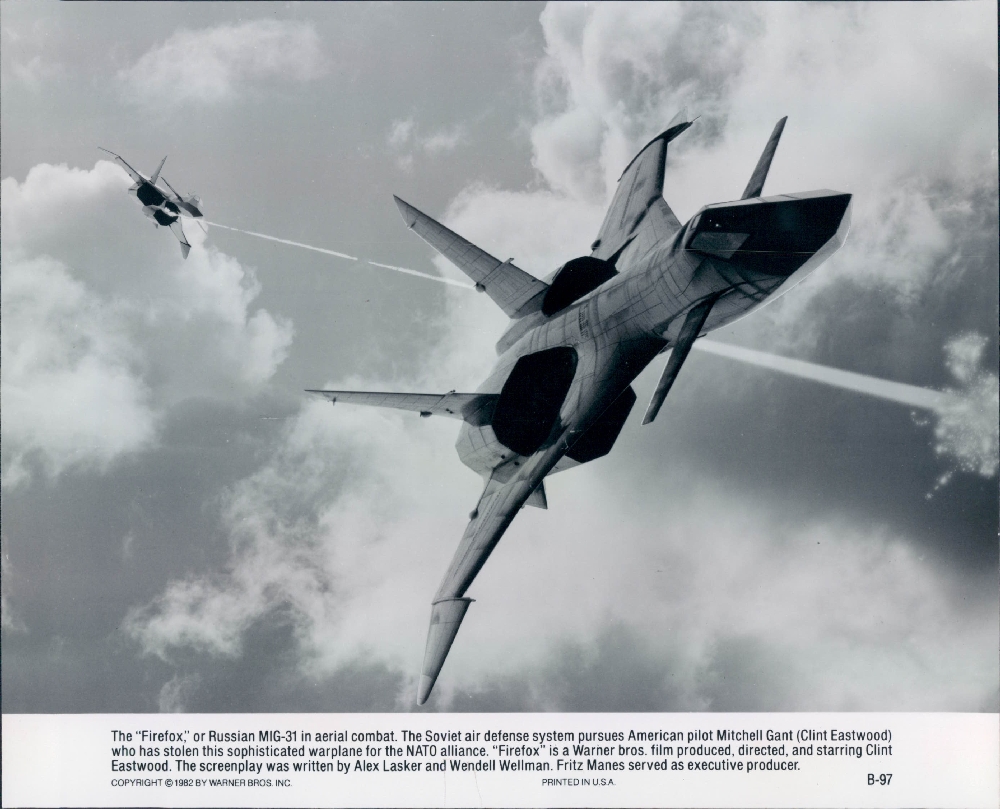
The winner is course- Firefox. Rumour has it that Clint Eastwood originally wanted to cast the Saab Viggen, but it proved cheaper to use dodgy special effects. The resultant ‘Firefox’ was an exciting shape, with four engine intakes and a canard and cranked-delta wing design. With thought control and energy weapons, ‘Firefox’ was ahead technologically of even today’s F-35. Our winner also had a small amount of faceting on its nose and transparencies, but this appears to be for aesthetic reasons rather than hinting at a stealth insight. The 1982 film Firefox was based on a novel of the same name by Craig Thomas, in the novel however, the type looked similar to the MiG-25, as does the real MiG-31. Firefox was released at a time when real, new Soviet fighters were secretive and mysterious, and the film perfectly exploited this sexy mystique.

Over 99.8% of our readers ignore our funding appeals. This site depends on your support. If you’ve enjoyed an article donate here. Recommended donation amount £12. Keep this site going.


safe_image.jpg

“If you have any interest in aviation, you’ll be surprised, entertained and fascinated by Hush-Kit – the world’s best aviation blog”. Rowland White, author of the best-selling ‘Vulcan 607’

I’ve selected the richest juiciest cuts of Hush-Kit, added a huge slab of new unpublished material, and with Unbound, I want to create a beautiful coffee-table book. Pre-order your copy now right here  


TO AVOID DISAPPOINTMENT PRE-ORDER YOUR COPY NOW

From the cocaine, blood and flying scarves of World War One dogfighting to the dark arts of modern air combat, here is an enthralling ode to these brutally exciting killing machines.

The Hush-Kit Book of Warplanes is a beautifully designed, highly visual, collection of the best articles from the fascinating world of military aviation –hand-picked from the highly acclaimed Hush-kit online magazine (and mixed with a heavy punch of new exclusive material). It is packed with a feast of material, ranging from interviews with fighter pilots (including the English Electric Lightning, stealthy F-35B and Mach 3 MiG-25 ‘Foxbat’), to wicked satire, expert historical analysis, top 10s and all manner of things aeronautical, from the site described as:

“the thinking-man’s Top Gear… but for planes”.

The solid well-researched information about aeroplanes is brilliantly combined with an irreverent attitude and real insight into the dangerous romantic world of combat aircraft.

FEATURING

      • Interviews with pilots of the F-14 Tomcat, Mirage, Typhoon, MiG-25, MiG-27, English Electric Lighting, Harrier, F-15, B-52 and many more.
      • Engaging Top (and bottom) 10s including: Greatest fighter aircraft of World War II, Worst British aircraft, Worst Soviet aircraft and many more insanely specific ones.
      • Expert analysis of weapons, tactics and technology.
      • A look into art and culture’s love affair with the aeroplane.
      • Bizarre moments in aviation history.
      • Fascinating insights into exceptionally obscure warplanes.

The book will be a stunning object: an essential addition to the library of anyone with even a passing interest in the high-flying world of warplanes, and featuring first-rate photography and a wealth of new world-class illustrations.

Rewards levels include these packs of specially produced trump cards.

Pre-order your copy now right here  


I can only do it with your support.

Reunited with a source book of aircraft

20120708-170628.jpg

I lost my favourite book over twenty years ago. I could not remember its title or the author’s name so it seemed unlikely I would ever see it again. But this week, by chance, I rediscovered it.

I had arranged to meet my friend to watch an circus performance on London’s Southbank. She was delayed, so I watched the performance by myself. I moved to the front to join 30 confused and delighted school children. The show was outside, on one of those sunny days when the Southbank is the happiest place on Earth.

The two performers climbed and spun from tall flexing poles- swinging in dramatic switchblade movements- for the climax they wrapped themselves in reels of clingfilm, which reminded me of the funniest book I’ve ever read, ‘Ulrich Haarburste’s Novel Of Roy Orbison In Clingfilm’. This contains short stories, written in the voice of an Orbison clingfilm fetishist. Each story is a contrived set-up, leading (inevitably) to Roy Orbison being wrapped in clingfilm.

20120708-171122.jpg

20120708-171444.jpg
The show ended and my friend still hadn’t arrived, so I went to the book market under Waterloo Bridge. Being a mono-maniac with time to burn, I immediately looked for books about aeroplanes. The first I came across was entitled ‘Air Shows’, and was a rather dry guide from the early 1980s.
As I walked toward the next stall, I spotted a small landscape book with the image of a BOAC VC10 taking-off on the cover. Within seconds of opening it, I realised it was THE MISSING BOOK.
There have been two books that have changed my life, directly and profoundly. The second was The Wild, Wild World of The Cramps by Ian Johnston. The one I was now holding was the first.
I double-checked. It was the book. I hadn’t held a copy in twenty years. Every photo I could recall in absolute detail. I ran to the book-seller and paid the £3 pencilled in the inside cover.

Lowercase book

I have tried to avoid looking at it until now. I want to share with you my reunion feelings as they happen.

Ok, I’m ready now. First impressions- my initial copy had no dust jacket, the cover image, in the dismally dreary colour reproduction of 1970, was new to me. The title ‘a source book of aircraft‘. The lowercase ‘a’ was strangely progressive, it made the little book appear friendly. As I look at the cover, I hear thunder outside. Written and compiled by m. allward (all lowercase). The reviews inside are lovely:

“For transport enthusiasts of any age…clear illustrations and and neatly laid out vital statistics for instant identification of the beloved objects.” The Sunday Telegraph

Beloved objects, how marvellous. Beloved indeed.

The Irish Independent said:

“easy reading in a survey ranging from the first perilous contraption to the latest droop-snouted supercilious model. There also grows on the reader a profound respect to those who flew the early machines or even believed the machines would fly.”

SUPERCILIOUS! Ha ha, a little bitchy snipe at Concorde, at a time when it was a fashionable target of criticism. I was just about to open the first page when my mobile phone barked (remind me to change my ringtone). I have a visitor. Well, I’ve waited twenty years, I can wait another couple of hours. Time for tea with the artist Katie Horwich.

I’m back. My first copy I marked with crosses and ticks, showing my approval or disapproval of each type. I was about five when I first saw the book. It introduced me to aeroplanes. I fell in love with aeroplanes from seeing them in this book.

20120708-171150.jpg
The book is organised chronologically, starting with the Wright Brothers 1903 Flyer I. As a child I did not like the early machines. They were not sleek, they resembled piers or bridges or fences. The first sexy aircraft was the Nieuport 17 Scout of 1915. On the side is a skull and crossed bones on a heart, a tattoo-like artwork which brings the ’17 to life.
The locations of the aeroplanes in the pictures were mysterious. Large empty airfields, woods and lakes. The Empire of 1936 was on a body of water next to a castle, a frothy wake streaming from its hull.

The Spitfire was unique in having two pictures- surely this made it the king of the aeroplanes?

The handsome Boeing 314 sat on a sunlit ocean and was photographed from the air- where was it? What was it doing? The absence of captions forced my imagination to make up the story.

Rocket-propelled nazis and jet Christs
When good quality photos could not be found (or copyrights granted?) the aircraft were shown in exciting, but naïve, paintings. The paintings were crudely over-painted photos, each seemingly completed in five minutes. This naïvety could not conceal the mad excitement of the Messerschmitt Me.163; a rocket-propelled nazi fighter and the first aircraft in the book with raked back wings. If that wasn’t titillating enough, the opposite page showed a gorgeous image of the Tempest fighter. As a boy this high-sided machine reminded me of a knight’s charger, the shape speaking of massive power and nobility. The Salamander of 1944 was cool, but incomprehensible, with a black boiler trying to mount it like a randy labrador.

The Sea Hawk of 1947 was a pure, uncluttered shape. The shape of the aircraft resembling a jet-propelled Christ on the cross.

The Sabre carried USAF markings, happy and garish, and familiar to me from toys and comics. The Comet of 1949 shared the same Christian looks as the Sea Hawk. A mass of well-balanced compound curves, the Comet had the gentle look of a deer.

Flying daggers!

In striking contrast to this- the Draken and F-104 were flying daggers! They looked to me like swords or battle-axes. They were speed, aggression and purpose. I loved them, maybe the most of all. The HS 125 and Trident 2E (I have used the aircraft titles and designations from the book), were further Christians, but this time with pally, dog-like snouts.

20120708-170925.jpg
The MiG-23 was a revelation. It was Soviet, and therefore little was known about it. The painting showed a duet of zooming spaceships. They looked invincible. The designation ‘MiG-23’, later proved to be wrong. The aircraft was actually the MiG-25, the legendary ‘Foxbat’.

The world in the pictures was now looking more like the world I knew in 1983. The Harrier of 1966, with its ventilator-like nozzles and oversized tyres was apparently landing in Hampstead Heath, behind were winter-stripped trees. The setting familiar to a British child. The Viggen of 1967 earned a big tick; a gothic cathedral that had transformed into a fighter and flown off over some enigmatic misty landscape.

In 1969 the world ends. Concorde comes into land, in all its supercilious droop-snouted glory.

Seeing the book again was a main-lining of nostalgia that I will be unable to feel again, even if I bury this book for another twenty years.
I dedicate this article to Beatrice Brown, as without her terrible experiences on the London Underground that summer day, I would not have been reunited with this old childhood friend.


Want to see more stories like this: Follow my vapour trail on Twitter: @Hush_kit

Thank you for reading Hush-Kit. Our site is absolutely free and we have no advertisements. If you’ve enjoyed an article you can donate here. At the moment our contributors do not receive any payment but we’re hoping to reward them for their fascinating stories in the future.

Have a look at 10 worst British military aircraft, Su-35 versus Typhoon, 10 Best fighters of World War II , top WVR and BVR fighters of today, an interview with a Super Hornet pilot and a Pacifist’s Guide to Warplanes. Was the Spitfire overrated? Want something more bizarre? The Top Ten fictional aircraft is a fascinating read, as is The Strange Story and The Planet Satellite. The Fashion Versus Aircraft Camo is also a real cracker. Those interested in the Cold Way should read A pilot’s guide to flying and fighting in the Lightning. Those feeling less belligerent may enjoy A pilot’s farewell to the Airbus A340. Looking for something more humorous? Have a look at this F-35 satire and ‘Werner Herzog’s Guide to pusher bi-planes or the Ten most boring aircraft. In the mood for something more offensive? Try the NSFW 10 best looking American airplanes, or the same but for Canadians. 

How British company Airspeed designed the Predator & Reaper

There are many things that the US Military Industrial Complex don’t want you to know. One of the things it doesn’t want you to know is that two of its much vaunted drones are developments of a rather peculiar line of British aircraft development dating from the late 1950s.
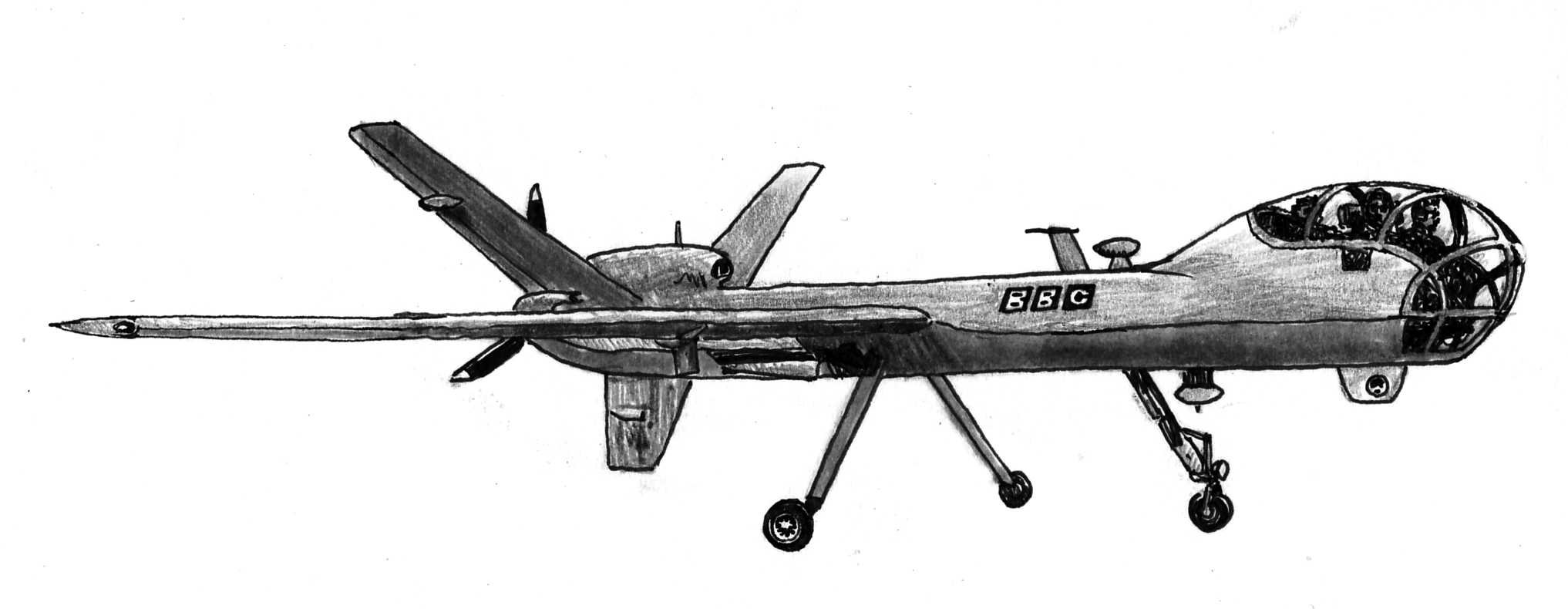
In 1955 the BBC approached the struggling aircraft company Airspeed Ltd to provide it with a dedicated aerial camera platform. It was to have excellent low speed handling and exceptional endurance to enable its crew to film sporting events or appropriate news items with maximum efficiency. A crew of three was envisaged: pilot, camera operator and director/producer. For such items as football matches it was intended that a commentator might be carried in the place of the director and the capability for live audio transfer from the aircraft was a requirement from the very beginning. A helicopter design was considered but rejected due to endurance and noise concerns.

Peeper
The Airspeed AS66 ‘Peeper’ was the result. Powered by a small and quiet Turbomeca turboprop derived from the Astazou, the Peeper made its first flight on the 6th July 1962 and proved an immediate success. BBC cutbacks meant that the initial order was cut from 126 to 4 but this quartet of aircraft would provide sterling service for the next forty years. Amazingly, according to a BBC correspondent, one is retained in mothballed condition at Brooklands aerodrome in Surrey ‘just in case’.
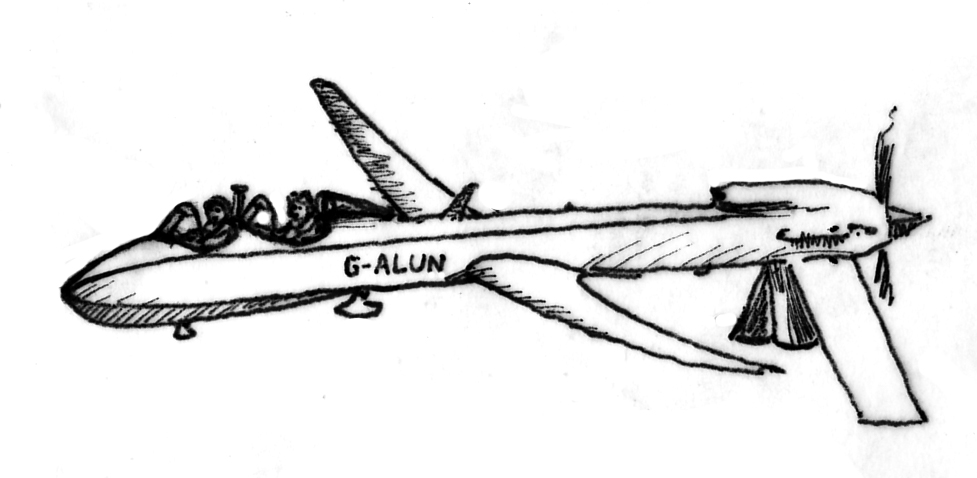
Despite its great success the Peeper did present its pilots with some rather peculiar handling characteristics so a training version was developed. This, the piston-engined AS67 ‘Editor’ was much cheaper to operate but effectively mimicked the larger aircraft’s characteristics. The economical Editor was a charming aircraft to fly and cheap to operate but the asking price was high and, despite a herculean sales effort, Airspeed managed to sell a mere five examples, two going to the BBC.

Looking back without a man

Fast forward thirty odd years and General Atomics is charged with developing a reliable, quiet unmanned aircraft with a good loiter time to spy on America’s enemies. Unwilling to bother developing a new airframe from scratch for a requirement that might turn out to be a dead end, General Atomics looked around for a suitable base airframe for its UAV. By this time Airspeed was long since defunct, having initially merged with de Havilland which in turn was absorbed into Hawker Siddeley and thus ultimately becoming part of British Aerospace. To cut a long story short General Atomics approached BAe with their requirements, BAe dug out Airspeed’s drawings for an aircraft designed to carry cameras with a great loiter time and the rest is history. The prototype General Atomics MQ-1 ‘Predator’, an unmanned Airspeed Editor took to the sky from Brooklands aerodrome in July 1994 followed by the larger turboprop MQ-9 ‘Reaper’ in 2001. Both have proved of great worth to US forces and are despised and feared by all manner of people the world over.

In a curious footnote to this tale it was discovered in 2005 that Neville Shute, Director of Airspeed, had postulated a radio controlled ‘Queen Peeper’ in 1961 when a lost notebook of the designer/author turned up at an auction in Devon. His idea was that it could be used to film newsworthy events where a human crew would be put at risk – his example being a tactical nuclear battlefield situation. Available technology at the time simply could not provide the necessary remote control for such a vehicle but thirty years of radio and TV improvement have resulted in the ‘Queen Peeper’ becoming a reality, though not (thankfully) in a nuclear war.

No. 39 Squadron RAF currently operates the MQ-9 Reaper in Afghanistan, they will be joined by No. 13 squadron during 2012.

If you enjoyed this, you may like our other ULTIMATE WHAT-IF AIRCRAFT, like this one: http://hushkit.net/2012/06/12/the-ultimate-what-if-fighter-the-griffon-powered-hawker-hurricane-mk-xiv/

EUROFIGHTER TYPHOON BOON! THE LUFTWAFFE TAKE ON THE F-22 RAPTOR AT RED FLAG

Eurofighter GmbH, producer of the Typhoon fighter, is beginning to emerge from a period of serious self-reflection. Recent sales campaigns have ended in bitter defeat. Eurofighter has watched big prized contracts being dished out to all of it rivals. It lost in Switzerland to the Swedes, in Japan to the United States and in India to the French. Rafale, Typhoon’s closest rival, had emerged victorious in India, the biggest fighter contest in the world. Future enhancements to Rafale are almost certain to be bank-rolled by India, as well as making sales to additional customer more likely for the French fighter. This was disastrous news as the Rafale is very similar in capability to the Typhoon. Could the shrinking fighter market support two such near rivals?

Added to this gloom was the F-35’s seeming invincibility to cancellation. The F-35 is set to become the first massed-produced stealth fighter, available to all (well, almost all). Many air forces have been envious of the US’ stealth technology since the F-117’s star-turn in the 1991 war with Iraq. As well as the promise of stealth, the F-35 has enormous political backing and Lockheed Martin’s incredible mastery of the black arts of military hardware promotion. Despite the F-35’s dire development problems, customers are still clinging to the notion that the F-35 will be the Model-T of stealth and will make ‘aluminum’ aeroplanes obsolete overnight. However, the F-35’s problems have given Eurofighter an extended time window in which large sales have been possible, but these opportunities have been repeatedly squandered. To many observers it was looking like Typhoon was a dead duck, that would fail to achieve any more significant export sales.

 Typhoon boon?

After several years of misery for Eurofighter, the last week has brought a little bit of sunshine. The most conspicuous piece of good news was from the Luftwaffe regarding Typhoon’s performance over in Alaska. A detachment of 8 German Typhoons from JG74 were deployed to Red Flag 2012 in Eielson AFB in June. During the exercise they took part in basic fighter manoeuvres (BFM) against the F-22. Now before I go any further, we all know the usual disclaimer: without details, and in particular without rules of engagement specifics, not much can be inferred from BFM anecdotes. But…the following exciting titbits did emerge-

  • According to the Col. Andreas Pfeiffer, commander of JG74 “Typhoon is a superior dogfighter” to the F-22 in within visual range combat.
  • Typhoon can out-climb the F-22
  • Typhoon can out-accelerate the F-22

These are all very interesting claims. The latter point reminds me of a conversation I had with a Eurofighter representative a few years ago. I asked him if Typhoon could out-climb the F-22. He replied it could. Two days later he withdrew this comment.

The confident statements by Pfieffer are significant for two reasons:

  1. The F-22 is the aircraft to beat

Of course the Raptor decimated the Typhoons at Beyond Visual Range, a domain where the F-22 is still peerless. But, the Raptor is also one of the very best close-in dogfighters, thanks partly to thrust vector control (TVC). Performing well against the F-22, even if just in the Within Visual Range domain is still a notable achievement. On the subject of TVC, Luftwaffe pilots noted the F-22’s tendency to sink when employing thrust-vectoring. This echoes the experience of the F-15C pilots who flew against India Su-30s in training exercises. The USAF Eagle pilots were quick to identify counter-tactics to the energy depleting TVC moves employed by IAF ‘Flanker’s, though admittedly the F-22 is probably far better at recovering energy than the Su-30.

2.  These were German Typhoons

Luftwaffe Typhoons (for the sake of clarity I will not refer to them as ‘Eurofighters’ as the Luftwaffe generally does) are the worst equipped of the partner nations (the RAF aircraft are the best). To put it simply, if the worst Typhoons can put up a decent fight against the F-22, what could the best Typhoons do?

The defensive systems are not to the same spec as the RAF, lacking several components and featuring a smaller amount of data about potential threats. They do not have an infra-red search and track device, possibly the best way to track a low Radar Cross Section (RCS) target like the F-22.

Importantly they didn’t have the Typhoon’s advanced helmet system. The helmet displays vital information to the pilot and allows weapons to be slewed onto targets very quickly indeed and at extreme angles.

RAF Typhoons took the helmet system to a multi-national exercise in Malaysia last year. The system was deemed to be a strong contributor to the Typhoon’s domination of air combat exercises against F/A-18s, F-16s, MiG-29s and advanced F-15 variants during this training event.

The JG74 aircraft sent to the US were upgraded examples. Changes included an upgrade to the aircraft’s radar software and new radio, mission data and countermeasures software system. Other modifications were classified.

Luftwaffe Typhoons are considered behind the curve in terms of tactics and equipment, especially when compared with RAF aircraft. This success in Red Flag is thus particularly good news. Especially as Germany is keen to offload as many of its older Typhoons to export nations as possible, offering these low-mileage, early Tranche aircraft at competitive rates.

The next piece of good news, is that Eurofighter is waking up to the basics of sales. Shockingly, it emerged that the company put little or no effort into reducing unit costs to potential buyers, instead relying on the weight of high-level governmental support. The obvious example must be India, where the Typhoon bid was supported by extravagant promises and visible efforts by heads of state, but ultimately lost on cost grounds.

Guiseppe Orsi, chairman and chief executive of Finmeccanica (one of Eurofighter’s main partners), acknowledged the lessons learnt in an interview with the Financial Times. He stated:

“We will all be around the table and start from what is the competitive price to win a competition, as we do in the commercial field, then we go back and see what each company has to do in order to get that competitive price.”

The partner companies must work together to achieve this for the greater good of Typhoon sales. Clearly the united ‘front’ of Eurofighter is a smokescreen for large defence contractors viewing their partners as rivals and being unwilling to share sensitive information on costs and margins. Sadly it seems Eurofighter represents a microcosm of the EU itself, its problems analogous to a failing Europe.

However, awareness and public admission of this is a sign that this culture may change.

The aircraft itself is by all accounts excellent, the missing piece to the puzzle of its failure to achieve greater export success may have been found.

If this interests you, support Hush-Kit.net with a donation (buttons above and below). If this goes well we’ll be able to give you much more! Recommended donation £10. Many thanks for helping to keep us impartial and independent.

You may also enjoy A B-52 pilot’s guide to modern fighters, Flying and fighting in the Lightning: a pilot’s guide, Interview with a Super Hornet pilot, Trump’s Air Force Plan, 11 Worst Soviet Aircraft, 10 worst US aircraft, and 10 worst British aircraft. MiG-21s, MC-21s and the overrated Typhoon: In conversation with FlightGlobal’s Stephen Trimble, The F-35 will fail, until the US learns to share, An air force of my own #1, Top 8 Mach 3 fighters

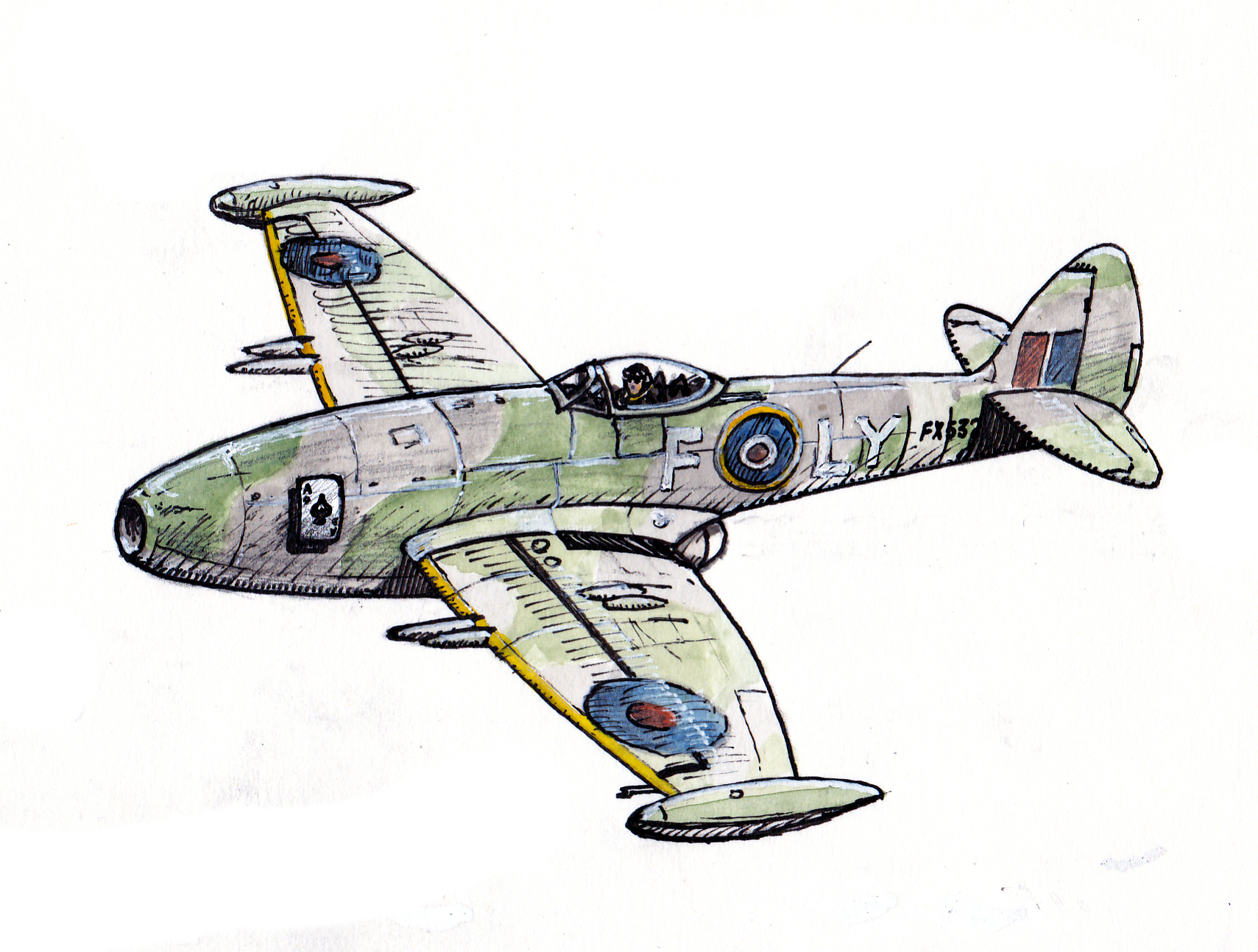
THE ULTIMATE WHAT-IF: THE SUPERMARINE JETFIRE

Following the lead of the Yakovlev Yak-15 (a delegation from Vickers Supermarine having visited Soviet aviation facilities in late 1945), the Spitfire F.Mk 25 was an attempt to obtain an effective jet fighter aircraft whilst avoiding the tiresome rigmarole of designing one from scratch. Shoehorning a bulky Derwent engine into the slender nose of the Spitfire did nothing for the aesthetic qualities of the aircraft, nor, as it proved, did it radically transform the performance. Despite its new powerplant the ‘Jetfire’ proved to be slower than its Griffon engined progenitor. It did, however, possess a superior rate of climb. Soon after the start of production its meagre range was improved by the addition of tip tanks. Although adequate as a first generation jet fighter the Jetfire offered only limited development potential and it was soon supplanted by true jet aircraft that had been designed as such from the start.

follow my vapour trail on Twitter: @Hush_kit

Do you have an idea for a Hush-Kit article you would like to write? Contact: hushkiteditorial@gmail.com

NAPALM BATS: THE BIZARRE TRUE STORY OF BAT BOMBS

Image

Animals have been a part of military organisations for about as long as human history. Horses revolutionized combat. Carrier pigeons provided a cheap and effective way to communicate during combat. Bomb-sniffing dogs continue to save lives. There are a few instances of attack animals, such as Hannibal’s use of war elephants and police attack dogs, but fortunately for the critters of the world, technology has progressed to a point that attack animals are essentially unnecessary.

But did you know that the US military poured money into an actual ‘bat bomb’? Not bombs shaped like a bat, or a bomb that just had “bat” as part of a secret code name — actual bats carrying around incendiary devices. As bizarre as it may sound, it’s true. Not only was this top secret weapon on the verge of being deployed in combat, but initial testing suggested that the bat bomb would have been one of the most destructive weapons in the US military’s arsenal.

My dentist is always busy.

Shortly after Japan bombed Pearl Harbor, the military was inundated with ideas for new, ingenious, and often quirky weapon ideas. One such idea came from Dr. Lytle S. Adams, a dentist and inventor. Adams happened to be friends with First Lady Eleanor Roosevelt, which allowed him to submit a proposal to President Roosevelt.

Image
“Thanks, our reputation for being dark and evil has been helped no end.”

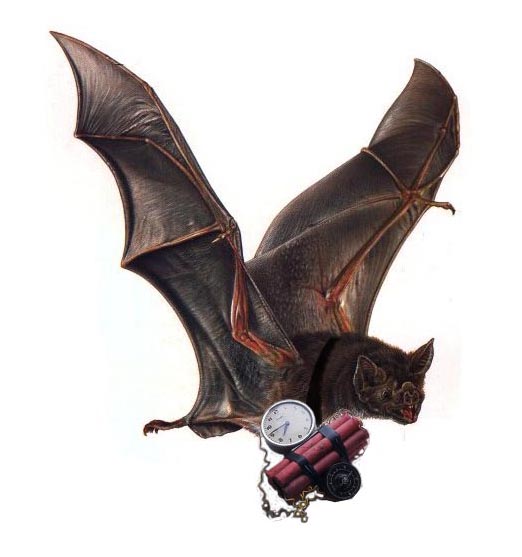
His idea was to attach incendiary devices to bats and drop them over Japan to create a widely effective firebomb. Four facts made this a tempting idea:

1. Bats can be induced to hibernate, which makes them easy to transport.

2. Millions upon millions of bats can be found in caves across the US, which means that they would be cheap to acquire.

3. Bats seek out dark areas during daylight, so there is a good chance that they would roost in the attics and cubbyholes of buildings.

4. Bats can carry several of their young at a time, so they can probably carry a bomb.

The project received funding, amazingly, and the US military set about experimenting with ways to equip bats with incendiary devices. After a few bungled prototypes, they eventually developed a napalm device that weighed less than an ounce and operated on a 30 minute timer.

Image
The bat bomb- the perfect weapon for biblical apocalypses.

Testing the bomb proved to be incredibly effective — even moreso than anybody had ever predicted. Several bats escaped from captivity at the Carlsbrad auxiliary airfield, and within a few minutes the entire base was up in flames. The military later performed another test in a mock Japanese village; the fake town was completely obliterated. The military wrote, “It is concluded that the bat bomb is an effective weapon.”

Image
“Several bats escaped from captivity at the Carlsbrad auxiliary airfield, and within a few minutes the entire base was up in flames.”

At that point, the only tricky part was figuring out how to deploy the bats. Bats cannot be dropped out of a plane like bombs, because they would simply crash into the ground. That’s where the bat bomb came in. The military created a bomb-shaped device that held hundreds of bats in stacked layers. The bomb would release a parachute after it was deployed and then open its stacks to give the bats a chance to wake up and take to the skies.

Unfortunately for the bat bomb project, another famous program, the Manhattan Project, had secretly rendered the bat bomb obsolete. Everything that the bat bomb could do, Fat Man and Little Boy could do a thousand times better. The nuclear era had just begun, and the age of the bat bomb was over before it even got started.

By Dabney B. http://strikefighterconsultinginc.com/blog/