MOSQUITO versus BEAUFIGHTER Round 1

We take class warfare to 300mph as we pit the aristocratic Mosquito against the no-nonsense proletariat muscle of the Beaufighter to find out who the real war-winning twin is.

A well-born beauty with two Merlins running on blueblood, the ecstatically swift Mosquito was the most refined fighter in the war. The Mosquito was stealthy enough to choose fights as it wished and had a reputation for invulnerability. Then there was the honest, almost thuggish, functionalism of the Beaufighter, which was all firepower and brute force – a design that seemingly believed streamlining was for cowards. The Beau carried enough ammunition to invade a small nation single-handedly and outgunned everything it faced with its multiple cannons and machine guns. But when push comes to shove, which was actually the war winner, the Mosquito or the Beaufighter? To determine the answer, we’ve developed some unimpeachable criteria based on actual operational usage. We then did a fucking ton of homework. Strap in!

ROUND 1: Timing

If World War II had started two years earlier, the Bristol Blenheim would have been legendary, and the Fairey Battle would still be remembered as shite.

In the crucial aspect of timing, the Beaufighter scores extraordinarily well. Its introduction coincided with the Luftwaffe switch to night bombing in early September, and it was there for the first Airborne Interception radar in the Autumn of 1940. Crucially, it also arrived late enough to avoid being squandered on the hopeless Battle of France or mis-deployed in the Battle of Britain, like its forerunner, the Bristol Blenheim.

You don’t fear AI as much as the Luftwaffe did.

The Beaufighter’s presence meant crucial lessons about night-fighter interception were learned in time to later defeat the Blitz in the Spring of 1941. Its contemporaries, such as the Blenheim, simply didn’t have the performance to keep up with German bombers, while the Boulton Paul Defiant was obsolete the moment AI radar was made to work. The perfect timing would play out with its introduction into the Mediterranean Theatre in 1941 and 1942, in time to make a decisive difference. The Beaufighter shone a harsh light on the shortcomings of its predecessors and would revolutionise aerial anti-shipping, as we’ll soon see.

However, the Mosquito was also well-timed, though somewhat later. Reaching squadrons in early 1942, its arrival as a light bomber coincided with Bomber Command’s building of a strategic air force. There was also a desperate need for a high-performance light bomber for target-marking when losses were soaring, and it was discovered that bombers were missing their targets by miles. Like the Beaufighter, it truly underscored where the RAF was going badly wrong, and had it been available one year earlier, the RAF might have avoided the idiocy of mass-escorted Stirlings, Hampdens and Blenheims on futile and wasteful Circus and Rhubarb raids (small-scale fighter sorties against ground targets of opportunity).

By the end of the war, both the Mosquito and Beafighter remained effective in what they were tasked to do (even if the Mosquito had some time earlier superseded the Beaufighter as the RAF’s main night fighter).

The Beaufighter edges it with perfect timing of its introduction at the inception of AI and the Luftwaffe’s switch to night bombing.

Beaufighter 1, Mosquito 0

8 MORE BLOODY ROUNDS TO COME…STAY TUNED!

Eddie Rippeth/Joe Coles

Eddie Rippeth is Head of Primary Publishing, International schools
Cambridge University Press
NAPALM BATS: THE BIZARRE TRUE STORY OF BAT BOMBS

Image

Animals have been a part of military organisations for about as long as human history. Horses revolutionized combat. Carrier pigeons provided a cheap and effective way to communicate during combat. Bomb-sniffing dogs continue to save lives. There are a few instances of attack animals, such as Hannibal’s use of war elephants and police attack dogs, but fortunately for the critters of the world, technology has progressed to a point that attack animals are essentially unnecessary.

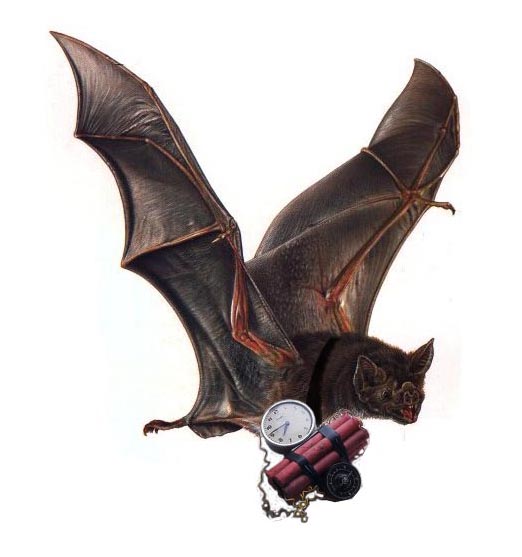
But did you know that the US military poured money into an actual ‘bat bomb’? Not bombs shaped like a bat, or a bomb that just had “bat” as part of a secret code name — actual bats carrying around incendiary devices. As bizarre as it may sound, it’s true. Not only was this top secret weapon on the verge of being deployed in combat, but initial testing suggested that the bat bomb would have been one of the most destructive weapons in the US military’s arsenal.

My dentist is always busy.

Shortly after Japan bombed Pearl Harbor, the military was inundated with ideas for new, ingenious, and often quirky weapon ideas. One such idea came from Dr. Lytle S. Adams, a dentist and inventor. Adams happened to be friends with First Lady Eleanor Roosevelt, which allowed him to submit a proposal to President Roosevelt.

Image
“Thanks, our reputation for being dark and evil has been helped no end.”

His idea was to attach incendiary devices to bats and drop them over Japan to create a widely effective firebomb. Four facts made this a tempting idea:

1. Bats can be induced to hibernate, which makes them easy to transport.

2. Millions upon millions of bats can be found in caves across the US, which means that they would be cheap to acquire.

3. Bats seek out dark areas during daylight, so there is a good chance that they would roost in the attics and cubbyholes of buildings.

4. Bats can carry several of their young at a time, so they can probably carry a bomb.

The project received funding, amazingly, and the US military set about experimenting with ways to equip bats with incendiary devices. After a few bungled prototypes, they eventually developed a napalm device that weighed less than an ounce and operated on a 30 minute timer.

Image
The bat bomb- the perfect weapon for biblical apocalypses.

Testing the bomb proved to be incredibly effective — even moreso than anybody had ever predicted. Several bats escaped from captivity at the Carlsbrad auxiliary airfield, and within a few minutes the entire base was up in flames. The military later performed another test in a mock Japanese village; the fake town was completely obliterated. The military wrote, “It is concluded that the bat bomb is an effective weapon.”

Image
“Several bats escaped from captivity at the Carlsbrad auxiliary airfield, and within a few minutes the entire base was up in flames.”

At that point, the only tricky part was figuring out how to deploy the bats. Bats cannot be dropped out of a plane like bombs, because they would simply crash into the ground. That’s where the bat bomb came in. The military created a bomb-shaped device that held hundreds of bats in stacked layers. The bomb would release a parachute after it was deployed and then open its stacks to give the bats a chance to wake up and take to the skies.

Unfortunately for the bat bomb project, another famous program, the Manhattan Project, had secretly rendered the bat bomb obsolete. Everything that the bat bomb could do, Fat Man and Little Boy could do a thousand times better. The nuclear era had just begun, and the age of the bat bomb was over before it even got started.

By Dabney B. http://strikefighterconsultinginc.com/blog/

THE ULTIMATE WHAT-IF: The cancelled SUPERMARINE SPITFIRE progenitor

Image

 Just as the Messerschmitt Bf 109 was derived from the civil Bf 108 Taifun so the Spitfire was derived from the four seat cabin monoplane Supermarine Typhoon. First flown in 1935 the Gypsy Major powered Typhoon achieved a remarkable performance due to its fine aerodynamics. The sole example was written off barely two months after the first flight when chief test pilot ‘Mutt’ Summers forgot to lower the undercarriage on landing. The projected high price and complicated construction coupled with Supermarine’s increasing preoccupation with Spitfire development doomed the project and the attractive Typhoon was destined to remain an intriguing example of what might have been had war clouds not threatened.

If you enjoyed this, you may also enjoy: http://hushkit.net/2012/06/27/the-ultimate-what-if-the-supermarine-jetfire/