“After an impressively short time, all their weapons systems lit up our warning receivers..â€
Operation Friston was the UK response when Soviet ships passed through waters near the UK. It was regularly activated as Northern Fleet Soviet warships often transited the Iceland – Faroes gap en route to the Atlantic. The Operation Order, which we were regularly required to read and sign for, laid down very strict rules about how close, how fast and how often we could approach the Soviet ships. No rules in the entire RAF were so universally disregarded as those!
Hush-Kit Aviation Newsletter is a reader-supported publication. To receive new posts and support my work, consider becoming a free or paid subscriber.
One spring day in 1985, we were tasked against the Soviet aircraft carrier Kiev and her escorts transiting the gaps North of the UK. It may have been a period of tense relations because the decision was made to make our presence well and truly felt. An experienced four-ship was put together ( I was in number 4 – so no responsibilities!), and we planned to make a radio and radar silent approach and try and take them by surprise.
So, once we ditched UK Air Traffic Control we went silent – we met a VC10 tanker and refuelled – itself an achievement radio silent- and headed North. A Nimrod was on station broadcasting the task group’s position, and well outside their radar coverage, we let down to a low level – fifty feet over the sea where the Buccaneer was happiest. We headed in towards the targets listening to the Nimrod and watching the leader for his changes of heading and speed, and once close, we accelerated to 550knots, still at 50 feet!
“Scary? Night close formation over the sea at low level was very scary. I swear we went thirty minutes without daring to blink!â€
We received no warning indications that they were aware of our approach, and sure enough, they appeared right on the nose.
As we went as low and as close as we dared past the Kiev, successive aircraft taking bow and stern below the level of their deck, we saw they were having a parade on the flight deck! It must have been quite a shock! They maintained their formation for the second pass, but they scattered during the third.
After an impressively short time all their weapons systems lit up our warning receivers, and we decided that enough fun had been had for one day, and we went home feeling very satisfied.
We did wonder whether we might have caused a diplomatic incident but no complaint came. I think the Soviet Navy saw it as “fair game”.
“The front cockpit was an absolute slum.â€
CREDIT: Mike Looseley
What was the best thing about the Buccaneer? It can fly VERY….
THE REST OF THIS LONG, EXCITING BUCCANEER ARTICLE, FULL OF SALTY REVELATIONS, CAN BE READ HERE
The attack helicopter is costly and complex to operate, yet it is taking a mauling in the Russian invasion of Ukraine. Russia’s full-scale invasion attempt of Ukraine starting in 2022 has shown both the vulnerability of helicopters and the effectiveness of small, uncrewed aircraft against armour. With this in mind, we ask: Is the attack helicopter dead?
Ron Smith
Few observers thought Ukraine could withstand the Russian onslaught of 2022. Footage released in April footage of the destruction of a Russian Kamov attack helicopter was a huge morale boost. And more followed. The war in Ukraine has been marked by staggering losses of both anti-armour helicopters and armour.
Typical Western doctrine (offensive or defensive) uses manned armoured reconnaissance ahead of the Forward Line of Own Troops (FLOT) to locate enemy forces and determine their intentions. Increasingly, manned operations will be supported by other ISR (intelligence, surveillance, and reconnaissance) platforms, such as Uncrewed Air Vehicles (UAV) and later Uncrewed Ground Vehicles (UGVs), to augment the manned platforms.
Recce: This is driven by a recce Plan determined by the Commander’s Critical Information Requirements (CCIRs), designed to fill in gaps in intelligence and distinguish enemy feints and deception tactics from their main force’s true intentions and timing. Other objectives would typically be to locate enemy command and control, logistics, air defence units, long-range artillery, and other high-value/high-threat components.
The recce info will then shape the deployment of main armour and infantry (again offensive or defensive), supporting anti-armour helicopter and precision long-range artillery operations.
Manned armoured reconnaissance beyond the FLOT (i.e., in enemy territory) is likely hazardous, particularly if the enemy has effective electronic surveillance capabilities. Traffic analysis can be used to locate signal traffic from unknown forces and, even if encrypted, is likely to result in unwelcome attention. The US tends to assume its comms cannot be read, so it reports every enemy observation. The UK is more concerned about detected transmissions (even if not read) and operates largely under radio silence.
Terrain masking to avoid detection may make Very High Frequency traffic difficult, so HF or datalink to SATCOMs may have to be used.
Armour and Mechanised Infantry: In addition, armour, on both sides, is having a hard time. In the Ukraine case, the threat has proven to be a combination of precision artillery and long-range missile attack, combined with top attack by armed drones.
The author identified this latter threat as a concern more than a dozen years ago – having noted that Hezbollah, in the first Lebanon conflict, had deployed armed drones against Israeli armour.
Because the high mass of protective armour leads to weight and mobility issues, MBT protection is concentrated against direct fire attacks from other MBTs. Top protection is typically reduced, primarily against artillery near misses rather than direct hits, which are now the norm. Even with these measures, deployed MBT mass is typically around 62 tonnes, and top protection is one area that is typically traded off to achieve acceptable mobility.
Active protection systems are not yet regarded as mature and may introduce hazards to nearby personnel (if operating with infantry, for example). I am unsure how successful these are in Israeli use, or whether they have been used successfully in Ukraine.
Furthermore, Western armour generally has no organic means of detecting or countering the drone threat, although directed energy weapons or RF countermeasures may offer some capability in the future and are undoubtedly being actively researched and trialled.
So heavy armour is looking increasingly vulnerable, as, in the Ukrainian conflict at least, attack helicopters. However, heavy armour is clearly still important for taking and holding ground, so it will most likely continue to be central in many operations.
Attack Helicopter operations
When the UK was developing its thinking for GST3971 to acquire a dedicated attack helicopter in the mid-1980s, the vision was of a helicopter that could engage in autonomous direct-fire attack of heavy armour. The threat was essentially Cold War, with massed Soviet armour operating across the North German Plain. Organic air defence (then primarily radar-directed ZSU-23-4) was a significant threat, leading to a desire to stand-off outside its lethal range. Priority targets were enemy air defence, command and control centres and heavy armour.
The solution was deemed to be a low-signature helicopter (radar and IR signatures, particularly) fitted with a mast-mounted sight and using terrain screening. A long-range fire-and-forget weapon was required so that the helicopter would not be exposed throughout the weapon’s flight time.
Initially, Apache was not favoured because the AH-64A was regarded as having large visual and radar signatures and an inadequate sighting system. Without a mast-mounted sight, Scout helicopter support would also be required for target acquisition and designation.
The AH-64D with Longbow and RF Hellfire largely solved these problems by acquiring targets at long range and engaging in indirect fire. However, the missile and target detection range exceeded the recognition and identification range of the TADS sight (which also required the helicopter to be exposed to gain a line of sight to the target). This introduced some concern about the ability to achieve positive target identification when operating under restrictive rules of engagement.
The Situation in Ukraine
Russian operations over Ukrainian-held territory
Today, taking the Ukraine experience as representative, Russian attack helicopters are operating over large regions of Ukrainian-held territory without air superiority and with a dispersed infantry threat armed with capable MANPADS systems. The defending forces can adopt positions that are well hidden, but which offer good fields of fire.
The difficulty of detecting and countering this threat, combined with extensive areas lacking terrain cover, significantly increases the risk to attack helicopters in transit to and from their targets. This is compounded by the apparent ineffectiveness of the helicopter protection and countermeasures equipment.
There are reports of both sides in Ukraine using armed drones for anti-personnel operations against individual soldiers, so operation under cover, if not actually below ground is becoming necessary, if there are enemy drones in the area. This undoubtedly reduces the opportunities for, or increases the risk of, MANPADS operation.
Ukraine perspective – early phase
In the early phase of the invasion there was an armoured attack along the borders, but particularly moving south towards Kyiv from Belarus. This was largely canalised along main routes, as were its supporting logistic columns. This resulted in heavy losses. These were inflicted mainly by mines and artillery. Flooding of off-road terrain reduced the transit route options for the invading force.
Later Developments
After being pushed back from Kyiv in the initial armour thrust, Russian armour and mechanised infantry have been grinding out attacks from Ukraine’s borders, particularly from the south and east. This relatively static land battle is accompanied by long-range missile attacks on critical infrastructure and population centres.
Both sides have effective anti-aircraft missile systems, and neither side has achieved full air superiority over the battlefield. The later Russian attack has featured the use of medium- to long-range stand-off weapons (cruise or ballistic missiles and glide bombs), air-or ground-launched, often from within Russian territory. There seems little scope to counter this, while the political does not exist to mount attacks on launch locations well into Russian territory. The best possible missile defence system may ameliorate damage but will not hasten the end of the conflict, which has become strategic rather than tactical.
Significant numbers of western ground-to-air missile systems are also being supplied. Ukrainian anti-armour operations have increasingly been able to use precision artillery such as HIMARS and ATACMS. The availability of such systems and their munitions is likely to be in short supply and is dependent on enduring political support from EU and NATO countries. It is, therefore, vulnerable, for example, should Donald Trump be returned as US President following the November election.
It seems likely that NATO surveillance assets (E-3, RC-135W, U-2S and satellite cover) are gathering real time intelligence over the battlefield – whether such information is being passed to inform Ukraine deployments and targeting decisions has not been revealed. In any future conflict, using such overhead assets and effective datalinks to transmit near real-time intelligence is likely to be key to effective offensive or defensive operations.
Both Russia and the Ukraine have adopted the use of armed drones for the top attack of armour and these appear to have been very successful. (Relatively little imagery has been released showing Ukraine anti-armour helicopter attacks on Russian armour, or indeed Russian helicopter attacks on Ukrainian armour – Western or otherwise).
NATO nations are beginning to supply air-to-ground weapons such as Brimstone and Storm Shadow, and F-16 aircraft have entered Ukrainian service. It is not known whether Western air-to-ground missiles have been integrated for release from existing Russian-built equipment operating with the Ukrainian Air Force.
Suggested Success Factors for Helicopter anti-armour operations
What do you need for successful helicopter anti-armour missions? Ideally, you want air superiority and not to operate over large swathes of enemy-held territory occupied by determined resistance, equipped with capable MANPADS and other air defence systems such as S-200 and S-300.
Here is a list of possible success factors for postulated helicopter anti-armour operations.
Accurate intelligence as to disposition and movement of enemy armour: satellite, aerial recce, stand-off radar, comms / SIGINT, manned armoured reconnaissance, SF, etc.
A command and control infrastructure capable of providing updated target information in near real-time
Ability to comply with restrictive rules of engagement when necessary
Preferably having air superiority over the area of operations
Ability to reach an engagement position with minimal exposure to threat systems
Ability to engage at long-range
The necessity of avoiding enemy drone threats to AH is likely to favour mobile rather than static operation.
Carriage of sufficient weapons to inflict significant attrition on the enemy force (likely to determine the number of helicopters in the attack)
Use of longer-range missiles (Rafael Spike NLOS quotes 27 km range, helicopter-launched Brimstone is said to have similar range capability).
Proven and effective countermeasures against unexpected missile attack – missile launch detection and tracking, plus sophisticated countermeasures and effective signature reduction. Today, there must be some query as to the availability and effectiveness of such systems.
Ballistic tolerance at least against small arms and medium machine gun threats
Reliable, low-maintenance platform, capable of operation in all weather and climatic conditions.
Crashworthy fuel systems
Run-dry transmission systems
Defensive Operations
The above factors suggest that deploying attack helicopters operating defensively (over one’s territory) could still be effective.
If the enemy uses the same or similar equipment, there would still be problems to solve regarding positive target ID. Also, effective command and control to deal with a fluid ground situation could be problematic, as could maintaining a supply of munitions to the AH force. Missile countermeasures remain an uncertain problem.
Offensive Operations
Long-range indirect fire engagements would be preferred for both offensive and defensive operations, and they would probably be essential in the offensive case.
The high helicopter losses sustained by Russia in current offensive operations probably reflect high risk operations, in the face of determined opposition with capable weapons and not much terrain cover for the helicopters. Also, no air superiority to provide top cover and hinder ground air defence, together with apparently ineffective measures to hinder missile lock-on and to break lock, once engaged.
Moreover, the threat is not the organic air defences of battlegroups or a Soviet Motor-Rifle Regiment or Brigade but dispersed and well-hidden infantry and special forces units equipped with modern MANPADS missile systems. Furthermore, because the enemy forces are operating over the defenders’ own ground, the defence can be cued and alerted to approaching helicopters, given good data connectivity.
In the case of offensive operations, it would appear that stand-off operations from the ground already held by one’s own forces might be the order of the day. In this case, the helicopters might operate similarly to a highly mobile precision artillery unit, able to redeploy kilometres across the field of operations in minutes. With a lack of local air superiority, the Russian use of stand-off weapons launched from within their territory supports this proposition.
A further consideration is that maintaining the mobility of the helicopter force is likely to benefit it by hampering any drone threat targeted at it.
The focus of attack might shift towards enemy logistics – MBTs without fuel or ammunition cannot conduct manoeuvre warfare.
Increasing the range at which the attack is conducted could suggest the use of larger helicopters to carry the heavier weapons likely to be required – feasible if operating over safe ground. The carriage of Exocet on certain export Sea King aircraft is an example of such a usage. Rafael Spike and Brimstone are also attracting interest because of their long-range capability. Clearly, target selection would be entirely dependent on the higher-level ISTAR infrastructure, although salvo-fired Brimstone has already shown some autonomous target discrimination capability.
An alternative to using one heavy long-range missile per tank destroyed might be to use a larger helicopter to launch long-range drone-carrying systems. This could allow several medium helicopters to launch attack and surveillance drones into a given operational area, possibly in the enemy’s rear. Command and control, logistics, comms, armour, barracks, and hardened targets could all be engaged in this way.
Forward-launched recce drones could provide target designation and satisfy positive ID requirements when operating under tight rules of engagement.
Such an approach could also overload the enemy air defence command and control and be usefully deployed in conjunction with simultaneous missile and/or manned aircraft operations.
This capability is alluded to in several planned US programmes, including the abandoned FARA and FLRAA. We are talking about air-launched effects (LE) for reconnaissance or attack and Future Tactical Unmanned Aircraft Systems. The air-launched effects were described (Vertiflite March / April 2024) as being deployed from FARA, FLRAA and Black Hawk “to decoy, disrupt or destroy enemy air defences and to spot targets for joint forcesâ€. The same article indicates that â€the Army plans first flight of a fully-integrated ALTIUS – Air-Launched, Tube Integrated Unmanned System from a Black Hawk this year†potentially for a rapid fielding decision in 2025.
The US’s â€long-standing interest in technologies that enable a single operator to control multiple UAS is associated with this.â€
— Hush-Kit Aviation News, History & Satire (@Hush_Kit) October 7, 2024
Perhaps network-enabled command and control, ISTAR, and other means of target verification can integrate existing AH capability in defensive operations. Medium helicopters operating further back could launch a mix of longer-range weapons and ‘Launched effect UAS’ in both offensive and defensive scenarios.
Further to the suggestion of stand-off medium helicopters for anti-armour ops over enemy territory (and the US reference to Air Launched Effects), see here.
It is also worth noting that Sea King was cleared for export customers to launch Sea Eagle (India) and Exocet (Qatar, Pakistan), suggesting plenty of payload for air-launched systems controlled by medium support helicopters. [A good role for the FAA Merlin Mk.4 force?]
The Drone Threat to Helicopters
In a traditional mechanised offensive, armour and infantry fighting vehicles (IFVs) operate collectively to gain and hold ground. Helicopters are used forward to take out enemy armour and attack command posts while scouting and designating targets for precision artillery strikes.
Infantry also relies on helicopter support for air cover and casevac. Recently, drones have been used in kamikaze attacks on helicopters. Used in this way, drones could significantly hamper helicopter operations and severely affect infantry morale.
Both helicopters and ground vehicles now need to adopt design and protection / defensive measures cognisant of the drone threat. In this scenario, the twin tail rotors suggested on some Westland designs (admittedly for other purposes) could provide a degree of redundancy.
General Observations
As the earlier discussion shows, the systems are more important than the platform. Ideally, you want to be network-enabled (so that someone else sorts out the targets and satisfies the rules of engagement). Then you want a long-range fire-and-forget weapon system capable of defeating enemy countermeasures and with a tandem charge, warhead to deal with ERA. If the missile sensor can discriminate between target types, so much the better. If I were in a tank, I’d still be worried about drones – as I said in a briefing a dozen years ago.
Given the right network integration and the right weapons, you could inflict a deal of pain in a fairly basic helicopter while staying well out of the way of any air defence. You still have to protect yourself against chance encounters – partisans or special forces with shoulder-launched weapons, for example. This appears easier said than done.
Assuming conditions allow offensive aircraft operations, integrating western weapon systems such as Brimstone on suitable platforms, such as Frogfoot, could provide the ability to salvo fire against multiple targets. Its MMW radar seeker is supposed to support this capability, with the weapons themselves avoiding duplication of effort and allocating targets across the salvo (fire-and-forget en masse).
The capacity offered by a medium helicopter in this role could extend to area denial or countermobility operations. This type of platform might be used to deliver area denial or scatterable countermeasures (even mines, perhaps) to rapidly counter enemy armour. Missiles such as Brimstone might be more effectively employed in this scenario.
Whether in a defensive or offensive posture, an agile and responsive command and control system will be required to maintain a responsive decision-making process. This is known as the OODA-loop (OODA stands for observe, orient, decide, act). There is some question as to whether current NATO surveillance assets are providing near-real-time intelligence to Ukraine. It is clear, however, that long-range stand-off anti-armour operations will require a persistent (probably stealthy) high-flying or stand-off system to provide situation awareness, detect armour targets across the battlefield and enable the use of precision indirect fires (whether by artillery or helicopter, operations).
Use Code DISCOUNT15 for a healthy 15% discount on your pre-order of The Hush-Kit Book of Warplanes Vol 3 here.
One very good use case for low or zero sensors but good comms is to have airborne nodes in a ‘scrum half’ position behind the tactical edge. Anything up threat (exquisite and LO) can use directional comms to get data back / receive C2 and Intel from the nodes; the nodes then use any route to get to the optimal place – including space and terrestrial – from a position that cannot be easily targeted by OPFOR.
Urgent Operational Requirements manage rapid change during conflict, usually in response to painful lessons learned. This is generally at the subsystem/protection level rather than the system and platform level. Examples could be the rapid introduction of electronic countermeasures, protective screens, and responses to enemy countermeasures. The targeting infrastructure required to support helicopter indirect fire long-range attacks appears a little different from that required to support MLRS / HIMARS / ATACMS operations and should, therefore, be available, provided suitable tasking orders can be accommodated.
Interestingly, the available description of the Leonardo AW249 mentions the ability to operate air-launched RPVs. The latest Aerospace magazine indicates more on its network capability: “acts as a sensor ISR node on a C4 network, and (can) control and manage UAVs – with a Wide Band LOS Datalink … LTE Gateway and Link 16.” The articles do not address the routine concept of operations, but the connectivity and network capabilities could allow a range of collaborating systems to provide targeting data. Now they just need to adapt AW149 and/or NH90 TTH to the stand-off anti-armour role …”
Tentative Conclusions
There are many problems facing armoured units in modern land warfare. Broadly, these fall into
(1) threats: enemy armour, helicopters, armed drones, precision artillery and missiles, minefields and obstacles;
and (2) the difficulty of sustaining operations over time at long range: logistics – fuel, ammunition, repair, crew sustainment, rules of engagement.
Similarly, one can discuss the problems facing the counter-armour forces – again dependent on terrain/area of operations, posture, equipment and C4ISTAR systems and their connectivity.
Operational changes may arise under TTPs (Tactics, Techniques, and Procedures) rather than wholesale doctrinal revisions. The challenge is to inflict heavy casualties on enemy forces while increasing one’s own chances of survival.
Used carefully, existing attack helicopters operating over ‘friendly’ terrain can still be effective. Increased use of ‘network-enabled warfare’ seems essential, combined with the ability to engage targets primarily at range and preferably non-line-of-sight.
You might end up with some new operational concepts and the reprioritisation of target lists. Flooding of land to ‘canalise’ (literally and metaphorically) the routes available to armour (and logistics); out-of-contact launching and controlling of recce/designator / armed drones – and longer-range missiles from medium helicopters looks like a decent tactic for anti-armour operations and may have a place in both defensive and offensive postures.
Brimstone 2 (helicopter launched) has a stated range of 40 km+. As an operational concept, half a dozen AW149s (or NH90s, or Merlins, or Sea Kings), each with eight Brimstone 2, could do a lot of damage providing indirect fire—provided near real-time networked stand-off target information was available. In this role, the helicopter fleet operates as a highly mobile precision artillery force.
Exploitation of night capability and simultaneous attacks along a front might come into play. Deep strikes into enemy training and rear areas (and recruitment centres) might also be targeted to affect public opinion and morale.
Other options could include using dummy armour supported by signals deception activity to draw in enemy forces or distract from more covert operations.
Finally, it would appear that heavy armour forces do need organic close-in air defence. Perhaps the naval approach (e.g., Phalanx)—whether by high rate-of-fire radar-directed gun systems, electronic countermeasures (potentially including EMP to disrupt connectivity of control systems), or directed energy means—might go a good way to countering the ‘kamikaze drone’ threat. Target detection and tracking systems would have to be modified to suit the targets to be engaged.
The low cost and simplicity of the drones mean that they have a significant number of advantages, and identifying and then defeating drones once in the air is hard; their low profile and low signature are a challenge, and their agility makes physical defeat hard. This strongly favours electronic countermeasures might be the preferred approach.
There’s a Hush-Kit Book of Warplanes Vol 1, and there will soon be a Vol 2 and then a Vol 3!
Thank you for reading the Hush-Kit site. It’s all been a massive labour of love to which I have devoted much time over the last 12 years. There are over 1100 free articles on Hush-Kit; think of the work that’s gone into that! To keep this going, consider donating (see button on top of page) or supporting on Patreon. Not having a sponsor or paid content keeps this free, unbiased (other than to the Whirlwind) and a lot naughtier. We can only do this with your support. I love this site and want it to continue; this is where you come in.
To those who already support us, I’d like to thank you.
The discussion suggests that intelligence, communications, and the ability to counter enemy operations are becoming dominant factors in future land warfare. Land platforms and helicopters should now be designed, considering enemy drone operations as a key threat.
Equally, friendly drone operations – offensive, defensive, intelligence gathering, defence suppression, etc. —should be integrated into and with operational planning and land and air platform capabilities.
RV Smith
Dr Ron Smith joined the British helicopter company Westland in 1975, working in Research Aerodynamics, and remotely piloted helicopters (before they were cool), and later became Head of Future Projects. He had a strong influence on the design of the NH90 helicopter, and was involved in the assessment of the Apache for Britain. He also explored a variety of exotic future technologies for Westland. One such exotic machine was a secret stealth attack helicopter.
Credit is also due to John Puddy, Robert Hopkins, Jeremy Smith, and Jim Smith for the valuable insights they provided.
Use Code DISCOUNT15 for a healthy 15% discount on your pre-order of The Hush-Kit Book of Warplanes Vol 3 here.
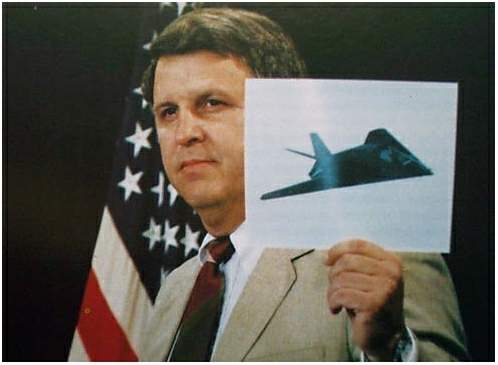
On November 10 1988, a heavily airbrushed photo was shown at a press briefing by Assistant Secretary of Defense for Public Affairs, J. Daniel Howard. Until that moment the subject of the photo had been one of the world’s most closely-held secrets.
The photograph was of the Lockheed F-117, the legendary ‘stealth fighter’.
It was a new and weird shape. Slightly preceding this, (in April 1988) the Northrop B-2 had also emerged from the Black world of secret defence projects. The B-2 ‘stealth bomber’ was a charcoal grey flying-wing, clearly designed by the same person who had created the Batmobile.
Stealth was big news. Until then, aeroplanes had been tubes with wings, designed primarily with air particles in mind, now they were shaped for their reaction with radio waves; things had suddenly changed. As an aeroplane-fixated ten-year-old, I was hungry for more information on this new world. With its secrecy, its potency and dramatic unveilings, it was wildly exciting.
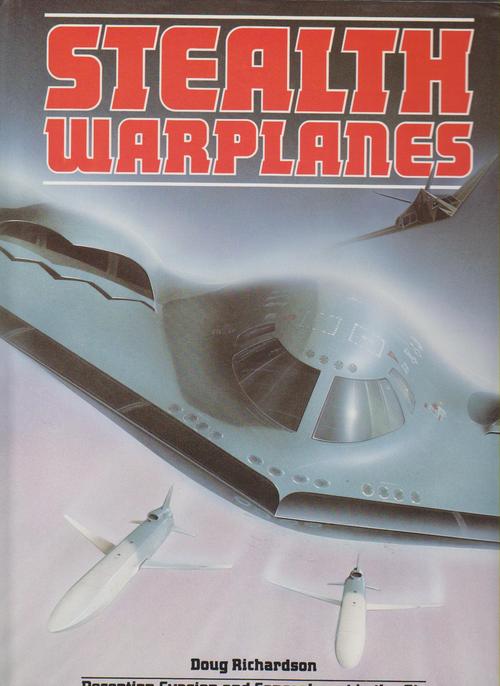
So I was very happy when I was bought a copy of Stealth Warplanes, a book by Doug Richardson. Â I believed that this book, with its thrilling cover, was my secret pass to the nefarious world of Stealth. I picked up another copy today, as I was curious to see how well this book had stood the test of 23 years.
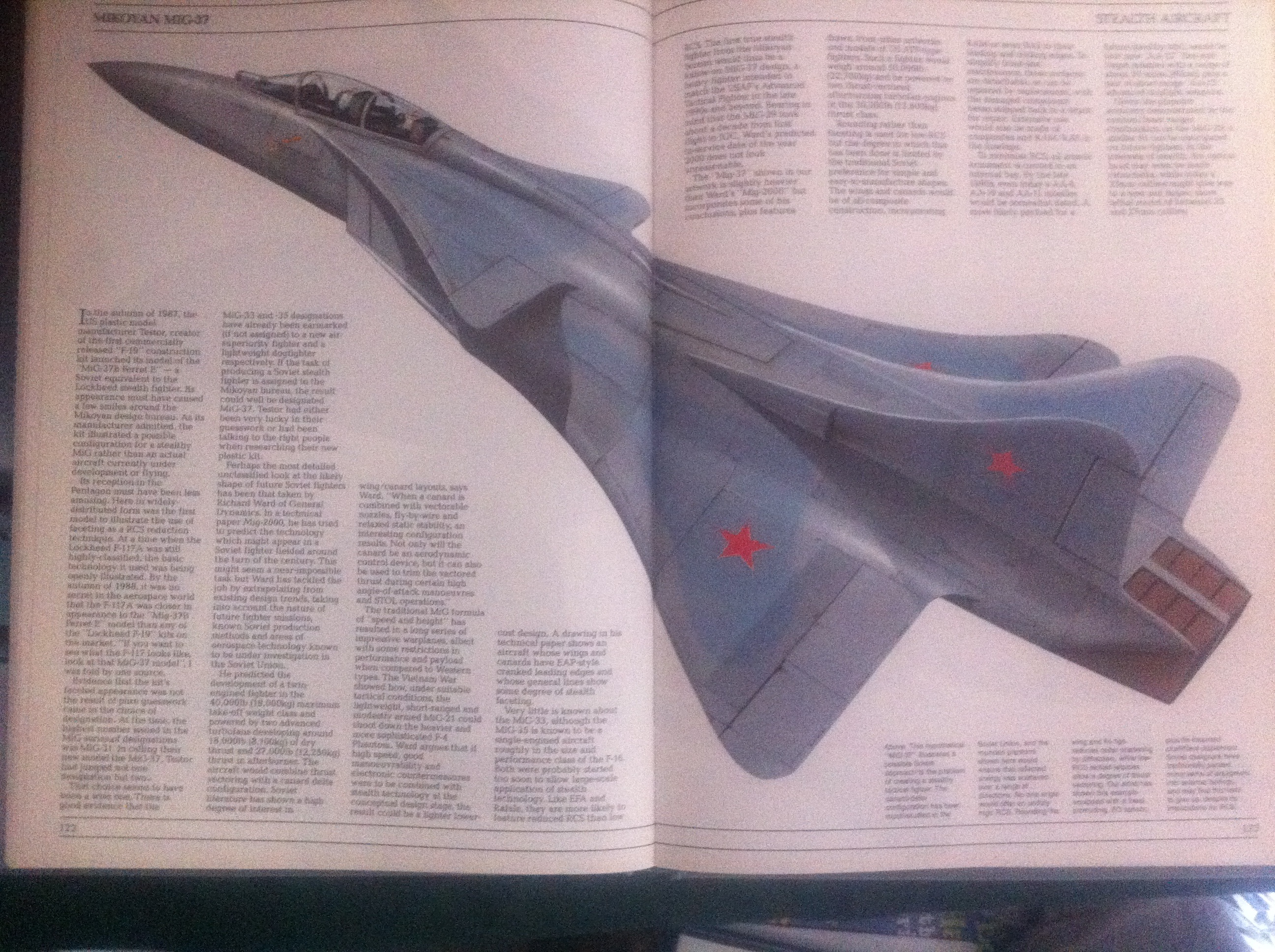
‘Mikoyan MiG-37’
Ward’s MiG-2000 featured inward canting fins. Another popular ’80s idea for stealth aircraft, possibly stemming from leaked information on Lockheed’s ‘Have Blue’.
Soviet developments could not be ignored by the book, despite the fact that at this time, nothing about Soviet stealth projects was known in the press. So the ‘Mikoyan MiG-37’ was pure conjecture, based on the pure ‘conjecture’ (more on this later) of the MiG-2000. The MiG-2000 was a notional threat aircraft devised by General Dynamics’ Richard Ward, of what a follow-up to the MiG-29 might look like. It was intended to give the international F-16 community an idea of what they may be up against in the year 2000. This was based on Ward’s observations of several technologies the Soviets appeared to be very interested in, most notably thrust vectoring and the canard-delta arrangement. At this time, it was rumoured that the MiG-35 was to be a single-engined aircraft in the F-16-class, though in retrospect it is more likely that this rumour related to the Izdeliye 33 (Izd 33) which would have probably been designated MiG-33 (and may have been a design influence on the JF-17).
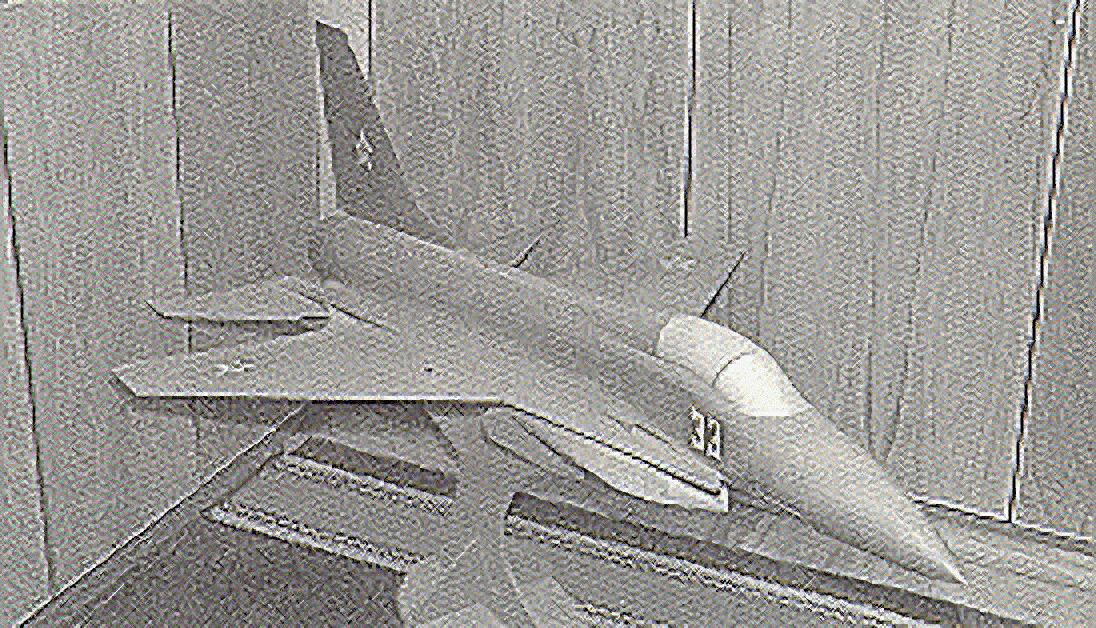
The Mikoyan Izdeliye 33 (Izd 33) LFI light fighter concept.
Regardless, it looked to many observers that MiG-37 seemed the most likely designation for the first Soviet stealth fighter. As the text points out:
“In the autumn of 1987, the US plastic model manufacturer Testors.. launched its model of the “MiG-37B Ferret Eâ€- a Soviet equivalent to the Lockheed stealth fighter. Its appearance must have caused a few smiles around the Mikoyan design bureau. As its manufacturer admitted.. Its reception in the Pentagon must have been less amusing. Here in widely-distributed form was the first model to widely illustrate the use of RCS reduction technique.†(more on Testor’s MiG-37 can be seen here). It seems that the concepts of a gridded intake and a surface made of flat panels was already there for those looking. And Testors’ model designer John Andrews certainly seemed to have his ear to the ground.
The ‘F-19’ was featured in the 1990 computer game ‘Operation Stealth ‘.
One of the fascinating features of this book was its strong belief in ‘round stealth’. Many of the hypothetical aeroplanes in this book feature rounded-off wingtips, noses and fin-tips of the hypothetical aircraft. Radar returns would be scattered from these curves:
“…the rounded planform (of the MiG-37) shown here would ensure that reflected energy was scattered over a range of directions.”
A 1982 Lockheed ATF concept that includes ’round stealth’.
In reality, this design idea was never used (albeit to a small degree on some cruise missiles), and it could be argued that the cultivation of this idea was the result of deliberate disinformation by several companies. Loral, Northrop and Lockheed (in several ATF artworks) may have been actively involved in this attempt to draw attention away from the F-117-facetingand B-2 flying wing approach. This idea can be seen on most ‘F-19s’ and is evident on this MiG-37.
 Of course complex curves are used in modern low observable designs, but this ‘round stealth’ is not like the two US schools of stealth that have emerged, the Lockheed approach (sharp angles and flat surfaces) and the Northrop approach (as flat as possible, and of the flying wing configuration for subsonic designs, as seen on the B-2, Lockheed Martin RQ-170, Dassault NeuroN etc). When Northrop and McDonnell Douglas designed the YF-23, they incorporated the ‘flat as a pancake’ Northrop approach.
Doug Richardson’s Mikoyan MIg-37
The notional MiG-37 is a tactical fighter that weighs around 50,000 lb and is powered by two 30,000 lb (in reheat) thrust class turbofans. It has two-dimensional vectored thrust provided by ‘slotted low-RCS nozzles’. It is a two-seater, with a canard delta planform and two canted out vertical fins. The concept emphasizes performance and reduced radar cross section.
Did history provide us with a real MiG-37 to compare it to? The simple answer is yes. The Mikoyan Project 1.44/1.42 was a technology demonstrator that first flew in 2000. It displayed some similarities to Richardson’s MiG-37.
MiG 1.44/1.42
It was a canard delta, it did have out twin canted tails. The thrust class was similar, though the real aircraft was even more powerful, with two Lyulka AL-41F turbofans rated at 176 kN (39,680 lb) in reheat. Weight was between 42-62,000 lb depending on fuel load, test equipment etc, so again- excellent guesswork. It certainly did not have rounded-off wingtips or tail-fins. The nozzles were not flat, despite the stealth advantages these could have conferred. The reason for the inclusion of round exhaust nozzles could have been one or more of the following-
1. 3D vectoring was envisioned, requiring a circular nozzle (perhaps extreme manoeuvrability was considered more important than minimum RCS) 2. Russian metallurgy was not good enough to make square nozzles which could withstand the high temperatures of a vectoring jet nozzle 3. The actual production version if made, would have featured 2D nozzles 4. They were not required or were not consider a suitable design feature
It was claimed that the aircraft would feature plasma stealth technology, an exotic idea that a General Electric employee had filed patents relating to in 1956. Little has been heard about plasma stealth since, though the fact that the later PAK FA is so carefully shaped suggests it is not a technology that was made to work satisfactorily. Problems in developing working plasma stealth include the generation of sufficient power to create the required plasma layer, and the operation of radar and radio in what amounts to a ‘radio blackout’. Talk of this technology may have been deliberate disinformation.
The MiG 1.44/1.42, a candidate for the Mnogofunksionalni Frontovoy Istrebitel (Multifunctional Frontline Fighter) programme was cancelled (though some contend that research from this effort found its way into the Chengdu J-20 project though there is no direct evidence of this). Sukhoi’s rival S-47 ‘Berkut’ took a radically different approach and adopted canards with forward swept wings, as can be seen from later developments this configuration appears to have been a design dead-end, at least for the time being.
As far as we know MiG’s current stealth efforts are devoted to developing a Northrop-style UCAV with Sukhoi (using experience gained on MiG’s cancelled ‘Skat’ UCAV).
The Russian stealth fighter in development today is the Sukhoi PAK FA. The design features with some smaller similarities with Richardson’s MiG-37. Both the ‘MiG-37’ and the PAK FA feature a IRST/laser ranger finder (à la MiG-29/Su-27)- something the Russians very much appreciate, and there seems relatively little effort to reduce this sensor’s radar cross section.
It appears the PAK FA is built with a more attention to ease of maintenance than the ‘hygienically’ smooth Raptor, which seems to favour absolute minimum radar return (but this is pure speculation). The PAK FA does not have a canards (a difficult feature to make stealthy, nevertheless featuring on the J-20), instead, it has an innovative kind of movable leading edge root extension (described by some as Povorotnaya Chast Naplyva or PChN). The Sukhoi approach to stealth includes elements seen in both the Northrop and LM schools, but seems to have less emphasis on achieving a minute RCS to the detriment of serviceability and aerodynamic efficiency.
The Sukhoi PAK FA is a large advanced stealth fighter now in development.
Richardson’s MiG-37 concept was, given the information available to him, an excellent piece of guesswork, and a pleasantly revealing insight into a ‘crossroads’ period of aviation history. It is also interesting that, on first impressions, the MiG-37 was a more accurate guess than Ward’s MiG-2000. However, there is more to the story than this, as Richard Ward was one of the most experienced figures in the design of stealth aircraft. General Dynamics had inherited a wealth of stealth research from Convair, from projects including the A-11 and Kingfish. Ward probably worked on the Model 100/Sneaky Pete and other A-12 precursors. As Bill Sweetman said to Hush-Kit: “He knew what to avoid with MiG-2000.”
The PAK-DA is a new stealth bomber project at a very early stage of development.
Thank you for reading Hush-Kit. Our site is absolutely free and we have no advertisements. If you’ve enjoyed an article you can donate here– it doesn’t have to be a large amount, every pound is gratefully received. If you can’t afford to donate anything then don’t worry.
At the moment our contributors do not receive any payment but we’re hoping to reward them for their fascinating stories in the future.
As a thank you….
Those who donate more than £50 may ask for a short article on a particular subject.
Those who donate more than £100 may ask for a long article on a particular subject.
Special thanks to the great Bill Sweetman for ironing out several of the facts in the original version of this. There are likely to be further amendments to this piece at a later date.
“If you have any interest in aviation, you’ll be surprised, entertained and fascinated by Hush-Kit – the world’s best aviation blogâ€. Rowland White, author of the best-selling ‘Vulcan 607’
NOW AVAILABLE: The Hush-Kit Book of Warplanes, a gorgeous heavily illustrated – and often irreverent- coffee-table book covering the history of aviation 1914 – the present.
From the cocaine, blood and flying scarves of World War One dogfighting to the dark arts of modern air combat, here is an enthralling ode to these brutally exciting killing machines.
The Hush-Kit Book of Warplanes is a beautifully designed, highly visual, collection of the best articles from the fascinating world of military aviation –hand-picked from the highly acclaimed Hush-kit online magazine (and mixed with a heavy punch of new exclusive material). It is packed with a feast of material, ranging from interviews with fighter pilots (including the English Electric Lightning, stealthy F-35B and Mach 3 MiG-25 ‘Foxbat’), to wicked satire, expert historical analysis, top 10s and all manner of things aeronautical, from the site described as:
“the thinking-man’s Top Gear… but for planes”.
The solid well-researched information about aeroplanes is brilliantly combined with an irreverent attitude and real insight into the dangerous romantic world of combat aircraft.