
Here are ten monstrous flying machines that had they voices would have probably rasped, “master, why did you create me?”

9. Bartini Beriev VVA-14 (1972) ‘Millenium Balkan’

Robert ‘Ludvigovich’ Bartini was an aristocratic Italian aircraft designer. The Italian Communist Party sent him to the USSR following the Fascist take-over of Italy. It was the intention of the ICP that he would bring modern Italian know-how to the Soviet aviation industry to aid its fight against fascism.

Being an aircraft designer was an extremely dangerous occupation in Stalin’s terror state, being a foreign aircraft designer even more perilous. In 1938 Bartini began an eight year prison sentence. Despite spending the Great Patriotic War imprisoned, he still did a huge amount of design work, notably on the Tu-2 bomber.

He became one of the most important Soviet aircraft designers, and survived to design the exceptionally unusual VVA-14, designed to counter the threat of Polaris missile submarines. This was a wing-in-ground-effect vehicle, a type of aircraft which sits on the recirculated air that forms beneath wings at extremely low altitudes. Capable of taking off from land or water, the vehicle could fly far faster than any boat at ultra low-level while carry large loads. It could also fly at higher altitudes as a true aeroplane.

In collaboration with the Beriev Design Bureau, Bartini planned to develop the prototype VVA-14 in three phases. The initial M1 was to be an aerodynamics and technology testbed. The M2 would have a battery of 12 Rybinsk RD-36-lift engines to give full VTOL capability, and was to be fitted with one of the world’s first fly-by-wire flight control systems. The M3 would integrate weapons (including depth charges, torpedos and anti-shipping missiles), the Burevestnik computerised anti-submarine warfare (ASW) system and the huge Bor-1 magnetic anomaly detector (MAD).


Bartini died in 1974 and with him the momentum that drove the project. Like all Ekranoplans, being neither fish nor fowl no one quite knew what to do it with it and the the VVA-14 never entered service.

8. THK-13 Flying Wing Glider ‘Turkish Spirit’

Not outright weird but definitely an unorthodox design for its time. From an unexpected country with little or no background in aircraft production, the THK-13 flying-wing glider deserves to be on this list.
Met with harsh criticism for its looks, the THK-13 glider was a product of Turk Hava Kurumu (THK – Turkish Air Association), the aviation bureau of the young Turkish Republic. THK was established in 1925, only two years after the foundation of the republic itself. THK quickly set up a production facility and trained a core engineering team. It created several aircraft and glider programmes from the THK-1 to the THK-16. Of these, the THK-5 twin engine light transport and THK-15 two-seat trainer were the most successful.

The THK-13 design work was started in 1943 by senior engineer Yavuz Kansu. The prototype made its maiden flight on 26 August 1948 in Ankara, and was towed into the air by a Focke-Wulf Fw 44. During take-off, the towing cable ripped off and the glider went out of control, resulting in an emergency landing in a nearby field. The pilot, Kadri Kavukcu, survived without a scratch — and the prototype was quickly repaired in the field. Several hours later, it made another ‘first flight’, again towed by the Fw 44. This time landing safely back at the THK airfield.
Upon the news of the crash, local media jumped on the opportunity to blame THK for designing such a ‘weird’ aeroplane, speculating that such an unlikely looking machine was sure to fail. The project was shelved until the next year. A flight on 29 September 1949 ended in a more severe crash, seriously wounding the pilot and sealing the fate on this extraordinary glider.
You can find more unusual flying machines here.Â

7. Mississippi State University XV-11 MARVEL ‘The Marvel Superfan’
Looking like it flew straight through a wind tunnel taking the fan with it, the first all-composite aircraft was the Mississippi State University XV-11 MARVEL. MARVEL is a backronym standing for ‘Mississippi Aerophysics Research Vehicle with Extended Latitude’. The aircraft was build to continue research for the military into boundary layer control, an effort that had been ongoing since the 1950s. Accordingly, the MARVEL employed a blower driven by the engine to draw suction through more than one million tiny holes in the wings and fuselage.  The aircraft also spurned conventional flaps in favour of wing warping to deflect the wing trailing edges. So far, so weird, but the good people of the Department of Astrophysics and Aerospace Engineering at the Mississippi State University weren’t stopping there and added a ‘Pantobase’ or ‘rollerboot’ undercarriage with tandem wheels fitted within two sprung wooden pontoons which were intended to allow operations from rough surfaces or water.
The ducted pusher propeller returned with little success in the Edgely Optica and RFB Fantrainer.Â

6. Tumonecotrans Bella 1, Russia (1994) ‘The Swamp Monster’

Our initial efforts revealed that Google video searches for ‘Trans Bella’, while distracting, are not helpful for researching rare Russian aircraft. What was useful however, was an ancient Russian website looking for investors in an utterly bizarre form of transportation.
The story starts in the Soviet Union in 1989. Alexander Filimonov wanted to build an aircraft that could operate from the Arctic regions, Siberia and the far east of Russia without airfields. According to the aforementioned (and extremely quaint) website “70% of aircraft maintenance costs in this region relate to airfields”.

On the other hand there are numerous natural flat airstrips in the form of lakes, rivers, marshes and fields. But even a rugged seaplane will struggle with marshes, and a helicopter or aeroplane needs special adaption (and a brave pilot) to operate from very thick snow or long grass. As the company’s website notes, “For example, the well-known Russian An-2 aircraft has three changeable takeoff and landing devices: wheel, ski and hydrofloat. The first two require runways.”


So how could an aircraft deliver cargo or people to such austere locations? Filimonov believed the answer was to combine the advantages of a ‘wing-in-ground’ effect ekranoplan with a conventional aeroplane. The result is a strange hybrid, with a horizontal ducted helicopter-like fan, a hovercraft-like ‘skirted donut’ – and pusher engines and wings. Here was a machine that could make very short take-off from extreme terrain, and do it in terrible weather conditions. Funding was never found for this extremely unusual project.

Sadly, this site will pause operations if it does not hit its funding targets. If you’ve enjoyed an article you can donate here.
5. Vought V-173/VF5U ‘Zimmers Skimmer’Â


In the 1930s, Charles H. Zimmerman advocated the ‘discoidal’ aircraft with its pancake-shaped fuselage acting as a lifting surface. Zimmerman had worked on NACA’s (later renamed NASA) early wind tunnels. Influenced by the circular designs of Cloyd Snoder, and the less ridiculously named Steven Nemeth and Richard Johnson, he took this concept a step further. He wanted to produce a circular VTOL aircraft capable of flights at unbeatable speeds and altitudes, and able to hover like a helicopter. This proved overly ambitious with contemporary technology, but earned Zimmerman a prestigious NACA award. 
Zimmerman believed that discoidal aircraft could be capable of near vertical take-off and landings. They also promised excellent manoeuvrability, high speed and great structural strength.
The concept, nicknamed the ‘Zimmer Skimmer’, was radical and unlikely-Â so Zimmerman set about demonstrating its veracity with a series of prototypes for both himself and the Vought company. The V-173 flew in 1942. Soon local residents were reporting UFOs, or they would have if the term existed (‘UFO’ was coined in 1953 by USAF). Nazi sympathiser and general douche Charles Lindbergh flew the type and found it handled extremely well, especially at low speed. Initial problems were centred more around the propulsion system, which used a complex geared system to route power to the propellers from the engine than the novel aerodynamic configuration.
Â
One propulsion failure led to a dramatic emergency landing on a beach. As the aircraft landed the pilot spotted two utterly bewildered bathers in the aircraft’s path. Full braking effect was applied, resulting in the aircraft somersaulting over on itself. Thanks to the aircraft’s immense strength both the pilot and aircraft emerged unscathed.

Before the V-173 had flown, Zimmerman was working on its weaponised successor, the the Vought XF5U ‘Flying Flapjack’ for the US Navy. Fast, agile, well armed (six 50 cals or four 20mm cannon) and with a tiny take-off run the aircraft was a tantalising prospect as a carrier fighter. The geared propulsion system again proved troublesome, as did repeated operation of piston-engines and very large propellers at very high angles of attack. Development dragged on, and the war ended.
By 1947 the XF5U-1 was finally ready to fly. But propellers were passé, Vought was busy moving to Dallas and the ‘Pancake’ had run out of luck. Unusually, the US Navy ordered the aircraft be reduced to scrap. Vought’s chief test pilot Boone Guyton had been looking forward to flying the aeroplane and was extremely upset by this wanton destruction. He tried to physically stop the wrecking crew, but failed. The wrecking ball took a long time to destroy the immensely tough airframe, but eventually succeeded.
After it was destroyed and sent to the scrapheap someone remembered that the gearbox contained $6000 ($71,713 in 2020 dollars) worth of silver. Staff and security personnel scoured the scrapheap but failed to find the missing silver. Eventually the local scrap dealer who had hauled the wreckage away was caught by the FBI trying to sell the silver. But as Vought had made the mistake, it was found that the dealer’s actions were completely legal. The dealer kept the silver, and Vought was forced to pay back the Navy.


4. Antonov An-14SH ‘Clodhopper’

The West believes the world should adapt to support its aeroplanes, whereas the Soviet Union believed the aeroplane should adapt to function in the world as it is.

The Antonov An-14 was a small tough short take-off and landing transport. It was intended to replace the hugely popular An-2 biplane, the only problem being that the An-2 was still doing its job very well and didn’t need replacing. Antonov gave up after only 332 units – which is small potatoes compared to the 18,000-plus An-2s. Perhaps as a punishment for lack of success, Antonov used the unlucky type for multiple experimental purposes. On January 22 1983, one aircraft took the sky with the indignity of a hovercraft undercarriage. This would have allowed the An-14Sh to have taken off or landed from any flat (or almost flat) surface from rivers to bumpy fields.  The huge drag and reduction in range and payload were unacceptable and the project did not carry only beyond the prototype stage though the idea may have influenced the later Bella 1.


If you’re a multimillionaire and you want a new private jet, you have many obvious if slightly unadventurous choices. Textron, Dassault, Bombardier, Gulfstream or Beechcraft will be happy to sell you a sleek, safe and refined jet that will perfectly fit any brief. If you’re feeling a bit quirky, you might even take a look at Pilatus and their PC-12, or maybe the stiletto-inspired HondaJet.

But if you’re not just a run of the mill multimillionaire, you’ll want a jet which will stand out on the apron when you fly into Samedan for a spot of snow polo. In that case, there’s only really one choice. The wonderfully weird Piaggio Avanti P.180.


Ok, from some angles it’s a bit carp-like, but most of the time the Avanti gives off strong Thunderbirds-meets-Flight of the Navigator vibes. The fact that the turboprop engine and its propellers point backwards, the third, anhedral lifting surface at the front, the wing shaped fuselage, the T-tail and massive delta fin strakes, the scimitar shaped blades in the latest EVO version… it all adds up to something a child of the 60s would have imagined we’d all be flying around in today. Jeff Tracy would have definitely flown in an Avanti to get to and from Tracy Island.

Perhaps it’s not surprising that the Avanti is so different, because Piaggio has a history of making decisions against the grain. First, there was the P.2, an aerodynamically clean monocoque, low wing monoplane which flew in 1923, when most other manufacturers were busy bracing the wings of their biplanes with wires. But Piaggio’s place in the heritage of weird planes is assured by the P.7, an amphibian racer built to compete in the famous 1929 Schneider Cup Race, which forced designers and manufacturers to make ever more low drag designs and liquid-cooled engines, inspiring the Spitfire and the P-51 Mustang.

The P.7 had a streamlined and stunningly beautiful look, and to avoid the drag and weight of floats, it used hydrofoils to take off from the water. To make it “work”, the Italians came up with a very convoluted take-off procedure. To reach the speeds needed to attain lift on the hydrofoils, the P.7 had a water propeller at the back as well as an airscrew up front. Once the hydrofoils lifted the aircraft out of the water, a clutch would be engaged and switch the power to the front. It was an utterly mad idea and it never got airborne, but without that adventurous heritage which inspired the Avanti, the world of private aviation would be a lot more boring.
2. Avro Canada VZ-9 Avrocar ‘The Malton Saucer’ (1959)

Wobbling drunkenly into this house party of weirdos, our next guest is a two-
place, triple-jet, circular wing, VTOL concept demonstrator with a special take on aerodynamics. A secretive joint undertaking of the Canadian government, Avro Canada, the US Army and the USAF from the late 1950s the Avrocar was a mid- century effort to embrace a scientific principle called the Coanda effect. This is the Bernoulli-like business of deliberately bending a jet of air flowing over a curve to generate controllable lift. In other words, the Avrocar is the silver, convex-bodied aerospace equivalent of Theremin music.
Bench testing and wind tunnel findings aimed at further harnessing Coanda theory remained inconclusive in the mid-1950s after some interest in the 1930s and 1940s. Everything from flying jeeps mounting recoilless rifles to big supersonic NORAD interceptors were briefly envisioned using this handy principle and a circular wing.

This being that gilded era of fabulous prototypes money was available to be thrown at a Coanda-based project, though not the CF-105 Arrow, apparently!
The result does look pretty cool to our jaded 2020 eyes, a throwback to shiny,
imagined futures long given up on. Unhappily, the gyroscopes of the day couldn’t regulate the Avrocar’s tendency to pitch and roll without constant pilot input. A t-tail and other modifications designed to further refine and direct airflow lent only minor improvements to controllability. Wheels were added in place of fixed circular moon lander style feet because the Avrocar couldn’t transition safely out of ground effect. It was only nominally safe in untethered flight at all and right away those two lovely plastic bubble canopies were replaced on the first example with racing car style roll bars at the cockpits. Luckily, the domes remained on the example sent to NASA’s Ames Research Center in California and which you can see at the National Museum of the United States Air Force.

The Coanda effect was never harnessed well enough here to eliminate the dinner plate hanging from a string effect visible in film footage of the Avrocar taken outside
Avro’s plant in Malton, Ontario. Helicopters, STOL aircraft, hovercraft and motor
vehicles were already doing more than the Avrocar ever would. Perhaps some day composite materials and digital flight controls will combine to unweird the circular ducted flow wing and truly unleash the Coanda? We can only hope.

– Stephen Caulfield
- British Rail Flying Saucer (1970)

British Rail, the much missed national rail service, couldn’t make a decent sandwich – but that didn’t stop them flirting with interplanetary nuclear fusion powered flying saucers. Simply squirt liquid fuel beneath the aircraft, ignite it with a series of lasers, create a nuclear fusion explosion and contain the highly radioactive explosion within a magnetic field. Then you can take 22 people to the moon (probably sustained on terrible sandwiches squeezed from toothbrush tubes). Unsurprisingly this radical patent was seen as a being rather too ambitious, but who knows, perhaps one day science will catch up with the imagination of Charles Osmond Frederick, a 1970s locomotive engineer.
You can find more unusual flying machines here.

We launch our new beautiful book!

“If you have any interest in aviation, you’ll be surprised, entertained and fascinated by Hush-Kit – the world’s best aviation blogâ€. Rowland White, author of the best-selling ‘Vulcan 607’
I’ve selected the richest juiciest cuts of Hush-Kit, added a huge slab of new unpublished material, and with Unbound, I want to create a beautiful coffee-table book. Here’s the book link .

I can do it with your help.

From the cocaine, blood and flying scarves of World War One dogfighting to the dark arts of modern air combat, here is an enthralling ode to these brutally exciting killing machines.
The Hush-Kit Book of Warplanes is a beautifully designed, highly visual, collection of the best articles from the fascinating world of military aviation –hand-picked from the highly acclaimed Hush-kit online magazine (and mixed with a heavy punch of new exclusive material). It is packed with a feast of material, ranging from interviews with fighter pilots (including the English Electric Lightning, stealthy F-35B and Mach 3 MiG-25 ‘Foxbat’), to wicked satire, expert historical analysis, top 10s and all manner of things aeronautical, from the site described as
“the thinking-man’s Top Gear… but for planesâ€.
The solid well-researched information about aeroplanes is brilliantly combined with an irreverent attitude and real insight into the dangerous romantic world of combat aircraft.
FEATURING
- Interviews with pilots of the F-14 Tomcat, Mirage, Typhoon, MiG-25, MiG-27, English Electric Lighting, Harrier, F-15, B-52 and many more.
- Engaging Top (and bottom) 10s including: Greatest fighter aircraft of World War II, Worst British aircraft, Worst Soviet aircraft and many more insanely specific ones.
- Expert analysis of weapons, tactics and technology.
- A look into art and culture’s love affair with the aeroplane.
- Bizarre moments in aviation history.
- Fascinating insights into exceptionally obscure warplanes.

The book will be a stunning object: an essential addition to the library of anyone with even a passing interest in the high-flying world of warplanes, and featuring first-rate photography and a wealth of new world-class illustrations.

Rewards levels include these packs of specially produced trump cards.


I’ve selected the richest juiciest cuts of Hush-Kit, added a huge slab of new unpublished material, and with Unbound, I want to create a beautiful coffee-table book. Here’s the link to pre-order your copy.

 By Bing Chandler. Bing Chandler is a former Lynx Observer and current Wildcat Air Safety Officer. If you want a
  This Top 10 concentrates on combat aircraft in a vague attempt to keep to an actual ten for once, hence the absence of aircraft like the S-3 Viking, Gannet, and Vigilante. In an attempt to address obvious criticism just outside the 10, and in no particular order, were the Corsair II – which only stayed in production a few years longer than the A-4 which it was supposed to replace; the Super Étendard – couldn’t do anything a Sea Harrier couldn’t and needed a catapult to get airborne; Grumman Panther – did get the first carrier jet-on-jet kill, but barely had the performance of a Sea Hawk despite getting the more powerful Tay derivative of the Nene jet engine.
10. Hawker Sea Fury
This Top 10 concentrates on combat aircraft in a vague attempt to keep to an actual ten for once, hence the absence of aircraft like the S-3 Viking, Gannet, and Vigilante. In an attempt to address obvious criticism just outside the 10, and in no particular order, were the Corsair II – which only stayed in production a few years longer than the A-4 which it was supposed to replace; the Super Étendard – couldn’t do anything a Sea Harrier couldn’t and needed a catapult to get airborne; Grumman Panther – did get the first carrier jet-on-jet kill, but barely had the performance of a Sea Hawk despite getting the more powerful Tay derivative of the Nene jet engine.
10. Hawker Sea Fury
 Arriving just too late to see combat in WW2 the Sea Fury represents the final evolution of piston-engine fighters alongside the Bearcat and the Sea Hornet. All three of which have broadly similar performance and weaponry. Unlike the latter two however, the Sea Fury saw combat from the deck of a carrier.
Taking over from the Seafire FR47s onboard Triumph (not on this list because they were so damaged by carrier landings that the squadron AEO would only allow them to fly under wartime regulations, grounding them once the ship left Korean waters) the Sea Furies of HMS Thesus were the first to conduct patrols over the Korean Peninsula in 1950. These would be maintained by aircraft from Ocean, Glory and the RAN’s Sydney for the rest of the conflict.
Perhaps most famous for 802 NAS’ Sub-Lt ‘Smoo’ Ellis shooting down a MiG-15 on 9 Aug there was also at least one other probable MiG kill by Lt ‘Toby’ Davis also of 802 NAS the following day. As well as their air-to-air ability the Sea Fury could carry two 1000lb bombs or a collection of 60lb rockets. The former soon becoming the weapon of choice when it was realised the Fury’s bubble canopy gave the pilot an advantage in the dive-bombing role compared to the Firefly. These were used to great effect conducting close-air-support for Commonwealth troops and strikes on enemy and tactical positions. The pilots could also direct naval gunfire support, a task not without its problems such as asking a ship to correct its fire by nine miles, or the USS Missouri almost shooting the spotter down. [1]
Arriving just too late to see combat in WW2 the Sea Fury represents the final evolution of piston-engine fighters alongside the Bearcat and the Sea Hornet. All three of which have broadly similar performance and weaponry. Unlike the latter two however, the Sea Fury saw combat from the deck of a carrier.
Taking over from the Seafire FR47s onboard Triumph (not on this list because they were so damaged by carrier landings that the squadron AEO would only allow them to fly under wartime regulations, grounding them once the ship left Korean waters) the Sea Furies of HMS Thesus were the first to conduct patrols over the Korean Peninsula in 1950. These would be maintained by aircraft from Ocean, Glory and the RAN’s Sydney for the rest of the conflict.
Perhaps most famous for 802 NAS’ Sub-Lt ‘Smoo’ Ellis shooting down a MiG-15 on 9 Aug there was also at least one other probable MiG kill by Lt ‘Toby’ Davis also of 802 NAS the following day. As well as their air-to-air ability the Sea Fury could carry two 1000lb bombs or a collection of 60lb rockets. The former soon becoming the weapon of choice when it was realised the Fury’s bubble canopy gave the pilot an advantage in the dive-bombing role compared to the Firefly. These were used to great effect conducting close-air-support for Commonwealth troops and strikes on enemy and tactical positions. The pilots could also direct naval gunfire support, a task not without its problems such as asking a ship to correct its fire by nine miles, or the USS Missouri almost shooting the spotter down. [1]
 Â ” …the greatest workhorse the Navy ever had. It was loved and trusted by those who flew it. A pilot who trusts his plane is a bold pilot. And bold pilots really do the job. “Â Â Adm. Tom Connolly
Another design that entered service too late for the war for which it was intended the Douglas Skyraider was a single seat piston-engined aircraft that shot down MiGs. There the similarity with the Sea Fury more or less ends as the A-1 was designed as a dive/torpedo bomber rather than a fighter. Intended to replace the Avenger and the Dauntless the XBT2D-1 Destroyer II first flew in March of 1945, by April the USN had placed an order for 548 and thankfully changed the name to the AD-1 Skyraider. Part of the success was due to Ed Heinemann’s design team’s emphasis on weight reduction and simplicity inspired by an information bulletin that showed for each 100lbs of weight saved take-off would be reduced by 8’, combat radius increased 22 miles, and rate of climb increased by 18’ per minute. In total the team saved 1800lbs enabling the Skyraider to carry 8000lbs of weaponry, in something of a worrying trend for the USN this included plans for one way trips with a nuclear weapon.
Thanks to its promise and relatively low-cost orders for the AD-1 were not cut back at the end of the Second World War and the first squadron was formed in December 1946. With the invasion of South Korea Skyraiders from Valley Forge were soon in action conducting ground attack and minelaying operations. The following year VA-195 and VC-35 onboard the Princeton were called upon to make an attack on the Hwacheon Dam. Despite little training in the use of torpedoes the necessary modifications were made to the aircraft to allow them to carry the weapons including disabling the airbrakes. On 1 May, in what to date was the last aerial torpedo attack on a surface target, eight Skyraiders attacked the dam successfully disabling the control gates and preventing Communist forces from controlling water levels.
Remaining in service until 1968 AD-1s were also active in Vietnam, where as well as attack, close air support, and rescue missions they shot down two MiG-17s. The Skyraider’s only other naval user was the Royal Navy who operated it in the AEW role.
Remarkably long lived for an aircraft that was designed at the dawn of the jet age the Skyraider is probably unique in being the only aircraft to have been developed into single, two, three, and four seat combat variants.
8. Hawker Sea HawkÂ
 ” …the greatest workhorse the Navy ever had. It was loved and trusted by those who flew it. A pilot who trusts his plane is a bold pilot. And bold pilots really do the job. “  Adm. Tom Connolly
Another design that entered service too late for the war for which it was intended the Douglas Skyraider was a single seat piston-engined aircraft that shot down MiGs. There the similarity with the Sea Fury more or less ends as the A-1 was designed as a dive/torpedo bomber rather than a fighter. Intended to replace the Avenger and the Dauntless the XBT2D-1 Destroyer II first flew in March of 1945, by April the USN had placed an order for 548 and thankfully changed the name to the AD-1 Skyraider. Part of the success was due to Ed Heinemann’s design team’s emphasis on weight reduction and simplicity inspired by an information bulletin that showed for each 100lbs of weight saved take-off would be reduced by 8’, combat radius increased 22 miles, and rate of climb increased by 18’ per minute. In total the team saved 1800lbs enabling the Skyraider to carry 8000lbs of weaponry, in something of a worrying trend for the USN this included plans for one way trips with a nuclear weapon.
Thanks to its promise and relatively low-cost orders for the AD-1 were not cut back at the end of the Second World War and the first squadron was formed in December 1946. With the invasion of South Korea Skyraiders from Valley Forge were soon in action conducting ground attack and minelaying operations. The following year VA-195 and VC-35 onboard the Princeton were called upon to make an attack on the Hwacheon Dam. Despite little training in the use of torpedoes the necessary modifications were made to the aircraft to allow them to carry the weapons including disabling the airbrakes. On 1 May, in what to date was the last aerial torpedo attack on a surface target, eight Skyraiders attacked the dam successfully disabling the control gates and preventing Communist forces from controlling water levels.
Remaining in service until 1968 AD-1s were also active in Vietnam, where as well as attack, close air support, and rescue missions they shot down two MiG-17s. The Skyraider’s only other naval user was the Royal Navy who operated it in the AEW role.
Remarkably long lived for an aircraft that was designed at the dawn of the jet age the Skyraider is probably unique in being the only aircraft to have been developed into single, two, three, and four seat combat variants.
8. Hawker Sea HawkÂ
 The Sea Hawk started as a private venture by Hawkers under the lead of Sydney Camm, also responsible for the Sea Fury. The initial concept being to replace the later’s Centaurus engine with a Rolls-Royce Nene turbojet. After what, it must be assumed, was a lot of development work the P.1040 emerged as a tapered wing jet with the intakes and bifurcated exhaust based in the wing roots. Despite a lack of interest (this is disputed by some) from the Admiralty and the Air Ministry Hawkers produced three prototypes, the first flying in September of 1947 (again there is some debate on the prototypes’ chronology). Following successful carrier trials, the Royal Navy ordered 151 with the first front line squadron, 806 NAS forming in 1953. Ironically after all that effort, Hawkers only built the first 35 Sea Hawk Mk1 before turning over their Kingston factory to producing its ultimate evolution the Hunter. Development and production were transferred to their subsidiary Armstrong Whitworth who went on to produce over 500 in 6 principle marks adding bombing and ground attack capabilities to the basic day fighter’s 4 x 20mm cannons.
 Arguably one of the most beautiful aircraft to take to the sky the Sea Hawk served with 13 front-line RN squadrons. In 1956 seven of these took part in the Suez conflict, with little air opposition they conducted bombing, strafing, and close air support missions. During one of these their strafing was accurate enough that the paratroopers they were supporting felt confident enough to advance while it was taking place. [2] Only two Sea Hawks were lost during the action, both pilots surviving, while a number of other aircraft recovered even with severe damage.
 By the end of 1960, the Sea Hawk had left front line service with the Royal Navy having also conducted operations in Aden from Bulwark in 1958. At the same time, it was entering service with what would be its final operator the Indian Navy. Operating from the Majestic class carrier INS Vikrant the Sea Hawks of 300 INAS, the White Tigers, took part in the 1971 Indo-Pakistani War which led to East Pakistan gaining its independence, becoming Bangladesh. Despite catapult problems the 18 aircraft of 300 INAS ranged across Bangladesh attacking air bases, ammunition dumps, and troop positions. Battle damage was repaired on board and all the aircraft remained serviceable during the ten days of operations.[3] Although formally leaving service in 1978 a Sea Hawk met the first three Sea Harriers for the Indian Navy over the Arabian Sea in 1983.
Also operational with the Royal Netherlands Navy until 1961 the Sea Hawk’s viceless handling, excellent visibility, and rugged construction make it one of the standout aircraft of the early cold war.
[2] Brian Cull. Wings Over Suez. London: Grub Street, 1996. 302
[3] Michael Doust. Sea Hawk From the Cockpit. Ringshall: Ad Hoc Publications, 2007. 60-61
7. Grumman F-14 Tomcat
By the end of 1960, the Sea Hawk had left front line service with the Royal Navy having also conducted operations in Aden from Bulwark in 1958. At the same time, it was entering service with what would be its final operator the Indian Navy. Operating from the Majestic class carrier INS Vikrant the Sea Hawks of 300 INAS, the White Tigers, took part in the 1971 Indo-Pakistani War which led to East Pakistan gaining its independence, becoming Bangladesh. Despite catapult problems the 18 aircraft of 300 INAS ranged across Bangladesh attacking air bases, ammunition dumps, and troop positions. Battle damage was repaired on board and all the aircraft remained serviceable during the ten days of operations.[3] Although formally leaving service in 1978 a Sea Hawk met the first three Sea Harriers for the Indian Navy over the Arabian Sea in 1983.
Also operational with the Royal Netherlands Navy until 1961 the Sea Hawk’s viceless handling, excellent visibility, and rugged construction make it one of the standout aircraft of the early cold war.
[2] Brian Cull. Wings Over Suez. London: Grub Street, 1996. 302
[3] Michael Doust. Sea Hawk From the Cockpit. Ringshall: Ad Hoc Publications, 2007. 60-61
7. Grumman F-14 Tomcat
 To some the F-14 is the ultimate naval fighter, and they might not be wrong. However, in terms of the Cold War it doesn’t quite make the top ranks. Entering service in 1972 with VF-124 the F-14A inherited the TF30 engines from the F-111. These were less than ideal for a fighter, rapid throttle movements, especially pulling the throttle to idle, could cause the engine to stall. Like in that film you’ll have seen, where due to the wide spacing of the engines a flat spin developed due to the asymmetric thrust. There were similar issues operating above 30,000’ which forced crews to operate lower than ideal reducing range and endurance.
 All these problems were solved, the range greatly increased, and take-off performance improved by the introduction of the F110 engine in the F-14B. These only started to enter service in 1987 though, four years before the end of the Cold War. By that point at least 24 Tomcats had been lost due to engine issues, around 28% of all losses. For variety one had also managed to shoot itself down with a Sparrow missile…
 Despite this the F-14A did manage to cover the withdrawal from Saigon on its maiden cruise, engaged two Libyan Su-22 in the 1981 Gulf of Sidra incident, and engaged two Libyan MiG-23s in the 1989 Gulf of Sidra incident. Which at least shows a degree of consistency on the part of the USN and the Libyan Air Force. They also covered the Invasion of Grenada and intercepted the Egypt Air 737 carrying the hijackers of the MS Achille Lauro, appearing alongside the aircraft at night while an EA-6B jammed radio communications. Oh and one shot down a USAF RF-4C during an exercise, which is taking inter-service rivalry a bit far.
The F-14A was the Cold War Tomcat, it wasn’t perfect, and the pilots flew the engines as much as they flew the aircraft, but it was still a capable fleet defender.
Despite this the F-14A did manage to cover the withdrawal from Saigon on its maiden cruise, engaged two Libyan Su-22 in the 1981 Gulf of Sidra incident, and engaged two Libyan MiG-23s in the 1989 Gulf of Sidra incident. Which at least shows a degree of consistency on the part of the USN and the Libyan Air Force. They also covered the Invasion of Grenada and intercepted the Egypt Air 737 carrying the hijackers of the MS Achille Lauro, appearing alongside the aircraft at night while an EA-6B jammed radio communications. Oh and one shot down a USAF RF-4C during an exercise, which is taking inter-service rivalry a bit far.
The F-14A was the Cold War Tomcat, it wasn’t perfect, and the pilots flew the engines as much as they flew the aircraft, but it was still a capable fleet defender.
 Following on from the success of the Skyraider Ed Heinemann and his team produced a proposal for its successor. The USN specified an aircraft of no more than 30,000lbs to meet their range criteria for carrying a 2000-lb ‘special’ (in that way that a nuclear bomb is ‘special’) weapon. Laughing in the face of such limitations the Douglas design was half the weight while still meeting the requirements. The ‘special’ weapon leading to the characteristic stalky undercarriage. One of the weight saving measures was restricting the wingspan to 27’ enabling them to fit down carrier lifts without folding, removing the need for hydraulic actuators and allowing 2000 litres of fuel to be carried in each wing.
 With the first operational squadron forming in 1956 two years later the Skyhawk was in action over the Lebanon. This and subsequent action in South East Asia led to improvements to the A-4s conventional weapons capabilities which expanded to carry a wide range of unguided and guided weaponry. At the same time max payload increased from 5,500lbs in the A-4A to 9195lbs in the A-4M.
 Although the USN retired the A-4 from front line service in 1976 they were still operating from US carriers until October of 1999 in the training role. The Royal Australian Navy operated them from 1967 embarking on HMAS Melbourne until it was retired in the early ‘80s, the A-4G being wired for Sidewinders to provide an air defence capability. This was something the USN had also done for operations from its smaller ASW Carriers. The Comando de la Aviación Naval Argentina received 16 A-4Cs in 1971, later replaced with A-4Qs, to operate from the ARA Veinticinco de Mayo, previously HNLMS Karel Doorman, previously HMS Venerable. However, due to issues with her catapult the majority of the Skyhawks missions were flown from shore, perhaps not surprising when using a third-hand carrier.
 The Skyhawk was a classic of Cold War naval aviation, proving its capability and perhaps uniquely for this list a new operator took it to sea almost a decade after the fall of the Berlin Wall. The Brazilian Navy taking delivery of 23 ex-Kuwaiti Air Force A-4KUs in 1998 and by 2001 these were operating from the carrier Minas Gerais.
5. Grumman A-6 IntruderÂ
The Skyhawk was a classic of Cold War naval aviation, proving its capability and perhaps uniquely for this list a new operator took it to sea almost a decade after the fall of the Berlin Wall. The Brazilian Navy taking delivery of 23 ex-Kuwaiti Air Force A-4KUs in 1998 and by 2001 these were operating from the carrier Minas Gerais.
5. Grumman A-6 IntruderÂ
 Following the Buccaneer into frontline service by around 18 months the first operational Intruder squadron VA-75 formed in November of 1963. The requirements that led to the Intruder were similar if slightly less ambitious than the British bombers, a two-man crew, radius of action of 300nm for close air support and 1000nm for long range interdiction, with a speed of 500knots. [4] Unlike the Buccaneer the Intruder also had a STOL requirement for USMC use during amphibious assaults, this led to the engine exhaust being deflected by 23° although ultimately this only featured on the first seven examples. It was however used during the types first flight the exhausts remaining vectored downwards throughout. After initial trials showed that the fuselage mounted airbrakes caused excessive turbulence over the tail plane when deployed they were moved to the wingtips giving the aircraft a distinctive appearance in the approach configuration. In a novel move to increase lift almost the entire trailing edge was used as flap with roll control being achieved through use of spoilers on the upper wing surface.
By 1965 VA-75 – The Sunday Punchers, were at war, using the advanced all-weather systems in the A-6 to strike targets at night, previously the North Vietnamese forces ally. Unfortunately, the systems were a bit too advanced and initially the aircraft suffered a 35% reliability rate. Improvements came with new radars and updates to the attack system known as DIANE. At the same time the USN undertook an effort to update all its mapping of North Vietnam, some of which was several miles out, to make sure the targets were where the Intruders’ systems thought they were.
Following the Buccaneer into frontline service by around 18 months the first operational Intruder squadron VA-75 formed in November of 1963. The requirements that led to the Intruder were similar if slightly less ambitious than the British bombers, a two-man crew, radius of action of 300nm for close air support and 1000nm for long range interdiction, with a speed of 500knots. [4] Unlike the Buccaneer the Intruder also had a STOL requirement for USMC use during amphibious assaults, this led to the engine exhaust being deflected by 23° although ultimately this only featured on the first seven examples. It was however used during the types first flight the exhausts remaining vectored downwards throughout. After initial trials showed that the fuselage mounted airbrakes caused excessive turbulence over the tail plane when deployed they were moved to the wingtips giving the aircraft a distinctive appearance in the approach configuration. In a novel move to increase lift almost the entire trailing edge was used as flap with roll control being achieved through use of spoilers on the upper wing surface.
By 1965 VA-75 – The Sunday Punchers, were at war, using the advanced all-weather systems in the A-6 to strike targets at night, previously the North Vietnamese forces ally. Unfortunately, the systems were a bit too advanced and initially the aircraft suffered a 35% reliability rate. Improvements came with new radars and updates to the attack system known as DIANE. At the same time the USN undertook an effort to update all its mapping of North Vietnam, some of which was several miles out, to make sure the targets were where the Intruders’ systems thought they were.
 The A-6 underwent a number of upgrades ultimately evolving into the A-6E with a sensor turret housing an infra-red camera and laser designator which were integrated with the avionics systems. After Vietnam, the Intruder took part in raids on Lebanon, Libya, Iranian shipping during the tanker wars, and as something of a swan song took part in the liberation of Kuwait in 1991.
 Britain’s aircraft manufactures have never had much success making carrier aircraft, or land ones if you look at the Supermarine Swift and Gloster Javelin. It’s something of a surprise then that a company that had previously produced such
  Demonstrating that the Admiralty could do asymmetric warfare if they put their minds to it the Buccaneer specification was drawn up in response to the emergence of the Soviet Navy’s Sverdlov cruisers. This called for an aircraft able to carry a variety of stores, including a 2,500kg Red Beard tactical nuclear bomb, the abortive Green Cheese anti-ship missile [5], or 4000lbs of conventional bombs, at speeds of at least 550kts at sea level, with a minimum radius of action of 400NM at low level. [6] For 1954 these were ambitious criteria, so much so that Percival Aircraft after asking to tender read the full requirements document and changed its mind. Fitting it into the limited dimensions of a British carrier called for novel solutions. While some aircraft had used high-pressure air from the engines blown over the flaps to improve take-off and landing performance the Buccaneer took the concept to the next level. Bleed air from the engines was ducted over the wings from just aft of the leading edge, the flaps, and the tail plane. This increased the coefficient of lift and the angle of attack at the stall allowing smaller wings and tail plane. In turn this gave a smoother ride at low level where a larger tail plane would have made the aircraft overly sensitive. For comparison with a 25% bigger wing at a weight of 33,000lb the Sea Vixen had an approach speed of 125kts to the Buccaneers 124kts. [Ref]
In something of a Blackburn tradition, the initial Buccaneer S1 was under-powered, on launching from a carrier the acceleration was around 1kt per second. Unusually plans to rectify this were in hand as the S1 entered service and the S2 fitted with the Spey was operational only three years later. This improved the acceleration after take-off to 7kt per second and let later Buccaneers leave the carrier with a full load of fuel rather than having to take some from a passing Scimitar.
Demonstrating that the Admiralty could do asymmetric warfare if they put their minds to it the Buccaneer specification was drawn up in response to the emergence of the Soviet Navy’s Sverdlov cruisers. This called for an aircraft able to carry a variety of stores, including a 2,500kg Red Beard tactical nuclear bomb, the abortive Green Cheese anti-ship missile [5], or 4000lbs of conventional bombs, at speeds of at least 550kts at sea level, with a minimum radius of action of 400NM at low level. [6] For 1954 these were ambitious criteria, so much so that Percival Aircraft after asking to tender read the full requirements document and changed its mind. Fitting it into the limited dimensions of a British carrier called for novel solutions. While some aircraft had used high-pressure air from the engines blown over the flaps to improve take-off and landing performance the Buccaneer took the concept to the next level. Bleed air from the engines was ducted over the wings from just aft of the leading edge, the flaps, and the tail plane. This increased the coefficient of lift and the angle of attack at the stall allowing smaller wings and tail plane. In turn this gave a smoother ride at low level where a larger tail plane would have made the aircraft overly sensitive. For comparison with a 25% bigger wing at a weight of 33,000lb the Sea Vixen had an approach speed of 125kts to the Buccaneers 124kts. [Ref]
In something of a Blackburn tradition, the initial Buccaneer S1 was under-powered, on launching from a carrier the acceleration was around 1kt per second. Unusually plans to rectify this were in hand as the S1 entered service and the S2 fitted with the Spey was operational only three years later. This improved the acceleration after take-off to 7kt per second and let later Buccaneers leave the carrier with a full load of fuel rather than having to take some from a passing Scimitar.
 The Buccaneer is also notable for being the first aircraft to have a head-up display, providing steering cues to the weapons release point as well as an indication of the distance to go and the air speed.
Having a relatively peaceful time in RN service its major actions were helping enforce the Beira patrol in support of sanctions against Rhodesia, bombing the stricken tanker Torrey Canyon off Lands’ End in an attempt to burn off the crude oil, and launching from Ark Royal in mid-Atlantic to conduct a show of force over Belize to deter a Guatemalan invasion. Which is the kind of thing someone should write a book about.
[5] This was ultimately cancelled in favour of just lobbing tactical nuclear bombs in the general direction of enemy shipping before Martel was invented and some sanity restored.
[6] Tony Butler. British Secret Projects – Jet Bombers since 1949. Hinckley: Midland Publishing. Chapter 5
[Ref] Flight International 14 Jan 1971. 55-59
3. Chance-Vought F-8 Crusader
The Buccaneer is also notable for being the first aircraft to have a head-up display, providing steering cues to the weapons release point as well as an indication of the distance to go and the air speed.
Having a relatively peaceful time in RN service its major actions were helping enforce the Beira patrol in support of sanctions against Rhodesia, bombing the stricken tanker Torrey Canyon off Lands’ End in an attempt to burn off the crude oil, and launching from Ark Royal in mid-Atlantic to conduct a show of force over Belize to deter a Guatemalan invasion. Which is the kind of thing someone should write a book about.
[5] This was ultimately cancelled in favour of just lobbing tactical nuclear bombs in the general direction of enemy shipping before Martel was invented and some sanity restored.
[6] Tony Butler. British Secret Projects – Jet Bombers since 1949. Hinckley: Midland Publishing. Chapter 5
[Ref] Flight International 14 Jan 1971. 55-59
3. Chance-Vought F-8 Crusader
 Attempting to prove anything the British could do the Americans could do better Vought produced two terrible jet powered fighters, the F6U Pirate and the F7U Cutlass. For professionals such as Supermarine this would have been considered a good warm up before producing something truly average like the Scimitar, Vought however fumbled the ball and produced the outstanding F8U Crusader instead.
Although powered by a Pratt & Whitney J57 like the F-100 Super Sabre the Crusader could fly further, faster, and higher while carrying more. To assist in getting the supersonic fighter onboard Vought used a variable incidence wing this allowed the pilot to maintain sight of the ship while flying slow enough to safely land. These were later modified to incorporate boundary layer control over the flaps, initially to allow the French Navy to land the Crusader on its smaller carriers by reducing the landing speed by 15kts.
Attempting to prove anything the British could do the Americans could do better Vought produced two terrible jet powered fighters, the F6U Pirate and the F7U Cutlass. For professionals such as Supermarine this would have been considered a good warm up before producing something truly average like the Scimitar, Vought however fumbled the ball and produced the outstanding F8U Crusader instead.
Although powered by a Pratt & Whitney J57 like the F-100 Super Sabre the Crusader could fly further, faster, and higher while carrying more. To assist in getting the supersonic fighter onboard Vought used a variable incidence wing this allowed the pilot to maintain sight of the ship while flying slow enough to safely land. These were later modified to incorporate boundary layer control over the flaps, initially to allow the French Navy to land the Crusader on its smaller carriers by reducing the landing speed by 15kts.
 The Crusader was active during the Vietnam War where it scored 19 air-to-air victories for 3 losses, the best ratio of any US aircraft. Armed with 4 x 20mm cannon it has frequently been called the last of the gunfighters, however it was upgraded through its life to carry an increasing range of stores allowing it to be used for ground attack missions as well as air defence. To provide the Essex Class carriers with an all-weather fighter from the F-8C onwards a new Magnavox radar was introduced with a larger dish. This allowed it to operate the AIM-9C, the only version of the Sidewinder to be radar guided giving it a head-on capability the IR version wouldn’t get until the AIM-9L in 1977. [Ref] However, being closely tied to the Crusader’s radar the 9C gave up the Sidewinders ability to be hung on nearly anything and didn’t equip any other type.
Entering service in 1957 the Crusader served with the USN as a fighter for 20 years and remarkably was only retired by the Aéronavale in 1999 after 35 years of service.
[Ref] Ron Westrum. Sidewinder, Creative Missile Development at China Lake. Annapolis: Naval Institute Press. Chapter 14
2. BAe Sea HarrierÂ
The Crusader was active during the Vietnam War where it scored 19 air-to-air victories for 3 losses, the best ratio of any US aircraft. Armed with 4 x 20mm cannon it has frequently been called the last of the gunfighters, however it was upgraded through its life to carry an increasing range of stores allowing it to be used for ground attack missions as well as air defence. To provide the Essex Class carriers with an all-weather fighter from the F-8C onwards a new Magnavox radar was introduced with a larger dish. This allowed it to operate the AIM-9C, the only version of the Sidewinder to be radar guided giving it a head-on capability the IR version wouldn’t get until the AIM-9L in 1977. [Ref] However, being closely tied to the Crusader’s radar the 9C gave up the Sidewinders ability to be hung on nearly anything and didn’t equip any other type.
Entering service in 1957 the Crusader served with the USN as a fighter for 20 years and remarkably was only retired by the Aéronavale in 1999 after 35 years of service.
[Ref] Ron Westrum. Sidewinder, Creative Missile Development at China Lake. Annapolis: Naval Institute Press. Chapter 14
2. BAe Sea HarrierÂ
 Books could, and have, been written on the inter-service shenanigans that led to the Royal Navy acquiring the Sea Harrier. Suffice to say with the writing clearly on the wall for its conventional carriers the emergence of the Harrier in the late ‘60s offered a potential solution to the task of maintaining air cover over the fleet without relying on shore based aircraft. The FRS1 essentially added a radar and a navigation system that could be aligned at sea to the basic Harrier GR3 airframe. It also removed as much magnesium as possible from the structure due to its tendency to fizzle in the presence of water.
Intended to ‘Hack the Shad’ by taking out Bear reconnaissance aircraft of Soviet Naval Aviation forces the Sea Harrier was initially armed with 30-mm cannons and 2 x Sidewinders. Alternatively, dumb bombs or rocket pods could be carried. Justifying the S in FRS1 it could also carry a WE177 nuclear bomb, while a Vinten F.95 camera took care of the R. First flight was in mid-1978 and in a move that would shock the F-35 development team one training and two operational squadrons, 899, 800, and 801 respectively, were formed at Yeovilton by February 1981.
Books could, and have, been written on the inter-service shenanigans that led to the Royal Navy acquiring the Sea Harrier. Suffice to say with the writing clearly on the wall for its conventional carriers the emergence of the Harrier in the late ‘60s offered a potential solution to the task of maintaining air cover over the fleet without relying on shore based aircraft. The FRS1 essentially added a radar and a navigation system that could be aligned at sea to the basic Harrier GR3 airframe. It also removed as much magnesium as possible from the structure due to its tendency to fizzle in the presence of water.
Intended to ‘Hack the Shad’ by taking out Bear reconnaissance aircraft of Soviet Naval Aviation forces the Sea Harrier was initially armed with 30-mm cannons and 2 x Sidewinders. Alternatively, dumb bombs or rocket pods could be carried. Justifying the S in FRS1 it could also carry a WE177 nuclear bomb, while a Vinten F.95 camera took care of the R. First flight was in mid-1978 and in a move that would shock the F-35 development team one training and two operational squadrons, 899, 800, and 801 respectively, were formed at Yeovilton by February 1981.


 In July 1959 the Royal Navy formed its first Sea Vixen squadron, an all-weather two-seat twin-engined carrier fighter that could just about break the sound barrier downhill. Rather un-sportingly 18 months later the USN formed its first F-4 Phantom squadron which could go twice as fast, carrying twice as many air-to-air missiles, while also hauling a selection of air-to-ground weaponry. It’s as if the Admiralty and British industry had had a total lack of imagination, although requiring the Sea Vixen to be able to conduct a free (catapult-less) take-off from the deck suggests they may have been smoking something.
 First flying in 1958, the same year as the Buccaneer, the Phantom used boundary layer control almost as much as the British aircraft*. Both aircraft also featured ailerons that drooped compensating for relatively small flaps in the take-off and landing configuration.
Originally designed as an all-weather fleet defence interceptor the Phantom was seemingly capable of almost any role, being able to carry 16,000lbs of pretty much anything in the US or NATO inventory. In the case of the RF-4B it also carried out photoreconnaissance for the USMC from afloat and ashore. It was one of the first carrier aircraft to have an automatic landing capability, first trialled on 12 converted F-4Bs. They had been fitted with a system allowing them to be controlled by AWACs or surface ships to conduct interceptions, resulting in a change of designation to F-4G (a decade before the USAF F-4G). By using a retractable radar reflector in front of the nose gear the aircraft carrier could use the system to control the aircraft on approach to the deck. Although the interception capability never saw widespread use the deck landing capability was retrofitted to standard F-4Bs.
First flying in 1958, the same year as the Buccaneer, the Phantom used boundary layer control almost as much as the British aircraft*. Both aircraft also featured ailerons that drooped compensating for relatively small flaps in the take-off and landing configuration.
Originally designed as an all-weather fleet defence interceptor the Phantom was seemingly capable of almost any role, being able to carry 16,000lbs of pretty much anything in the US or NATO inventory. In the case of the RF-4B it also carried out photoreconnaissance for the USMC from afloat and ashore. It was one of the first carrier aircraft to have an automatic landing capability, first trialled on 12 converted F-4Bs. They had been fitted with a system allowing them to be controlled by AWACs or surface ships to conduct interceptions, resulting in a change of designation to F-4G (a decade before the USAF F-4G). By using a retractable radar reflector in front of the nose gear the aircraft carrier could use the system to control the aircraft on approach to the deck. Although the interception capability never saw widespread use the deck landing capability was retrofitted to standard F-4Bs.
 Like the Intruder the Phantom saw its combat debut in Vietnam where it operated in the fighter and bomber roles. Unlike the Intruder it would also see service with the Royal Navy in a modified form, the J79 turbojets being replaced with Spey turbofans. Famously despite increasing the available thrust this reduced the top speed by around 0.2 Mach due to the drag from the larger intakes. They did however make the UK’s Phantoms the fastest accelerating up to around 400knots. They were also briefly considered for the USN as the F-4L for operations off the smaller Essex class carriers. However, a lack of commonality with the other US models and the potential threat to the Nimitz-class programme ended the idea.
 The Phantom remained in frontline service with the USN until 18 October 1986 when the type made its last carrier landing almost exactly 25 years after the first front-line squadron became carrier qualified. This period was the peak of the Cold War and throughout the F-4 proved a carrier aircraft could equal the best of any Air Force, if only because most of them ended up buying it.
 From the cocaine, blood and flying scarves of World War One dogfighting to the dark arts of modern air combat, here is an enthralling ode to these brutally exciting killing machines.
The Hush-Kit Book of Warplanes is a beautifully designed, highly visual, collection of the best articles from the fascinating world of military aviation –hand-picked from the highly acclaimed Hush-kit online magazine (and mixed with a heavy punch of new exclusive material). It is packed with a feast of material, ranging from interviews with fighter pilots (including the English Electric Lightning, stealthy F-35B and Mach 3 MiG-25 ‘Foxbat’), to wicked satire, expert historical analysis, top 10s and all manner of things aeronautical, from the site described as
“the thinking-man’s Top Gear… but for planesâ€.
The solid well-researched information about aeroplanes is brilliantly combined with an irreverent attitude and real insight into the dangerous romantic world of combat aircraft.
FEATURING
From the cocaine, blood and flying scarves of World War One dogfighting to the dark arts of modern air combat, here is an enthralling ode to these brutally exciting killing machines.
The Hush-Kit Book of Warplanes is a beautifully designed, highly visual, collection of the best articles from the fascinating world of military aviation –hand-picked from the highly acclaimed Hush-kit online magazine (and mixed with a heavy punch of new exclusive material). It is packed with a feast of material, ranging from interviews with fighter pilots (including the English Electric Lightning, stealthy F-35B and Mach 3 MiG-25 ‘Foxbat’), to wicked satire, expert historical analysis, top 10s and all manner of things aeronautical, from the site described as
“the thinking-man’s Top Gear… but for planesâ€.
The solid well-researched information about aeroplanes is brilliantly combined with an irreverent attitude and real insight into the dangerous romantic world of combat aircraft.
FEATURING


 It’s little wonder that the Gloster Gladiator – a warrior, a fighter, often to the last breath – fared better in the public imagination than the Gloster Gamecock.


 The Sea Harrier was a tiny, slow and lightly-armed curiosity at the time it entered service in 1978. But when pitted against the mighty no-compromise F-15 Eagle, the most respected combat aircraft in the world, it delivered an expected shock. We spoke to Commander ‘Sharkey’ Ward, who successfully took the Sea Harrier to war in 1982, to find out more.
How well did the Sea Harrier perform against the F-15 in DACT?
“Dissimilar Air Combat Training must be viewed as the bread and butter of the frontline fighter world.
Support Hush-Kit with our high quality aviation themed merchandise
The Sea Harrier was a tiny, slow and lightly-armed curiosity at the time it entered service in 1978. But when pitted against the mighty no-compromise F-15 Eagle, the most respected combat aircraft in the world, it delivered an expected shock. We spoke to Commander ‘Sharkey’ Ward, who successfully took the Sea Harrier to war in 1982, to find out more.
How well did the Sea Harrier perform against the F-15 in DACT?
“Dissimilar Air Combat Training must be viewed as the bread and butter of the frontline fighter world.
Support Hush-Kit with our high quality aviation themed merchandise  In late 1979, the Sea Harrier was the new boy on the block and fighter pilots everywhere were keen to know how capable it was going to be in combat. This led to the USAF F-5E Aggressor Squadron at Alconbury inviting my Trials Unit to visit them for an air combat program of mutual learning and evaluation. The results of the detachment spread rapidly through the fighter world. We came away having recorded 26 kills ‘for’ and just 10 ‘against’.
In very quick time, the boss of the fabled F-15 Eagle Squadron at Bitburg in Germany called me up and asked to come and visit us with two of his superb aircraft for more fighter combat evaluation. My first book provides full details of these two DACT detachments. Against the F-15, Ian Mortimer and I recorded seven kills ‘for’ and just one ‘against’.
In late 1979, the Sea Harrier was the new boy on the block and fighter pilots everywhere were keen to know how capable it was going to be in combat. This led to the USAF F-5E Aggressor Squadron at Alconbury inviting my Trials Unit to visit them for an air combat program of mutual learning and evaluation. The results of the detachment spread rapidly through the fighter world. We came away having recorded 26 kills ‘for’ and just 10 ‘against’.
In very quick time, the boss of the fabled F-15 Eagle Squadron at Bitburg in Germany called me up and asked to come and visit us with two of his superb aircraft for more fighter combat evaluation. My first book provides full details of these two DACT detachments. Against the F-15, Ian Mortimer and I recorded seven kills ‘for’ and just one ‘against’.
 Detractors might have called this a flash in the pan. But they would be wrong. In December 1981, I took my new squadron, 801, to the Air Combat Manoeuvring Installation at Decimomannu, Cagliari on the Italian Island of Sardinia to fight once more against the Aggressors and the Bitburg Eagles. It was a privilege to share the skies with them once more and benefit from their expertise.
We had flown our Sea Harriers down across France from the UK to participate in tri-national fighter combat training against the best of the US and Italian Air Forces. It was a terrific training opportunity – even though the Italian pilots never turned up in the air to fight (but they did wear flashy flying suits).
For 801 Squadron, the unique attraction of the detachment was the state-of-the-art range in which combat was to be conducted: an Air Combat Manoeuvring Installation (ACMI). Each aircraft carried a special telemetry pod that was monitored and recorded in real time by a ring of sensor stations encircling the combat area, which was over the sea. The pod transmitted accurate information about each aircraft’s relative position, heading, speed, attitude, angle of attack, ‘g’ and height. This information was collated by powerful computers on the ground and resulted in a complete three-dimensional recording of each combat which could be displayed on a large screen in the debriefing room – with freeze and replay options instantly available – just like a videogame. The real time view from each cockpit was available on demand and very realistic. The simulated release of missiles and the firing of guns was measured precisely to establish whether a ‘kill’ had been achieved, i.e. within range, missile acquired, gun tracking on target, etc. Spurious claims of ‘kills’ would be summarily discounted and disputed claims of combat success could be fairly and accurately adjudicated. In other words, one could not cheat and ‘win the fight in the debrief rather than in the air’.
Detractors might have called this a flash in the pan. But they would be wrong. In December 1981, I took my new squadron, 801, to the Air Combat Manoeuvring Installation at Decimomannu, Cagliari on the Italian Island of Sardinia to fight once more against the Aggressors and the Bitburg Eagles. It was a privilege to share the skies with them once more and benefit from their expertise.
We had flown our Sea Harriers down across France from the UK to participate in tri-national fighter combat training against the best of the US and Italian Air Forces. It was a terrific training opportunity – even though the Italian pilots never turned up in the air to fight (but they did wear flashy flying suits).
For 801 Squadron, the unique attraction of the detachment was the state-of-the-art range in which combat was to be conducted: an Air Combat Manoeuvring Installation (ACMI). Each aircraft carried a special telemetry pod that was monitored and recorded in real time by a ring of sensor stations encircling the combat area, which was over the sea. The pod transmitted accurate information about each aircraft’s relative position, heading, speed, attitude, angle of attack, ‘g’ and height. This information was collated by powerful computers on the ground and resulted in a complete three-dimensional recording of each combat which could be displayed on a large screen in the debriefing room – with freeze and replay options instantly available – just like a videogame. The real time view from each cockpit was available on demand and very realistic. The simulated release of missiles and the firing of guns was measured precisely to establish whether a ‘kill’ had been achieved, i.e. within range, missile acquired, gun tracking on target, etc. Spurious claims of ‘kills’ would be summarily discounted and disputed claims of combat success could be fairly and accurately adjudicated. In other words, one could not cheat and ‘win the fight in the debrief rather than in the air’.
 Critically, and during each sortie debrief, a pilot could see his tactical aircraft-handling mistakes at any part of the combat and could learn from them as they were pointed out by experienced Instructors. I was fortunate to be one of those – a fully qualified Air Warfare Instructor (AWI) trained by the élite aircrew of 764 Naval Air Squadron at Naval Air Station Lossiemouth, Scotland.
After getting used to the Decimomannu range facilities with private squadron sorties, the real business began against the F-15’s and the F-5E’s. Our little Sea Harrier jump jet more than held its own against these two superb fighter aircraft which could fly faster and turn much tighter. To the uninitiated, this should have meant a one-sided contest that we would always lose. But not so.
Critically, and during each sortie debrief, a pilot could see his tactical aircraft-handling mistakes at any part of the combat and could learn from them as they were pointed out by experienced Instructors. I was fortunate to be one of those – a fully qualified Air Warfare Instructor (AWI) trained by the élite aircrew of 764 Naval Air Squadron at Naval Air Station Lossiemouth, Scotland.
After getting used to the Decimomannu range facilities with private squadron sorties, the real business began against the F-15’s and the F-5E’s. Our little Sea Harrier jump jet more than held its own against these two superb fighter aircraft which could fly faster and turn much tighter. To the uninitiated, this should have meant a one-sided contest that we would always lose. But not so.
 All my squadron pilots approached the air combat detachment with a high level of confidence. Our earlier successes against the F-5E’s and the F-15’s had not been forgotten by our opponents. They treated us with a great deal of respect on the ground and, importantly, in the air. This proved to be to our considerable advantage. The real time recording of every engagement ensured that what had happened in the air was properly and correctly recognised afterwards in the debrief.
 In one brief skirmish with the pair of F-15’s, Desmond had guided me in to intercept them from their left-hand side. They were in relatively close attack formation and didn’t see me until I was racing in on their beam at 600 knots. They were less than a mile away crossing right to left at about 450 knots when they saw me and decided to take evasive action. Because of the need to conserve fuel they could only use reheat/afterburner and their supersonic capability when engaged in actual combat manoeuvring. But instead of breaking hard towards me and splitting up to give me two targets to cope with, which is what I expected, they decided to try to outrun me and deny me a missile shot. Applying full reheat, they both tried to run but it was too late. As I turned hard-left close behind them, I simulated the release of two Sidewinders at very short range. “Fox Two. Fox Two! Splash two F-15’sâ€. Why they chose to run rather than fight is still beyond me. Probably it was a result of our earlier close-in engagements.
 During that electrifying combat sortie I claimed a total of seven kills – a mixture of Eagles and Freedom Fighters – with no kills against me. Back on the ground and when we reviewed each combat on the screen in the debrief, my claims were fully justified. This was too much for one of the F-15 pilots who tried to say it was all wrong. But the Aggressor pilots, bless their honesty, told him he had been well beaten and should take it like a professional – as they did themselves.
 My two young first-tour pilots Charlie Cantan and Steve Thomas made remarkable progress during the detachment, understanding at last the tactical lessons that we had been trying to teach them verbally but without access to such digital technology. In fully developed fighter combat, a fraction of a second delay in decision-making is all it takes to make the difference between winning and losing your life. There are many nuances to this process of tactical thought. Anticipation, experience and knowing your adversary’s capabilities, intent and future position can only be properly acquired in the air. This learning process usually takes a lot of time. As a result during training at our home base, I had been able to ‘shoot down’ Charlie and/or Steve within a minute of commencing combat. Following the ‘Deci’ detachment those days were now over – the penny had dropped and it took rather longer for me to achieve the same result.
Our successes had rocked the fighter world. We had built a reputation that was to have a major impact on the conduct of the Air War in the Falklands just a few months later.”
My two young first-tour pilots Charlie Cantan and Steve Thomas made remarkable progress during the detachment, understanding at last the tactical lessons that we had been trying to teach them verbally but without access to such digital technology. In fully developed fighter combat, a fraction of a second delay in decision-making is all it takes to make the difference between winning and losing your life. There are many nuances to this process of tactical thought. Anticipation, experience and knowing your adversary’s capabilities, intent and future position can only be properly acquired in the air. This learning process usually takes a lot of time. As a result during training at our home base, I had been able to ‘shoot down’ Charlie and/or Steve within a minute of commencing combat. Following the ‘Deci’ detachment those days were now over – the penny had dropped and it took rather longer for me to achieve the same result.
Our successes had rocked the fighter world. We had built a reputation that was to have a major impact on the conduct of the Air War in the Falklands just a few months later.”


 The McDonnell RF-4C ruled the tactical reconnaissance skies for the U.S. Air Force from 1964 through the early 1990s. The aircraft’s main job was the first step of John Boyd’s famous OODA loop—observe, orient, decide, act, repeat. After all, you can’t even get started without observing. And before remotely piloted vehicles came on the scene, the best way to get near-instantaneous information over a specific target was to send in manned tactical reconnaissance aircraft.
Designed to overcome shortcomings of the RF-101, rather than just hang a bunch of cameras on an existing F-4 models, engineers went back to the drawing board and lengthened the existing F-4 nose to fit in sophisticated sensors: film and infrared cameras, along with an advanced side-looking radar. The longer-nosed variant also became the basis for the F-4E model.
The YRF-4C prototype first flew on August 9, 1963 and the first production aircraft flew May 18, 1964, followed shortly after by deliveries to Shaw Air Force Base, South Carolina. Although a weapon systems operator (WSO) later flew in the rear cockpit, the USAF initially used two pilots, funneling an inexperienced pilot into the rear cockpit as a Pilot Systems Operator, abbreviated as PSO and pronounced ‘pay-so.’ After initial training, pilots moved to the first operational squadron to fly the RF-4C, the 16th Tactical Reconnaissance Squadron (TRS), also at Shaw. On October 27, 1965, 16th TRS pilots ferried nine aircraft to Vietnam, landing at Tan Son Nhut Air Base near Saigon on October 31. RF-4Cs later arrived at Udorn Royal Thai AFB in Thailand.
The McDonnell RF-4C ruled the tactical reconnaissance skies for the U.S. Air Force from 1964 through the early 1990s. The aircraft’s main job was the first step of John Boyd’s famous OODA loop—observe, orient, decide, act, repeat. After all, you can’t even get started without observing. And before remotely piloted vehicles came on the scene, the best way to get near-instantaneous information over a specific target was to send in manned tactical reconnaissance aircraft.
Designed to overcome shortcomings of the RF-101, rather than just hang a bunch of cameras on an existing F-4 models, engineers went back to the drawing board and lengthened the existing F-4 nose to fit in sophisticated sensors: film and infrared cameras, along with an advanced side-looking radar. The longer-nosed variant also became the basis for the F-4E model.
The YRF-4C prototype first flew on August 9, 1963 and the first production aircraft flew May 18, 1964, followed shortly after by deliveries to Shaw Air Force Base, South Carolina. Although a weapon systems operator (WSO) later flew in the rear cockpit, the USAF initially used two pilots, funneling an inexperienced pilot into the rear cockpit as a Pilot Systems Operator, abbreviated as PSO and pronounced ‘pay-so.’ After initial training, pilots moved to the first operational squadron to fly the RF-4C, the 16th Tactical Reconnaissance Squadron (TRS), also at Shaw. On October 27, 1965, 16th TRS pilots ferried nine aircraft to Vietnam, landing at Tan Son Nhut Air Base near Saigon on October 31. RF-4Cs later arrived at Udorn Royal Thai AFB in Thailand.
 A typical reconnaissance mission in Vietnam might include taking pictures of trucks destroyed along the Ho Chi Minh Trail. Enemy gunners on the ground often waited for the RF-4C crews as they neared a target and crews quickly developed deceptive manoeuvres to counter the gunners. Pilots climbed to a high altitude after takeoff, but nearing a target, they descended to 3,500 feet to both give them good photo coverage and keep them above 50-caliber machine gun range. About three miles from the target, the front-seat pilot yanked into a 75-degree bank turn and then rolled out, held it for 15 seconds, then did another rapid turn and roll out, and then turned on the radar for one second to make the North Vietnamese think the aircraft was headed someplace else. The whole sky still filled with bullets, but the maneuvering largely kept aircraft from harm.
 Recce crews also discovered that the RF-4C was surprisingly speedy and could outrun many threats. Designers had expected the new airframe to have more drag than the earlier models, but the opposite was true. However, crews often couldn’t take full advantage of that speed over North Vietnam—cruising faster than 480 knots made navigation harder, increased fuel consumption, and the increased turn radius made threat evasion maneuver less effective. In addition, the RF-4C’s fighter escorts, often heavily laden with external munitions, couldn’t keep up at the higher speeds.
For defenses against surface-to-air missiles, the RF-4C had chaff dispensers on the rear of the aircraft to fool the radar guided missiles and a radar warning receiver in the cockpit that alerted pilots to a lock-on and launch via chirping in headsets and cockpit displays. Pilots could often outmaneuver the missiles, and with two engines, even a damaged aircraft could sometimes limp home or make it out over the Gulf of Tonkin where an ejection was more likely to result in a rescue. Not everyone was so lucky, though. On August 12, 1967, an RF-4C from the 11th TRS flying from Udorn was hit by a SAM, forcing the crew to eject (see USAF photo 4 below). Captains Edward Atterbury and Thomas Parrot were captured; Atterbury later died after an escape attempt and Parrott was released in 1973 after the war ended.
The RF-4C had important Cold War missions as well, including Peacetime Aerial Reconnaissance Program (PARPRO) flights along the DMZ between North and South Korea. To peer into North Korea, crews used a telephoto camera mounted in a monstrous “Bench Box†pod hung so low under the fuselage that pilots had to be careful not to snag arresting cables at the end of the runway.
Recce crews also discovered that the RF-4C was surprisingly speedy and could outrun many threats. Designers had expected the new airframe to have more drag than the earlier models, but the opposite was true. However, crews often couldn’t take full advantage of that speed over North Vietnam—cruising faster than 480 knots made navigation harder, increased fuel consumption, and the increased turn radius made threat evasion maneuver less effective. In addition, the RF-4C’s fighter escorts, often heavily laden with external munitions, couldn’t keep up at the higher speeds.
For defenses against surface-to-air missiles, the RF-4C had chaff dispensers on the rear of the aircraft to fool the radar guided missiles and a radar warning receiver in the cockpit that alerted pilots to a lock-on and launch via chirping in headsets and cockpit displays. Pilots could often outmaneuver the missiles, and with two engines, even a damaged aircraft could sometimes limp home or make it out over the Gulf of Tonkin where an ejection was more likely to result in a rescue. Not everyone was so lucky, though. On August 12, 1967, an RF-4C from the 11th TRS flying from Udorn was hit by a SAM, forcing the crew to eject (see USAF photo 4 below). Captains Edward Atterbury and Thomas Parrot were captured; Atterbury later died after an escape attempt and Parrott was released in 1973 after the war ended.
The RF-4C had important Cold War missions as well, including Peacetime Aerial Reconnaissance Program (PARPRO) flights along the DMZ between North and South Korea. To peer into North Korea, crews used a telephoto camera mounted in a monstrous “Bench Box†pod hung so low under the fuselage that pilots had to be careful not to snag arresting cables at the end of the runway.
 As unmanned reconnaissance aircraft began to debut, the RF-4Cs began heading for the boneyard at Davis-Monthan AFB, but the aircraft had a brief renaissance in 1991 during Desert Storm, after commanders realized they didn’t yet have enough unmanned aircraft to do the first part of the OODA loop. RF-4Cs stationed at Zweibrucken Air Base, Germany, about to head to the boneyard, were diverted to the Gulf instead.
The RF-4Cs that I flew at Edwards have scattered and I don’t know where all of them are. Two are on display in Quartzsite, Arizona. Another Edwards RF-4C, referred to as ‘Balls Four,’ suffered a hydraulic failure in 1965 while assigned to a TAC unit; the resulting hard landing punched one strut through a wing and damaged the other strut. The aircraft apparently never fully recovered from its landing incident and wound up at Eglin AFB, Florida as a test support aircraft and then later moved to Edwards, where it had a reputation as a hangar queen. RF-4C is now on display at Edwards and will eventually be moved into the Air Force Flight Test Museum when its new building is constructed.
Support Hush-Kit with our high quality aviation themed merchandise
As unmanned reconnaissance aircraft began to debut, the RF-4Cs began heading for the boneyard at Davis-Monthan AFB, but the aircraft had a brief renaissance in 1991 during Desert Storm, after commanders realized they didn’t yet have enough unmanned aircraft to do the first part of the OODA loop. RF-4Cs stationed at Zweibrucken Air Base, Germany, about to head to the boneyard, were diverted to the Gulf instead.
The RF-4Cs that I flew at Edwards have scattered and I don’t know where all of them are. Two are on display in Quartzsite, Arizona. Another Edwards RF-4C, referred to as ‘Balls Four,’ suffered a hydraulic failure in 1965 while assigned to a TAC unit; the resulting hard landing punched one strut through a wing and damaged the other strut. The aircraft apparently never fully recovered from its landing incident and wound up at Eglin AFB, Florida as a test support aircraft and then later moved to Edwards, where it had a reputation as a hangar queen. RF-4C is now on display at Edwards and will eventually be moved into the Air Force Flight Test Museum when its new building is constructed.
Support Hush-Kit with our high quality aviation themed merchandise  For more information on the RF-4C and some great pilot and WSO stories, please see
 “the thinking-man’s Top Gear… but for planesâ€.
The solid well-researched information about aeroplanes is brilliantly combined with an irreverent attitude and real insight into the dangerous romantic world of combat aircraft.
“the thinking-man’s Top Gear… but for planesâ€.
The solid well-researched information about aeroplanes is brilliantly combined with an irreverent attitude and real insight into the dangerous romantic world of combat aircraft.
 FEATURING


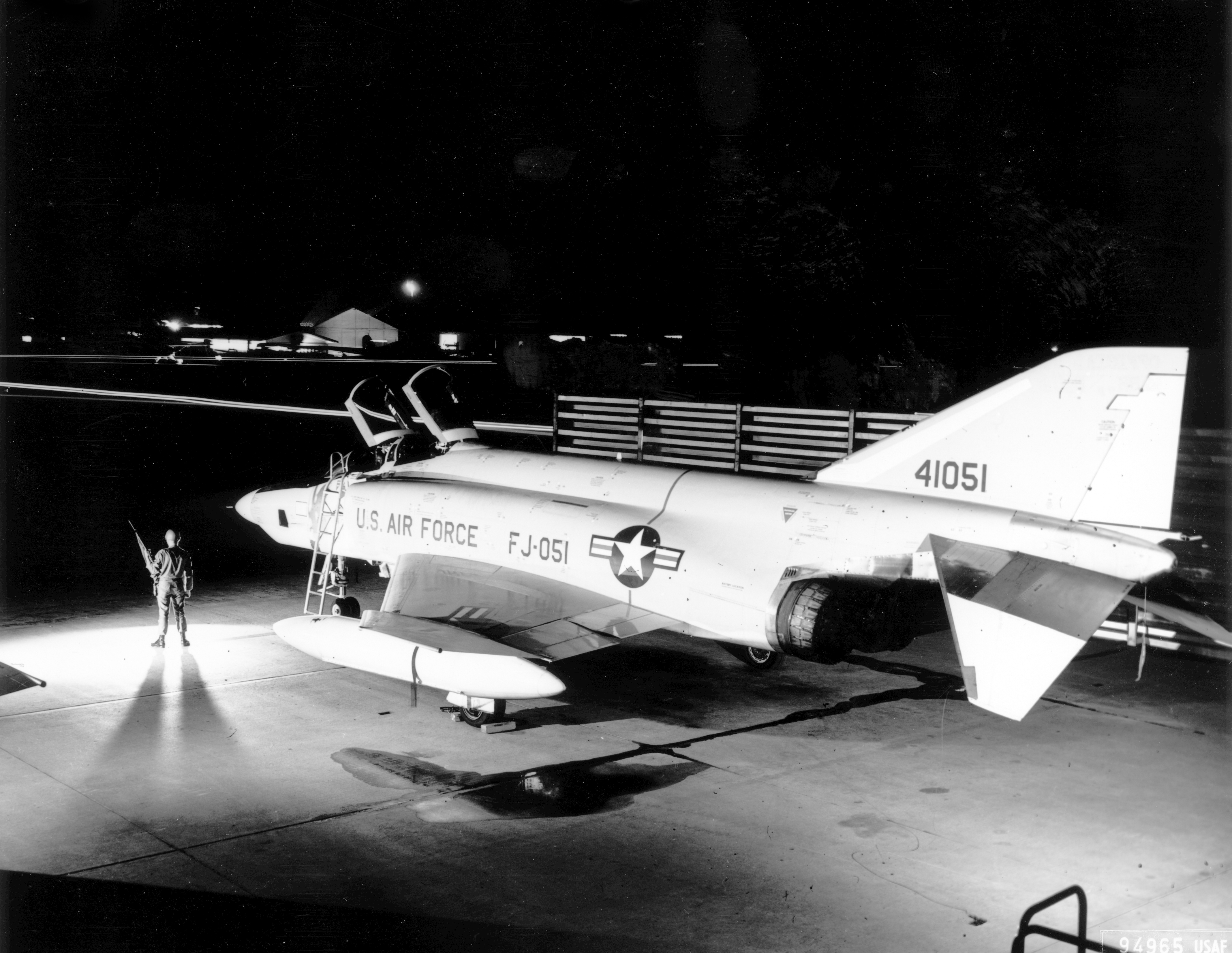


 “Favourites?


