Ten Flying Freaks


HH-43B_Huskie_during_a_firefighting_exercise_c1960sWhat makes an unusual design solution, and how have we selected the ten examples we are presenting in this article? Well, an ‘unusual design’ is clearly a flexible concept. As time and technology changes, so too does our notion of what a ‘normal’ aircraft design looks like. So, there is clearly a link to technology, and clearly early adopters of new technologies will be considered ‘unusual’ when they emerge. In this list, for example, we could have included the Messerschmitt Me 262, with its jet propulsion and swept wings. But with only a list of ten to work with, we chose the Me 163 instead, which featured not only a swept wing, but also rocket propulsion. Importantly, too, the Me 163 also pioneered a new role, that of the point-defence interceptor, and this links to another important reason for inclusion in this list, design to meet an extreme or specialist requirement.
Several examples of aircraft addressing such extreme or specialist requirements are included in this list. In discussing these aircraft, we attempt to explain how the designers have responded to the requirement in shaping the aircraft, its propulsion or other systems to meet the requirement or role. Examples of such aircraft include the U-2 and SR-71 among others.

03-14b
Finally, we have included some aircraft with more general requirements, but where, for specific reasons, unusual design choices have been made, leading to designs which differ markedly from other contemporary aircraft seeking to meet similar needs. These examples of original thinking are included as a reminder that innovation and originality remain a great aspect of the aviation business.
We have decided only to include in this list aircraft which could be regarded as successful, a consideration which eliminated numerous research aircraft, and also designs which, for whatever reason, had not been selected for operational use. However, there remain many others which met our criteria, and which we could easily have selected. If @Hush_Kit readers are interested in a further discussion of unusual design solutions, or if you vigorously disagree with our selections and would like to propose others – let us know through your comments on this piece.

By Jim & Ron Smith 
10. Lockheed U-2 ‘Gaz’s prison bus’ 

pic2u2
The Lockheed U-2 was designed in 1954, in response to a requirement for an aircraft to overfly the USSR at an altitude of at least 70,000 ft. This requirement was prompted by events such as the detonation of the first Soviet Hydrogen Bomb in August 1953, years earlier than expected by the US. This showed that the US lacked accurate technical intelligence about the capabilities and intentions of the USSR, particularly its emerging capability to directly threaten the United States homeland.

Screenshot 2020-05-22 at 20.54.11
Initial design work was directed to an Air Force requirement, but when Lockheed’s proposal, the CL-282, was rejected, Lockheed approached the Central Intelligence Agency (CIA), resulting in the establishment of Project Aquatone, approved in December 1954. After rapid development, in great secrecy, by the Lockheed Skunk Works the U-2 made its first flight on 29 July 1955, and made its first operational mission over the USSR just under a year later on 4 July 1956.

KellyJohnsonandGaryPowers
Francis Gary Powers (right) with U-2 designer Kelly Johnson in 1966. Powers was a USAF fighter pilot recruited by the CIA in 1956 to fly civilian U-2 missions deep into Russia. Powers and other USAF Reserve pilots resigned their commissions to become civilians. (U.S. Air Force photo)

Despite hopes that the high altitude flightpath would prevent detection by Soviet radars, this proved not to be the case, and while overflights of the USSR would continue up to May 1960, these were terminated following the shooting down of Gary Powers’ U-2 over Sverdlovsk.
The initial role of the U-2 was high-altitude photographic intelligence gathering. Although flights over the USSR ceased from 1960, U-2s were used over Cuba in the context of the Cuban missile crisis of 1962, and over mainland China in 1963. The sensors developed for the aircraft were critical to its success, with high-resolution, long focal length cameras developed by Dr Edwin Land, specifically to achieve extraordinary resolution of ground targets from the operating altitude of 70,000 ft.
The roles of the aircraft gradually broadened to include Electronic Intelligence gathering (ELINT), atmospheric high-altitude research including sampling radio-active products of nuclear tests and testing various sensors. Along with these developments came significant weight increases and erosion of the aircraft’s altitude capability.
This led to the development of the second-generation U-2R, which is considerably larger than the original aircraft, and has greater thrust. The U-2R first flew in August 1967, and a further production batch, designated TR-1A were ordered in 1979. The role of the U-2R/TR-1A is now to deliver network-connected real-time intelligence via SATCOM for air and ground assets and command decision making. A wide range of sensors are available, and other capabilities include ELINT, Signals Intelligence (SIGINT) and Synthetic Aperture Radar (SAR) mapping.

U2withExperiments
The U-2 and U-2R/TR-1 are unusual because of their high-aspect ratio un-swept wings, their low-wing loading, and their two-point centre-line landing gear. The driving requirement for the design is to be able to operate at very-high altitude over extended ranges, carrying a significant sensor payload. The aircraft operate close to their maximum achievable altitude, and typically cruise near the maximum lift coefficient available from the wing. Because the aircraft operate at such high lift, it is important that their lift dependent drag is minimised, as this will minimise thrust requirements and maximise range. The distinctive high-aspect ratio wing is used to achieve this, and it is notable that other aircraft with similar high altitude mission requirements, such as the RQ-4 Global Hawk and the Myasishchev M-17 and M-55 adopt a similar approach.
At high altitude, the speed of sound is less than at sea level, and high local Mach numbers occur on the wing as a result of its pressure distribution at high lift. In the cruise the aircraft operates in an approximately 10 kt window where it can fly above its low-speed stall, without high local Mach numbers causing a high-speed, or compressibility, stall.
The extreme requirements, for the aircraft to deliver its mission at very high-altitude, result in a number of other operational complications. Structural margins on the aircraft are reduced to achieve a lighter structure; the thrust required at high altitude far exceeds the thrust required at lower altitudes, and an extremely steep climb on take-off is usually used, both to limit loads on the airframe, and to limit exposure of the mission to prying eyes.

U2_Cockpit_2
The U-2 is notorious for being difficult to land, and operationally is generally talked down onto the runway by an external observer following the aircraft in a high-speed car. This is because precise handling is required to achieve the correct landing attitude and to avoid excessive bounce or float on landing.
The aircraft first flew in 1955, and remains in service. More than 100 aircraft of all variants were built, and there are currently no plans for its retirement.
9. Tupolev Tu-95 and Tu-142 ‘Bear’ ‘The Tupo-leviathan’ 

nre
The Tu-95 Bear was designed as a long-range strategic bomber, able to deliver thermonuclear weapons over a very long range. Since first flying in 1955, the aircraft has remained in service, and has been upgraded and modified to deliver a number of roles. The origins of the aircraft go back to the Second World War – it is no coincidence that the fuselage diameter is the same as that of the B-29 Superfortress, as the DNA of the Bear goes back to the Tupolev Tu-4 copy of the Boeing design. Developments of that aircraft, the Tu-80 and Tu-85, led to the Tu-95 when it was realised that the use of powerful and efficient turbo-prop engines could allow a transformation in speed, range and payload to be achieved.


Today, the principal roles of the Bear are the delivery of a variety of nuclear and conventional cruise missiles, allowing strategic power projection, with a global reach enabled by air-to-air refuelling. In addition, specialist variants are, or have been, used for electronic intelligence gathering, maritime reconnaissance and targeting, Anti-Submarine Warfare and as long-range communications platforms.

IMG_9252
The Bear is unusual because it uses a unique combination of swept wings and very large turbo-prop engines. The Tu-142 version was developed initially for maritime reconnaissance and ASW, and uses the 14,795 hp Kuznetsov NK-12M powerplant, driving 18ft 4in (5.59m) diameter contra-rotating propellers, and also has an extended fuselage. The propellers are operated at a very coarse pitch setting, which allows them to generate the necessary cruise thrust while operating at low rpm, avoiding high blade-tip Mach numbers. Combined with the wing sweep of 37 deg (at ¼ chord), these powerplants and the configuration enable the aircraft to achieve both high speed and very-long range.
Quoted performance figures vary depending on source and variant. A maximum speed of 450-500kt with full payload, and a maximum unrefuelled range with a 25,000 lb weapons load of 7,800 miles, or 9,300 miles with no payload have been stated.

IMG_9255
The requirements that drove the development of the Tu-95/142 were, as is normal for a strategic bomber, range, speed and payload. The aircraft was developed at a time when USSR turbo-fan engine development was insufficiently mature to match the thrust and fuel economy available through use of turbine-driven large-diameter contra-props. The use of slow-rotating contra-props and a swept wing enables high-speed, in addition to the range and payload conferred by the large size of the aircraft and its economical powerplant. The initial engine power of 9,750 hp was increased to 12,000 hp in the production Tu-20, and to 14,795 hp in the Tu-142. The Kuznetsov NK-12M is easily the most powerful turbo-prop engine built to date.
The aircraft has been an outstanding and long-lived success for its designers and operators, remaining in active service with the Russian Air and Naval Aviation Forces. It was also operated in limited numbers by the Indian Navy and Ukraine. Wikipedia lists more than twenty variants of the aircraft, and notes that many other sub-variants have been used.

8. Shin Meiwa Flying Boats ‘Hyper Sunderland’

ShinMaywa_US-2_at_Atsugi
The Japanese company Shin Meiwa (later renamed ShinMaywa) have produced a series of large amphibious flying boats for use on anti-submarine patrols (PS-1) and search and rescue operations (US-1A and US-2). The PS-1 was a pure flying boat, but carried its own retractable beaching gear. The US-1A and US-2 are amphibian flying boats with retractable undercarriages and can operate from hard runways, or from the open ocean.
In the 1950s, the Shin Meiwa company began to investigate how to create a flying boat of improved performance that could provide year-round operations in the seas around Japan. To achieve this, the performance requirements are somewhat extreme, combining a range of some 2,000 nm, carrying extensive mission equipment and the ability to routinely operate with wave heights up to 3.0 metres. This is coupled with the ability to take-off and land in extremely short distances at maximum weight.
Shin Meiwa initially extensively modified a Grumman HU-16 Albatross as an experimental aircraft to evolve their ideas and to demonstrate to the Japanese authorities. This aircraft, the UF-XS, pioneered many of the features later incorporated on the operational designs.
After several years of development, in 1966 the Japanese Maritime Self Defense Force (JMSDF) awarded a contract for the development of an anti-submarine patrol flying boat. Two PS-X prototypes were built, one of which demonstrated the ability to land successfully in four-metre high waves during trials in 1968.
As a result, a production order was placed for 21 PS-1 aircraft. The PS-1 flying boat was powered by four 3,060 shp General Electric T64-IHI-10 turboprop engines, built under license by Ishikawajima-Harima Heavy Industries (IHI), supplemented by an additional 1,250 shp General Electric (GE) T58 turboshaft engine solely to provide blowing air for the boundary layer control system fitted to the high-lift flaps, elevator and rudder control surfaces.
The PS-1 is a large aircraft, with a span of 108 ft 9 in and a length of 109 ft. Its maximum weight is 94,800 lb (43,000 kg). The effectiveness of the BLC system is such that the aircraft can take-off from a calm sea in 250m and land in 180m. Nine crew are carried, comprising pilot and copilot; flight engineer; radio operator; radar operator; MAD operator; two sonar operators; and a tactical coordinator. The PS-1 was withdrawn from service in 1989, having been replaced in the ASW role by the Lockheed P-3 Orion.
The JMSDF requested the development of a search-and-rescue (SAR) variant. The resultant aircraft, designated US-1 deleted most of the PS-1’s mission equipment (other than the search radar), allowing a considerable increase in fuel capacity.
A large sliding door was built into the starboard side of the aircraft to allow launch and recovery of an inflatable rescue dinghy, with a hoist fitted above the sliding door. The US-1 had a crew of eight, including pilot; copilot; flight engineer; navigator; radio operator; radar operator; and two observers. Up to five medics or rescue divers could also be carried. The aircraft could accommodate 12 stretchers and three sitting passengers, or 36 sitting passengers.

Us-1a_01l
The US-1 has an amphibious capability with a fully retractable undercarriage and was first flown on 15 October 1974, with a total of twenty aircraft being procured. After the seventh aircraft, an uprated version of the T64 engine was used rated at 3,490 shp, all aircraft being modified to this US-1A standard. Take-off weight was increased to 45,000 kg.
The final variant of the aircraft is the ShinMaywa US-2, which was first flown on 18 December 2003. This type has several aerodynamic refinements and a pressurised upper cabin, together with improved avionics and a new search radar. Power is provided by four Rolls-Royce AE2100 engines, each of 4,592 shp, driving six-bladed propellers. The APU is replaced by a 1,360 shp LHTEC CTS800-4K turboshaft. Take-off weight is increased to 47,700 kg and range to 2,500 nm. The US-2 can take-off at maximum weight from a hard runway with a ground run of 500 metres. Planned procurement by Japan is fourteen aircraft, and sales of the type have been discussed with India, Indonesia, Thailand and Greece, although no overseas sales have so far been reported.
A number of videos showing the impressive take-off performance of the aircraft can be found on the internet – see, for example:

7. Kaman helicopters ‘Intermeshion’

kaman-k-225
The Kaman helicopter family is a series of helicopters with twin intermeshing rotors that make use of a novel control system. The design is particularly suited for operations that require primarily hovering and low speed flight in roles such as cargo and freight transfer between ships, plane guard duties and aircraft crash rescue and firefighting. More recently, the civilian K-Max has found a role in the civilian heavy lift market.
Charles H Kaman was an engineer working for United Aircraft (the parent company of Sikorsky) at Hamilton Standard who developed novel ideas about how to control a helicopter rotor. After establishing that United Aircraft would not support a second helicopter enterprise within their business, Kaman left and set up the Kaman Aircraft Corporation on 12 December 1945.

Douglas A-1H

There are two main features to the design, the rotor configuration, and the flight control system employed.
• Rotor Configuration: The Kaman family of helicopters feature two intermeshing contra-rotating two-blade rotors, geared together so that they cannot rotate independently. The toque of the two rotors cancels each other out, so that no tail rotor (and associated supporting structure) is required. This configuration originated with the German Flettner designs (such as the FL282 Kolibri) and was also investigated by the Kellet Aircraft Corporation in the United States.

combat-search-rescue-history_pie2
• Rotor Control: rather than use conventional cyclic and collective pitch control by using pitch-change bearings at the blade root with pitch links controlled by a swashplate, Kaman decided to use a much-simplified head with no pitch change bearings. Instead, control was achieved by fitting controllable servo flaps at about three-quarter radius on each blade. Deflection of the flaps caused the blade to twist, increasing or reducing its lift. Symmetric operation of the flaps applied collective pitch; differential operation resulted in cyclic pitch control. This system is unique to Kaman’s designs, and its operation is analogous to the warping wing controls used in some pioneer fixed wing aircraft.
The main requirements leading to Kaman’s design were light weight, efficient hover performance and effective control independent of wind direction. The configuration saves weight by eliminating the weight and power penalties associated with the rear fuselage, tail rotor and associated gearboxes and drive shafts.
The low inertia of the servo-flap systems means that control loads are minimal and responsiveness is excellent, meaning that Kaman rotors can be controlled manually and therefore do not need hydraulic control actuators. The presence of two separate rotor hubs and their support pylons introduces a drag penalty, but this is not a major consideration in the main roles for which these types have been used.
By any measure, the Kaman intermeshing rotor designs have been very successful and established some notable firsts, including the world’s first turbine powered helicopter, America’s first twin turbine helicopter and the world’s first remotely-controlled helicopter.

Kaman HH-43B
After two prototypes (K-125, K-190), production commenced with the K-225. 11 were built, primarily for crop dusting, with one exported to Turkey and four going to the US services. One K-225 was experimentally fitted with a Boeing 502-2 turboshaft engine, becoming the world’s first turbine powered helicopter, when flown of 11 December 1951.
Military acquisition built up with the 235 hp HTK-1, 29 being acquired by the US Marines (plus one HTK-1K modified for pilotless flight as the world’s first drone helicopter). One was modified with twin Boeing 502-2 turboshaft engines, becoming the first US twin-turbine helicopter when it flew on 26 March 1954.
Production continued with 81 HOK-1 (US Marines OH-43D), 24 HUK-1 (US Navy UH-43C) and 18 HH-43A (USAF). These aircraft were all powered by the 600 hp Pratt & Witney R-1340 piston engine.

HH-43B_Huskie_at_Cam_Ranh_Bay
The larger HH-43B and HH-43F followed for rescue and fire-fighting duties. The HH-43B was primarily used by the USAF. First flown on1 November 1958 and powered by an 860 shp Lycoming T53-L1B, 208 HH-43B were built, the type also being supplied to Colombia, Burma, Morocco, Pakistan, and Thailand.
The HH-43F provided better performance in hot and high conditions, being powered by a 1,150 shp Lycoming T53-L-11A flat rated to 825 shp. The HH-43F was first flown in August 1964, with 32 being supplied to Iran and 5 to Burma. Two pilotless QH-43G were also built, together with a single civil prototype designated K-1125.

Kaman_K-1200_Rotex
The final design in this family is the Kaman K-1200 K-Max Commercial single seat heavy lift and fire-fighting helicopter. This type remains in production with some 53 built. The K-Max was first flown on 23 December 1991 and is powered by one Honeywell T53-17 turboshaft, flat rated to 1,500 shp for take-off and 1,350 shp in flight. The K-Max has 6000 lb external lift capacity, exceeding the aircraft’s empty weight of 5,145 lb.
Nearly 470 Kaman intermeshing rotor helicopters have been built, including two prototypes (K-125, K-190), eleven K-225, 152 piston-powered HTK, HOK, HUK & HH-43A, 248 turbine-powered HH-43B, HH-43F, QH-43G and K-1125, and (to date) 53 K-1200 K-Max.
6. English Electric Lightning ‘The Double Decktric’

1434589118154
Credit: BAE Systems

The English Electric Lightning was developed as a specialist point-defence interceptor. The specific requirement was to defend the RAF nuclear deterrent V-bomber bases, against attack by the USSR. The term ‘point-defence’ is used because the requirement was to defend specific locations, close to the aircraft’s operating base, by intercepting and shooting down attacking aircraft. The development aircraft (P-1A) first flew in August 1954, and the Lightning entered service with the RAF in 1960, serving until 1988.

main-qimg-60b4877f8400f8ff0bb21a9dcdfc1bd7-c
The Lightning’s Air Defence role evolved over time, in response to technical developments in threat aircraft and missiles. As air-launched cruise missile systems were developed, allowing threat bombers to launch their weapons at significant stand-off range, it became apparent that point-defence interception was no longer a viable approach. Consequently, the Lightning was developed to provide additional fuel in the wing, and in a larger under-fuselage fuel tank, and the role of the aircraft switched to combat air patrol, supported by aerial tankers. In addition, the nuclear deterrence role was transferred to the Royal Navy missile submarine force, removing the specific requirement for a point-defence aircraft.

1434589117145
Credit: BAE Systems

Three main variants were developed. The initial F1/F1A used the 14,430 lb thrust Avon 200 engine, and had the distinction of being able to take-off, cruise and land on either of its two engines, and could even maintain supersonic flight on one engine. The F1A added air-refuelling capability to the F1. Armament was 2 30mm cannon and 2 Firestreak air-to-air missiles.
The F2 was an interim version with an improved reheat system, and the next major variant was the F3, which introduced Avon 301 engines with 16,300 lb thrust, and an enlarged fin. The F3 could carry either Firestreak, or the larger Red Top missile, but the cannon armament was deleted. The F3A introduced an enlarged ventral fuel tank.
The final variant, the F6, introduced a new wing with extended and cambered leading edges, which allowed more fuel to be carried, and also reduced subsonic drag. The cannon armament, which had been deleted for the F3, was re-introduced for the F6, mounted in the front of the significantly enlarged belly fuel tank, which had been introduced in the F3A.

1434589117858
Credit: BAE Systems

Unusual features of the aircraft were the very highly-swept wing, and the arrangement of the two engines, which were stacked in the fuselage, with the lower engine forward of the upper one. This engine arrangement was fed from a common nose inlet, featuring a central cone, which contained the aircraft’s Air Intercept radar.
The configuration of the aircraft was driven by the need to achieve a very rapid rate of climb, and high intercept speed, to minimise the time to achieve an interception from a ground alert status. This placed an emphasis on rapid climb to height, which is a driver for thrust to weight ratio and low drag; and high-speed dash, which requires low supersonic wave drag. High sweep back, minimal frontal area, powerful engines, and light weight, including minimal fuel in early versions, are all consequences of this point-defence interception requirement. The aircraft ws renowned for its excellent handling, and for its ability to cruise at supersonic speeds in dry thrust.
Quoted performance figures for the Lightning include a climb rate of 20,000 ft/min, a maximum speed of Mach 2.0, and the ability to climb to 36,000 ft in less than three minutes.
The Lightning was operational with the RAF from 1960 to 1988, and 337 were built. The aircraft was also used by Saudi Arabia and Kuwait.


5. Transavia PL-12 Airtruk ‘Pellarini’s Flying Mango’


03_p6_1
The Transavia Airtruk is a crop-spraying aircraft with a most extraordinary configuration. The aircraft has a truncated pod fuselage with the pilot sat high and well forward above, and only just behind, the engine. The main 36 cubic feet chemical hopper is immediately behind and below the pilot and there is space in the truncated fairing behind the hopper for the carriage of two ground crew. Power of the standard PL-12 design is provided by a 300 hp Continental IO-520-D piston engine.

03_p6_2
Rather than being at the end of a conventional rear fuselage, the rear control surfaces are carried at the end of two well-separated tail booms, each of which carries a fin and rudder topped by a high set tailplane and elevator. The two tail booms attach at the mid-span point on the port and starboard upper wings of the sesquiplane biplane wing structure. The spacing of the tail booms provides a clear space of 11 ft 5 in width between the tailplanes.

03_p5_2

The configuration is a classic case of the engineering form following function. Some of the main advantages are listed below:
• The space between the tail booms allows rapid direct filling of the chemical hopper from a truck approaching from behind the aircraft
• The high seating position provides exceptional forward view from the pilot and prevents them from being crushed between the engine and hopper in the case of an accident
• The absence of the rear fuselage structure saves weight and means that this area cannot be contaminated by chemicals
• The strut-braced sesquiplane wing structure is structurally efficient and provides plenty of wing area for manoeuvrability and low stall speed (60 mph for the standard aircraft)
• A wide track (8 ft 0 in) tricycle undercarriage is provided, with the main gear mounted from the lower wing
• The aircraft empty weight is 1,850 lb, while the maximum weight in agricultural operations is 4,090 lb, providing an impressive disposable load of 2,240 lb (or 120% of the empty weight)
• The fuselage pod allows the aircraft to carry its ground crew on board, while positioning to and from operational sites
Variants include the PL-12(U) utility aircraft, which first flew in December 1970. The chemical hopper is removed from this aircraft and the reconfigured cabin volume allows four passengers to be carried in the lower cabin, with one further passenger rearward-facing behind the pilot. The T-300 Skyfarmer has a 300 hp Lycoming IO-540-KIA5 engine, while the T-320 uses a 320 hp Continental Tiara 6-320-2B.

Screenshot 2020-05-22 at 19.47.45
A total of some 118 aircraft were built, with aircraft operating in Australia, Denmark, India, Kenya, Malaysia, New Zealand, South Africa and Thailand. A number of aircraft were assembled in New Zealand by Flight Engineers Ltd.
4. Dornier Do 335 ‘Pfeil’ ‘The X-Pfeils’ 

do335_06 (1)
The Dornier 335 Pfeil (Arrow) has been described as ‘the most audacious fighter of the Second World War’ . The Pfeil was produced in three variants – Fighter-Bomber, Zerstorer (Night Fighter) and trainer. As, a twin-engine fighter-bomber, its role is broadly comparable with the de Havilland Mosquito FB VI. Like that aircraft, it was both heavily armed, with one 30-mm cannon and two-15 mm cannon, and had both an internal weapons bay capable of carrying two 250 kg bombs, and external hardpoints for a further two 250 kg bombs. The more heavily armed Zerstorer had three 30-mm cannon and two 20-mm cannon, but used the internal weapons bay as an additional fuel tank.
The Mosquito FB VI Series 2 carried the same bomb load, but was more heavily armed, with four 20-mm cannon and four Browning machine guns, and had greater range, but had a maximum speed some 100 mph slower than the Pfeil.

do335_16
The Pfeil featured a unique engine arrangement, with both a conventional front-mounted engine, and a centre-fuselage engine driving a pusher propeller located behind a cruciform tail. This tandem-engine arrangement minimised the frontal area of the aircraft, while retaining a clean wing, with sufficient volume available for an internal weapons bay. In addition, avoiding a twin-boom arrangement would have reduced roll inertia and improved manoeuvrability.

do335_08
The driving requirements were to maximise speed, manoeuvrability and payload (gun armament and bombs). One of the fastest piston-engine fighters ever built, the Pfeil is described by Eric ‘Winkle’ Brown as ‘very fast and quite manoeuvrable’ and as ‘the fastest piston engined machine in the world’. The aircraft is unusual because the tandem engine arrangement is a key enabler for the high speed achieved by the aircraft.
An indication of the aircraft’s capabilities is given by this description of an attempt by two Tempests to engage a Dornier Pfeil at low altitude .

do335_06
“Throttle full open, I tried to cut inside his turn, but he was moving astonishingly fast. Longley was better placed and fired at him, but without effect. The strange aircraft completed his turn and flew off at full speed. He really was an extraordinary looking customer. His tailplane was cruciform, and it looked as if he had not only a normal propeller in front but on top of that a pusher propeller right in the tail, behind the rudder. His front engine was an ‘in line’ with a cowling like a DB603 in a Focke-Wulf Ta 152C with a ring-shaped radiator; the other engine was buried in the fuselage, behind the pilot. The two long grey trails in his slipstream showed he was using a supercharger, and the thread of white escaping from his exhausts showed that he was using GM-1. I toyed with the idea of bringing my supercharger into action, but even with 3,040 hp we wouldn’t be able to get him. We were doing nearly 500 mph and he was easily gaining on us.”
The Dornier Pfeil was completed too late in the war to achieve true operational service, although it had been used for operational trials and tactics development, and clearly experienced at least one combat engagement. A total of 11 production aircraft, two trainers and 12 prototypes were completed, with a further 15 aircraft in final assembly when the factory was captured. The aircraft is included in this list because, had circumstances allowed, it would clearly have been used operationally by the Luftwaffe.

do335_09

3. Messerschmitt Me 163 Komet ‘Taschenrakete’

Messerschmitt Me 163B
The Messerschmitt Me 163 was a small rocket propelled air defence aircraft, and was one of the most dramatic developments in wartime combat aircraft design. Its role was to deliver what was itself a new concept, point defence interception. An example of its operational use was the defence of synthetic oil manufacturing facilities against Allied bombers.

The ground-breaking features of the aircraft included its tailless swept-wing airframe, liquid-fuelled rocket propulsion, and its small size and light weight. To reduce weight the Me 163 dispensed with a conventional undercarriage, taking off using a wheeled dolly, dropped once airborne, and landing using a simple skid. The armament carried was two 30-mm cannon.

images
As a point-defence interceptor, the aircraft needs to achieve high climb rate to reach operational altitude quickly, and high speed to achieve a rapid interception. As discussed in another piece for Hush-Kit on aircraft design, climb rate is maximised by combining high thrust with low weight and drag. The Me 163 achieved its extraordinary climb rate through its rocket propulsion, minimum size and weight airframe, and its use of swept wings.
The climb performance of the Me 163 was probably not matched in an operational aircraft until the introduction to service of the Lightning. The extraordinary test pilot, Eric ‘Winkle’ Brown, reports reaching 32,000 ft in 2 ¼ minutes in his first powered flight in the aircraft . Fully operational aircraft could climb to 39,500 ft in 3 ½ minutes, and attaining a maximum speed of 596 mph.

download
The Me 163 was operational from July 1944 to the end of the Second World War. Its success was somewhat limited, however, despite being armed with twin 30mm cannon. The very high speeds achieved by the aircraft resulted in very rapid closing rates against bomber targets, even in a stern attack. Combined with a relatively low rate of fire from its cannon, this resulted in firing opportunities typically limited to a few seconds only. This problem was exacerbated by the low powered endurance, which was typically less than 5 minutes at altitude. More than 300 aircraft were delivered.
2. Lockheed SR-71 Blackbird ‘Trisonic Turdus’

DF-ST-89-06288
The Lockheed A-12 and SR-71 are high-altitude strategic reconnaissance aircraft, capable of sustained operation at more than Mach 3.0. They were designed to conduct intelligence gathering and reconnaissance flights over unfriendly territories at altitudes and speeds that make them difficult, if not impossible, to intercept. An additional variant operated as a drone carrier aircraft, while the YF-12 air combat variant was never deployed operationally.
These aircraft feature unique configurations and construction materials, driven by high-speed and high-altitude requirements to be out of reach of SAM-systems. This leads to a highly-swept blended delta configuration with twin variable by-pass turbo-ramjet engines. These aircraft were also designed for reduced radar signature with RAM wedges incorporated in leading and trailing edges.\

335828main_EC97-43902-1_full
The aerodynamic heating, encountered at cruise speeds in excess of Mach 3, means that Aluminium cannot be used for their structures. As a result, the main structural material is Titanium, which is notoriously difficult to work, but can withstand the high skin temperatures. The outer layer of cockpit glazing is of quartz, to withstand local temperatures in excess of 300 degrees Celsius.
The Lockheed A-12 was developed for the CIA as a secret project of Kelly Johnson’s Lockheed ‘Skunk Works’. The A-12 was a single seat aircraft and was the precursor to the twin-seat Lockheed YF-12 prototype interceptor, the M-21 (launcher for the supersonic D-21 drone), and the SR-71 Blackbird. The codename for the A-12 programme was Oxcart and the aircraft flew for the first time on 26 April 1962. Thirteen A-12 aircraft were built, together with two M-21 two-seat aircraft designed to carry and launch the D-21 supersonic ramjet-powered drone.

335595main_EC92-3103-8_full
Three prototype armed YF-12A were built. These were twin-seat aircraft armed with the AIM-47 Falcon air-to-air missile. The YF-12A can be distinguished by its nose radar, cut-back chines and twin ventral fins.
These aircraft were followed by the Lockheed SR-71 two seat strategic reconnaissance aircraft, which was slightly stretched (increased in length by 5 ft 2 in) and had a significantly higher maximum weight (172,000 lb versus 117,000 lb) than the A-12, together with aerodynamic refinements to the forward chine shapes.
The SR-71 flew for the first time on 22 December 1964 attaining a speed in excess of 1,000 mph on its first flight. (Ref: Lockheed’s Skunk Works: The First Fifty Years, Jay Miller). The SR-71 was used to set absolute speed and altitude records and several point-to-point speed records. These included an absolute speed record of 2,193.17 mph and 2,092.29 mph over a 1,000 km closed circuit, with a maximum sustained altitude of 85,069 ft. In operations, the aircraft routinely cruised at Mach 3.2 at altitudes above 75,000 ft.
Production comprised 13 A-12 and 2 M-21 (drone carriage); 3 YF-12A and 31 SR-71 plus one aircraft from salvaged YF-12A and SR-71 static test article. Thrust for the SR-71 was provided by two 34,000lb Pratt & Whitney JT11D-20A (J58).

335816main_EC95-43351-2_full
No aircraft were shot down during operational sorties that included flights over Libya, Vietnam, Laos, North Korea, the Kola Peninsula and the Baltic and other areas of conflict such as the Yom Kippur War.
The SR-71 was initially withdrawn from service in 1989, with the last operational mission October 1989. However, the decision was taken in September 1994 to reactivate three aircraft, with the first example becoming operational in June 1995. The last SR-71 flight being made on 9 October 1999. During its operational career with Strategic Air Command, the SR-71 accumulated more than 50,000 flight hours, nearly 12,000 of these being at speeds in excess of Mach 3.
1. Lockheed F-117 ‘The Woblin’ Goblin’ 

COMBAT HAMMER
The Lockheed F-117 broke new ground as the first operational low-observable tactical strike aircraft. The outcome of a process which started with a DARPA study into reduced signature fighters in 1974. Out of this emerged the radical ‘Have Blue’ concept demonstrator program, and the F-117 itself, which achieved initial operational capability in 1983.

DARPA_USAirForce_HaveBlue
The aircraft’s role has been the attack of heavily-defended, high-value targets, at night, using precision laser guided bombs, carried in an internal weapons bay. The F-117 was the first true ‘stealth’ aircraft, designed to counter radar and infra-red sensors, while minimising its own electronic emissions. Every feature of the aircraft is influenced by the approach taken to minimise these signatures.
A key element in the management of radar and IR signature so as to avoid detection and prevent successful engagement was the ability to predict the signature of the aircraft, and to design a flyable shape with low signature. At the time of its development, signature prediction capabilities were limited, but it was realised that if a flyable aircraft could be developed using a finite number of flat surfaces, then it would be possible to predict and minimise its signature.

F-117A_Nighthawks
The benefit of using a faceted design, with careful control of geometry to align edges and surfaces, is that radar returns can be essentially limited to a number of ‘flashes’ with very narrow dispersion, directed at a large angle to the illuminating radar. As a result, not only would a F-117 be difficult to detect, it would also be very difficult to track. The unique faceted, highly-swept configuration of the F-117, with its triangular fuselage cross-section, is a consequence of this design approach.
Additional features of the aircraft contributing to its low signatures include gridding of the intakes and sensor window, and gold flashing on the canopy, to prevent radar reflection from these cavities; a large weapons bay to allow all stores to be carried internally; a narrow letter-box exhaust located on the upper surface of the aircraft to minimise infra-red signature; and retractable communications aerials.

After take-off on a mission, these aerials are retracted, and the aircraft performs the mission with no external communication being used. Mission planning is critical, as is a knowledge of the ‘Electronic Order of Battle’ – the location and nature of any radar systems which might detect the aircraft. This information is used to plan ingress and egress to avoid directing radar return ‘flashes’ at threat sensors, minimising the likelihood of detection or tracking.

Sadly, this site will pause operations in June if it does not hit its funding targets. If you’ve enjoyed an article you can donate here.

Doors covering all apertures on the aircraft, such as the weapons and undercarriage bays, have distinctive serrated edges, and the entire aircraft has a special coating applied to further reduce radar signature. Examination of the aircraft on its first public appearance revealed the use of ‘RAM putty’ to fill fastener heads, as part of the LO maintenance of the aircraft.
59 aircraft were produced, and the first operational use of the aircraft was in Gulf War 1 in 1991. Despite having been first flown in production form in 1982, its existence was not formally acknowledged until November 1988, and the aircraft was revealed to the public (and the author) on 21 April 1990 at Nellis AFB, Nevada.
Although supposedly retired in April 2008, examples are still flying for undisclosed purposes, assumed to include testing defences against similar capabilities.

Stealthy stars and stripes

Support the crowdfunded Hush-Kit Book of Warplanes by pre-ordering your copy of our book here

From the cocaine, blood and flying scarves of World War One dogfighting to the dark arts of modern air combat, here is an enthralling ode to these brutally exciting killing machines.

The Hush-Kit Book of Warplanes is a beautifully designed, highly visual, collection of the best articles from the fascinating world of military aviation –hand-picked from the highly acclaimed Hush-kit online magazine (and mixed with a heavy punch of new exclusive material). It is packed with a feast of material, ranging from interviews with fighter pilots (including the English Electric Lightning, stealthy F-35B and Mach 3 MiG-25 ‘Foxbat’), to wicked satire, expert historical analysis, top 10s and all manner of things aeronautical, from the site described as

HUSHKITPLANES_SPREADS4_4.jpg“the thinking-man’s Top Gear… but for planes”.

The solid well-researched information about aeroplanes is brilliantly combined with an irreverent attitude and real insight into the dangerous romantic world of combat aircraft.

HUSHKITPLANES_SPREADS4_6.jpg

FEATURING

  • Interviews with pilots of the F-14 Tomcat, Mirage, Typhoon, MiG-25, MiG-27, English Electric Lighting, Harrier, F-15, B-52 and many more.
  • Engaging Top (and bottom) 10s including: Greatest fighter aircraft of World War II, Worst British aircraft, Worst Soviet aircraft and many more insanely specific ones.
  • Expert analysis of weapons, tactics and technology.
  • ssdd.jpg
  • A look into art and culture’s love affair with the aeroplane.
  • Bizarre moments in aviation history.
  • Fascinating insights into exceptionally obscure warplanes.
  •  Pre-order your copy here. Hurry to avoid disappointment.Go on. Go on. 

  • 03-14b


What is the new plasma ‘foo-fighter’ technology and is it responsible for the Hornet UFO footage?

STILL2-articleLarge-v2

The US Navy has filed patents relating to Laser Induced Plasma Filiments to counter infra-red missiles.  We asked former British technical liaison Jim Smith to explain this exotic technology and consider if it offers a solution to the mysterious UFOs spotted by US Navy Hornets’ targeting pods. 

Hush-Kit asked me to have a look at this article from Forbes.com. The article draws attention to a US Navy patent suggesting that Laser-induced Plasma Filaments might be used to provide agile, frequency-variable decoys to defeat imaging infra-red missile seekers.

I’ll have a go at explaining the technology, and how it is supposed to work, and then I’ll try and identify some of the elements which might be a bit tricky. I should explain that, despite having once funded, and observed the demonstration of, a quite impressive neutral particle beam, I am not a high-energy particle or optical physicist, so my explanations may be a little simplistic.

Lasers and Plasmas

92770b1d2e92d015d19278aa53992bb2

So, Laser-Induced Plasma Filaments (LIPF) – what are they, and how might they be used to generate decoys?

Lasers (Light Amplification by Stimulated Emission of Radiation) are, despite the complex expansion of the acronym, very familiar objects in today’s world. They are essentially a coherent light source that can be used for anything from entertaining your cat to measuring the distance to the moon, or, if you are old-fashioned enough, playing the music encoded on a Compact Disc.

Lasers have been being investigated as the basis of Directed Energy Weapons for some time, and these weapons themselves can vary considerably in nature. A common feature of the lasers employed in proposed lethal and non-lethal weapons systems is that they are much more powerful than those encountered in the hardware or stationery store serving as tape-measures or pointers to aid presentations.

The lasers used in the application covered by the Forbes article, and the US Navy Patent to which it refers, are pulsed at a very high frequency, and at high power, which allows them to generate plasma as they pass through air, and to exploit that plasma to form self-focussing beams and plasma filaments.

What is a plasma ? A plasma is a gas, which has been ionised, generally through the application of very high temperatures, and is therefore conductive. Ionisation refers to the stripping of electrons from the atoms of the gas. These conduct electrical currents, and the remaining positively charged atoms are the Ions of the element concerned. A natural example of a plasma is a lightning bolt, and a man-made example is a Neon sign.

Laser-Induced Plasma Filaments and Decoys

What does the US Navy Patent describe? The process starts with a very high-power, tunable, pulsed laser. By tunable, the Patent states that the laser wavelength, spatial and temporal (shape, duration and size) ‘and etc’ of the pulses can be varied. This variation allows plasmas to be produced which can emit spectra across a range of frequencies of interest, from Infra-Red through Visible to Ultra-Violet.

Sadly, this site will pause operations in June if it does not hit its funding targets. If you’ve enjoyed an article you can donate here.

At sufficiently high power, a process called the Kerr effect allows the laser to produce a self-focussed beam, or plasma column which has a small diameter and high intensity. Broadly speaking, a sufficiently high energy pulse, through the Kerr effect, causes the laser beam to focus to an energy level where a plasma is formed. This tends to de-focus the beam, which in turn reduces the degree of ionisation and allows the beam to re-focus. This repetitive process is referred to as self-guiding, and, when completed, results in the generation of a steerable, tunable plasma filament, which can then propagate out through the air as a LIPF.

STILL2-articleLarge-v2

The emerging plasma beam can be rastered – i.e. scanned from side to side as in an old-fashioned TV set or cathode ray tube, and adjusted in distance, so that an apparent three-dimensional object can be created at a distance to the plasma projector, and it is this that creates the decoy. In principle the nature of the image, and its apparent frequency content can be adjusted to optimise the decoy, and it can be repositioned, essentially arbitrarily quickly. The distances achievable are said to be about 10 times greater than achievable without self-focussing of the beam.

The Forbes article in the link at the start of this item itself contains a link to a video apparently demonstrating the generation of images by a low-powered system.  The patent claims the ability to generate large ghost images as decoys, and suggests that multiple images could be produced. Reference is made to the use of a 248 nanometer, Krypton-Flourine excimer laser to generate the decoy images – this type of laser is in common use, suggesting that the patent is claiming to use available technologies.

Tricky Elements

The patent makes clear that the management of the laser, specifically the energy, pulse shape, duration and repetition rate, are critical in determining the nature of the plasma beam produced. It is claimed that the output decoy can have an extremely broad-spectrum response, from broadband to gamma rays. Generating and optimising the appropriate decoy spectrum is clearly one challenge.

Another will be the process of pointing and rastering to generate a coherent image, and then the management of that image so as to seduce the missile seeker to follow the decoy, and to maintain that lock-on to the point where the genuine target cannot be re-acquired.

A critical element of that image generation process is ensuring that the propagation range of the rastered plasma filaments making up the image is tightly controlled, otherwise coherence will be lost. This seems likely to require extremely precise control of the driving parameters of the laser system, and unsurprisingly, no explanation is provided of how this is to be achieved.

Patents, in general, seek to talk up the widest possible range of applications and attributes of the technology being patented. There are some suitably ambitious claims made in the patent, including the vast range of spectrum over which decoys could be produced, the range of electromagnetic systems which could be used as the basis of decoys, and the ability to generates decoys over an area large enough to protect a fleet of ships, or even a city.

Are plasma flares the basis of the UFOs?

Well, obviously, I don’t know. The technologies accessed in the paper appear plausible. The Kerr effect, self-focussing, and Laser induced plasma filaments are all real, and an afternoon spent cruising around the many available sources on the web will turn up a heap of other fascinating applications as well.

Can sufficiently credible images be constructed at a workable distance, and with the right attributes to decoy a missile? Again, I don’t know, but in principle, I don’t see why not, if the Tricky Elements (above) can be managed.

Hush-Kit asked physicist Brian Clegg for his opinion, he noted that “Clearly you can create a glow etc. by heating air – its effectively what lightning is – so the plasma filament idea seems entirely feasible. I’m not as sure about how you create a ball of plasma at a position in midair as lasers don’t stop (it’s the old light sabre problem).”

Support the crowdfunded ‘Hush-Kit Book of Warplanes’ by pre-ordering your copy of our book here

Two aspects concern me. If this system works as advertised, and if it were mature enough to generate the images seen in the US Navy videos, it’s surprising that we have not seen something like this in service.  Similarly, I would have expected any promising system like this, related to new countermeasures against advanced IR seekers, would not be accessible through the open internet. The content of such a patent would be classified and only available to those with a need to know.

The UFO community also cite the apparent detection on radar of the UFO-like images in the released videos, as evidence that they are not plasma decoys; question why the patent would appear some years after the apparent use of a similar technology in the videos; and why such a technology would be trialled against evidently unbriefed Navy airmen.

Sadly, this site will pause operations in June if it does not hit its funding targets. If you’ve enjoyed an article you can donate here.

I have no answers to these points. One tantalising reason why a patent might appear in a public forum is that the technology is known to all the key players already, and the US is able to counter it.

Or else this is another disinformation effort to distract our attention from the real aliens. …

https___cdn.cnn.com_cnnnext_dam_assets_171219092059-ufo-department-of-defense-unidentified-flying-object

Support the crowdfunded Hush-Kit Book of Warplanes by pre-ordering your copy of our book here

From the cocaine, blood and flying scarves of World War One dogfighting to the dark arts of modern air combat, here is an enthralling ode to these brutally exciting killing machines.

The Hush-Kit Book of Warplanes is a beautifully designed, highly visual, collection of the best articles from the fascinating world of military aviation –hand-picked from the highly acclaimed Hush-kit online magazine (and mixed with a heavy punch of new exclusive material). It is packed with a feast of material, ranging from interviews with fighter pilots (including the English Electric Lightning, stealthy F-35B and Mach 3 MiG-25 ‘Foxbat’), to wicked satire, expert historical analysis, top 10s and all manner of things aeronautical, from the site described as

HUSHKITPLANES_SPREADS4_4.jpg“the thinking-man’s Top Gear… but for planes”.

The solid well-researched information about aeroplanes is brilliantly combined with an irreverent attitude and real insight into the dangerous romantic world of combat aircraft.

HUSHKITPLANES_SPREADS4_6.jpg

FEATURING

  • Interviews with pilots of the F-14 Tomcat, Mirage, Typhoon, MiG-25, MiG-27, English Electric Lighting, Harrier, F-15, B-52 and many more.
  • Engaging Top (and bottom) 10s including: Greatest fighter aircraft of World War II, Worst British aircraft, Worst Soviet aircraft and many more insanely specific ones.
  • Expert analysis of weapons, tactics and technology.
  • ssdd.jpg
  • A look into art and culture’s love affair with the aeroplane.
  • Bizarre moments in aviation history.
  • Fascinating insights into exceptionally obscure warplanes.
  •  Pre-order your copy here. Hurry to avoid disappointment.


STILL2-articleLarge-v2

Flying & fighting in the Lockheed EP-3E Aries II: Interview with Cold War spy


EP-3E and EA-3B's Straits

For over fifty years the EP-3 has been sticking its beak in were it is not wanted, gathering signals intelligence for the US Navy. Hoovering up the signals, active sensor transmissions and communications of non-consenting parties is the stock-in-trade of the Navy’s oldest flying spy, the Lockheed EP-3. We spoke to Captain ‘Dirty Duck’ Niemyer to find out more about this shadowy aircraft. 

Tell us a little about what kinds of reconnaissance missions the US Navy was flying in the Cold War and the risks involved?

“The very short answer? While the US Navy’s photoreconnaissance effort, from various carrier-based aircraft, including AJs, F9Fs, F2Hs, RF-8s, RA-5Cs and even the RA-3B was well known, the Navy’s other reconnaissance effort, that of signals intelligence collection, in both tactical and strategic applications, is intentionally far less known or written about. Throughout most of the Cold War, and beyond, the US Navy mounted nearly daily flights in international airspace to provide information of a technical nature, often with very real-time analytics, to tactical and strategic decision makers and to help build the database on emitters and other information. The programme remained very intentionally obscured until the early 2000s.

EP-3E VQ-2 RAF Fairford 1978

Caveat: This is my version of things. It’s true, because I’m telling the story. Your version may be different.) Short of the outstanding, multi-part series of the history of the US Navy’s two SIGINT collections squadrons written by the late Captain Don East and published in the Hook magazine (The journal of the Tailhook Association), this downloadable monograph, ‘A Dangerous Business’, published by the historical branch of the National Security Agency on the occasion of the dedication of an actual Douglas EA-3B airframe at NSA Headquarters at Fort Meade, Maryland, will really give readers an in-depth history of the Navy’s role in the Peacetime Aerial Reconnaissance Program, PARPRO.


These flights were both land and carrier-based and involved several types of aircraft over the decades. The two aircraft I flew in as a Naval Flight Officer serving as a Senior Tactical Electronic Warfare Evaluator, SEVAL, were the Douglas EA-3B Skywarrior, more popularly known as the ‘Whale’, and the Lockheed EP-3E ARIES.”

Ranger 21 and Ranger 12 Rota 1976
 What was the role of the aircraft
“The EP-3E was the natural follow on to the early PB4Y-2’s, P4M-2Q’s and the Lockheed EC-121s that it directly replaced. (The very first were EP-3B’s, but they were very narrowly modified and proved the concept admirably). It had a large crew in the back end to fulfil the SIGINT collection mission, with a commensurate larger crew of operators and coordinators. At the time I flew in them, mainly to hone my skills as a Senior Evaluator-in-Training, they were far, far more dedicated to flying on nationally-tasked reconnaissance missions, including the Caribbean, Baltic Sea and the Mediterranean, even the North Cape and environs on occasion.”

[NOTE: The EP-3E has gone through constant improvements in airframes, engines and above all the collective systems in the back-end over the years. The EP-3Es that went to war in 1991 were way different from the EP-3E’s of the 70s and early 80s, just as the EP-3Es currently flying bear only a superficial resemblance to those EP-3E’s that were flying in 2003]

8655240395_a24510d690_b

What was the best and worst features of the aircraft?
“The absolute best feature, from a purely technological aspect, is one that, honestly, isn’t still talked about much, and won’t be here. From an operator’s POV, the collective ARIES (Airborne Reconnaissance Integrated Electronic System) remains, through its many manifestations, a very impressive system, especially its ability to fully integrate data from across the RF spectrum and give both real-time situational awareness as well as to preserve signals for further technical analysis, post-mission. The fact that instead of being a simple ‘vacuum-cleaner’, sucking up data, you have real people in the loop, makes a huge difference for lots of reasons.

Additionally, besides flying reconnaissance missions assigned by Higher Authority, the EP-3E was certainly seen and appreciated as a “Fleet Asset.” So much so that if they were flying one flavour of reconnaissance tasking and they came across things that Commander Sixth Fleet and the various Med naval forces would need to know about, they were authorised to leave that mission and prosecute those emitters, platforms, etc. And anytime we had various NATO or US Fleet exercises, the EP-3E’s were big players.

The other thing the EP-3E brought to the reconnaissance table was the fact that its physical architecture was such that its reconnaissance capabilities could be reconfigured in the field, by the Squadron itself. That lent itself to a lot of flexibility and the ability to try things based on real-world experiences, and to do so very quickly. That paid off a number of times out in the real world.

unnamed

The platform, the Lockheed P-3, was designed for lower altitude use as an anti-submarine warfare aircraft. The EP-3E’s mission required flight up much higher and I think that required a lot more handling finesse by the pilots. The fact that our USAF peers were flying much higher and much faster in their RC-135’s made the comparison tough to consider. Of course, for a lot of reasons, we justifiably thought we did a whole lot of things better than they did. One thing for certain was that since we were a Mediterranean-based squadron, we knew our theatre of operations intimately, day in and day out, whereas they’d fly out from Omaha, do their thing, then go back to “The World.”

I would be remiss if I did not add that, from a crew point of view, the EP-3E did have a significant advantage: Whale crews went, mainly, to the Boat. EP-3 crews went to big, nice bases all over, often with contract hotel rooms, great chow and were paid per diem for every day they were away. That led to some pretty hard feelings between the two aircraft types that existed in the squadrons at the time.”

What was the hardest system to operate?
“I think it really took a lot of time and real-world experience to master all the intricacies of the many bits and pieces that made up the ARIES systems. Then, to add the added coordination and mission leadership skills needed to be a good SEVAL, to it, meant that it generally took at least a year for a SEVAL to be initially qualified, leaving him with only about 24 months to get really good at his job before transferring.”

Support the crowdfunded ‘Hush-Kit Book of Warplanes’ by pre-ordering your copy of our book here

What was the most effective system and why?
“I think it’s exceedingly difficult to point to one particular receiver system and say it was better or worse than another. The individual Electronic Warfare Operators (“EWOP’s”) had their likes and dislikes when it came to individual operator positions, most of them became specialised in a particular position and part of the RF spectrum. I think it was easier to get the hang of coordinating folks during the course of a mission, but very, very hard to do it well and to do real-time analysis on what all this data that was coming at you was really telling you.”

Interview with RC-135 pilot here. 

How effective was it and why?
“EP-3E’s started flying missions in the 1970’s, and while the actual airframes are much, much newer, here they are, at the beginning of the third decade of the 21st Century and they are still out there, doing missions they were never originally envisioned to be doing, and doing them incredibly well. The EP-3E has been involved in most of the Cold War and every hot war the US has been involved in, as well as a lot of other things we may finally hear about at some unknown date in the future. I really think the US Navy and the nation has more than received their monies-worth on their investment. We really screwed up by thinking the MQ-4 is ever going to really replace it. (Don’t get me started, for heaven’s sake).”

EP-3E_Orion_of_VQ-2_parked_c1971

How well would it have survived in a full-scale war with the USSR?
“What mission are you envisioning? Let’s face it, the P-3 is not a fighter, so as the NSA commemorates, blood has been spilled by the ELINT community for decades. That’s the price of vigilance, and it always will be. It’s considered a “National Asset” so I would hope that the people who planned that stuff may have thought that putting too close to something like a Very Longe Range SAM envelope or subject to fighter intercept in a shooting war wouldn’t be doing a lot for asset protection.”

Sadly, this site will pause operations in June if it does not hit its funding targets. If you’ve enjoyed an article you can donate here.

What was your most memorable missions and why?
“I got most of my EP-3E flight time as part of my training as an EA-3B SEVAL, but one mission does stand out. For reasons, we felt, of sheer perversity, the Soviets would always sortie various ship types out from the Soviet Baltic and Northern Fleets to the Med, with estimated arrivals in the vicinity of the Straits of Gibraltar either on December 24/25 and/or December 31st. This, of course, led our being tasked, along with the local Navy P-3 VP Detachment, to go out on those nights waiting to see if we could pick up any presence of the passage of their submarines. As a ‘Geographic bachelor’ I was picked to spend a Christmas Eve, along with a bunch of other hand-picked folks who were ‘voluntold‘ that we’d spend the night flying to the west of the Straits. I manned a plotting position for most of the evening, as we drilled holes in air, wishing only the worst for Ivan for having screwed up the holiday. And yes, they did it every year.”

Was it better than the Nimrod R.1?

2560px-Formation_of_No_51_Squadron_Nimrod_R1_and_Sentry_AEW1_of_No_8-23_Squadron.10-04-2000_MOD_45137400
“I had a shipmate who was able to do an exchange tour on 51 Squadron and the R.1s. He admired the fact that the RAF’s operational mindset was much more attuned to how the US Navy did things (anything not specifically prohibited was implicitly permitted) than the USAF. He liked the available range and altitude advantage it had over the EP-3E, but also mentioned that while the two systems were complimentary, each had features he’d have liked to have seen on the other. He just wished the RAF had many more of them.

I also flew missions with the USAF in the RC-135 Rivet Joint in an advisory capacity. Great birds, but their way of doing things, back then, differed significantly to ours. Not in a bad way, per sé, just ‘different’. I’m sure they looked on us the same way.”

airplanepictures_2272_54663576
Incident Over The South China Sea, 4/2001 by Ronald Wong

Tell me something I don’t know about the EP-3?
“Right after take-off in the generation of EP-3E I flew in, there was a requirement for certain portions of the fuselage under the floorboards to be inspected, I presume for leaks, things being where they’re supposed to be, smoke, fires (!) and nothing askew. Or something, I never quite knew. It’s quite a sight on initial climb out to see certain designated aircrew running up and down the cabin, to and fro, opening and slamming hatches in no apparent coherent order.”

Describe the aircraft in three words
“Ubiquitous, under-appreciated, well-used”

What should I have asked you?
“Do I have a favourite among the three? Yes. No. Each airplane taught me a whole lot, about flying, airmanship, crew resource management, carrier operations, air warfare, the ‘Big picture’, intelligence collection and analysis, strike warfare, life, the universe and everything.

And yes, there was another aircraft type you didn’t ask about, the one I have the most flight time in of the four: The Douglas KA-3B Skywarrior, the long-range pathfinder/refueller in which I gained ~1900 of my nearly 3200 Navy flight hours.”

unnamed

Support the crowdfunded Hush-Kit Book of Warplanes by pre-ordering your copy of our book here

Flying & Fighting in the A-3 Skywarrior

EA-3B_Skywarrior_of_VQ-2_over_the_Gulf_of_Sidra_1984

Catapult take-off in an aircraft that weighs the same as fifteen wartime Corsairs is a daunting prospect, yet the US Navy’s Skywarrior served with aplomb from US aircraft carriers for 35 years. Ed Heinemann’s ‘Whale’ was huge, fast and challenging — and could do almost anything asked of it. We spoke to Captain ‘Dirty Duck’ Niemyer to find out more. 

What was the role of the aircraft?
“Shortly after debuting as a purpose-designed carrier-based strategic nuclear bomber, the Navy and Douglas’s legendary Ed Heinemann recognised its immense and roomy fuselage design would lend itself to a variety of other tasks. This included a design change that would beef up pressurisation and make the cockpit, companion-way and bomb-bay area one large, sealed and pressurised vessel, allowing room for massive amounts of equipment, including four extra systems operators and equipment to fulfill a CVA-based electronic/signals intelligence collection capability. After a few A3D-1Q’s, the Navy went on to build around 20 or so A3D-2Q/EA-3B’s over the years, including the conversion of several VA-3B’s and TA-3B’s to replace losses. The ‘Whales’ provided a fused SIGINT product that could be passed to Battle Group Commanders, strike leaders and strike packages in real and near-real time, as well as collecting important and new data for later, fine-grain analysis by other entities.”

VQ-2 EA-3B Ranger 14 touch and go #2
What was the best and worst features of the aircraft?

Its size and its size. The A-3 was huge, for it was designed to fulfil a late-1940’s NAVAIR requirement for a nuclear bomber with a roughly 2000-NM range at high altitude and very high sub-Mach 1 cruise speed. Ed Heinemann was incredibly proud that his design came in well, well under the 100,000-pound projected maximum gross weight, with performance numbers well ahead of its competition. Nonetheless, with a demonstrated max catapult weight of 83,000 pounds (Routinely kept to 73,000 pounds in actual use) and a very long unrefuelled, still-air range in excess of 2000NM, the Skywarrior was over 74 feet long and its long, high aspect ratio swept wings were over 72 feet wide. (Which meant line-up at the boat was everything. Don’t be drifting or lining up to the right!) See why it almost immediately got the fleet nickname of the ‘Whale’?

6-2

That size meant that she rapidly became a jack-of-all trades. Nuke and conventional bomber and minelayer, the last two of which they did during Vietnam; reconnaissance; trainer; VIP transport, tanker-jammer, tanker, EW aggressor; developmental testbed. All these and more made the Whale a unique and valued platform. The range we offered meant that an Admiral, who wanted information, that morning, on what the various elements of the Soviet Mediterranean Fleet might be up to, could dispatch us over the course of a day to acquire what information we could from all of the three major SOVMEDFLT anchorages. Something we called “Getting a hat-trick” on the day. (At that time, due to our slim fuel reserves brought about by our high empty gross weight versus maximum landing weight of only 50,000 pounds, we did only daytime carrier operations. That later changed.)

DN-SC-87-10654

That size also made us hated by the Flight Deck and Hangar Deck Officers. Our so-called “Flight Deck Multiple”, or footprint, with wings folded was huge. We simply took up, in their’s and often the carrier CO’s and even sometimes CAG’s (Carrier Air Wing Commanders) eyes, too much room they could use stuffing in more shooters and bomb-droppers. For us VQ bubbas, depending on who had been “read in” on our mission and its value to the Wing and the Battle Group, that meant that sometimes we were made welcome and other times made us the true cross-eyed stepchild in the Air Wing. (At the time I flew in the EA-3B we didn’t do the extensive pre-deployment work-up cycle stateside. We joined the Air Wing when it in-chopped the Med as a Detachment and left when the carrier left the Med for home)

DN-SC-87-00506

The Whale was NOT easy to bring aboard, in the least. The Pratt & Whitney J-57 was a straight axial-flow engine with attendant lag in spool up and the jet had the low thrust-to-weight ratio of its era. So, pilots had to constantly be anticipating their next power response well ahead of when that was going to be needed. They learned the individual characteristics of each boat we cruised on, as each seemed to have its own characteristics. Some moved in a unique way, others’ turbulence aft of the ship, the ‘burble’, was unique.

2560px-DN-SC-83-05204_NRA-3B_Snoopy_at_Pacific_Missile_Test_Center,_Point_Mugu_in_1982
NRA-3B ‘Snoopy’

The distance between the pilot’s eyes and the hook point to capture the cross-deck pennant was significant, so most pilots I flew with, in both the EA-3B and later, when I was a navigator up front in the KA-3B, flew the Whale seeing the ball in the optical landing system, the “Meatball,” about ½ ball higher from what was considered optimal in other aircraft. The Whale had very narrow main landing gear track, and at the high tire pressures called for in carrier operations, when combined with a perhaps excessive descent rate, maybe a little bit of left or right wing down, or even worse, an in-flight engagement of hook before the wheels actually hit the deck or a too-flat attitude could lead to, well, spectacular results. Not in a good way. Which see: Whale Dance. (I’ll save that for another time).

DN-SN-90-03678

Oh, did I forget to mention, we didn’t have ejection seats. In the late 1940’s ejection seat technology wasn’t very good and when needed most, on launch and recovery, one was already outside the speed and altitude envelope. So, we had individual parachutes, two overhead ditching hatches, one in the cockpit and other in the EW compartment, a large emergency bailout hatch on the right side of the EW compartment and the main entry/exit door that could be blown and locked down as a bailout slide. Looking back at it, out of the 282 Whales manufactured, over 125 were either lost or damaged enough to be struck from the register including several EA-3B’s. We tended towards dark humor as a result. “What are you going to do to me? Make me fly Whales? Off the Boat? You don’t scare me, there’s a reason it was originally known as ‘All 3 Dead,’ I’m a dead man walking already.”

EA-3B ECM Compartment
Rare view of the ECM console of the EA-3B

Pre-order The Hush-Kit Book of Warplanes here

The other thing the Whale had working against it was both the airframe design age (Late 1940’s) and actual manufacturing age. The last Whales came off the El Segundo line in January 1961. By the late 1970’s, they’d been rode hard and put away wet. Aircraft parts failed more frequently, and parts were hard to find for both our sister squadron, VQ-1 in Guam and us. The Maintenance Man hours/flight hours ratios were not good at times. On more than one occasion we would literally have to divert from an in-flight mission back to Rota to get the plane fixed, leaving the Det on the boat to wait, often days, for our return. That loss of capability often hurt.

VQ-2 EA-3B's over Gibralter (2)

On the other hand, the back-end systems were being constantly updated. We had a mix-and-match of “Old, but reliable,” “Old, and needs a lot of TLC” and “New, cool (For 1978) tech” gear. But constant catapult shots and arrested landings take their tolls on anything electronic and we sometimes worked with some systems working a little less well than we would have liked. But the data we could collect was wide across the spectrum and a good crew at all five stations could collect a massive amount of useful information.

What was the hardest system to operate?
“Each of the five operator positions, four in the EW compartment and one in the cockpit was equipped with receiver equipment able to collect data from various parts of the RF spectrum, with some cross-coverage between individual stations. In the most general sense, it depended on the operator himself. (No women flew the EA-3B when I was flying these missions) Some operators could be running different bands of the spectrum through two receivers, one going in each ear and know when he had a ‘hit’ just from the audio sounds generated by the specific receiver. He could then look at the signal analysis equipment and know if he had an emitter worth focusing some detailed analytic attention upon. Sometimes we focused on what the emitter was and the weapons system associated with it and other times we wanted to know where it was radiating from. Sometimes, both. Adding in other source data, we were able to build a much more complete picture of what was happening involving the platform, etc. That was the stuff worth getting.

EA-3B Cockpit from Pos 4

That being said, for me, the hardest system to get to work right was the massive data recorder, using what was for the 1970s, state-of-art wide magnetic tapes to record any data of high interest we were collecting. The tapes were heavy and huge, and the recorder was a bitch to operate. You’d thought you’d recorded a real signal of interest only find out when it got back for analysis that it didn’t collect squat.”

USS_Constellation_(CVA-64)_flight_deck_1967

What was the most effective system and why?
“The generation of EA-3B I flew in was equipped with an updated ‘system of systems’ contracted and put together by GE, called Seawing. As a collective system, it was incredibly effective in extending the carrier battle group commander’s situational awareness. When all the receivers were working well and with an experienced crew of operators, we were able to do a job, with just five of us, that many larger platforms couldn’t do. Plus, the system allowed us, in the right scenarios, to be incredibly effective in giving carrier air strikes valuable I&W of the air defence systems they were facing and how effective their countermeasures may be, in real time.”

Kuznetsov from EA-3B (1)
Keeping an Eye on Ivan, Kuznetsov from an EA-3B

Sadly, this site will pause operations in June if it does not hit its funding targets. If you’ve enjoyed an article you can donate here.

How effective was it and why?
“The EA-3B was, when properly tasked by the BG commander and/or often “Higher Authority,” incredibly effective. We had an inherent taking flexibility that neither of the predominant land-based assets possessed. We were part of the Carrier Air Wing we were assigned to and we felt it our duty to look out for our fellow fliers as best we could and to help them do their mission, be it offensive or defensive. When teamed up with the E-2, S-3 and the EA-6B we could add a significant ISR and I&W package to any operation, before we called it “ISR” or “I&W.” That came in very, very handy when the carrier group would start to nose its way south or east in the Med towards littoral nations that may not have seen us as the loveable liberty risks we really were.

Pre-order The Hush-Kit Book of Warplanes here

We always considered a huge compliment if, when debriefing any operation where instead of just taking off and heading over the horizon on our own (“Don’t ask and we won’t have to lie to you”) we worked with the fighter and attack squadrons, they’d ask “How the hell did you guys know that? That made a huge difference!”

8655240395_a24510d690_b

How well would it have survived in a full-scale war with the USSR?
“Like all air assets, that depends. Because we normally operated at high altitudes, well above where most of the Air Wings of that era operated, we had incredible stand-off range from any of the SAM’s that then equipped the Soviet Med Fleet’s and their allied nations’ assets. Plus, with the equipment we had, the Whale’s max speed and other factors, any land-based aircraft intercept would be very hard-pressed to get to where we were when he launched, much less get to where we’d be by the time he got to the first point. We were way more concerned about the Soviets’ subs sinking “mother.” After all, that’s where the food was! Plus, the Soviets maintained an AGI off Rota pretty much 24/7/365. We knew Homeplate was a primary target. Something you simply accepted.”

Pre-order The Hush-Kit Book of Warplanes here

What was your most memorable missions and why?
“The ones I feel most comfortable in talking about were a series of daily reconnaissance missions we flew in early 1979 off Libya while operating from USS Eisenhower. Tensions were more than a little ratcheted up and there was some genuine concern that the Libyans might do something stupid. We flew two-three missions a day, with two crews swapping out between launch and recovery cycles. We had a bird with tight systems and the mission ‘take’ was good. (We’d write up a daily mission summary and send it out via message).

Vq2

When we returned, our Commanding Officer, a man I always held in the very highest respect, for a whole different number of reasons, came out and met us on the parking ramp in front of the squadron. He told us to our faces that we had done “spectacular” work out there. He took me aside and told me he’d been up at a regular conference at  Commander in Chief, Europe ( Commander in Chief, Europe) headquarters and that then CINCEUR, General Haig, had told him he’d been reading my nightly messages and asked him to pass on his personal “Attaboy” to me specifically for the missions and the results we were getting.

AIM-54A_first_test_A-3A_NAN11-66
As well as frontline duties, the A-3 served as a testbed for weapon systems. An XAIM-54A Phoenix air-to-air missile is launched from the Douglas NA-3A Skywarrior on 8 September 1966. Note that the NA-3A has been fitted with an AWG-9 radar. These tests were vital in the development of the F-14 Tomcat.

As a junior officer, flying a ‘Cats-and-Dogs’ aircraft, in an obscure squadron and with a personal reputation among some of the ‘older’ folks for being a bit of a loose cannon and overall crazy man, to know that what I was doing was being noted at that level and that our missions were being briefed daily to the National Command Authority, was pretty affirming stuff.”

A3D-2_nose_wheelSaratoga

Tell me something I don’t know about the aircraft?
“Until the advent of the FA-18, no US Navy aircraft normally cruised at the altitudes and speeds the Whale did. Our most fuel-efficient flight was 420-480 knots TAS and well in the 30,000 feet and well above altitude range. The FA-18 only matched us on its emergency fuel ‘bingo profile.'”

Describe the aircraft in three words
“Big, fast, challenging.”

Support the crowdfunded Hush-Kit Book of Warplanes by pre-ordering your copy of our book here

From the cocaine, blood and flying scarves of World War One dogfighting to the dark arts of modern air combat, here is an enthralling ode to these brutally exciting killing machines.

The Hush-Kit Book of Warplanes is a beautifully designed, highly visual, collection of the best articles from the fascinating world of military aviation –hand-picked from the highly acclaimed Hush-kit online magazine (and mixed with a heavy punch of new exclusive material). It is packed with a feast of material, ranging from interviews with fighter pilots (including the English Electric Lightning, stealthy F-35B and Mach 3 MiG-25 ‘Foxbat’), to wicked satire, expert historical analysis, top 10s and all manner of things aeronautical, from the site described as

HUSHKITPLANES_SPREADS4_4.jpg“the thinking-man’s Top Gear… but for planes”.

The solid well-researched information about aeroplanes is brilliantly combined with an irreverent attitude and real insight into the dangerous romantic world of combat aircraft.

HUSHKITPLANES_SPREADS4_6.jpg

FEATURING

  • Interviews with pilots of the F-14 Tomcat, Mirage, Typhoon, MiG-25, MiG-27, English Electric Lighting, Harrier, F-15, B-52 and many more.
  • Engaging Top (and bottom) 10s including: Greatest fighter aircraft of World War II, Worst British aircraft, Worst Soviet aircraft and many more insanely specific ones.
  • Expert analysis of weapons, tactics and technology.
  • ssdd.jpg
  • A look into art and culture’s love affair with the aeroplane.
  • Bizarre moments in aviation history.
  • Fascinating insights into exceptionally obscure warplanes.
  •  Pre-order your copy here. Hurry to avoid disappointment.

EA-3B_Skywarrior_of_VQ-2_over_the_Gulf_of_Sidra_1984USS_Constellation_(CVA-64)_flight_deck_1967

Flying & Fighting in the A-6 Intruder

DN-SC-04-15247

Ugly and formidable, the A-6 Intruder was a lethal enforcer of US foreign policy for over a third of a century. We spoke to Bomber/navigator Captain Andrew ‘ComJam’ S. Niemyer about his time on Grumman’s ‘Iron Tadpole’, an impressively effective all weather attack aircraft. 

“Most of the people who fallaciously claim I owe them money know me as ‘Comjam.’ (And a few remember an even earlier callsign ‘Dirty Duck’)”

A-6E ND500 1991

What was the role of the aircraft?

“Three simple words: All Weather Attack. We meant all three.  When briefing the Intruder to guests, I would say ‘When it’s a dark, cold, stormy night and the bad guys are all hunkered down inside, trying to keep warm and dry, we’re there to ruin their night. Because we can’.”

What was the best and worst features of the aircraft?

“From a  bomber/navigator (BN) point of view, the overall radar/terrain avoidance/TRAM (Target Recognition Attack Multi-sensor (FLIR/Laser) system absolutely rocked.  Working together, along with the pilot’s display which was also part of the terrain avoidance and the bombing system, we really had a very robust capability.  With the digital Armament Control Unit, ACU, we could deliver huge varieties of dumb bombs and PGM’s.  The IMU (Inertial nav system), working with the radar (Unless we were not radiating to avoid being ESM’d by the bad guys) to generally identify a target, then rolling out the FLIR to confirm identifying the target, locking it up in the system, then lazing it to get absolute precision and then letting the ACU tell the pilot exactly when to commit the system to automatic bomb release was pretty damn slick.  A very tight system in the Intruder was a wonder to behold.

DN-ST-93-03005

Again, as a BN, when the inertial system or the weird analog/digital memory unit would go stupid on you, it would cause a raft of headaches.  A degraded system could lead to decreased accuracy in both navigation on bombing, although we trained from the first day in the Sim at the RAG in systems degradations, for obvious reason.  But it sometimes sucked up a lot of your attention if it went bad at the wrong moment, and that was attention you really didn’t want to divert from your basic duties to get safely to the IP, ID the target and drop on it .  So, you would downgrade the system and work hard to recall everything you were now going to have to enter manually or work around.  Which is why most BN’s carried not only a NATOPS Pocket Checklist, but also a huge pocket gouge book with all those steps and procedures in them.”

download

What was the hardest system to operate?

“First, know that I transitioned to the Intruder as a senior Navy Lieutenant Commander, with around 2400 hours in the A-3.  So I had a lot to “unlearn” as well as a huge new set of systems to learn from scratch.  Many of my peers had been flying the A-6 since they earned their wings, and so stuff I found a PITA, they did not and vice versa.  I tried to make up with old age and treachery what I seriously lacked in youth and skill.

navy-va-304-firebirds-a-6-intruder-patch_1_c39aef8174cf73c20142329ea1197e3c

For me, the hardest was really tuning the inertial navigation system while in flight.  You could do that several ways and really being good at it was as much art as it was science.  I was really getting the hang of it at the 400-500-hour point, which is when time caught up to me and I flew my final Navy flight as a Naval Flight Officer as a mid-grade Commander.”

What was the most effective system and why?

“Two of them: The radar system in the A-6E, the Norden (Yes, that Norden) AN/APQ-148.  This was a combined ground mapping/terrain mapping radar that was so precise that you could do) a so-called “Self-Contained GCA” down to minimums, even painting clearly the runway remaining marker boards on either side of the runway.  I did them a couple of times for the fact that I could do it.  Some of my best bombing scores on ranges were done using the radar only and not the FLIR/Laser, it was that good.  When combined with the Moving Target Indicator (MTI) system, you could easily lock up and track a moving target and get a great target lock, bomb solution and whack that mover cleanly.

A-6E ND504

The other system?  The most effective one the A-6 had from Day One: The Pilot-Bombardier/Navigator team, hands down. It took the two of you, working in absolute synchrony, to make the Intruder completely function at its peak efficiency.  Each one had specific duties, but both had to have 100% reliance and trust the other was doing his job.  In bad weather/night, terrain following, it was an absolute act of total and complete trust.

22683722647_d759dab386_b

The BN’s radar display was a map as seen from overhead.  The pilot’s display, with silhouettes of seven “slices” of terrain at ascending distances from the aircraft, giving a synthetic horizontal view of that same terrain.  Together, you made it through to the IP and the attack phase.  You looked out for one another in every way possible and totally trusted what the other said and did.  Flying together as often as possible, you could make that airplane do all that it was ever asked to do, and then some.”

How effective was it and why?

“Amazingly so, as its long combat history so amply proves.  One of the best stories comes from the Vietnam War: A single Intruder night mission did some truly precision bombing on the outskirts of Hanoi one night.  No one else went downtown that night.  Next day, Hanoi reported it had fought off a mass attack of B-52’s.  Its systems kept improving with each version, and the late A-6E’s, with highly improved digital systems stayed very effective until it was forcibly retired in 1996.

78cbf91a787b33cd525e20906da74130

unnamed

The fact that it was well-suited for systems improvements, had exceptional range and was remarkably robust due to its great Grumman heritage all played a part on why it proved so successful.  Granted, the early DIANES system were very problematic, but the fundamental airframe was tough.  NAVAIR remained dedicated to keeping the good stuff and improving the things that needed fixing.”

How well would it have survived in a full-scale war with the USSR?

va-304 firebirds attack squadron atkron a-6e intruder nas alameda reserve cvwr 03x

“What’s the target? In all Strike warfare, that’s your first question.  Some targets were naturally far more highly defended than others, and that would of course drive ingress and egress routes, tactics and SEAD planning.  We had tough losses in Vietnam, the various skirmishes in the 80’s and in Desert Storm, so the answer would have to be is it in Russia, proper?  Is it war-at-sea? Is it a client state/ally of the USSR? What’s my target? That will drive my weapons load and my tactics.  My defensive load, i.e. chaff/flares may also have some variables based on the answers.

VA-304 Mass Formation

Bottom line: Yes.  But how many would have?  That would have depended on the targets they were assigned.”

What was your most memorable missions and why?

“I flew the Intruder exclusively in the US Naval Air Reserves, and for a lot of complex reasons that require ample amounts of adult beverages to tell, we were less than a week from finally deploying for Desert Storm when the war ended.  So, no combat missions in the Intruder for me. But two do stand out:

That being said up front, our Air Wing, due to its proximity to the Naval Strike Air Warfare Center at NAS Fallon, NV was employed extensively to try the proposed tactics that were developed for the active air war phase of the war.  I, along with most of my squadron, frequently flew practice missions into the Fallon complex during the months between August 1990 and January 1991.  We knew what we were doing and why, and we felt we were at least doing something to contribute to keeping our peers both safer and more lethal.

unnamed (1)

The other mission was flown in mid-September 1992.  It was from NAS Alameda, CA to the Fallon complex, specifically to bomb in the Range Complex known as Bravo-15.  We were loaded with 12 25# practice bombs, a.k.a. “Blue Death.”  We flew a low-level route across northern California and then down into the range.  We “split” the bomb load, the pilot doing six practice drops using his bombsight and I did six “systems” runs, using the FLIR/laser.  We had a good time, came back low over the Sierra Nevada and down into the San Francisco Bay Area, and landed with no drama back at Alameda.  Another day, another low level, another set of bombing targets.  And it was the last flight I ever made as a fully NATOPS-qualified Naval Flight Officer in my wildly improbable Navy career.

Speaking of ‘memorable’, I totally forgot one of the most memorable moments in my wildly improbable time in Naval Aviation (Folks almost universally started and spent their entire careers in one aircraft type/mission; I did three: reconnaissance, over-water pathfinding/navigation and Medium Attack) One year, since we were heading as a squadron to to join the rest of our Air Wing (CVWR-30) for two weeks at NAS Fallon, NV, we decided to do a ‘max effort’ and managed to do a 12-plane fly over of the Golden Gate Bridge and San Francisco Bay.”


Was it better than the Royal Navy’s Buccaneer?

“I have zero Bucc time, so I don’t feel qualified to answer.  If you haven’t flown in both, then it’s simply semi-informed opinion.  From what I know, I think the Bucc had some real strengths, but also had its own weaknesses.  Likewise, the Intruder.  Both had the ability to put ordnance right where you needed it, when you needed.  I will note that while the Intruder did indeed look like a flying chicken drumstick with wings, the Bucc looked like the inspiration for Queen’s ‘Fat-Bottomed Girls’ ;)”

va-304 firebirds attack squadron atkron us navy a-6e intruder reserve cvwr-30 13

Tell me something I don’t know about the A-6…

“The A-6 had no published maximum speed ever listed in the NATOPS manual.  Under the limitation section, where “Maximum Speed” is listed, are simply the initials “LBA.” Limited By Airframe. No matter the altitude, push the throttles as far forward as you want, you can’t overspeed it.”

Describe the aircraft in three words

“Ugly, lethal and effective.”

A-6E at ramp CV-62 1989


Unlike the USAFR and Air National Guard, the Naval Air Reserves at that time did not take folks in, put them through flight training and have them come back to the squadron.  Only folks leaving active duty and therefore with at least one, if not two, flying tours under their belts, were considered.  Thus a FNG would show up already well-seasoned.  Sometimes they may have been flying another aircraft type, but we knew they were “trainable” and it was a matter of transitioning them.  This was not as common in the Reserve A-6’s, however my squadron had been an A-7 squadron and most of the Reserve pilots did the transition. (Transitioning their mindsets from ‘single seat’ to ‘crew concept’ was a bit of a challenge)  After that, we mainly took guys who’d flown A-6’s.  Not always, but it was less common to transition guys.  This overall level of expertise sometimes raised a little bit of ire among the active duty Navy.  At one point the Admiral who was in charge of West Coast A-6’s banned the Navy Reserves from participating in the annual All-Whidbey Island A-6 bombing derby, as they would win every single year.  Old age and treachery *will* overcome youth and skill every single time.
 
304 took a number of KA-3B Navs, including me, and we all went to either VA-128 (West Coast) or VA-42 (East Coast) RAG’s for a Fleet Transition BN syllabus, lasting around 120 days or so.  As time went on, more and more Fleet and former USMC Intruder pilot and BN’s came into the squadron.  This led to some interesting ‘sub-cultures’ in the squadron.  We had the ‘Single-seat forever’ former A-7 guys, we had the former Whalers (‘#$%^, what’s this button do again?!?’) we had the long-range, all-weather attack experienced career A-6 guys and we had what we called the “MARDET’ (Marine Detachment)  They’d all focused on close air support and little else.  For a generally unruly lot (“We’re the US Naval Air Reserves: Your Profession, Our Hobby”) they were generally the most unruly.  OTOH, when we’d get calls for CAS training for ground elements, be they US Army, Army Guard, Marines, SOF, we’d have crews who could do that stuff really well.  Word got out and we did a lot of training missions doing CAS all over the western USA.”
 
 
*The Navy dissolved the distinctions between USN and USNR in the late 00’s, so formally, I’m USN(Retired) not USNR(Retired).  Whatever.


  •  

A-6E ND500 1991

Those litigious men in their flying machines: The Wright Brothers & why the US wasn’t ready for war

the-wright-brothers-orville-wilbur-portraits

How did the United States, which invented the first fixed wing powered aircraft, fall so distantly behind the Europeans in military aviation by the end of World War I? The US got a slow start for several reasons, including a general apathy for the war and a lack of institutional will. An underrated villain, though, was the problematic application of intellectual property protection, a problem that the United States defence establishment continues to struggle with.

wright-brothers-airplane-patent-vintage-aviation-art-airplane-art-airplane-blueprint-pilot-gift-aircraft-decor-airplane-poster-5a1e9fca

Intellectual property protection and national security have long been intertwined. For as long as espionage has existed, spies and agents have tried to steal and copy foreign technology.  Early modern kings used patent protection to provide monopolies for important supporters, as well as to reward efforts at innovation in military technology.


First_Class_Battleship_(11850935903)

When the development of military equipment (and especially naval equipment) became cost-prohibitive for private companies at the beginning of the 20th century, the government stepped in to support research and production.  This came with a price (detailed in Katherine Epstein’s wonderful book Torpedo), which usually included ownership of the patents and trade secrets associated with the resulting technologies.

NASM-NASM-9A00721

Modern military aviation began just as industrialisation began to overtake war. The successful first flight of the Wright Flyer in December 1903 was a magnificent engineering achievement, especially given the limited resources available to the Wrights. The brothers moved aggressively to counter anyone who used anything approaching their system of guidance, which they interpreted broadly to mean anything that changed wing surface in order to affect manoeuvrability (for more, see Lawrence Goldstone’s Birdmen). The Wrights hoped that the United States government would come through with a big cash payment for rights to the machine, and in fact refused to even demonstrate the flight in front of large audiences out of fear of theft.

wright-brothers-flying-machine-patent-1903-bill-cannon

Unsurprisingly, this made it difficult for other inventors to build upon their achievements. Almost any aircraft could run afoul of the “wing change” claim, even though the particular ‘wing warping’ technique used by the Wrights was not replicated in many other aircraft of the era. In 1909, the Wrights sued Glenn Curtiss for patent infringement following the developing of his own aircraft, which used lever-controlled aileron to manage manoeuvrability.  The legitimacy of the Wright’s claim remains in some dispute, and the suit played out across a host of legal venues in several different countries, but never resulted in a significant finding for the Wrights.

Glenn_Curtiss_on_his_V-8_motorcycle,_Ormond_Beach,_Florida_1907
Glenn Curtiss on his V8 motorcycle

The Wright’s obsession with litigation, combined with the unfortunate death of Wilbur, slowed innovation within the firm and made it ever more important to profit from already existing intellectual property.  At least one history describes them as “patent trolls,” but this term usually connotes a genuine grifter, not an over-zealous inventor. Wright Co. suffered, but so did the rest of American aviation as inventors hesitated to develop new technologies out of fear of debilitating lawsuits from the Wrights.  Some pre-emptively avoided the problem by paying off Wright Co. ahead of time, but the threat of lawsuits generated bad blood and deterred sharing.

Sadly, this site will pause operations in June if it does not hit its funding targets. If you’ve enjoyed an article you can donate here.

SPAD_XIII_040510-F-1234P-019
SPAD S.XIII in livery of Capt. Eddie Rickenbacker, 94th Aero Squadron.

As a result, despite having a huge economy and a vast industrial base, the United States found itself breathtakingly behind European standards as the war began.  Rather than build its own aircraft, it relied on European producers, straining industries already working at near maximum capacity.  US pilots would enter the war flying foreign aircraft, with the US aviation industry far behind its competitors.

The patent fight wasn’t the only reason for US unpreparedness for World War I.  The Army had not devoted sufficient attention to aviation in the years before the war, leaving responsibility with the Signal Corps, which was under-resourced and struggled to develop a strong procurement plan or any theories of offensive and defensive warfare.  Unlike in Europe, the executive did little to push the Army into developing a more aggressive aviation strategy. Moreover, the US aviation industry struggled even to produce European models under license, as US production methods were not well-suited to the craftsmanlike approach of the early aircraft production.

Eventually, the prospect of war in Europe drew the conflict into clearer focus.  The United States government pressed the major aircraft manufacturers (including Wright and Curtiss) to enter a ‘patent pool’ which would ensure access to critical inventions but ensure the payment of a reasonable fee. Not coincidentally, this gave the government a stronger hand in negotiations with manufacturers, driving down overall prices.  Most historians (but not all) concur that the dispute dramatically slowed the development of US aviation, both in

poster_4

the military and civilian sectors. Eventually, clearing the tangles enabled the United States to develop a thriving, multifaceted aviation industry that would serve the country well in the Second World War.

Theoretically, strong patent and trade secret protection encourages innovation by giving inventors incentive, as well as a mechanism to protect any information that they share with other inventors.  But the system sometimes breaks down. Inventors, reluctant to give up exclusive rights in the civilian market, balk at selling out to the government.  Department of Defense officials can be overzealous in their pursuit of the data, trade secrets, and patents necessary to maintain the production of military equipment after the original producer has lost interest.  And governments sometimes use intellectual property law as a cudgel to hammer small businesses, or to undercut unwanted competition. The turn of the 19th century saw tremendous changes in the legal context of the production of military technology, and the turn of the 20th century seems to have seen something very similar.

Dr. Robert Farley teaches at the Patterson School of Diplomacy and International Commerce at the University of Kentucky.  He is the author of Grounded: The Case for Abolishing the United States Air Force and Patents for Power: Intellectual Property Law and the Diffusion of Military Technology.

Make this happen! Support the crowdfunded Hush-Kit Book of Warplanes by pre-ordering your copy of our book here 

From the cocaine, blood and flying scarves of World War One dogfighting to the dark arts of modern air combat, here is an enthralling ode to these brutally exciting killing machines.

The Hush-Kit Book of Warplanes is a beautifully designed, highly visual, collection of the best articles from the fascinating world of military aviation –hand-picked from the highly acclaimed Hush-kit online magazine (and mixed with a heavy punch of new exclusive material). It is packed with a feast of material, ranging from interviews with fighter pilots (including the English Electric Lightning, stealthy F-35B and Mach 3 MiG-25 ‘Foxbat’), to wicked satire, expert historical analysis, top 10s and all manner of things aeronautical, from the site described as

HUSHKITPLANES_SPREADS4_4.jpg“the thinking-man’s Top Gear… but for planes”.

The solid well-researched information about aeroplanes is brilliantly combined with an irreverent attitude and real insight into the dangerous romantic world of combat aircraft.

HUSHKITPLANES_SPREADS4_6.jpg

FEATURING

  • Interviews with pilots of the F-14 Tomcat, Mirage, Typhoon, MiG-25, MiG-27, English Electric Lighting, Harrier, F-15, B-52 and many more.
  • Engaging Top (and bottom) 10s including: Greatest fighter aircraft of World War II, Worst British aircraft, Worst Soviet aircraft and many more insanely specific ones.
  • Expert analysis of weapons, tactics and technology.
  • ssdd.jpg
  • A look into art and culture’s love affair with the aeroplane.
  • Bizarre moments in aviation history.
  • Fascinating insights into exceptionally obscure warplanes.
  • Convinced? Pre-order your copy here 


the-wright-brothers-orville-wilbur-portraits 


My favourite museum piece No.1: Gloster Meteor VZ608 VTOL testbed (Newark Air Museum)

06 Meteor FR9 VZ608.JPG
In flight picture of VZ608 [Credit: NAM Archive, via Rolls-Royce]
I want to support air museums during lockdown by raising awareness of their many treasures. With this in mind I have contacted several museums and asked them to share the story of their favourite exhibit (if you are part of an air museum and wish to take part please contact me here or by Twitter or Facebook). Let’s start with Newark Air Museum and their exceptional Gloster Meteor. Over to Museum Trustee, Howard Heeley. 


“I have always liked how Newark Air Museum [NAM] has acquired airframes associated with aircraft development and testing. My favourite aircraft in the collection that illustrates this policy is Gloster Meteor VZ608.

VZ608 was constructed as a standard FR.9 and saw squadron service with 208 Squadron, before being transferred to the Gloster Aircraft Company for conversion to testing duties.

01 VZ608-reheat (1).jpg
The extended reheat nacelle is visible in this picture of VZ608 [Credit: NAM Archive]
In early 1951 VZ608 was transferred to Rolls-Royce at Hucknall, Nottinghamshire. Here its engine nacelles were extended and modified to house a reheat system; a fifteen-month test programme saw VZ608 undertake both static and flight trials of the system.  In early 1954, VZ608 was modified again, with an elementary thrust reverser being fitted to the port jet pipe.

In the early 1950s work was also underway at Hucknall on the V-TOL [Vertical Take Off and Landing] concept, using an experimental test-rig to investigate control and stability factors affecting V-TOL flight. Eventually this led to their designing the TMR [Thrust Measuring Rig], which affectionately became known as the ‘Flying Bedstead’. Two TMRs were constructed and these undertook a range of tethered and free flights whilst at Hucknall.

11 Meteor F8 WH443.JPG
Meteor F8 WH443 that we acquired from Falfield, Gloucs to replace VZ608 [Credit: NAM Archive]
02 VZ608-reverse.JPG

Rolls-Royce also ran a parallel development programme to the TMR, which saw the development of the RB.108 vertical lift engine for use in the Short SC.1 Research Aircraft, which had been developed by Short Brothers & Harland Limited in Queens Island, Belfast. At the time an advantage of the RB.108 design was that it was able to generate nearly 10 pounds of thrust per pound of engine weight, a significantly better performance that other existing engines.

10 VZ608 Fire Dump.JPG
VZ608 languishes in the Rolls-Royce Hucknall Fire Section [Credit: NAM Archive]1
VZ608 was selected for modification to undertake the initial flight trials of the RB.108. Fitment trials with the engine began in 1955 with the RB.108 positioned in the fuselage aft of the cockpit, replacing the main fuel tank. Underwing fuel tanks were added to extend endurance but in this configuration VZ608 was limited to 30 minutes flying. The orientation of the engine could be altered in flight to simulate vertical flight, with a replica of the Short SC.1 air scoop fitted to accurately simulate SC.1 aerodynamics.

03 TMR.jpg
TMR [Thrust Measuring Rig] -the ‘Flying Bedstead’ [Credit: NAM Archive]
Correspondence and Log Book entries in the NAM Archive from test-pilot Alan Bavin confirm the details of the first running of the RB.108 lift engine as follows. “Following on from our interesting meeting the other day and our discussions about my old Meteor VZ608, I am enclosing a copy of my log book page which records the very first running of the RB.108 lift engine in flight. As you see, it took place on 23rd October 1956. Prior to that, I completed windmilling tests on 14th September with the bare engine and further similar tests with the lower spoiler [we called it a coal scuttle] the engine windmilled backwards”

08 LogBook_02.JPG
VZ608 entries from Alan Bavin’s Log Book [Credit: NAM Archive]

He continued, “The early engine, once lit and running in a low idle condition, had to be inched up to flight idle by a manually operated bleed valve. It also had no Acceleration Control Unit [ACU] which necessitated very careful throttle handling. Flight idling was at 14,000 rpm and top speed was 17,500 rpm. Later engines would automatically run up to flight idle after light up and the ACU would allow for extremely rapid throttle handling both up and down the range. I think the intake you have on VZ608 at the moment is the one used on the SC.1”.

08 LogBook_02.JPG
VZ608 entries from Alan Bavin’s Log Book [Credit: NAM Archive]
Following on from the flight trials film footage in the NAM Archive also shows VZ608 being used to assess ground erosion and foreign object ingestion. This involved running the aircraft over a variety of loose materials on the ground, whilst the effect of the jet efflux from the RB.108 was monitored and recorded. The RB.108 subsequently proved itself and VZ608 was eventually transferred to the fire section at Hucknall.

04 Short SC1.JPG
Schematic views of the Short SC1 [Credit: NAM Archive]
In February 1970 NAM arranged an exchange deal involving the hulk of Meteor F.8 WH443 and was thereby able to rescue VZ608 from the fire dump. The airframe, with outer wings removed was transported by road to the museum’s Winthorpe Airfield Site as a ‘special’ wide load by permission of the Ministry of Transport.

12 VZ608 loaded
February 1970 and VZ608 is loaded and ready for transportation to NAM’s Winthorpe airfield site [Credit: NAM Archive]
02 VZ608-reverse.JPG
Poor quality picture of the thrust reverser modification to VZ608 [Credit: NAM Archive]

Befitting its role in aviation testing and the V-TOL programme in particular, the VZ608 planform was incorporated into the NAM logo. During the mid-1990s a structural survey of the airframe revealed major corrosion on various spar sections and a major restoration programme was completed; this work, included replacement of the damaged spars.


09 VZ608 ingress trials.jpg
VZ608 ingress trials.jpg – VZ608 undertaking ground erosion and foreign object ingestion trials [Credit: NAM Archive, via Rolls-Royce]
Meteor FR.9 VZ606 is now displayed inside NAM’s Display Hangar 2, alongside Sea Harrier ZA176 and various engines and objects associated with VTOL development in the UK.

13 VZ608 lifted.jpg
VZ608 is offloaded at the museum site on the former RAF Winthorpe in 1970 [Credit: NAM Archive]
14 VZ608 Hangar 2.JPG
14 VZ608 Hangar 2.jpg – VZ608 on display in Hangar 2 and awaiting visitors during ‘Lockdown 2020’[Credit: Howard Heeley]
15 V-TOL.JPG
VTOL objects displayed alongside VZ608 in Hangar 2. Note the model of the proposed BAe P.1214 supersonic STOVL tactical fighter. [Credit: Howard Heeley]
 

05 VZ608 taxis out.jpg
VZ608 with one of the RB.108 modifications [Credit: NAM Archive]

Support the crowdfunded Hush-Kit Book of Warplanes by pre-ordering your copy of our book here 

From the cocaine, blood and flying scarves of World War One dogfighting to the dark arts of modern air combat, here is an enthralling ode to these brutally exciting killing machines.

The Hush-Kit Book of Warplanes is a beautifully designed, highly visual, collection of the best articles from the fascinating world of military aviation –hand-picked from the highly acclaimed Hush-kit online magazine (and mixed with a heavy punch of new exclusive material). It is packed with a feast of material, ranging from interviews with fighter pilots (including the English Electric Lightning, stealthy F-35B and Mach 3 MiG-25 ‘Foxbat’), to wicked satire, expert historical analysis, top 10s and all manner of things aeronautical, from the site described as

HUSHKITPLANES_SPREADS4_4.jpg“the thinking-man’s Top Gear… but for planes”.

The solid well-researched information about aeroplanes is brilliantly combined with an irreverent attitude and real insight into the dangerous romantic world of combat aircraft.

HUSHKITPLANES_SPREADS4_6.jpg

FEATURING

  • Interviews with pilots of the F-14 Tomcat, Mirage, Typhoon, MiG-25, MiG-27, English Electric Lighting, Harrier, F-15, B-52 and many more.
  • Engaging Top (and bottom) 10s including: Greatest fighter aircraft of World War II, Worst British aircraft, Worst Soviet aircraft and many more insanely specific ones.
  • Expert analysis of weapons, tactics and technology.
  • ssdd.jpg
  • A look into art and culture’s love affair with the aeroplane.
  • Bizarre moments in aviation history.
  • Fascinating insights into exceptionally obscure warplanes.
  • Convinced? Pre-order your copy here 

logo_round.jpg

06 Meteor FR9 VZ608


‘Havoc’ killer: An insider describes Britain’s cancelled Small Agile Battlefield Aircraft

7c4bcafc5111ae196154b614c84fb096

Geoff Richards was an aerodynamicist at BAe Kingston. Here he details more about the Small Agile Battlefield Aircraft. 

With the Soviet Mi-28 Havoc attack helicopter under development, the BAe Kingston Future Projects team began to look for ways to counter this new threat. The study was dubbed SABA, for Small Agile Battlefield Aircraft, and aimed to develop a vehicle that could out-manoeuvre and destroy helicopters like the Havoc and also provide combat air support to forces on the ground by attacking enemy armour and supply vehicles. It was to operate in all weathers, day and night, from dirt fields and have good loiter time and a high-subsonic maximum speed so as to reach wherever needed as quickly as possible. Several configurations were studied, including one with a pusher propeller and a twin-boom tail layout and another a tailless jet with a forward-swept wing and a weapons turret under the fuselage. ee23c5f6e2c1198eac4fe8e03ed2fd84Bringing in a requirement to carry as many as six AIM-132 (ASRAAM) air-to-air missiles as well as a gun helped to narrow down the choice of wing planform to a conventional minimal sweep one with enough span to fit the missiles under the wing. This requirement was a response to the suggestion that Soviet helicopters would operate in groups rather than singly.

download-3

Two configurations emerged as favourites. The P.1233-1 had a canard layout, a wing swept slightly forward and an unducted fan pusher propeller system powered by a modified T-55 engine. It also featured a dorsal air intake for the engine, dorsal and ventral fins and a rudder mounted under the nose.

The P.1234-2 was a more conventional ALF-502 turbofan-powered aircraft with twin fins and side-mounted intakes forward of the wing, like the Hawk. It was seen as a reserve should the new propulsion system of the P.1233-1 prove impractical. Both configurations included full-span flaperons for manoeuvrability and good short-field performance, an infra-red seeker and laser ranger targeting sensor in the nose and a conventional tricycle undercarriage. download-2

03220da1

As the name implied, both were small, with a span of 11 m and maximum take-off weight of five or six tonnes. The small size helped survivability, giving low optical and radar signatures. The P.1233-1 also had a low infra-red signature, helped by mixing cold air into the engine exhaust. The main line departments at Kingston were called in to look into various aspects in more detail and this is where I came in as one of a small team to do a detailed wing design. The other two members, Jack Wedderspoon and Ian Cairns, both came from BAe Weybridge, bringing their experience of the Airbus A320 wing design.

2KtagzE.png
Credit: British Cancelled Projects

We applied our respective design tools to the project, including CFD methods, and showed that both configurations were able to achieve the design agility target of a 180° turn in five seconds with a 150 m radius. SABA was publicly announced in late 1987, but although it reportedly attracted a good deal of enthusiasm from the military, government funding was not forthcoming.

c71bc7bfThere was a later version, the turbofan P.1239 with radar-stealth features and an unusual central weapons bay holding vertically-launched missiles, but the approaching end of the Cold War provided the final blow to SABA prospects. As with so many projects on my CV, it failed to leave the paper stage.
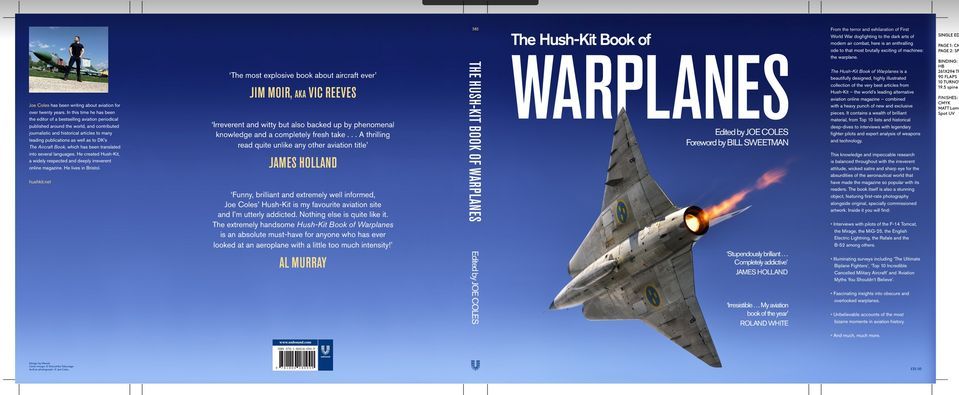
Joe Coles Book Launch: Hush-Kit Book of Warplanes , Crying Wolf, Bristol,  November 24 2022 | AllEvents.in

‘I absolutely love this book. Seriously well-informed, seriously funny, authoritative and full of passion for its subject. No one writes about aviation like Joe Coles. We’re lucky to have him. The Hush-Kit Book of Warplanes is my aviation book of the year.’

– Rowland White

Convinced? Order your copy of our book here 

From the cocaine, blood and flying scarves of World War One dogfighting to the dark arts of modern air combat, here is an enthralling ode to these brutally exciting killing machines.

The Hush-Kit Book of Warplanes is a beautifully designed, highly visual, collection of the best articles from the fascinating world of military aviation –hand-picked from the highly acclaimed Hush-kit online magazine (and mixed with a heavy punch of new exclusive material). It is packed with a feast of material, ranging from interviews with fighter pilots (including the English Electric Lightning, stealthy F-35B and Mach 3 MiG-25 ‘Foxbat’), to wicked satire, expert historical analysis, top 10s and all manner of things aeronautical, from the site described as

The solid well-researched information about aeroplanes is brilliantly combined with an irreverent attitude and real insight into the dangerous romantic world of combat aircraft.

  • 7c4bcafc5111ae196154b614c84fb096